Is "Noted With Thanks" Rude? The Plain Answer + What to Say Instead
"Noted with thanks" gets misread as cold or passive-aggressive by Western colleagues. Here's exactly when it offends — and 5 better professional alternatives.

A regional VP receives a three-paragraph email from a junior analyst — careful, detailed, took 25 minutes to write. The reply arrives in under a minute:
"Noted with thanks."
AI Grammar Buddy
Make this sound professional
Improve tone for work emails without changing your meaning.
The VP flags it to the analyst's manager that afternoon as a "communication concern." The analyst had no idea anything was wrong.
That is the actual stakes of is noted with thanks rude. Not a grammar question. A career question.
The direct answer: it is not inherently rude — but it is situationally dangerous, and most people using it have no idea when they're crossing the line.
Jump to sections
Use these anchors to jump straight to the section you need.
Is "Noted With Thanks" Rude? The Actual Answer
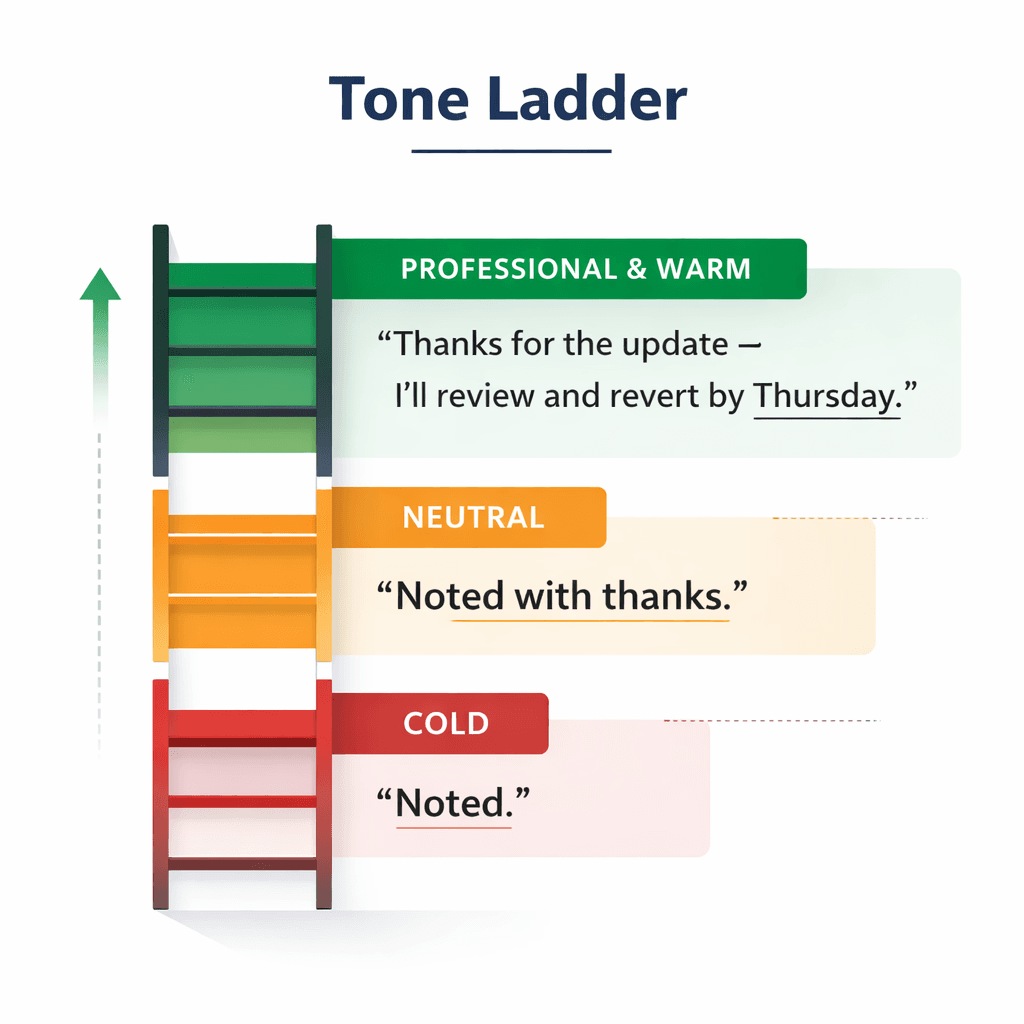
The phrase lives on a spectrum. In Singapore, Hong Kong, and India — where high-volume inboxes are the norm — "noted with thanks" is an efficiency tool, not a slight. In the US, UK, and Australia, the same phrase reads as robotic, dismissive, or passive-aggressive.
Same three words. Completely different professional consequences.
The phrase has a structural problem that makes this worse: it has no subject. "I noted it" versus "Noted" — the second removes the human from the sentence. That grammatical distance is what Western readers instinctively feel as coldness, even when they cannot name why.
What "Noted" Actually Signals in an Email
Understanding noted meaning in email requires separating intent from perception.
What the sender means:
- Message received
- No further discussion needed
- Acknowledged with gratitude
What the Western recipient often hears:
- "I've filed you away"
- "I'm not engaging with this"
- "Conversation closed"
Building AI Grammar Buddy, I reviewed thousands of cross-border email threads flagged for tone issues. "Noted with thanks" appeared in more misunderstanding chains than almost any other phrase — not because it is grammatically wrong, but because it signals finality at moments when the other person expected engagement.
The power dynamic factor is decisive.
When a manager sends "noted" to a direct report, it reads as efficient. Authority makes brevity acceptable. When an employee sends it to a manager or client, the same words register as dismissive — sometimes insolent.
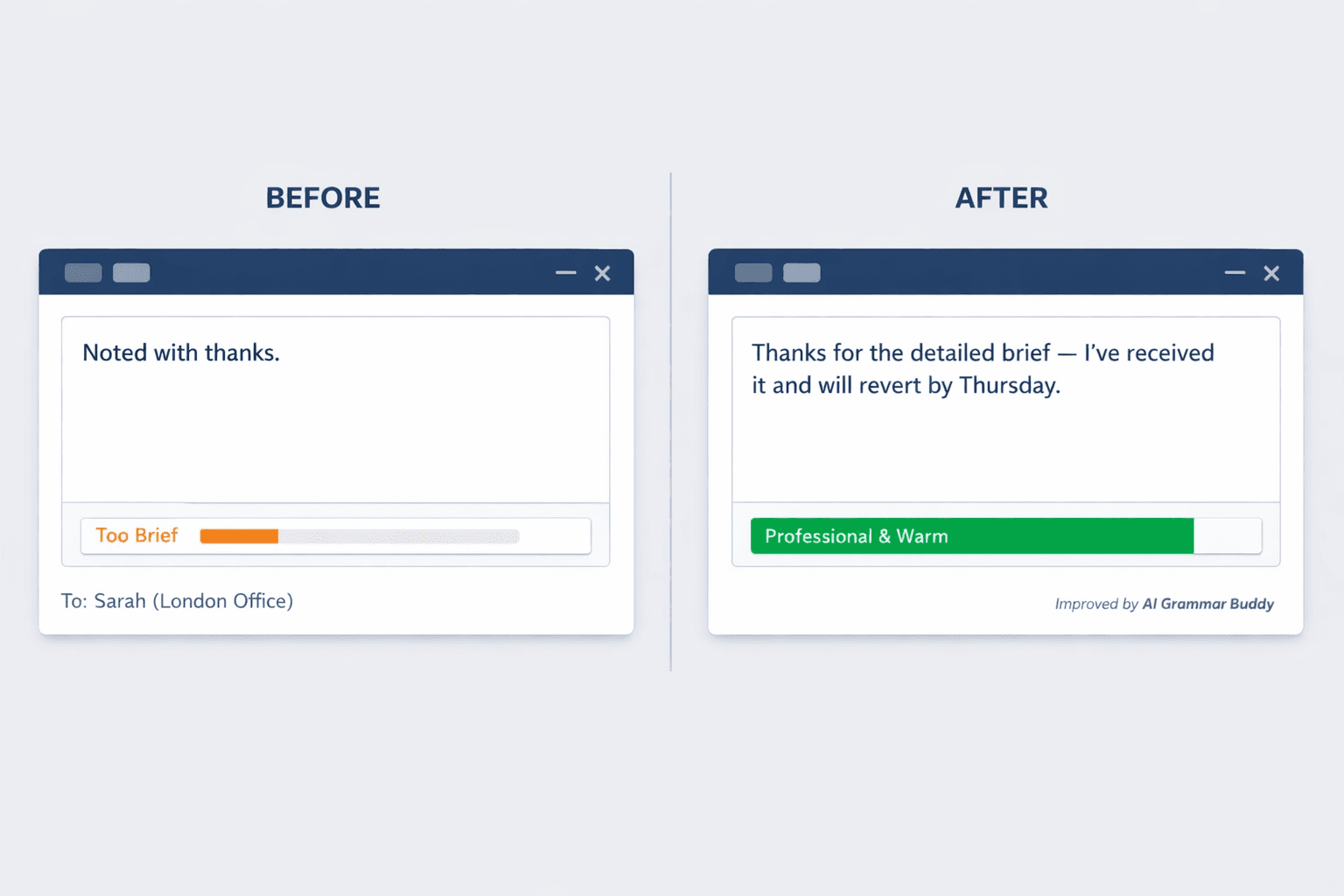
Before / After — Replying to Your Boss:
| Example | |
|---|---|
| ❌ Before | Noted with thanks. |
| ✅ After | Understood — I'll adjust the timeline and send you an update by EOD. |
One sentence. Confirms understanding. Signals action. Commits to a deadline. That is everything "noted with thanks" never delivers.
5 Scenarios Where "Noted With Thanks" Actively Damages You
The phrase is not the problem. Autopilot is. These are the exact situations where it misfires:
-
Someone shared bad news. A project failed, a client cancelled, a deadline was missed. "Noted with thanks" reads as chilling indifference — full stop.
-
Someone went above and beyond. They stayed late, covered a crisis, delivered early. Three words signals you either missed the effort entirely or simply don't value it.
-
A conflict or complaint was raised. "Noted with thanks" shuts the thread without resolution. The sender reads it as a wall going up.
-
Detailed feedback was given. A client or manager spent significant time on a thorough critique. Three words back tells them their effort did not register.
-
The thread is already tense. In a charged exchange, brevity does not read as neutral — it reads as the most hostile version of itself.
Singapore vs. Western Offices: Why the Same Phrase Lands Differently
Most guides either defend the phrase entirely or condemn it entirely. Both positions are wrong.
Singapore, Hong Kong, India, Malaysia: "Noted with thanks" is standard operating language. Processing 150–200 emails a day, quick closers are efficient — not cold. The phrase confirms receipt, expresses gratitude, and closes the thread in three words. Entire corporate email chains run on it and nobody blinks.
US, UK, Australia, Canada: Business norms here place high value on performed warmth and personalised engagement, even in transactional exchanges. The unspoken expectation is that you engage with the sender, not log their message. "Noted with thanks" violates this norm by sounding like a helpdesk ticket being closed.
The line that matters: the moment your email crosses a cultural border — geographically or organisationally — the phrase's safety profile changes completely.
The Decision Framework: Use It or Replace It
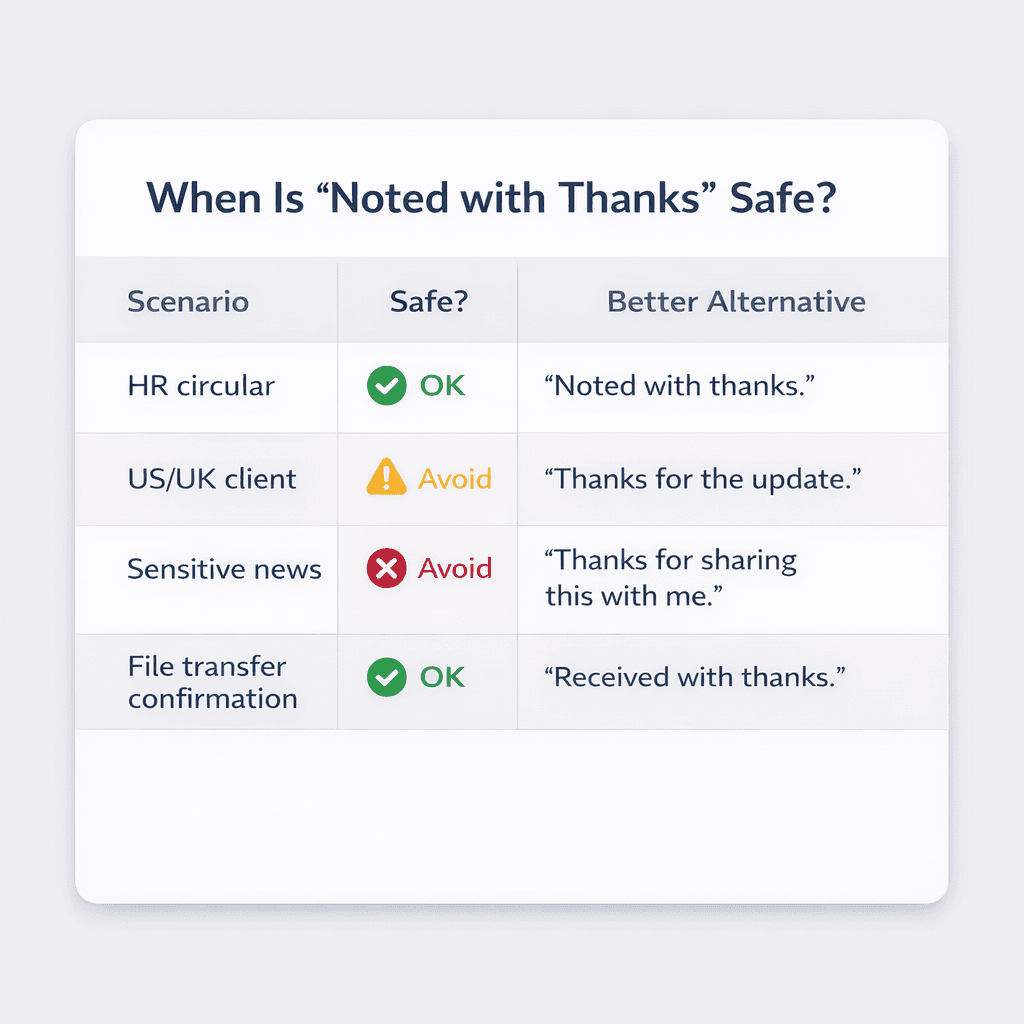
| Situation | Recipient | Verdict | Replace With |
|---|---|---|---|
| Routine FYI or update | Internal SG/Asia team | ✅ Safe | — |
| Admin confirmation | Any | ✅ Safe | — |
| Update from Western colleague | US / UK / AU / CA | ⚠️ Replace | "Thanks for the update — noted on my end." |
| Boss sends an instruction | Any | ⚠️ Replace | "Understood — I'll get this done by [day]." |
| Someone shared bad news | Any | ❌ Never | "Thanks for letting me know. Let me look into this." |
| Someone put in extra effort | Any | ❌ Never | "Thank you — I really appreciate you going the extra mile." |
| Conflict or complaint raised | Any | ❌ Never | "Thanks for flagging this. I'll follow up by [timeframe]." |
| Detailed feedback received | Any | ❌ Never | "Thank you for the thorough review. I'll incorporate your points by [deadline]." |
5 Professional Email Alternatives With Exact Scripts
These professional email alternatives are mapped to situation. Do not default to #1 every time — that defeats the point.
1. Routine update or FYI — no action needed
"Thanks for the update — I'll keep this in mind."
2. Document or deliverable received
"Received, thank you. I'll review and come back to you by [day]."
3. Bad news or a complaint raised
"Thanks for flagging this. I understand this is frustrating — let me look into it and follow up by [timeframe]."
4. Manager's directive or decision
"Understood — I'll action this today and keep you posted."
5. Detailed feedback from a client or senior stakeholder
"Thank you for the thorough review. I've gone through your points and will incorporate the changes by [deadline]."
Every one of these does something "noted with thanks" never does: it tells the sender what happens next.
Before vs. After: Three Real Scenarios
Scenario 1: Colleague submits a completed report
❌ "Noted with thanks."
✅ "Received — thanks for turning this around so quickly. I'll go through it today and share feedback by Thursday."
Scenario 2: Client says they're not renewing
❌ "Noted with thanks."
✅ "Thanks for letting me know. I'd like to understand what led to this — would a quick 15-minute call work this week?"
Scenario 3: Boss sends a new policy directive
❌ "Noted with thanks."
✅ "Understood. I'll update the team's workflow to reflect this by end of week and confirm once done."
The pattern is consistent: every strong alternative includes a next step, a human acknowledgement, or both. "Noted with thanks" includes neither.
FAQ
What is the exact "noted with thanks" meaning?
"Noted with thanks" means "I have received and acknowledged your message, and I appreciate it." Most common in Singapore, India, and Hong Kong as a short acknowledgement for routine emails. To Western recipients, it reads as cold or dismissive — not because of the grammar, but because it signals the conversation is being filed away and closed without engagement.
Is replying "noted" rude in a quick Slack message?
On Slack, a bare "noted" is generally fine for internal teams — it functions like a thumbs-up reaction. The risk increases with seniority and sensitivity of the topic. A "noted" to a client, a senior leader, or in a thread about an active problem reads poorly on any platform. When in doubt, add one sentence of context or intent.
Is "noted with thanks" grammatically correct?
Yes — it is a widely accepted sentence fragment. The full form is "Your message is noted with thanks." Grammar is not the problem. The issue is that removing the subject ("I") makes the phrase sound impersonal and administrative, which Western readers instinctively interpret as indifference regardless of the sender's actual intent.
Is "noted" rude when a boss says it to an employee?
From a manager, "noted" reads as efficient — authority makes brevity acceptable. The reverse is the real risk: employees using "noted" or "noted with thanks" toward a manager or senior client come across as curt or passive-aggressive. The same words carry entirely different weight depending on who holds the power in that exchange.
The Rule. One Sentence.
Use "noted with thanks" within Singapore and Asian business culture for routine, transactional email — and replace it the moment your recipient is Western, senior, or emotionally invested in what they sent you.
That is the complete decision. There is no nuance beyond that.
The underlying problem is not the phrase — it is writing on autopilot when the stakes are highest. AI Grammar Buddy's Email Improver flags exactly these tonal mismatches before you send: phrases that are grammatically fine but likely to land wrong with your specific recipient. If you're emailing across cultures daily, it catches what spellcheck never will.
Related Reads
Frequently Asked Questions
What is the exact "noted with thanks" meaning?▼
"Noted with thanks" means "I have received and acknowledged your message, and I thank you for it." Common in Singapore, India, and Hong Kong as a short efficiency reply. To Western recipients it often reads as cold or dismissive — not because of grammar, but because it signals the conversation is closed.
Is replying "noted" rude in a quick Slack message?▼
On Slack, a bare "noted" is generally fine for internal teams — it reads like a thumbs-up. For sensitive topics or external stakeholders, add one line of context or use a reaction emoji. A standalone "noted" to a client or senior stakeholder on any platform carries real risk.
Is "noted with thanks" grammatically correct?▼
Yes — it is a grammatically accepted sentence fragment. The full form is "Your message is noted with thanks." Grammar is not the issue. The subjectless construction sounds impersonal and administrative, which Western professionals instinctively interpret as indifference.
Is "noted" rude when a boss says it to an employee?▼
When a manager says "noted," it reads as efficient — authority makes brevity acceptable. The reverse is the problem: employees saying "noted" or "noted with thanks" to their manager risk coming across as curt or passive-aggressive. Hierarchy determines how the same words land.
Next step
Make this sound professional
Improve tone for work emails without changing your meaning.
Keep going
Continue with AI Grammar Buddy
AI Grammar Buddy
Email Improver
Paste your draft and rewrite it for clearer, more professional English.
Improve My ToneRelated guide
AI Email Rewriter for Professional Emails (Before & After)
Turn rough drafts into professional emails. See before-and-after rewrites, better prompts, and common mistakes that affect tone, clarity, and structure.
17 June 2026
Related guide
10 Better Ways to Say "In Conclusion"
Looking for a better way to say in conclusion? Learn 10 natural alternatives for essays, emails, and professional writing, with examples and a quick comparison table.
14 March 2026
Related guide
15 Polite Ways to Say No (Work & Email Examples)
15 ways to say no politely with workplace and email examples, common mistakes, and a quick reference table. Paste your draft into AI Grammar Buddy to make it sound more professional and natural.
14 March 2026