Singlish vs British English: Which One Should You Use in Professional Singapore Emails?
Learn when to use Singlish vs British English in professional Singapore emails. 5 real examples + Grammar Buddy tool guide to avoid international misunderstandings.
Jump to sections
Use these anchors to jump straight to the section you need.
Hook: That "Can or Not?" Moment
It’s 4:55 PM on a Friday. You’re replying to a London-based client about a project deadline.
AI Grammar Buddy
Make this sound professional
Improve tone for work emails without changing your meaning.
You type: "Can send me the file by Monday? I go there check already, still no have."
Then you pause.
Is that professional? Or will your client wonder if you’re shouting at them? (Why is "can" at the start? Who is "I"? And what is "no have"?)
So you backspace and rewrite: "Could you please forward the file by Monday? I have checked the folder, but it appears to be empty."
Better? Definitely. But do you need to talk like the Queen of England for every email? What if you’re just emailing your colleague Tan who sits two desks away?
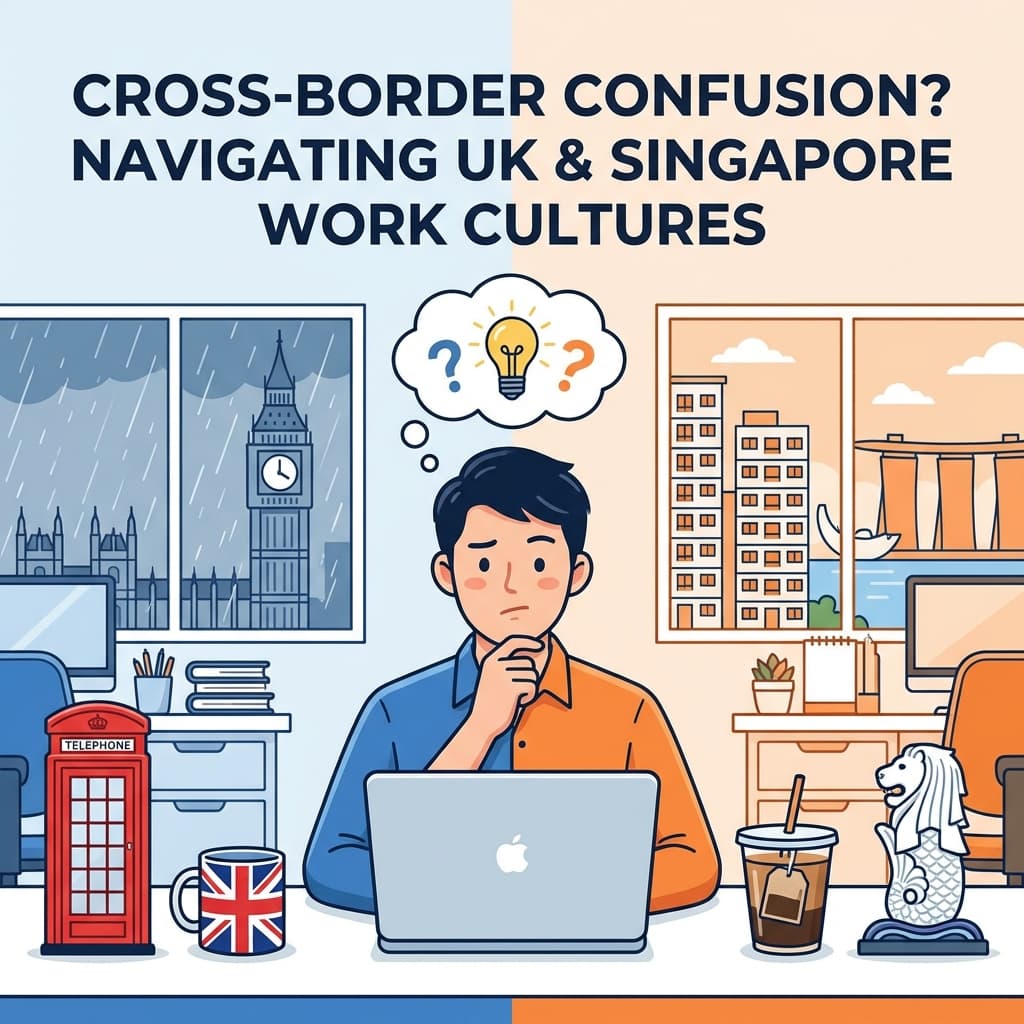
This is the daily struggle for Singaporean professionals: The Singlish vs. British English dilemma.
In this guide, we’ll break down exactly when to use each, show you 5 real-world examples, and help you find the sweet spot where you sound professional but still authentically Singaporean.
What’s the Difference? (And Why It Matters)
What is Singlish?
Singlish (Singapore Colloquial English) is our efficient, culturally rich rojak of English, Malay, Hokkien, Teochew, and Cantonese. It’s built for speed and camaraderie.
- Key traits: Sentence shortening ("Can?"), unique particles ("lah", "meh"), and direct translations from other languages.
- Vibe: Efficient, friendly, local.
What is British English (Standard English)?
British English is the "textbook" English used globally and in formal business contexts. Inherited from our history, it remains the standard for international business in Singapore.
- Key traits: Complete sentences, polite modal verbs ("Could you", "Would you"), standard grammar rules.
- Vibe: Professional, polite, globally understood.
Quick Comparison
| Feature | Singlish | British English |
|---|---|---|
| Object | "Check already." | "I have checked it." |
| Question | "You want meeting?" | "Would you like to meet?" |
| Time | "Yesterday I go there." | "I went there yesterday." |
5 Real-World Examples: Singlish vs. British English
Here are 5 common scenarios. See the difference?
1. Asking for a Review
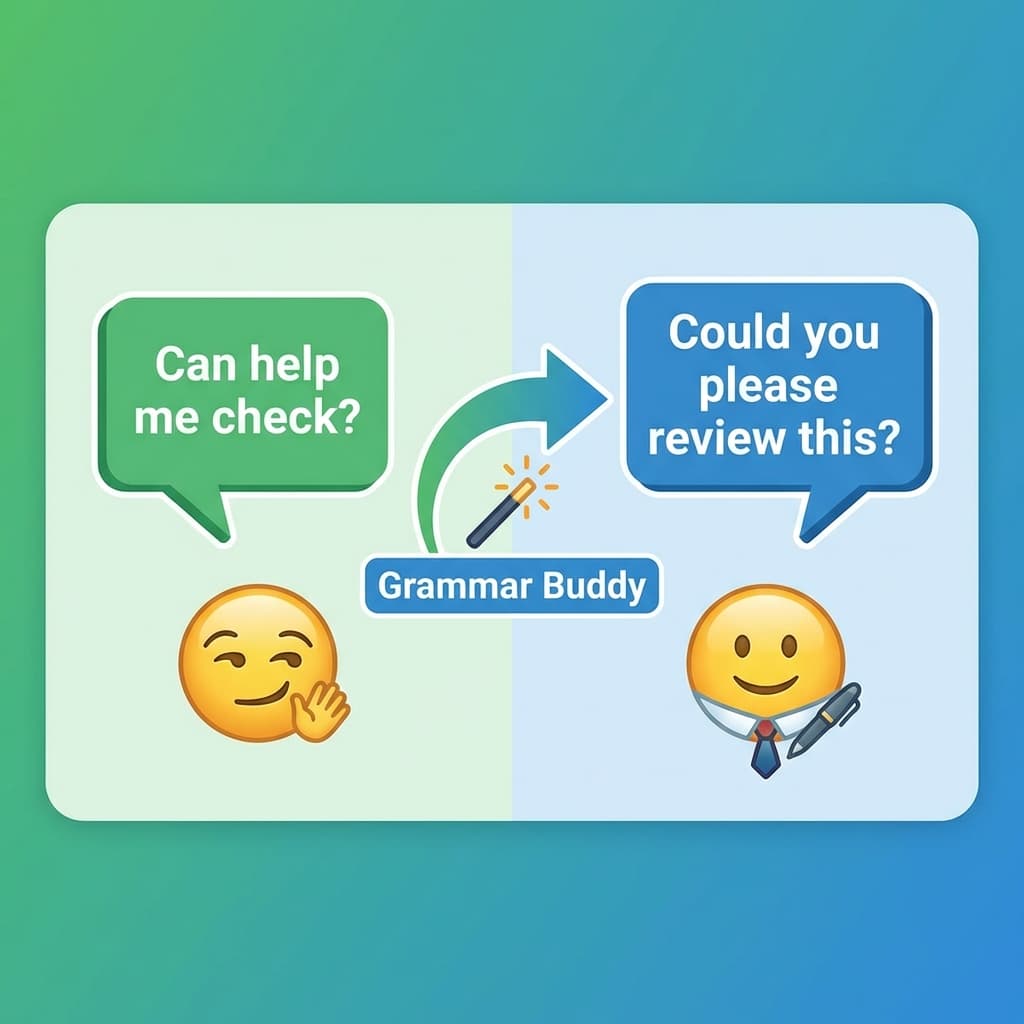
- Singlish: "Can help me check this one? I go there yesterday already."
- British English: "Could you please review this? I went there yesterday."
- When to use which:
- Use British English if asking a boss or client. "Can help me" sounds demanding to non-Singaporeans.
- Use Singlish (maybe "Eh help check leh") only with close work friends on WhatsApp/Slack.
2. Chasing a Reply
- Singlish: "Please revert to me ASAP."
- British English: "Please get back to me as soon as possible."
- 💡 Pro Tip: Revert actually means "to return to a previous state" (e.g., "The liquid reverted to a solid"). In Singapore, we use it to mean "reply", but clients in the UK or US will be confused. They might think you want them to turn back into their previous self!
3. Committing to a Task
- Singlish: "I will do the needful."
- British English: "I will handle this." / "I will take the necessary action."
- Why: "Do the needful" is an Indian English phrase common in Singapore, but often sounds archaic or vague to Westerners. "I will handle this" is strong and clear.
4. Reporting an Issue
- Singlish: "This one got problem."
- British English: "This item has an issue." / "There is an issue with this."
- Risk: "Got problem" is direct translation from Chinese (有問題 - Yǒu wèntí). In English, "This one got problem" sounds grammatically broken.
5. Confirming Action
- Singlish: "Actually I follow up on you already."
- British English: "I've already followed up with you."
- Grammar Note: Singlish often skips past tense markers ("follow" instead of "followed"). In professional emails, missing -ed endings can make you look careless.
[!IMPORTANT] Global Rule of Thumb: If your email is going outside Singapore/Malaysia, strictly stick to British English. Speed is not worth the risk of being misunderstood.
Decision Guide: When to Use Which?
Not every email needs to be a dissertation. Here’s a risk-o-meter to help you decide.
Situation 1: Local Singaporean Colleagues (Junior/Peers)
- Verdict: Singlish OK (Lightly)
- Tone: Casual, fast.
- Example: "Hi guys, meeting room changed to Room B. Paiseh!"
- Risk: Low. Everyone understands.
Situation 2: Cross-Functional Team (Singapore-based)
- Verdict: Standard English (Safe)
- Tone: Professional.
- Example: "Please note the venue change to Room B. Thanks."
- Risk: Low-Medium. New hires or expats might not get Singlish nuances.
Situation 3: Multinational Team / Regional Managers
- Verdict: British English (Required)
- Tone: Polished.
- Example: "Please be advised that the meeting has been moved to Room B."
- Risk: High. Singlish makes you look "too local" or unpolished in a regional role.
Situation 4: External Clients (Global)
- Verdict: British English (Strict)
- Tone: Formal, polite.
- Example: "Apologies for the inconvenience, but we have had to move the meeting to Room B."
- Risk: Very High. Using Singlish here can lose credibility and business.
How Grammar Buddy Helps You Switch
Not sure if you’re being "too Singlish"? That’s exactly why we built Grammar Buddy.
Our Singlish Translator doesn't just check for spelling errors. It understands the context of Singaporean English and helps you translate it for a global audience.
Try this example: Input: "Please revert back to me soonest." Output: "Please get back to me as soon as possible."
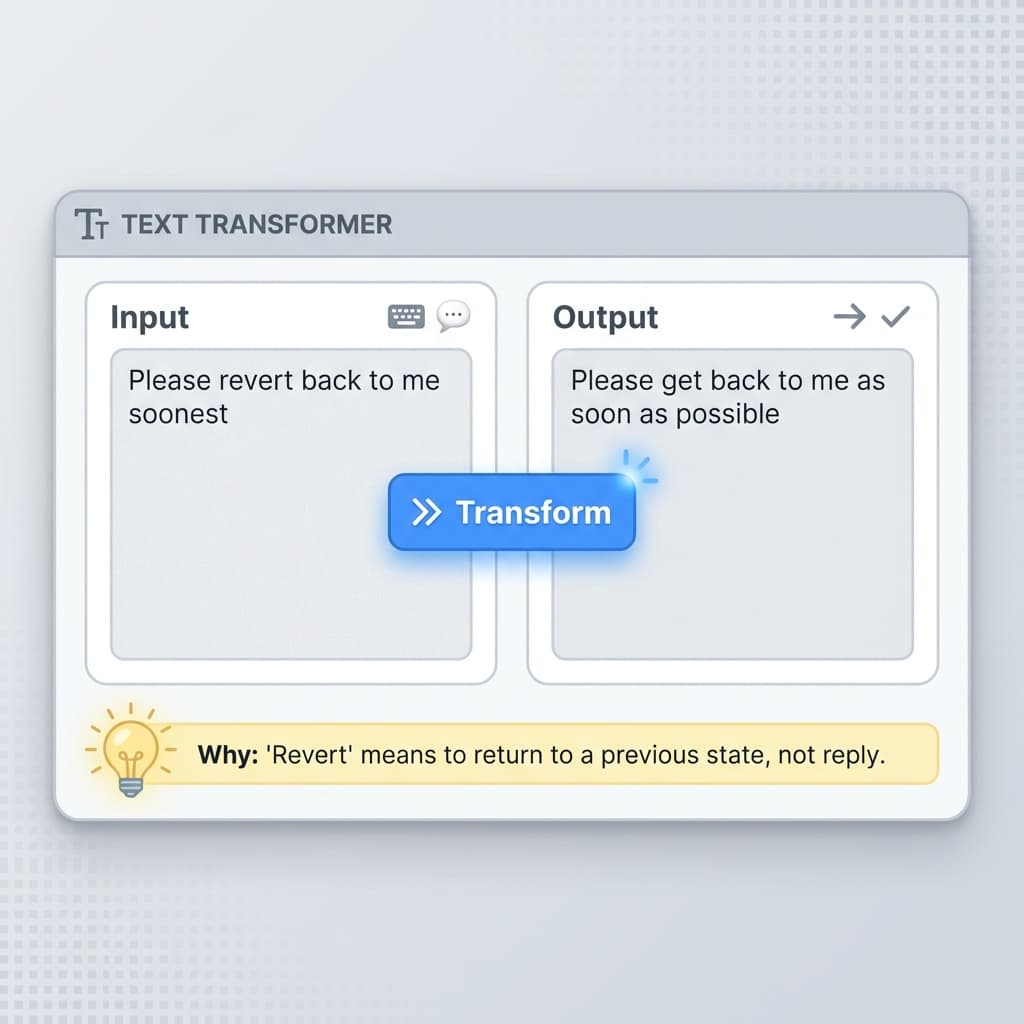
It’s not just about fixing "mistakes". It’s about Code-Switching. Grammar Buddy acts as your bridge between your efficient local identity and your professional global persona.
Why not just use normal spellcheck?
Standard spellcheckers will mark "Revert" as correct (because it's a real word). But they won't tell you that you're using it wrong in a business context. Grammar Buddy does.
A Note for our Taiwan Friends
To our readers from Taiwan, you face a similar challenge! You often translate directly from Mandarin ("Open the light", "Cost down").
The principle is the same: Empathy for the reader.
- If they are local, direct translation adds warmth/speed.
- If they are global, standard English ensures clarity.
Business communication isn't about "perfect grammar"—it's about removing friction causing confusion.
Summary
- Know your audience. Local = Flexible. Global = Standard.
- Watch your "Revert" and "Can". These are the biggest giveaways.
- Use tools. Don't guess. Let AI help you polish your tone.
Ready to professionalize your emails? Check out our next guide on Common Singapore HR Phrases That Sound Unprofessional or start fixing your emails now.
Write Flawless Professional Emails
Convert Singlish to Standard English in one click.
Try Grammar Buddy FreeNext step
Make this sound professional
Improve tone for work emails without changing your meaning.
Keep going
Continue with AI Grammar Buddy
AI Grammar Buddy
Email Improver
Paste your draft and rewrite it for clearer, more professional English.
Improve My ToneRelated guide
Business Trip English Phrases: Airport, Hotel & Meetings
Learn practical business trip English phrases for airports, immigration, hotels, meetings, and delays, with mini dialogues and ready-to-use examples.
30 July 2026
Related guide
OK Noted Meaning in Email: Rude? Better Replies
What does OK noted mean in email? Is okay noted rude? Why noted on this is wrong, plus clearer professional replies you can copy.
18 July 2026
Related guide
AI Email Rewriter for Professional Emails (Before & After)
Turn rough drafts into professional emails. See before-and-after rewrites, better prompts, and common mistakes that affect tone, clarity, and structure.
17 June 2026