Is “Noted with Thanks” Rude? Singapore Office Tone Guide
Is noted with thanks rude in Singapore? Usually no—unless the message is sensitive or needs action. See tone tests for colleagues, bosses, and clients.
TL;DR
In Singapore workplace English, “noted with thanks” is usually a normal, polite acknowledgement for a routine update. It can sound cold when the message is sensitive, detailed, urgent, or requires a clear next step.
Fast rule: keep it for low-stakes receipt; add the subject, action, or deadline when the message matters.
Top alternatives:
- •Routine update: “Noted with thanks.” is usually acceptable.
- •Action required: add what you will do and when.
- •Sensitive or client message: acknowledge the effort, concern, or impact.
AI Grammar Buddy
Make this sound professional
Improve tone for work emails without changing your meaning.
Jump to sections
Use these anchors to jump straight to the section you need.
Quick Answer: Is “Noted with Thanks” Rude in Singapore?
Is “noted with thanks” rude in Singapore? Usually, no. In many Singapore offices, it is a familiar, polite way to confirm that you have read and understood a routine update. It can sound cold, formulaic, or dismissive when the sender has shared detailed feedback, bad news, a sensitive issue, or a task that needs a clear next step.
If you have just sent “Noted with thanks” and the other person has not replied, do not assume you offended them. Check the context instead: was the message routine, and was no further action expected? If the answer is no, add one sentence that shows what you understood or what you will do next.
Not sure whether your reply is too brief? Paste it into the Email Improver and ask for a warmer professional tone while keeping the facts and Singapore workplace context.
For the phrase’s definition, grammar, and general professional use, read the complete “noted with thanks” meaning guide. This article focuses on tone in Singapore offices, by audience and by channel.
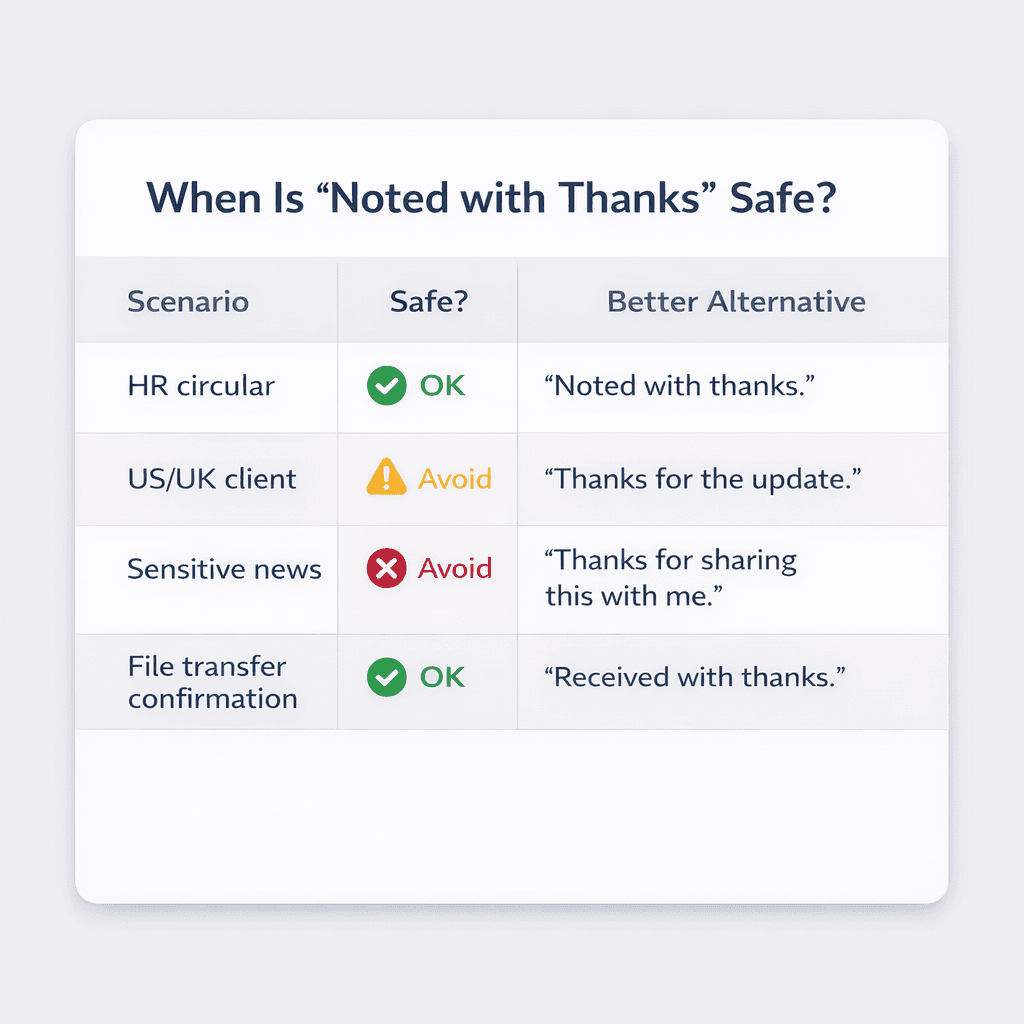
The practical question is not “Is this phrase always rude?” It is “Does this message need more than receipt?”
Why “Noted with Thanks” Is Common in Singapore Workplaces
Singapore teams often work across languages, time zones, seniority levels, and regional business norms. A short acknowledgement can be useful in a busy inbox: it confirms that an update has been seen without extending a routine thread.
That convention is not incorrect English, and it is not automatically impolite. The risk starts when the writer and reader assign different jobs to the reply. The writer may mean “I received this,” while the reader is waiting for “I understand the problem,” “I appreciate the effort,” or “I will do something by Friday.”
A recurring pattern in workplace drafts reviewed by AI Grammar Buddy is a perfectly grammatical acknowledgement being used where the reader needs ownership or reassurance. The fix is usually small: name the subject, acknowledge the effort, or add a realistic next step.
When “Noted with Thanks” Sounds Polite and Professional
The phrase usually works when the message is routine, complete, and low-stakes. It is especially natural when your team already uses short acknowledgements and nobody is waiting for a decision.
| Situation | Tone verdict | Why it works |
|---|---|---|
| A routine internal update | Acceptable | The sender only needs confirmation that you saw it |
| A clear instruction with an understood process | Acceptable | Both people already know what happens next |
| A system or administrative notice | Acceptable | The exchange is transactional and low-stakes |
| An internal chat with a familiar teammate | Usually fine | Brevity matches the channel and team norm |
| A simple file or schedule confirmation | Usually fine | The main need is acknowledgement of receipt |
For example, if a colleague writes, “The meeting room has changed to 08-12,” a short “Noted with thanks” is unlikely to cause concern. It closes the loop because there is no hidden request for empathy, judgement, or a deadline.
When It Can Sound Cold or Dismissive
The same three words can feel abrupt when the sender needs evidence that you engaged with the substance of the message, not merely that you opened it.
| Situation | Tone verdict | What a bare reply leaves unclear |
|---|---|---|
| A detailed client request | Potentially abrupt | Whether you understood the brief and what you will do |
| Criticism or negative feedback | Potentially dismissive | Whether you accept the concern or will investigate it |
| Sensitive personal or operational news | Too cold | Empathy and acknowledgement of the impact |
| An urgent deadline | Better with a next step | Ownership and a realistic time commitment |
| A senior stakeholder’s detailed guidance | Better with context | Evidence that you understood the priority |
| A message requiring a decision | Too vague | Whether you agree, need clarification, or are only acknowledging receipt |
The phrase is not inherently passive-aggressive. The negative reading usually comes from a mismatch: a weighty message receives a lightweight reply. If you are comparing nearby phrases such as “well noted,” see the guide to well noted meaning in email for the difference in tone.
Examples: Replying to a Colleague
With a close colleague, a short reply is often enough for an FYI, meeting detail, or simple status update. Established trust supplies some of the warmth that the words leave unstated.
Message received:
Hi Mei, the 3 p.m. meeting has moved to Room 08-12. No action needed—just letting you know.
Bare reply:
Noted with thanks.
Better reply when you want to close the loop naturally:
Thanks for the update. I’ll head to Room 08-12 at 3 p.m.
If the colleague solved a difficult problem, covered work for you, or raised a concern, add appreciation or ownership:
Thanks for staying late to fix this. I’ve noted the change and will check the remaining items before tomorrow’s stand-up.
Replying to Your Manager
To a manager, “Noted with thanks” can be respectful when an instruction is straightforward and the next step is already understood. It may sound vague if your manager needs to know whether you accept the task, understand the priority, or can meet the deadline.
Manager’s message:
Please update the Q3 forecast with the revised sales figures and send it to the regional team by Thursday afternoon.
Too brief:
Noted with thanks.
Clearer reply:
Understood, thank you. I’ll update the Q3 forecast and send it to the regional team by Thursday afternoon.
The second version is not better because it is longer or more formal. It removes uncertainty. If the instruction conflicts with another deadline, do not use a brief acknowledgement to hide the problem; clarify priorities before committing.
If the deadline conflicts with work already assigned to you, paste your draft into the Email Improver and ask it to “clarify the priority without over-promising a deadline.”
Replying to a Client or Senior Stakeholder
Client and senior-stakeholder messages carry more relationship risk. A bare “Noted with thanks” can sound like a ticket closure after a detailed brief, complaint, or high-impact decision.
Client’s message:
Thanks for reviewing the draft. We added comments to sections 2 and 4, and the launch date depends on the revised version. Could you send an update by Friday?
Too brief:
Noted with thanks.
Better client-facing reply:
Thanks for the detailed feedback. I’ve received the comments on sections 2 and 4, and I’ll send the revised draft by Friday afternoon so you can confirm the launch timeline.
The better reply acknowledges the effort, reflects the important details, and states a next step. Client briefs are the moment when a two-word acknowledgement is most likely to create doubt. Use the Email Improver to keep the facts, add a professional warmth, and make the action and timing explicit.
For a complaint or sensitive issue, add empathy before the plan:
Thanks for flagging this. I understand why the delay is frustrating, and I’ll investigate the handover and update you by 4 p.m. today.

Internal Chat vs Formal Email
Channel changes how brevity feels. In Slack, Teams, or another internal chat, a short acknowledgement sits beside names, timestamps, reactions, and an ongoing conversation. Those cues can make it feel efficient. In a formal email—especially the only reply in a thread—the words carry more responsibility for expressing tone and next steps.
| Channel | When the phrase works | When to expand it |
|---|---|---|
| Internal chat | Quick FYI, familiar teammate, no action needed | The message raises a risk, request, or sensitive issue |
| Internal email | Routine admin with a known process | A manager needs confirmation of ownership or timing |
| External email | Simple receipt within an established relationship | A client sends detail, feedback, a complaint, or a decision |
In a quick chat, OK noted meaning in email can help you judge whether “OK noted” is casual enough for the channel. If the sender needs proof that a file or request arrived, use a specific acknowledgement of receipt by email instead of relying on a phrase that may imply agreement.
For broader guidance on greetings, formality, and regional office habits, see the Singapore workplace email etiquette guide.
Singapore English vs International Business English
Singapore workplace English often tolerates compact acknowledgements because they are familiar and efficient in many local and regional teams. Some international business-English readers are more accustomed to replies that explicitly name appreciation, understanding, or follow-through.
Neither preference is universal. Do not assume that every Singapore reader welcomes brevity or that every US, UK, Australian, or European reader finds it rude. Team norms, seniority, channel, and subject matter usually tell you more than nationality alone.
When a thread crosses teams or regions, make the business meaning explicit: what you understood, what you will do, and—when necessary—when you will do it. That is audience awareness, not “correcting” Singapore English.
How This Tone Guide Was Reviewed
The examples use the same four-part test throughout:
- Receipt: Does the reply confirm that the message was seen?
- Understanding: Does it show what was understood, rather than imply agreement?
- Ownership: Does it state the next action and timing when the reader needs reassurance?
- Human context: Does it acknowledge effort, concern, or impact when the message is sensitive?
This separates a language question from a workplace judgement. “Noted with thanks” can be grammatically acceptable and still be too thin for a particular message. Kin applies this test when reviewing practical workplace-English examples for AI Grammar Buddy; it is a context framework, not a claim that every Singapore team uses the same rule.
How to Make the Reply Sound Warmer
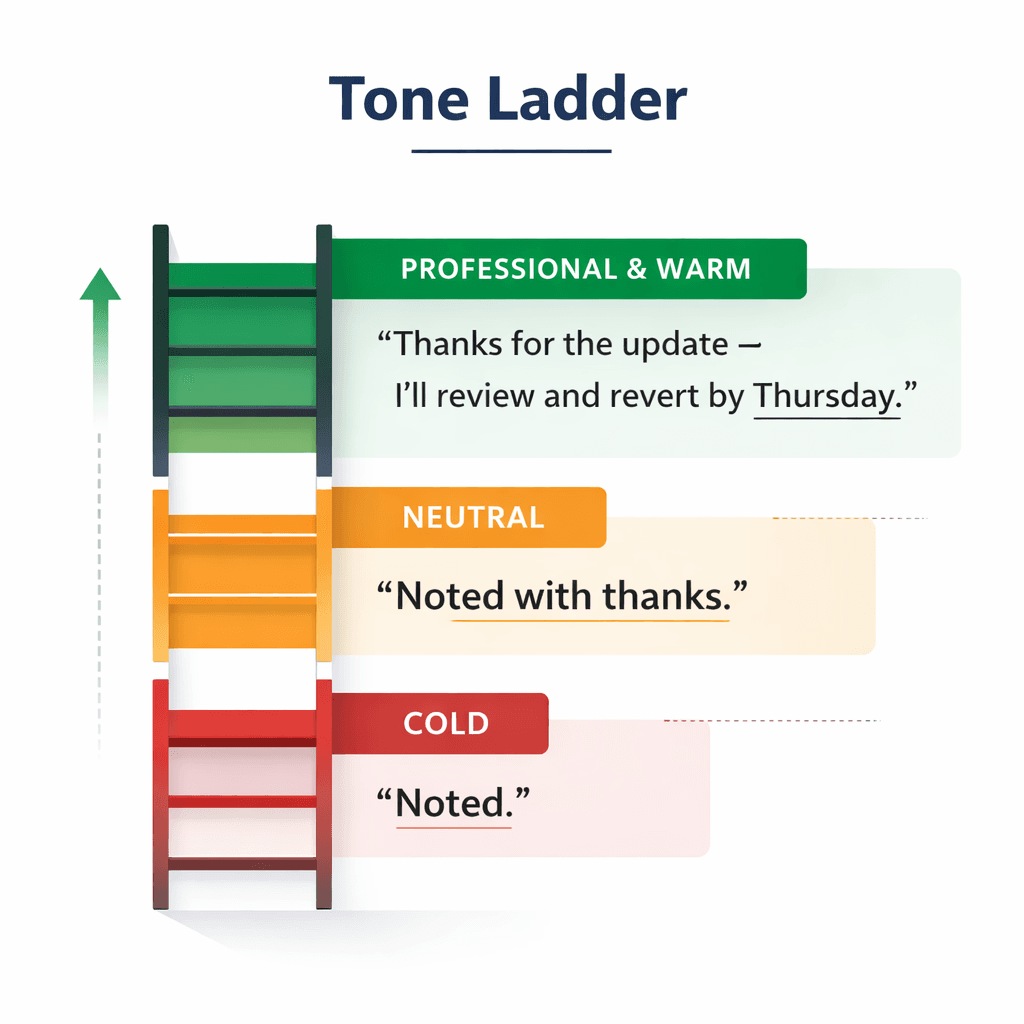
You do not need a long list of synonyms. Add the one piece the context is missing:
- Add the next step when you own an action: “Noted with thanks. I’ll update the report today.”
- Add appreciation when the sender invested effort: “Thanks for the detailed feedback.”
- Add context when reassurance matters: “I understand the urgency and will confirm the timeline by noon.”
- Name the subject when ambiguity is possible: “I’ve noted the revised delivery date.”
- Ask a question when acknowledgement is not agreement: “Thanks for the update. Do you want me to proceed with Option A?”
If you know what is missing but do not know how to phrase it naturally, paste the draft into the Email Improver and ask: “Keep the facts, use a warmer professional tone, and add the next step without promising more than I can deliver.” For role-specific copy you can adapt, see the workplace alternatives for Singapore emails.
Common Tone Mistakes
- Using the same reply for every message. Routine admin and sensitive feedback do not carry the same weight.
- Adding a deadline only to sound reassuring. A realistic time is helpful; an invented promise damages trust.
- Treating nationality as a tone rule. Individual and team preferences vary within every country.
- Writing a long reply when a short one is expected. More words do not automatically mean more respect.
- Confusing acknowledgement with agreement. If you disagree or need clarification, say so rather than using a phrase that may close the thread. The guide to how to reply to “noted” professionally covers this distinction.
- Using a receipt phrase for a complaint. If the message involves an apology or service recovery, use wording from these professional apology email templates instead of closing the issue with “Noted with thanks.”
How AI Grammar Buddy Can Help
AI Grammar Buddy’s Email Improver is useful when a draft is grammatically fine but the tone is uncertain. Paste the original reply and include the situation—for example, “client sent detailed feedback; keep the facts, sound warm and professional, confirm the next step and Friday deadline.”
The tool can suggest a clearer version without forcing every message into the same level of formality. You remain the final judge of whether the wording fits your relationship, team norm, and actual commitment.
Final Tone Checklist
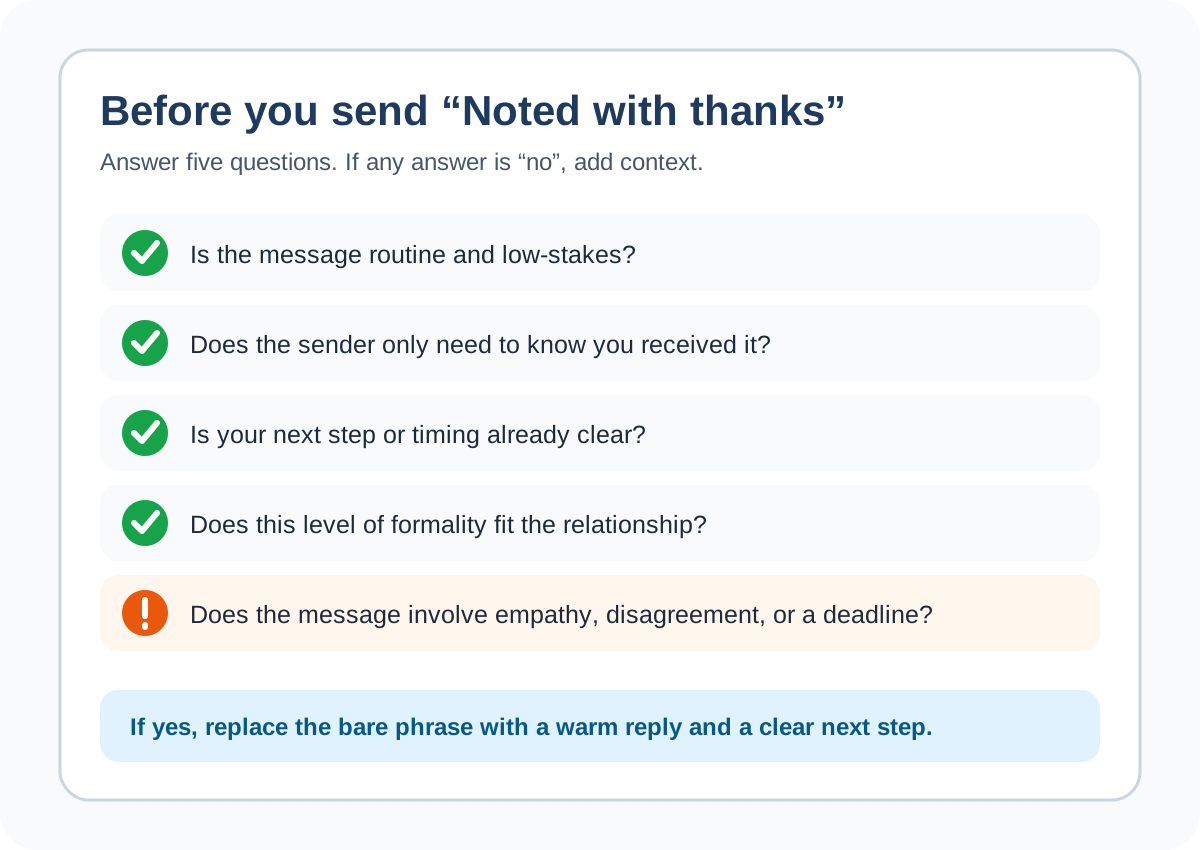
Before sending “Noted with thanks,” ask:
- Is this a routine, low-stakes update?
- Does the sender only need confirmation that I saw it?
- Is the next step already clear to both of us?
- Does this relationship normally use brief replies?
- Would the sender reasonably expect empathy, appreciation, or a deadline?
If the first four answers are yes and the last is no, the phrase will usually sound professional in a Singapore office. If the message involves effort, emotion, urgency, or action, add the relevant detail. If any answer feels uncertain, revise the draft before sending it.
Final Takeaway
“Noted with thanks” is usually polite in a Singapore workplace, especially for routine information and low-stakes internal updates. It is not a phrase you need to ban. The safer rule is to match the reply to the message’s weight.
Use the short acknowledgement when receipt is all the sender needs. For a manager’s deadline, a client’s detailed brief, or sensitive feedback, add what you understood, what you appreciate, and what you will do next. A few specific words can preserve the efficiency of Singapore office English while making the message easier for global readers to trust.
About This Article
Kin
Senior Business English Editor
Kin reviews workplace email drafts, acknowledgement phrases, and tone problems for AI Grammar Buddy. She focuses on how short replies land differently with colleagues, managers, and clients in Singapore and global teams.
Last updated 4 August 2026
Frequently Asked Questions
Is "noted with thanks" rude in Singapore?▼
Usually not. In many Singapore workplaces, it is a familiar short acknowledgement for routine information. Tone depends on the relationship, the weight of the message, and whether the sender expects action or empathy.
Is it rude to say "noted with thanks" to a boss?▼
It is generally acceptable for a routine instruction, but it may be too vague if your manager expects confirmation of the task or deadline. Add your next step when action is required.
Is it rude to say "noted with thanks" to a client?▼
Not automatically, but it can feel impersonal after a detailed request, complaint, or important decision. A client-facing reply should usually acknowledge the specific message and confirm what happens next.
Why can "noted with thanks" sound cold?▼
The phrase is brief and formulaic, so it gives few clues about empathy, understanding, or follow-through. Readers may supply a negative tone when the context calls for more engagement.
How can I make "noted with thanks" sound warmer?▼
Add one relevant detail: appreciation, context, or a next action. For example: “Noted with thanks. I’ll update the report today.” For sensitive feedback, acknowledge the effort before confirming your response.
Next step
Make this sound professional
Improve tone for work emails without changing your meaning.
Keep going
Continue with AI Grammar Buddy
AI Grammar Buddy
Email Improver
Paste your draft and rewrite it for clearer, more professional English.
Improve My ToneRelated guide
Noted With Thanks Alternatives for Singapore Workplaces
Copy-ready replies for managers, colleagues, clients, vendors, and schedule changes.
Related guide
Well Noted Meaning in Email: Is It Correct or Rude?
Compare the tone of “well noted,” “noted,” and warmer professional replies.
Related guide
How to Acknowledge Receipt of an Email Professionally
Use clear templates when the sender needs confirmation that a message or file arrived.