Please Revert Meaning in Email: Is It Correct? Better Alternatives
Please revert means “please reply” in Singapore and Indian business English. Learn whether it is correct, what review and revert means, and clearer email alternatives.
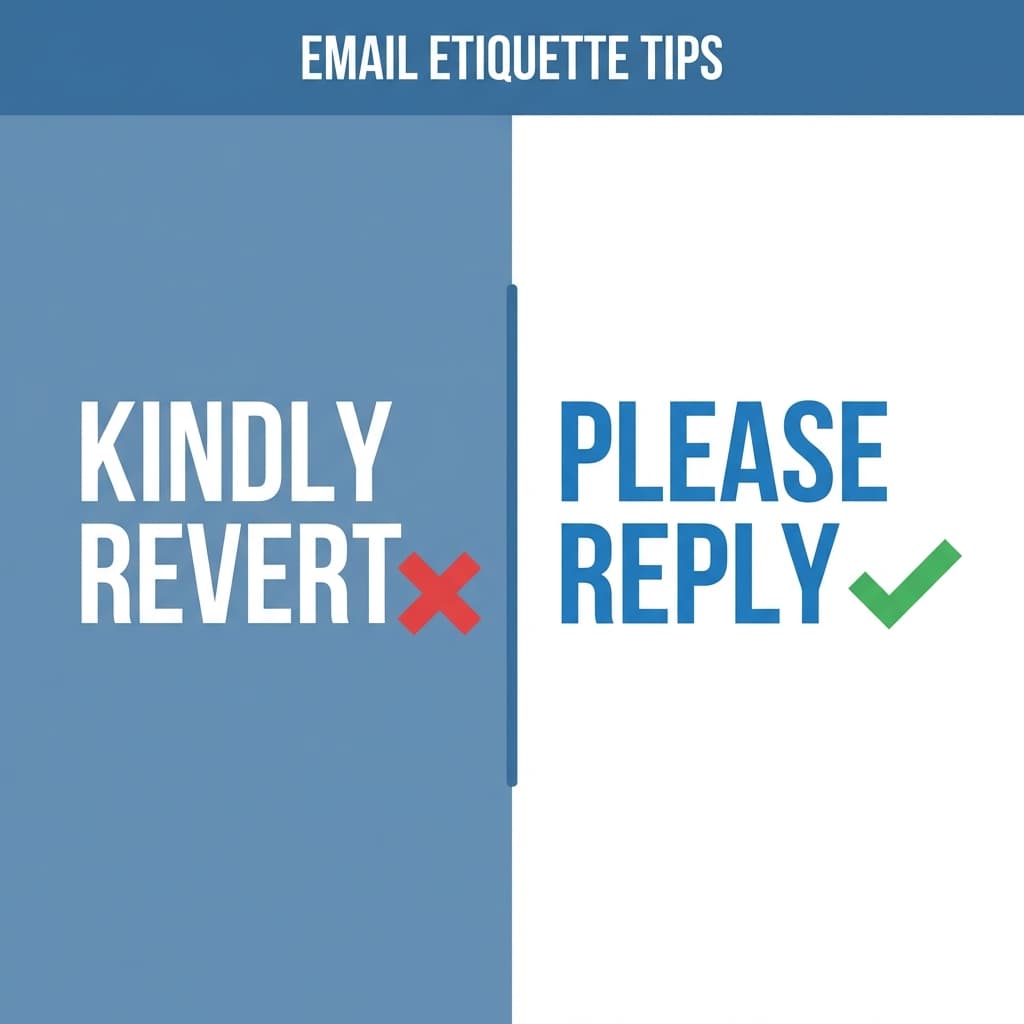
TL;DR
In Singapore and Indian business English, 'please revert' means 'please reply.' In global English, 'revert' usually means return to a previous state. Use 'please reply,' 'please respond,' or a specific action and deadline when your audience is mixed.
Top alternatives:
- •Please revert = Please respond (use: 'Please reply by Friday')
- •Kindly revert = Please get back to me (use: 'I'd appreciate a response by EOD')
- •Revert soonest = Please reply urgently (use: 'Please respond by [time]')
AI Grammar Buddy
Rewrite this phrase in context
Paste your sentence and AI Grammar Buddy will turn it into clearer professional English.
Jump to sections
Use these anchors to jump straight to the section you need.
🎧 Prefer to listen? Emily and Daniel break it down in this 8-minute episode:
Quick Answer
“Please revert” means “please reply” or “please get back to me” in Singapore and Indian business English. In global English, revert normally means return to a previous state. The table below shows why the phrase can work locally but confuse international readers.
| Audience / context | What “please revert” is understood to mean | Best wording |
|---|---|---|
| Singapore / Indian business English | Please reply or respond | “Please revert with your feedback.” |
| Global English | Return to a previous state | “Please reply with your feedback by Friday.” |
| Software, contracts, or policies | Undo a change or return to an earlier version | “Please revert the file to the previous version.” |
Please Revert Meaning in Email: Regional vs Global English
The phrase is a normal, well-intended request for a response in many Singaporean and Indian workplaces. In a mixed or international email, use reply, respond, or name the exact action and deadline instead. That removes the risk that a reader interprets “revert” as “undo.”
If you want the word-level definition and a fuller comparison of regional usage, see revert meaning in email: standard definition vs Singapore usage.
Part of our Singapore & Asian Workplace Email Phrases guide.
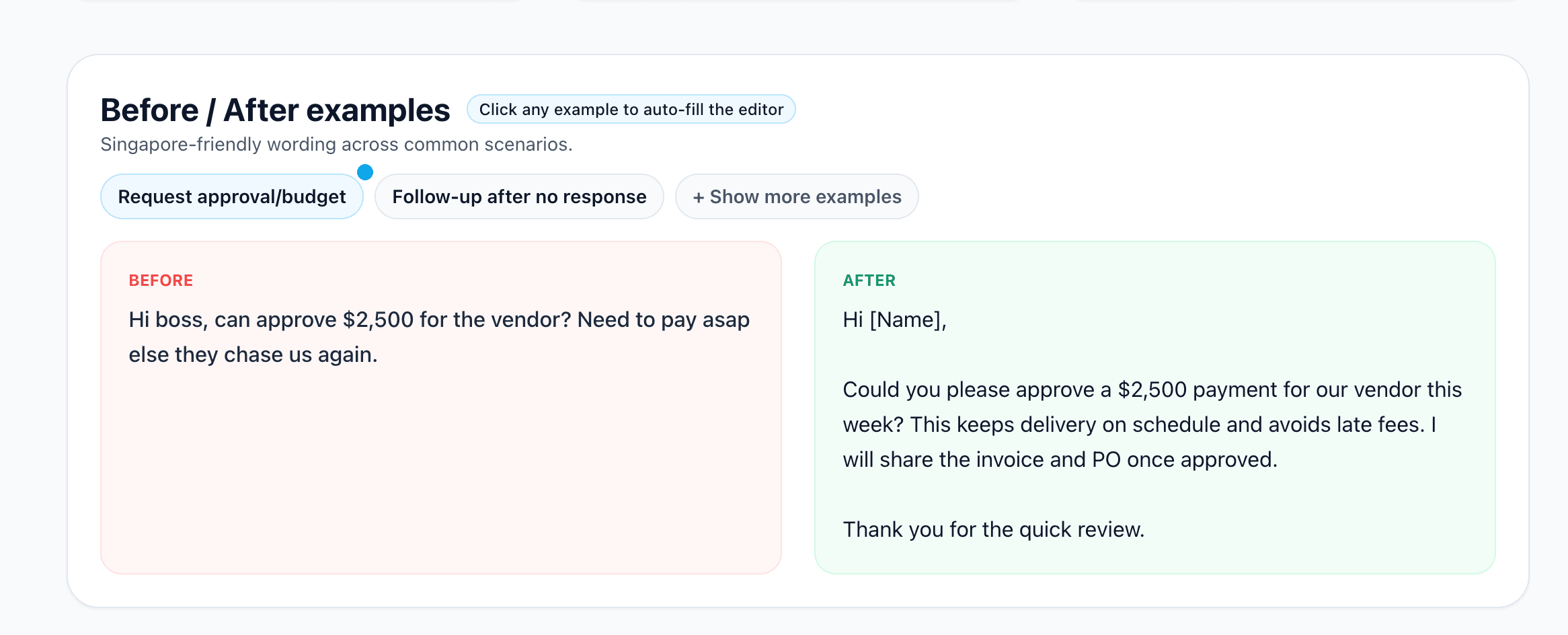 Email Improver catches Singlish phrases like 'please revert' in real time.
Revert Meaning: Global vs Regional Usage
To understand why this phrase is so controversial, we need to look at the dictionary definition versus how it's used in local workplaces.
The "Global" Definition
Revert (verb) Meaning: To return to a previous state, practice, topic, or belief. Origin: From Old French revertir "turn back."
Correct Standard Usage: "After the upgrade failed, we had to revert to the legacy system." "Should we revert to the original plan?"
The "Singaporean" Definition
Revert (verb) -- Singlish / Indian English Variant Meaning: To reply, respond, or get back to someone.
Local Usage: "Please revert with your comments by Friday." (Meaning: Please reply with...) "I will revert to you soon." (Meaning: I will get back to you soon.)
You may also encounter "kindly revert" — the polite form of the same phrase, equally common in Singapore and Indian business English.
Why "Please Revert" is Common in Singapore Emails
If you work in Singapore, Malaysia, or Hong Kong, you've likely seen variations like "kindly revert," "please check and revert," or even "revert back" hundreds of times.
It's often a direct translation of the desire for a response, carried over from colonial-era business English habits or local habits. It is intended to be polite ("kindly") and professional. When we built Grammar Buddy, this was one of the top phrases our Singapore users flagged — they were shocked it caused confusion abroad.
However, while understood locally, it is a major source of miscommunication in global business.
Revert vs Reply vs Respond
Here is a quick comparison to help you choose the right word for the right audience.
| Feature | Reply | Revert (Global) | Revert (Singapore) |
|---|---|---|---|
| Meaning | To answer / respond | To return to a past state | To answer / respond |
| Global Clarity | Clear (Universal) | Clear | Confusing |
| Professionalism | High | High (if used correctly) | Low (outside Asia) |
| Recommended? | Yes | Only for "going back" | No (Use "Reply") |
Note: "Respond" is slightly more formal than "reply" and works well in client-facing emails where you want to signal professionalism without sounding stiff. Use "reply" for everyday work emails, and save "respond" for situations where you need a touch more formality.
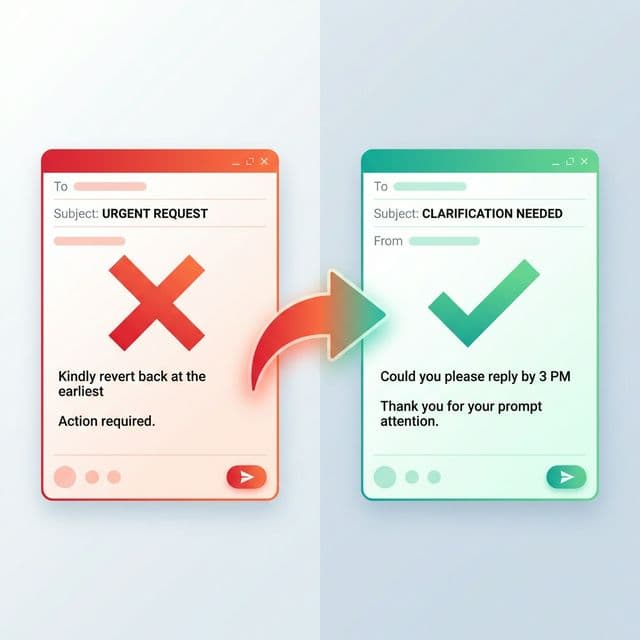 Quick reference: which word to use and when.
"Please Check and Revert" — What Does It Mean?
Another ultra-common variation you'll see across Southeast Asian inboxes is "Please check and revert." This phrase combines two actions: first, the recipient should review something (a document, email, proposal), and then they should reply with their feedback or confirmation.
In local business English, it's shorthand for "Please review this and get back to me with your response." It's efficient and widely understood within the region.
However, just like "please revert" on its own, the phrase falls apart when you send it to colleagues in the US, UK, or Australia.
To a Western reader, "revert" still means "go back to a previous state," so "check and revert" might sound like you're asking them to review something and then undo it—which makes no sense. The confusion slows down communication and can make your email look unprofessional.
4 Clear Alternatives to "Please Check and Revert":
- "Please review and let me know your thoughts." (Professional, invites feedback)
- "Could you take a look and reply by Friday?" (Adds a deadline, encourages action)
- "Please check the attachment and confirm if it looks correct." (Specific about what you need)
- "I'd appreciate your feedback on this when you have a chance." (Polite, respectful of their time)
Bottom line: if you want someone to review your work and respond, say exactly that. Skip "revert" entirely when emailing international clients.
What Does "Review and Revert" Mean?
"Review and revert" has the same regional meaning as "please check and revert": review the material, then reply with feedback, approval, or a decision. It does not mean “review it and undo it.”
For a global email, make the reply you need visible:
- “Please review the proposal and let me know whether you approve it by Friday.”
- “Could you review the attachment and share any changes by 3 PM?”
- “Please review the draft and confirm whether we can proceed.”
Kindly Revert Meaning (and Better Alternatives)
You will often see emails starting or ending with "Kindly revert." In the region, this is intended as a very polite way to say, "Please reply to me." The word "kindly" is added to soften the command, making it feel more respectful than a blunt "Please revert."
The same confusion applies to "kindly revert" — outside Southeast Asia, it simply doesn't land. To a US or UK reader, "kindly" can ironically sound patronizing or old-fashioned (like a stern schoolteacher), and "revert" still means "to go back to a previous state."
So, instead of sounding polite, you might sound like you are issuing a gentle but confusing order to return to a former version of yourself.
If you want to be genuinely polite and clear, drop the colonial-era phrasing. Use natural, modern English that invites a response.
Better "Kindly Revert" Alternatives:
- "I look forward to hearing from you." (Classic, warm, professional)
- "Please let me know your feedback when possible." (Respectful of their time)
- "Kindly reply by Friday." (If you must use "kindly," pair it with "reply," not "revert")
- "I'd appreciate your response on this." (Focuses on gratitude)
Not sure if your email sounds patronizing? Run it through our free AI grammar checker for Singapore professionals to check your tone before you hit send.
You may also encounter "please do the needful" in the same emails — another regional phrase that confuses Western readers. See our full guide to do the needful meaning.
What Does "Revert Email" Mean?
People sometimes search or write "revert email" when they mean reply to an email. In Singapore and Indian workplace English, “please revert by email” is usually a request for a response.
For global readers, use one of these direct options instead:
- “Please reply to this email by Thursday.”
- “Could you respond with your approval?”
- “Please let me know your decision by end of day.”
Use revert in an email only when you genuinely mean return to an earlier state: “Please revert the document to the approved version.”
Please Revert Back Meaning (Is It Correct?)
We often see the phrase "Please revert back" in emails. Is it correct? The short answer is no.
This is a tautology—a phrase that says the same thing twice. Since the standard definition of "revert" is "to go back" or "return," saying "revert back" is literally saying "go back back" or "return back." It is redundant grammar.
Even if you are using the Singaporean definition of "revert" (meaning "reply"), saying "reply back" is also redundant. You just "reply."
Using "revert back" is a double-whammy: it uses a word ("revert") that confuses global readers, and it uses a grammatical structure ("revert back") that suggests a lack of attention to detail. To sound sharp and professional, cut the "back" and, ideally, cut the "revert" too.
Correct Usage:
- ❌ Incorrect: "Please revert back to me."
- ❌ Incorrect: "I will revert back to you later."
- ✅ Better (Local): "Please revert to me." (Still not recommended globally)
- ✅ Best (Global): "Please get back to me."
- ✅ Best (Global): "I will follow up with you later."
Improve your grammar instantly with our Email Improver tool.
What to Say Instead (Copy-Paste Templates)
Stop using "revert" when you mean "reply." Here are 15+ clearer, more modern ways to ask for a response, organized by who you are emailing.
To Your Boss (Professional & Direct)
- "Please let me know if you approve this direction."
- "I'd appreciate your feedback on the draft."
- "Could you confirm if we can proceed?"
- "Please reply by Friday so we can stay on schedule."
To Peers & Colleagues (Collaborative)
- "Let me know your thoughts!" (Friendly)
- "Could you take a look and get back to me?"
- "Any thoughts on this? Let me know."
- "Hit reply when you have a sec." (Casual)
To Vendors & Clients (Polite & Action-Oriented)
- "Please reply at your earliest convenience."
- "We look forward to hearing from you."
- "Could you please send over the requested files?"
- "Kindly share your availability for a call."
- "Please confirm receipt of this email when you have a moment."
- "I'd appreciate your thoughts on this at your earliest convenience."
- "Please let us know how you'd like to proceed."
Real-World Misunderstandings
I've seen this cost teams real money. A Singaporean vendor once lost a renewal contract because their quarterly check-ins kept ending with "please check and revert soonest" — the London-based procurement lead thought they were being aggressive and unclear, and switched to a UK supplier who "communicated more professionally."
Scenario A: The Confused Client (US) You send: "Please check the contract terms and revert." Client thinks: "Wait, revert? Do they want me to undo the changes we just negotiated? Are we going back to the first draft?" Result: Delay & Confusion.
Scenario B: The Redundant "Revert Back" You send: "I will revert back to you next week." Recipient thinks: "Revert back? Their English seems a bit unpolished." Result: Lowered Professional Perception.
Before & After Examples
Before and after: how one word change transforms your email's clarity.
Let's polish some common Singlish email phrases.
Example 1: Asking for confirmation
❌ Avoid: "Please check the schedule and kindly revert." ✅ Better: "Please check the schedule and confirm if it works for you."
Example 2: Chasing a response
❌ Avoid: "I haven't heard from you. Please revert soonest." ✅ Better: "I'm following up on my previous email. Could you please update me on the status?"
Example 3: Submitting work
❌ Avoid: "Attached is the deck. Please check and revert." ✅ Better: "Attached is the deck. Please review and let me know your thoughts."
The Bottom Line: When to Keep "Revert" and When to Ditch It Forever
Stop defending "revert." It is not wrong in Singapore — it is invisible to you and confusing to everyone else. International communication does not reward regional loyalty; it rewards clarity. Use "reply." Use "respond." Use "get back to me." Any of the 15 alternatives in this guide will make you sound more professional to a Western reader in under five seconds. The word "revert" is not worth a single miscommunication, let alone a $50K deal.
Need Help Polishing Your Emails?
Breaking the "revert" habit is hard when everyone around you does it.
Try Email Improver — it instantly checks your draft for Singlish phrases like "kindly revert" and suggests professional, globally-friendly alternatives.
Before: "Please check and revert back soonest." After: "Please review and let me know your thoughts as soon as possible."
Need more features? View pricing to unlock higher limits for your team.
Related reads
Frequently Asked Questions
What does "please revert" mean in Singapore emails?▼
In Singapore, India, and Southeast Asia, "please revert" is standard business English meaning "please reply" or "please get back to me." However, in US/UK English, "revert" means "to return to a previous state," which causes confusion.
Is "please revert" grammatically correct?▼
In standard English, "revert" means "to return to a previous state". Using it to mean "reply" is considered incorrect in US/UK English, though it is accepted in Singaporean and Indian business English contexts.
What does "review and revert" mean?▼
In Singapore and Indian business English, "review and revert" means "review this and reply with your feedback or confirmation." For global readers, write "Please review and let me know your thoughts" or name the exact decision you need.
What does "kindly revert" mean in an email?▼
"Kindly revert" is a polite way to say "please reply" in Singapore and Indian business English. However, it confuses international clients who understand "revert" as "return to a previous state." Use "Please reply" or "Please get back to me" for clarity.
Is "revert back" redundant?▼
Yes, it is a tautology. "Revert" already means "to turn back" or "return". Adding "back" is unnecessary, similar to saying "return back" or "repeat again".
What does "revert email" mean?▼
In Singapore and Indian workplace English, people may use "revert email" to mean "reply to an email" or "send a response." In global English, say "reply to this email" or "respond to this message" to avoid ambiguity.
What should I use instead of "please revert"?▼
Use "reply," "respond," "get back to me," or "answer." These words are universally understood and professional. For example, "Please reply by Friday" or "I look forward to hearing from you."
Next step
Rewrite this phrase in context
Paste your sentence and AI Grammar Buddy will turn it into clearer professional English.
Keep going
Continue with AI Grammar Buddy
AI Grammar Buddy
Email Improver
Paste your draft and rewrite it for clearer, more professional English.
Rewrite This PhraseRelated guide
What Does Inherent Mean? Meaning, Examples and Business English Uses
What does inherent mean? Learn the meaning, inherent in vs to, and practical sentence examples for reports, emails and everyday English.
28 September 2026
Related guide
What Does Coherent Mean? Meaning, Examples and Business English Uses
Learn what coherent means, see natural sentence examples, compare coherent vs clear, and improve the flow of your emails and reports.
27 September 2026
Related guide
What Does Persist Mean? Meaning, Grammar and Examples
Persist means to continue despite difficulty or to keep existing. Learn how to use persist in, persist with, and persist correctly with workplace examples.
23 August 2026