14 January 202612 min read
"Please Revert" Meaning: The Complete Guide to Using (or Avoiding) This Singapore Email Phrase
What does "please revert" mean? Learn why this common Singapore email phrase confuses global colleagues and discover 15+ professional alternatives with examples.
"Please Revert" Meaning: The Complete Guide to Using (or Avoiding) This Singapore Email Phrase
Quick Answer
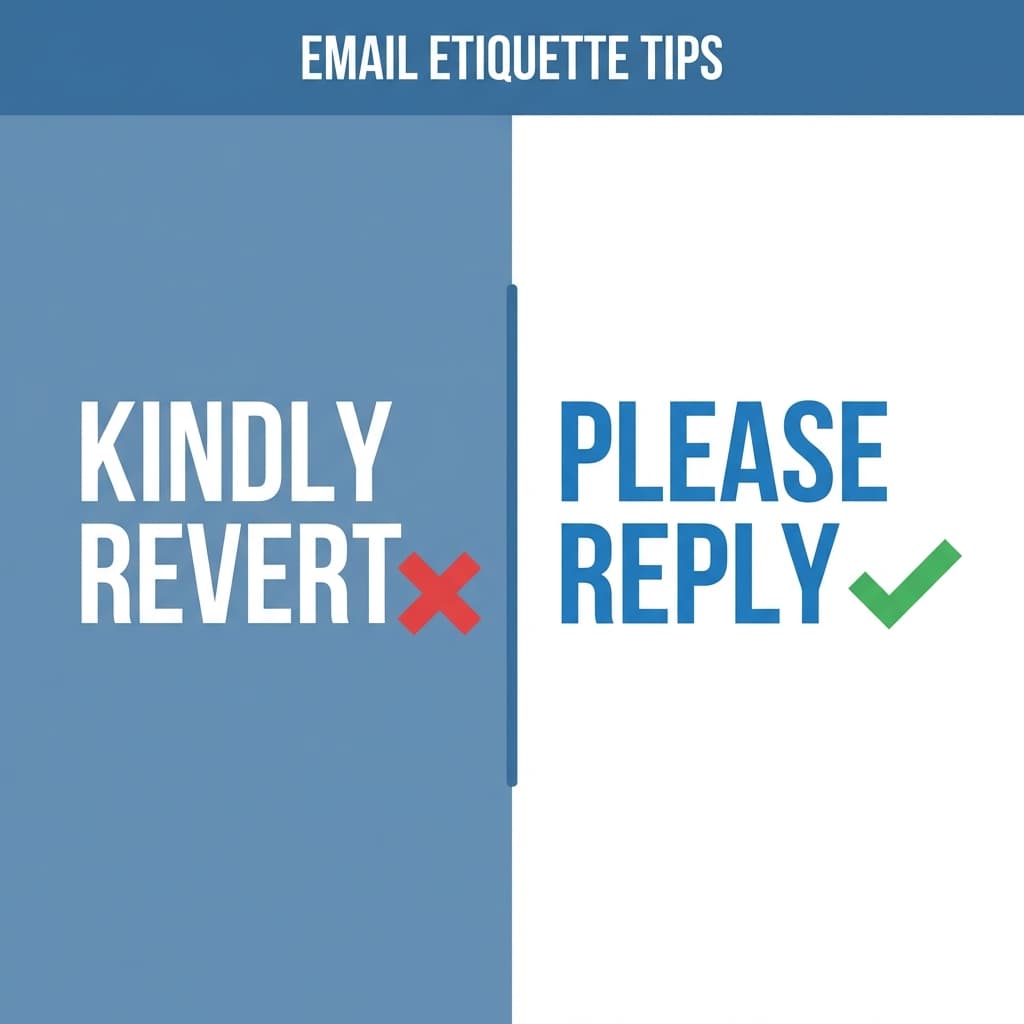
In Singapore, India, and parts of Southeast Asia, "please revert" is standard business English for "please reply" or "please get back to me."
However, in standard international English (US/UK/Australia), "revert" means "to return to a previous state" (e.g., "The software reverted to the old version"). Using "please revert" with global clients often causes confusion, as they may think you want them to undo changes. To be safe and professional globally, simply use "please reply".
Not sure if your email has this problem? Try Email Improver to fix tone and phrasing before you hit send.
What "Revert" Actually Means
To understand why this phrase is so controversial, we need to look at the dictionary definition versus how it's used in local workplaces.
The "Global" Definition
Revert (verb) Meaning: To return to a previous state, practice, topic, or belief. Origin: From Old French revertir "turn back."
Correct Standard Usage: "After the upgrade failed, we had to revert to the legacy system." "Should we revert to the original plan?"
The "Singaporean" Definition
Revert (verb) -- Singlish / Indian English Variant Meaning: To reply, respond, or get back to someone.
Local Usage: "Please revert with your comments by Friday." (Meaning: Please reply with...) "I will revert to you soon." (Meaning: I will get back to you soon.)
Why "Please Revert" is Common in Singapore Emails
If you work in Singapore, Malaysia, or Hong Kong, you've likely seen variations like “kindly revert,” “please check and revert,” or even “revert back” hundreds of times.
It’s often a direct translation of the desire for a response, carried over from colonial-era administrative English or local habits. It is intended to be polite ("kindly") and professional.
However, while understood locally, it is a major source of miscommunication in global business.
Revert vs Reply vs Respond
Here is a quick comparison to help you choose the right word for the right audience.
| Feature | Reply | Revert (Global) | Revert (Singapore) |
|---|---|---|---|
| Meaning | To answer / respond | To return to a past state | To answer / respond |
| Global Clarity | Clear (Universal) | Clear | Confusing |
| Professionalism | High | High (if used correctly) | Low (outside Asia) |
| Recommended? | Yes | Only for "going back" | No (Use "Reply") |
Kindly Revert Meaning (and Better Alternatives)
You will often see emails starting or ending with "Kindly revert." In Singapore, Malaysia, and India, this is intended as a very polite way to say, "Please reply to me." The word "kindly" is added to soften the command, making it feel more respectful than a blunt "Please revert."
However, just like "please revert," "kindly revert" falls flat with international audiences. To a US or UK reader, "kindly" can ironically sound patronizing or old-fashioned (like a stern schoolteacher), and "revert" still means "to go back to a previous state." So, instead of sounding polite, you might sound like you are issuing a gentle but confusing order to return to a former version of yourself.
If you want to be genuinely polite and clear, drop the colonial-era phrasing. Use natural, modern English that invites a response.
Better "Kindly Revert" Alternatives:
- "I look forward to hearing from you." (Classic, warm, professional)
- "Please let me know your feedback when possible." (Respectful of their time)
- "Kindly reply by Friday." (If you must use "kindly," pair it with "reply," not "revert")
- "I’d appreciate your response on this." (Focuses on gratitude)
Not sure if your email sounds patronizing? Run it through our free Email Improver to check your tone.
Please Do the Needful Meaning (When to Avoid It)
Another phrase that often accompanies "please revert" is "Please do the needful." This is a quintessential Indian English phrase that has seeped into the broader South Asian and Southeast Asian business lexicon. It means "Please do whatever is necessary to solve this problem or complete this task."
In a high-context local culture, this is efficient—it assumes the other person knows exactly what needs to be done. But globally, it is confusing and vague. It can also sound lazy, as if you can't be bothered to list out the actual steps required. A client in New York might read "do the needful" and think, "What exactly is the needful? Why aren't you telling me what you want?"
When to Avoid It:
- Always avoid it with clients outside of South/Southeast Asia.
- Avoid it when the task is complex and requires specific instructions.
Better Alternatives:
- "Please proceed with the necessary steps."
- "Could you handle this request?"
- "Please take care of this action item."
- "Please complete the transaction as discussed."
Please Revert Back Meaning (Is It Correct?)
We often see the phrase "Please revert back" in emails. Is it correct? The short answer is no.
This is a tautology—a phrase that says the same thing twice. Since the standard definition of "revert" is "to go back" or "return," saying "revert back" is literally saying "go back back" or "return back." It is redundant grammar.
Even if you are using the Singaporean definition of "revert" (meaning "reply"), saying "reply back" is also redundant. You just "reply."
Using "revert back" is a double-whammy: it uses a word ("revert") that confuses global readers, and it uses a grammatical structure ("revert back") that suggests a lack of attention to detail. To sound sharp and professional, cut the "back" and, ideally, cut the "revert" too.
Correct Usage:
- ❌ Incorrect: "Please revert back to me."
- ❌ Incorrect: "I will revert back to you later."
- ✅ Better (Local): "Please revert to me." (Still not recommended globally)
- ✅ Best (Global): "Please get back to me."
- ✅ Best (Global): "I will follow up with you later."
Improve your grammar instantly with our Email Improver tool.
What to Say Instead (Copy-Paste Templates)
Stop using "revert" when you mean "reply." Here are 15+ clearer, more modern ways to ask for a response, organized by who you are emailing.
To Your Boss (Professional & Direct)
- "Please let me know if you approve this direction."
- "I’d appreciate your feedback on the draft."
- "Could you confirm if we can proceed?"
- "Please reply by Friday so we can stay on schedule."
To Peers & Colleagues (Collaborative)
- "Let me know your thoughts!" (Friendly)
- "Could you take a look and get back to me?"
- "Any thoughts on this? Let me know."
- "Hit reply when you have a sec." (Casual)
To Vendors & Clients (Polite & Action-Oriented)
- "Please reply at your earliest convenience."
- "We look forward to hearing from you."
- "Could you please send over the requested files?"
- "Kindly share your availability for a call."
Real-World Misunderstandings
Why does this matter? Because clarity impacts your bottom line.
Scenario A: The Confused Client (US) You send: "Please check the contract terms and revert." Client thinks: "Wait, revert? Do they want me to undo the changes we just negotiated? Are we going back to the first draft?" Result: Delay & Confusion.
Scenario B: The Redundant "Revert Back" You send: "I will revert back to you next week." Recipient thinks: "Revert back? Their English seems a bit unpolished." Result: Lowered Professional Perception.
Before & After Examples
Let’s polish some common Singlish email phrases.
Example 1: Asking for confirmation
❌ Avoid: "Please check the schedule and kindly revert." ✅ Better: "Please check the schedule and confirm if it works for you."
Example 2: Chasing a response
❌ Avoid: "I haven't heard from you. Please revert soonest." ✅ Better: "I’m following up on my previous email. Could you please update me on the status?"
Example 3: Submitting work
❌ Avoid: "Attached is the deck. Please check and revert." ✅ Better: "Attached is the deck. Please review and let me know your thoughts."
FAQ: Common Questions About "Revert"
Q: Is "please revert" grammatically correct? A: In standard English, "revert" means "to return to a previous state". Using it to mean "reply" is considered incorrect in US/UK English, though it is accepted in Singaporean and Indian business English contexts.
Q: Why do Singaporeans use "revert"? A: It is a holdover from colonial administrative English that evolved into a unique local usage. It is taught and practiced as a formal way to say "reply" within the region.
Q: Is "revert back" redundant? A: Yes, it is a tautology. "Revert" already means "to turn back" or "return". Adding "back" is unnecessary, similar to saying "return back" or "repeat again".
Q: What should I use instead of revert? A: Use "reply", "respond", "get back to me", or "answer". These words are universally understood and professional.
Need Help Polishing Your Emails?
Breaking the "revert" habit is hard when everyone around you does it.
Try Email Improver — it instantly checks your draft for Singlish phrases like "kindly revert" and suggests professional, globally-friendly alternatives.
Before: "Please check and revert back soonest." After: "Please review and let me know your thoughts as soon as possible."
Need more features? View pricing to unlock higher limits for your team.
Related reads
Frequently Asked Questions
Is "please revert" grammatically correct?▼
In standard English, "revert" means "to return to a previous state". Using it to mean "reply" is considered incorrect in US/UK English, though it is accepted in Singaporean and Indian business English contexts.
Why do Singaporeans use "revert"?▼
It is a holdover from colonial administrative English that evolved into a unique local usage. It is taught and practiced as a formal way to say "reply" within the region.
Is "revert back" redundant?▼
Yes, it is a tautology. "Revert" already means "to turn back" or "return". Adding "back" is unnecessary, similar to saying "return back" or "repeat again".
What should I use instead of revert?▼
Use "reply", "respond", "get back to me", or "answer". These words are universally understood and professional.
Fix tone and clarity before you hit send.