Please Find Attached: Meaning, Is It Professional? 10 Alternatives
Please find attached means a file is included with your email. It is correct but formal; use these 10 professional alternatives for clear, modern messages.
TL;DR
“Please find attached” means a file is included with your email. It is grammatically correct and usable, but formal; modern business emails often use a clearer alternative such as “I’ve attached” or “Attached is.”
Top alternatives:
- •Please find attached = I've attached [file] for your review
- •Kindly find attached = Here's the [document] you requested
- •Please find enclosed = Attached is the [report]
AI Grammar Buddy
Rewrite this phrase in context
Paste your sentence and AI Grammar Buddy will turn it into clearer professional English.
Jump to sections
Use these anchors to jump straight to the section you need.
Quick Answer
“Please find attached” means “a file is included with this email.” It is grammatically correct and still professional in formal correspondence, but it can sound stiff in everyday business email. Choose the alternative that matches your audience and the action you need.
Is it correct? Yes. Best everyday default: “I've attached [file] for [purpose].” Best practice: name the file, explain why it matters, and state the next action.
When the attachment also needs a concrete task, see “for your kind action” meaning and clearer email alternatives for examples that name the verb and deadline.
| Tone | Better attachment line | Best use |
|---|---|---|
| Formal | “The requested contract is attached for your review.” | Contracts, formal records, first contact |
| Natural | “I’ve attached the contract for your review.” | Most client and workplace emails |
| Concise | “Attached is the contract.” | Clear, short updates when the file is the main point |
10 quick alternatives to “Please find attached”
- I've attached the [document] for your review.
- Please see the attached [document].
- Attached is the [document] you requested.
- Here's the [document] we discussed.
- The attachment contains [details].
- You'll find [details] in the attached file.
- I'm sending along the [document].
- As discussed, I've attached the [document].
- Below you'll find [details].
- Here's what you asked for: the [document].
Complete email example
Subject: Revised proposal for review
Hi Maya,
Thanks for your comments on yesterday's call. I've attached the revised proposal for your review. The updated pricing is on page 4, and the new delivery schedule is on page 7.
Could you please send any final comments by Thursday at 3 PM? If everything looks right, I will prepare the signature copy.
Best regards,
Daniel
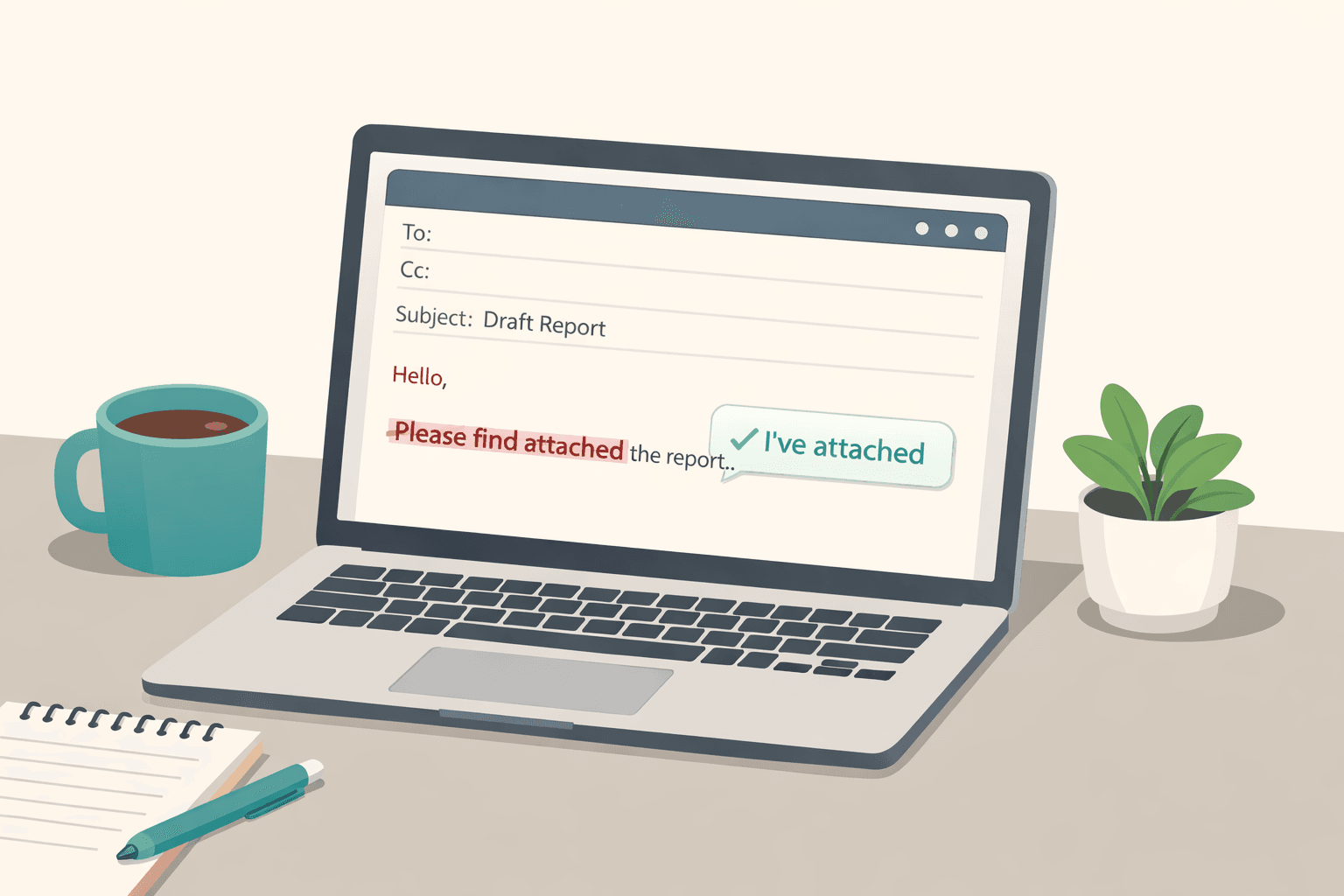
Is "Please Find Attached" Professional?
“Please find attached” is correct and can still fit a formal workplace or document-heavy industry. In modern everyday email, a direct line such as “I’ve attached the proposal for your review” is usually clearer and more natural.
That matters because attachment language sets the tone quickly. A stiff phrase can make a routine message feel distant, especially when you're writing to clients, hiring managers, or regional teammates who expect clear, human English.
In this guide, we'll break down 10 modern alternatives that sound clearer, warmer, and more professional. You'll also see when each option works best, common grammar traps to avoid, and practical etiquette notes for Asian business communication.
Part of our Singapore & Asian Workplace Email Phrases guide. If you also need to apologize in an email, see How to Apologize Professionally in an Email (15 Phrases + Templates).
Why Change "Please Find Attached"?
The phrase works — but it's showing its age. Here's why more professionals are switching:
- It sounds cold. The phrase comes from old-school formal letter writing (literally "enclosed please find..."). In a quick email, it creates unnecessary distance between you and the reader.
- It's a common grammar trap. For non-native English speakers, it’s easy to mix up "attached" vs. "attach" or "attachment." We often see errors like "Please find attach" or "Please find the attached."
- Modern business prefers directness. Modern business communication has shifted towards conversational, direct language — and attachment phrasing is no exception. Saying "I've attached the file" is simply more direct than the passive "Please find attached."
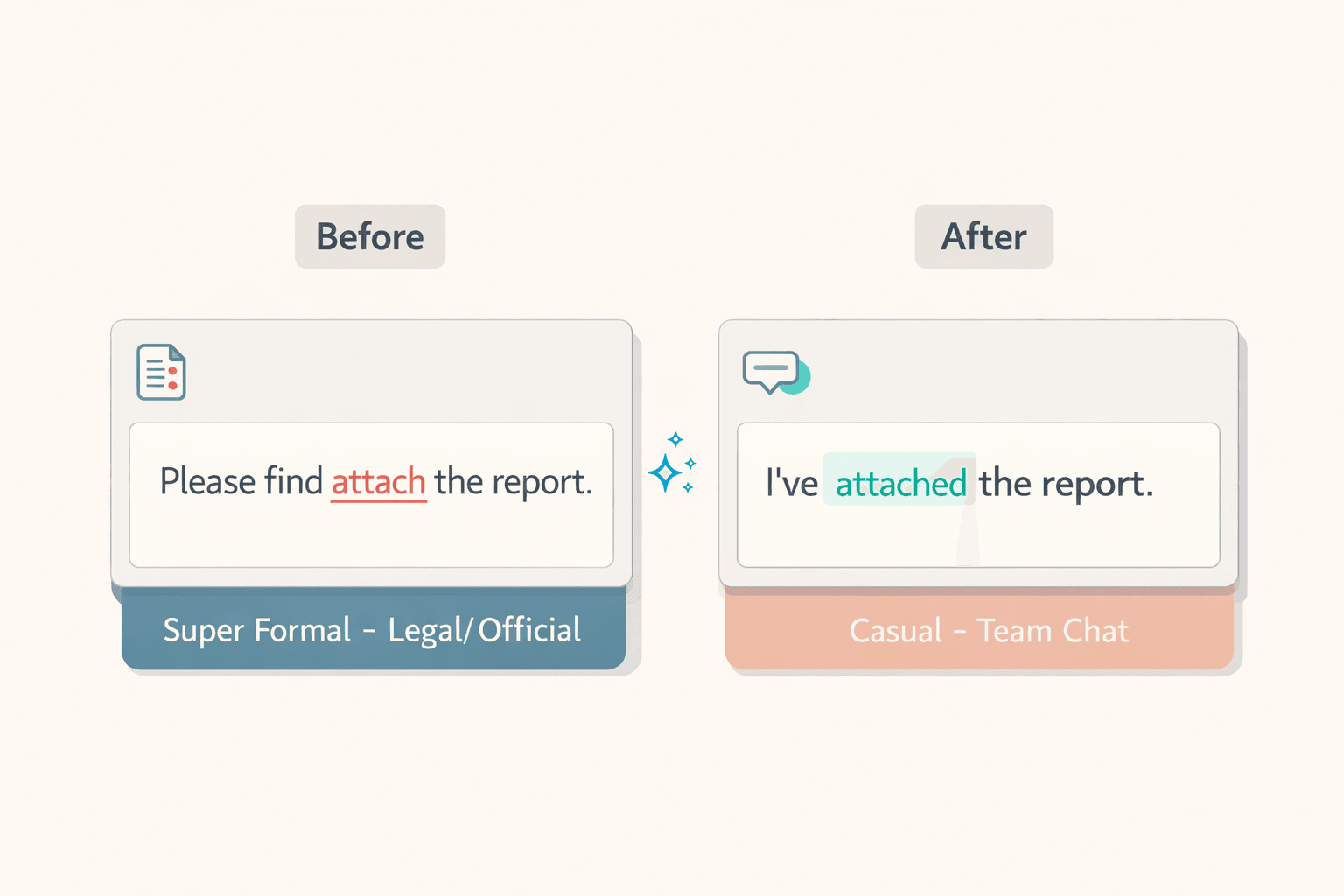
Formality Levels: Which Phrase Should You Use?
Not all emails are created equal. You wouldn't speak to your CEO the same way you speak to your lunch buddy. The same applies to attachment phrases.
We've broken down the alternatives into 4 levels of formality:
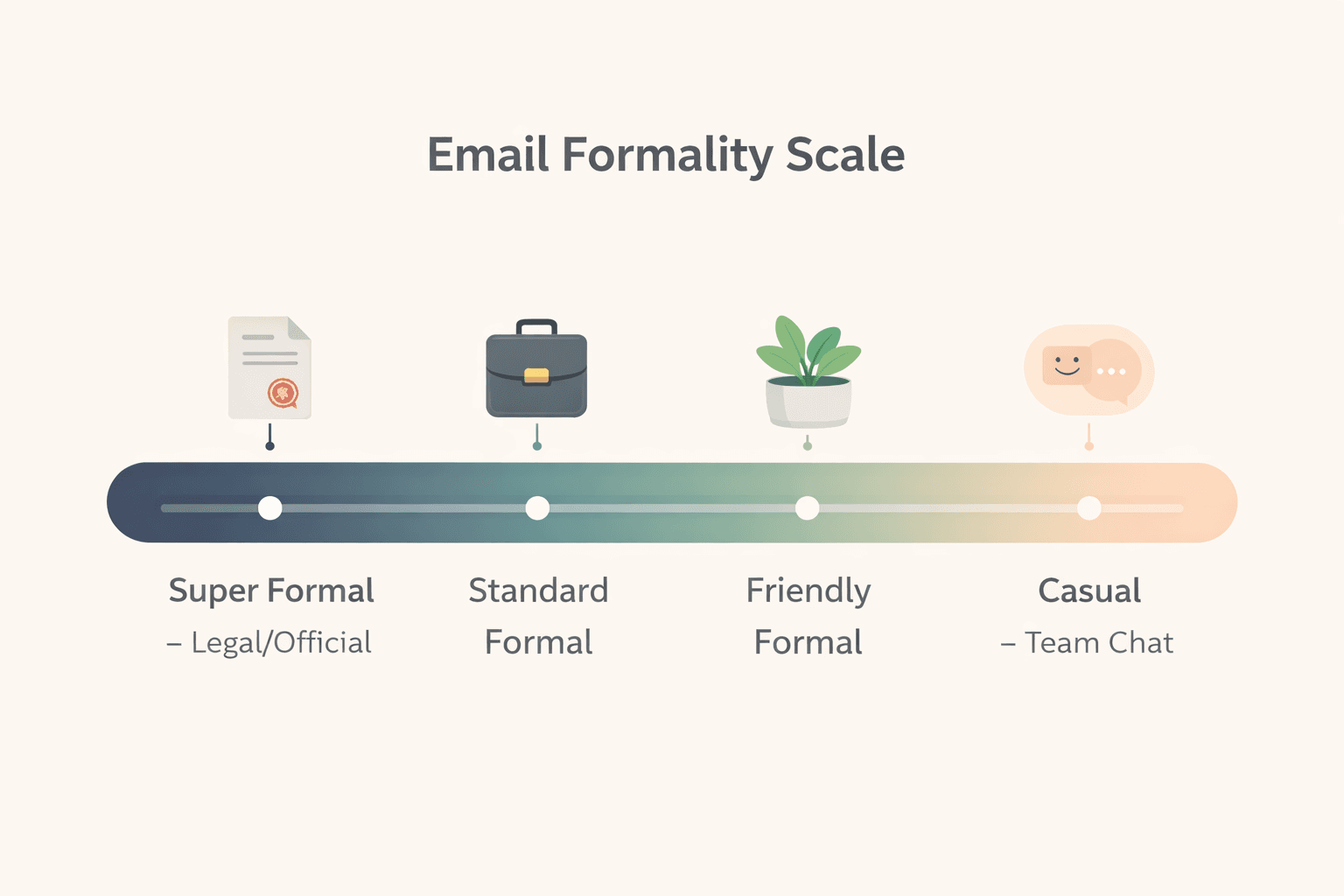
-
Level 1: Super Formal (Official/Legal)
- Usage: Government documents, contracts, legal matters.
- Example: "The attached contract outlines the agreement terms."
-
Level 2: Standard Formal (Business)
- Usage: New clients, first contact, cross-company communication.
- Example: "I've attached the Q3 report for your review."
-
Level 3: Friendly Formal (Internal)
- Usage: Familiar colleagues, daily work updates.
- Example: "Here's the budget breakdown we discussed."
-
Level 4: Casual (Team)
- Usage: Close team members, informal chats.
- Example: "Check out the new design mockups."
10 Professional Alternatives to "Please Find Attached"
Here are 10 specific phrases you can copy and paste, along with tips on when to use them.
1. "I've attached..."
- Formality: ✦✦✦☆☆ (Moderate)
- Example: "I've attached the meeting notes from yesterday. Please review and provide feedback."
- When to use: The most versatile option. Safe for 90% of business emails.
- Avoid: Very stiff, official government correspondence.
2. "Please see the attached..."
- Formality: ✦✦✦✦☆ (Formal)
- Example: "Please see the attached document for detailed specifications."
- When to use: A nice balance of formal and polite. Great for clients.
- Avoid: Overusing it in quick internal messages.
3. "Attached is..."
- Formality: ✦✦✦✦☆ (Formal)
- Example: "Attached is the presentation you requested for Friday's meeting."
- When to use: Formal business letters or when the attachment is the main point of the email.
- Avoid: It can sound a bit passive. "I've attached" is usually stronger.
4. "Here's the [file type]"
- Formality: ✦✦☆☆☆ (Friendly)
- Example: "Here's the contract you need to sign. Let me know if you have any questions."
- When to use: Colleagues, acquaintances, or building a friendly client relationship.
- Grammar Point: "Here's" is short for "Here is." Use it for singular items.
5. "The attachment contains..."
- Formality: ✦✦✦✦✦ (Very Formal)
- Example: "The attachment contains the Q4 financial report and budget projections."
- When to use: Technical documentation or explaining complex files.
- Avoid: Don't use this for simple, short emails—it's too wordy.
6. "You'll find [details] in the attached file"
- Formality: ✦✦✦☆☆ (Moderate-Formal)
- Example: "You'll find the invoice details in the attached spreadsheet."
- When to use: When you want to direct the reader's attention to specific information inside the file.
7. "I'm sending along..."
- Formality: ✦✦✦☆☆ (Moderate)
- Example: "I'm sending along the revised proposal as discussed on our call."
- When to use: Following up on a conversation. It sounds helpful and proactive.
8. "As discussed, I've attached..."
- Formality: ✦✦✦☆☆ (Moderate-Formal)
- Example: "As discussed, I've attached the timeline for the project rollout."
- When to use: Connecting the email to a previous meeting or call. It improves context.
9. "Below/Attached you'll find..."
- Formality: ✦✦✦☆☆ (Moderate)
- Example: "Below you'll find the template we discussed for the new process."
- When to use: Good for clarity, especially if you have both text content and an attachment.
10. "Here's what you asked for"
- Formality: ✦☆☆☆☆ (Very Casual)
- Example: "Here's what you asked for – the competitor analysis spreadsheet."
- When to use: Responding to a direct request from a teammate.
- Note: Keep this for internal use or clients you know very well.
Real Email Templates
See how these phrases look in practice. These templates were refined using AI Grammar Buddy — each was tested for tone consistency across formal and casual contexts.
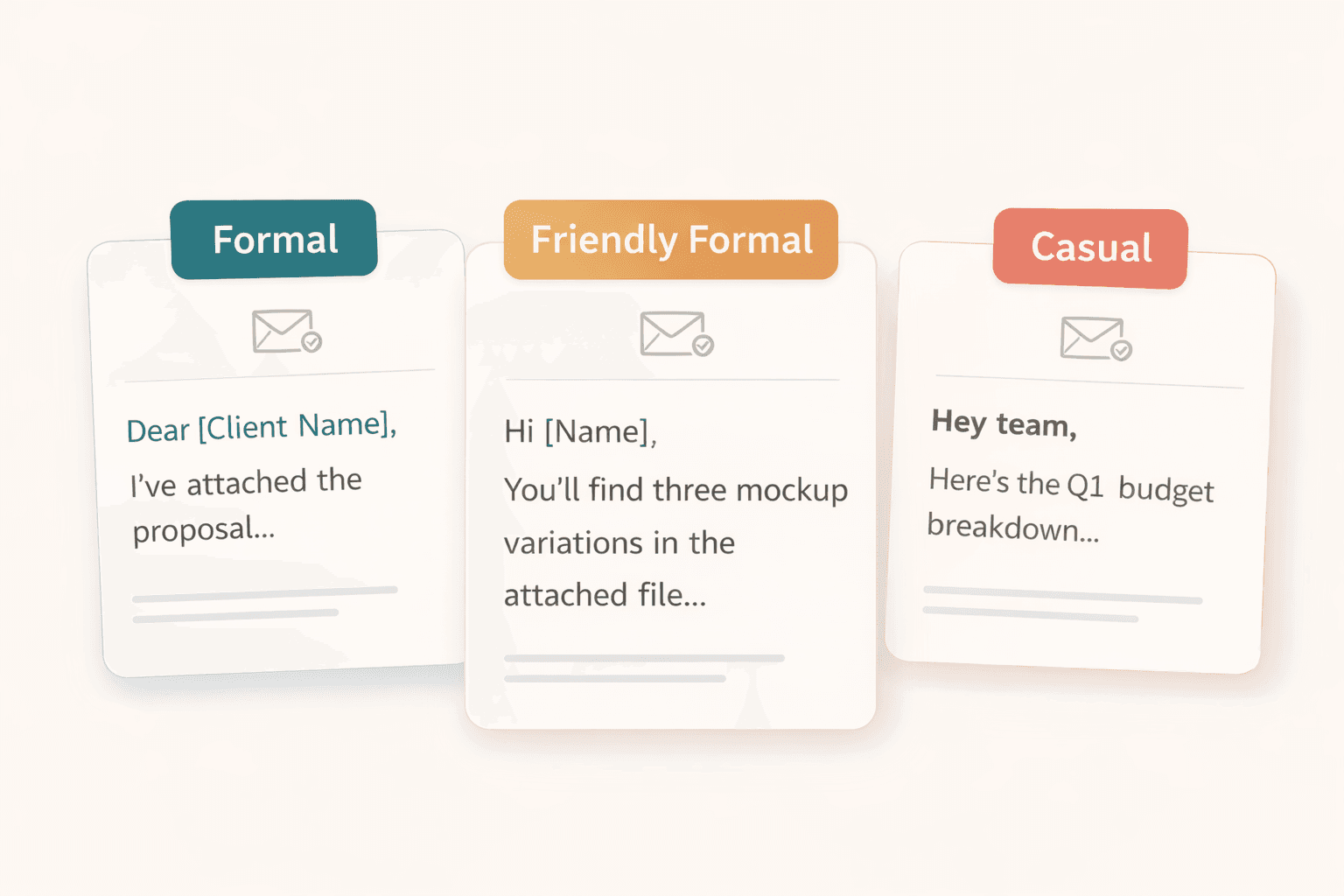
Template 1: Proposal to New Client (Formal)
This template uses "I've attached" for a clear, professional tone.
Subject: [Company Name] - Marketing Proposal for [Project]
Dear [Client Name],
Thank you for considering our services. I've attached the comprehensive marketing proposal for your [Project Name] initiative.
The document outlines:
- Strategic approach and timeline
- Expected deliverables
- Investment details
Please review and don't hesitate to reach out if you have any questions or would like to schedule a discussion.
Best regards, [Your Name]
Template 2: Follow-up with Colleague (Friendly Formal)
Here, "You'll find" is used to guide the reader.
Subject: Re: Design Mockups for Website Redesign
Hi [Name],
As we discussed in yesterday's meeting, I've attached the updated design mockups for the website redesign.
You'll find three variations in the file:
- Modern minimalist approach
- Traditional corporate style
- Contemporary gradient design
I'd appreciate your feedback by Friday. Let me know if you need any modifications.
Cheers, [Your Name]
Template 3: Internal Team Share (Casual)
Using "Here's" keeps it light and quick.
Subject: Budget spreadsheet - pls review!
Hey team,
Here's the Q1 budget breakdown we need to finalize. Can everyone review their department sections and flag any discrepancies?
Let's sync up tomorrow to discuss.
Thanks! [Your Name]
Common Mistakes & Grammar Traps
Even with alternatives, it's easy to make small mistakes. Watch out for these:
- "Please find attach" ❌ (Missing -ed)
- Correction: "Please find attached" or "I have attached."
- "Please find the attach file" ❌
- Correction: "Please find the attached file." Attached is an adjective modifying file.
- Mixing up "Attachment" vs. "Attached"
- "Attachment" is a noun ("See the attachment").
- "Attached" is an adjective ("The attached file") or part of a verb ("I have attached").
Grammar Buddy Tip: If you're unsure, try swapping "attached" with "linked." If "linked" makes sense, you probably need the -ed form!
Not sure if your phrasing sounds right? AI Grammar Buddy's Email Improver catches attachment phrase errors — and fixes them — before you hit send. Try it free →
Other Cultural Considerations
Attachment phrasing isn't one-size-fits-all. Across Singapore, Taiwan, and Malaysia, workplace email culture varies — here's how to adapt your language to each context.
Singapore
In Singapore, fast-moving internal emails often default to shorthand like "See attached" when teams are juggling approvals, vendor quotes, and last-minute deck updates. That phrasing is common, but it can sound abrupt when you're writing to a client, a regional counterpart, or someone senior outside your immediate team. In a procurement or finance scenario, "I've attached the revised quotation for your review" usually lands better because it names the file and signals the next step. If you're emailing across functions, pairing the attachment line with a deadline or action request keeps the tone efficient without sounding clipped.
Taiwan
In many Taiwanese workplaces, especially in traditional firms or cross-border supplier communication, email etiquette still leans a little more formal at the opening and closing. A line like “Attached is the updated pricing sheet for your reference” fits naturally after a respectful greeting and before a concise explanation of what changed. This is especially useful when sending bilingual materials, contracts, or revised documents to a manager who expects context before opening the file. If the recipient is senior, adding one sentence on why the attachment matters can make the email feel more polished and considerate. Use our guide to “for your reference” meaning in email to check whether that line signals optional context or accidentally hides a request.
Malaysia
Malaysian business email often balances speed with warmth, so the best attachment phrasing usually sounds direct but not cold. After a call or meeting, "I'm sending along the revised deck we discussed" works well because it feels collaborative rather than overly formal. In HR, sales, or account management contexts, adding a polite follow-up line such as "Please let me know if you'd like any edits" helps maintain the friendly tone many teams prefer. When you're chasing approvals or invoices, naming the document clearly is more effective than relying on vague phrasing like "please find attached herewith."
Summary
You don't have to ban "Please find attached" from your vocabulary forever, but using modern alternatives will make you sound more like a 21st-century professional and less like a textbook.
Key Takeaways:
- Use "I've attached" for most standard business emails.
- Use "Please see attached" for formal client communications.
- Use "Here's" for friendly updates with your team.
Want to make sure your emails are perfect? Try Email Improver to instantly check your tone and grammar. It catches Singlish errors and suggests professional alternatives in seconds.
Need higher limits for your team? View pricing.
Related reads
About This Article
GrammarBuddy Editorial Team
Last updated 2 August 2026
Frequently Asked Questions
Is "please find attached" grammatically correct?▼
Yes, it is grammatically correct but sounds formal and outdated. Modern business emails prefer direct alternatives like "I've attached" or "Here's the file."
What can I say instead of "please find attached"?▼
Use "I've attached," "Please see the attached," "Here's the [document]," or "Attached is the [file]." Choose based on formality level.
Is "please find attached" too formal?▼
For most modern business emails, yes. It originates from formal letter writing and can sound stiff in a casual email. "I've attached" works for 90% of situations.
What is the difference between "attached" and "enclosed"?▼
"Attached" is used for email attachments. "Enclosed" is used for physical letters where a document is placed inside an envelope. Use "attached" for all emails.
Is "Please see attached" better than "Please find attached"?▼
"Please see attached" is slightly more natural and direct than "please find attached," but both sound formal. The most modern alternatives are "I've attached [file]" or "Here's the [document]" — these are clearer, warmer, and preferred in contemporary business emails.
What is the best phrase to use when sending multiple attachments in one email?▼
When sending multiple files, be specific: "I've attached three documents: [File 1], [File 2], and [File 3]." You can also use "Please find the following attachments:" followed by a bulleted list. Avoid vague phrases like "please find attached herewith" — name each file so the recipient knows exactly what to look for.
What should a business email style guide say about "please find attached"?▼
A business email style guide can allow “please find attached” for formal correspondence, but should prefer plain, specific wording for most messages: name the file, state its purpose, and add the next action. For example: “I’ve attached the revised contract for your review. Please send any comments by Friday.”
Next step
Rewrite this phrase in context
Paste your sentence and AI Grammar Buddy will turn it into clearer professional English.
Keep going
Continue with AI Grammar Buddy
AI Grammar Buddy
Email Improver
Paste your draft and rewrite it for clearer, more professional English.
Rewrite This PhraseRelated guide
What Does Inherent Mean? Meaning, Examples and Business English Uses
What does inherent mean? Learn the meaning, inherent in vs to, and practical sentence examples for reports, emails and everyday English.
28 September 2026
Related guide
What Does Coherent Mean? Meaning, Examples and Business English Uses
Learn what coherent means, see natural sentence examples, compare coherent vs clear, and improve the flow of your emails and reports.
27 September 2026
Related guide
What Does Persist Mean? Meaning, Grammar and Examples
Persist means to continue despite difficulty or to keep existing. Learn how to use persist in, persist with, and persist correctly with workplace examples.
23 August 2026