Singlish Translator: Rewrite Singlish to Professional English (Guide)
Need a Singlish translator for work emails? Learn how to rewrite phrases like 'can is can' and 'do the needful' into professional business English.
Jump to sections
Use these anchors to jump straight to the section you need.
Singlish Translator: Rewrite Singlish to Professional English
AI Grammar Buddy
Make this sound professional
Improve tone for work emails without changing your meaning.
What is Singlish in Work Emails?
Singlish (Singapore Colloquial English) is the colorful, efficient, and culturally rich lingua franca of Singapore. In casual settings, it’s a badge of identity.
However, in work emails, Singlish can be a barrier. It often relies on direct translations from Chinese or Malay grammar, unique sentence structures, and local vocabulary that global partners simply don't understand.
Why It Causes Misunderstandings
When you use a "Singlish translator" approach—translating your thoughts directly into Singlish—you risk confusing international readers.
- Missing subjects: "Can send?" (Who sends? Send what?)
- Tone issues: "Noted with thanks" can sound cold to Americans.
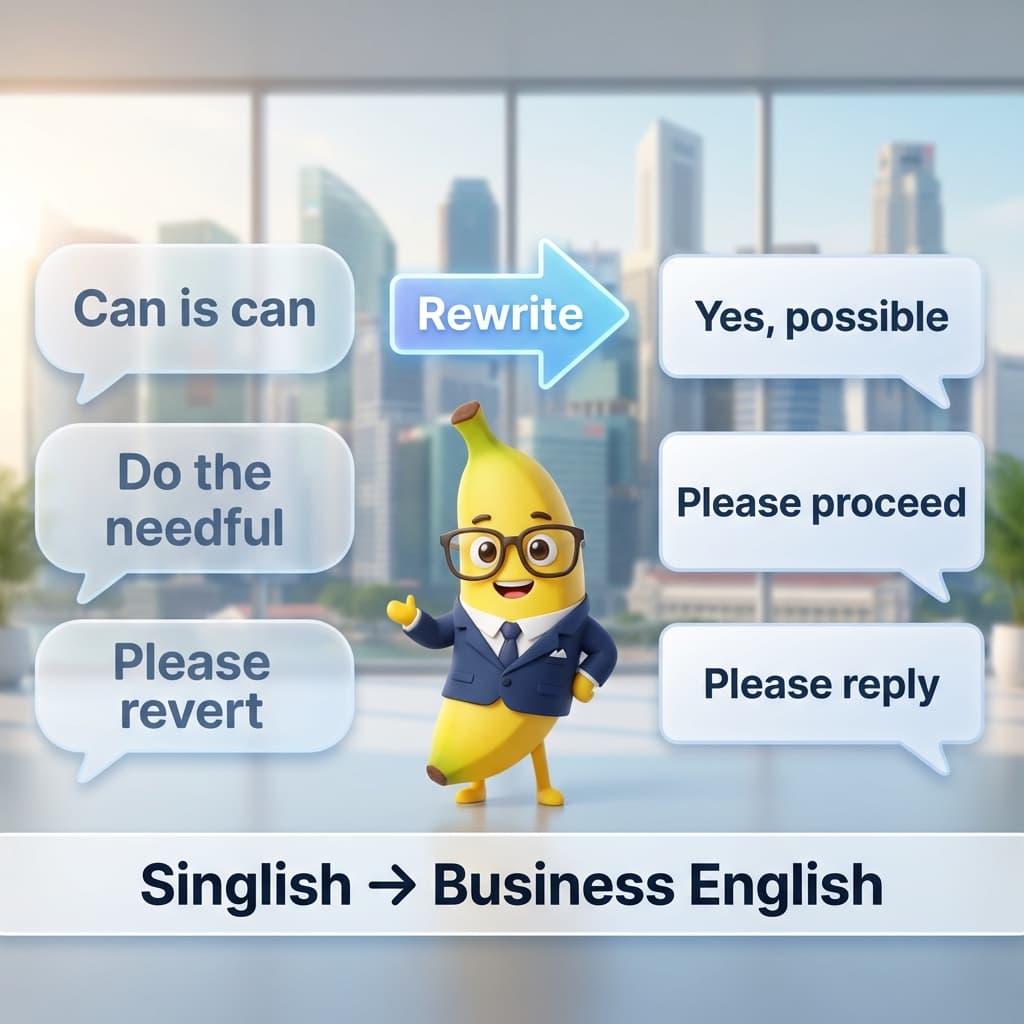
- Ambiguity: "Can is can" leaves clients wondering if it’s a "yes" or a "maybe."
Common Singlish Email Lines (The "Dirty Dozen")
Here are 10 common Singlish phrases that creep into corporate emails. Do you recognize any?
- "Please help to check."
- "Can or not?"
- "I will revert to you."
- "Same usage as per previous."
- "Please do the needful."
- "Any updates, please?" (Used as a standalone sentence)
- "Off day" (instead of day off/leave)
- "On leave" (used as a verb: "He is on-leaving today.")
- "Last time" (meaning "previously," not "the final time")
- "Makan already?" (Too casual for email)
Before vs. After Rewrites (Singlish to Professional English)
Let’s act as your personal Singlish translator. Here are 6 quick fixes.
1. The Request
❌ Singlish: "Can help to check and revert?" ✅ Professional: "Could you please review this and let me know your thoughts?"
2. The Confirmation
❌ Singlish: "Can is can, but need time." ✅ Professional: "We can do that, but we will need a bit more time."
3. The Follow-up
❌ Singlish: "Please do the needful." ✅ Professional: "Please proceed with the necessary steps."
4. The Past Reference
❌ Singlish: "Last time we utilize this vendor also." ✅ Professional: "We have used this vendor previously as well."
5. The Attachment
❌ Singlish: "Please find attached." (Outdated) ✅ Professional: "I have attached the report for your review."
6. The Permission
❌ Singlish: "Your side okay with this?" ✅ Professional: "Does this work for your team?"
Mini Style Guide for Singapore Emails
Follow these 3 simple rules to instantly polish your writing.
- Subject-Verb Clarity: Singlish often drops the subject ("Can do."). English needs it ("We can do it."). Always ask: Who is doing the action?
- Be Specific with Requests: Instead of "do the needful," state exactly what needs to be done ("please sign the contract").
- Soften Your Tone: Singlish is efficient. English is polite. Add "Could you..." or "I would appreciate..." to soften commands.
Quick Notes
- "Can is can": Just say "Yes, that is possible."
- "Do the needful": Replace with specific action verbs like "process," "approve," or "send."
- "Noted with thanks": Try "Received, thank you for the update" for more warmth.
CTA
Don't let Singlish limit your career. Use Email Improver to act as your instant Singlish translator. It detects informal phrasing and suggests professional alternatives in seconds.
Upgrade your entire team's communication with our Pricing plans.
FAQ
1. Is standard English better than Singlish?
In a professional context, yes. Standard English ensures clarity and prevents misunderstandings with global clients who don't know local slang.
2. Can I use Singlish with local colleagues?
Yes, it helps build rapport. But be able to switch codes (code-switch) instantly when emailing external partners or senior management.
3. Does the Singlish translator tool fix grammar errors?
Yes. Our tools catch specific Singlish grammar patterns (like missing articles or wrong verb tenses) that generic checkers often miss.
4. How do I say "blur" in professional English?
Use "confused," "unclear," or "unsure." E.g., instead of "He very blur," say "He seems unsure about the process."
(Related reads)
Next step
Make this sound professional
Improve tone for work emails without changing your meaning.
Keep going
Continue with AI Grammar Buddy
AI Grammar Buddy
Email Improver
Paste your draft and rewrite it for clearer, more professional English.
Improve My ToneRelated guide
Business Trip English Phrases: Airport, Hotel & Meetings
Learn practical business trip English phrases for airports, immigration, hotels, meetings, and delays, with mini dialogues and ready-to-use examples.
30 July 2026
Related guide
OK Noted Meaning in Email: Rude? Better Replies
What does OK noted mean in email? Is okay noted rude? Why noted on this is wrong, plus clearer professional replies you can copy.
18 July 2026
Related guide
AI Email Rewriter for Professional Emails (Before & After)
Turn rough drafts into professional emails. See before-and-after rewrites, better prompts, and common mistakes that affect tone, clarity, and structure.
17 June 2026