How to Sound More Senior in Emails (Without Using Fancy Words)
Learn how to upgrade your email tone to sound more senior. Focus on ownership, deadlines, and clear asks instead of complex vocabulary.
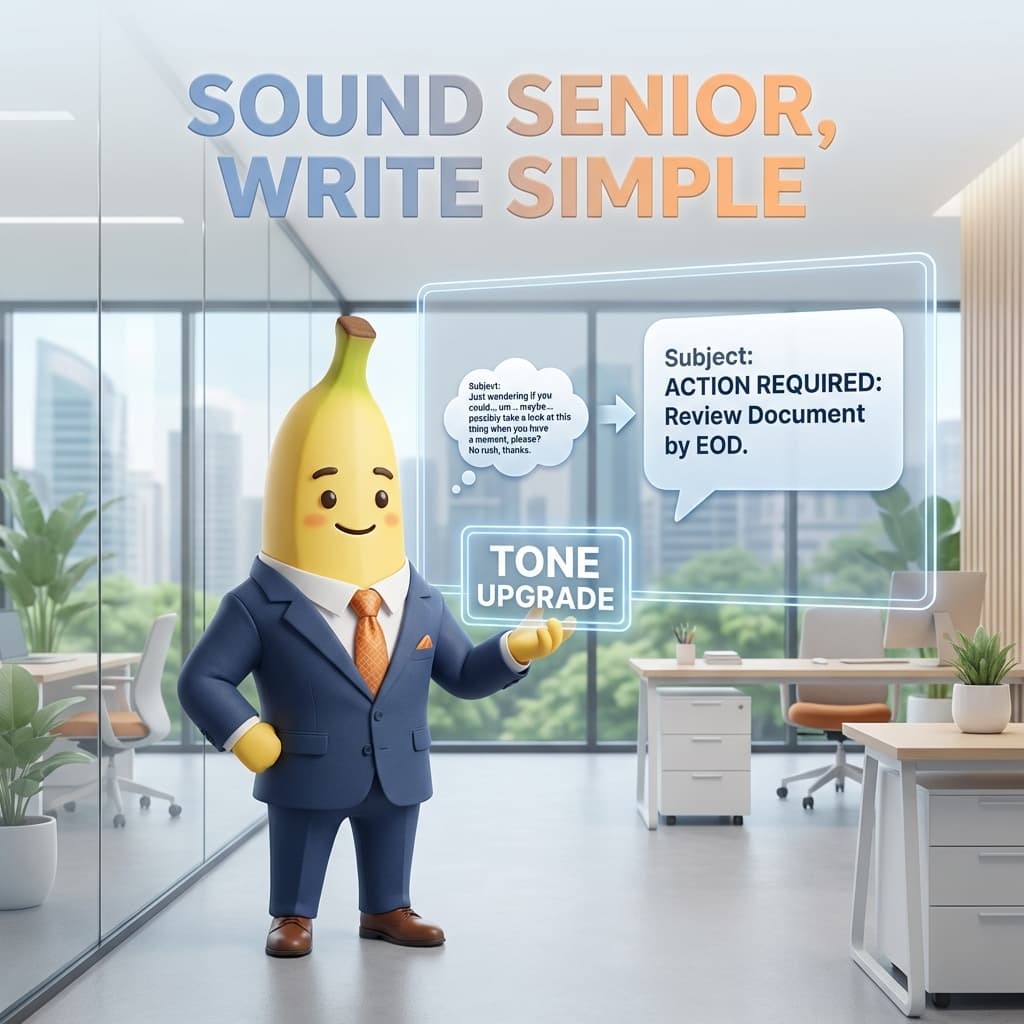
TL;DR
Sound more senior by using ownership language, making clear asks with deadlines, and choosing active voice over vague filler.
Top alternatives:
- •Replace hesitant phrases with confident ownership language.
- •State exactly what you need and by when.
- •Use active voice to sound decisive and professional.
AI Grammar Buddy
Make this sound professional
Improve tone for work emails without changing your meaning.
Jump to sections
Use these anchors to jump straight to the section you need.
Vocabulary Doesn't Make You Senior—Tone Does
Many professionals believe that a "senior" tone requires using long, academic words. In reality, sounding senior is about authority, ownership, and clarity. Senior leaders don't have time to decipher a "thesaurus-heavy" email. They appreciate clarity. Using simple language effectively can improve perceived professionalism and make you appear more decisive.
If you find yourself over-explaining or using too many "filler" words, you can Try in Email Improver to help refine your tone into something more executive-level.
The 3 Pillars of a Senior Email Tone
- Ownership: Instead of saying "The report was not finished on time," say "I am late with the report and will have it to you by tomorrow EOD." Ownership builds trust.
- Direction: Instead of asking "What should we do?", offer a recommendation: "Given the situation, I recommend we [Action]. Do you agree?"
- Brevity: Senior emails are often short because the writer knows their value is in the decision, not the word count.
Before → After: Tone Upgrades
Example 1: Asking for a Review
- Before: "Sorry to bother you, but could you maybe take a look at my draft whenever you have a second? No rush!" (Low confidence, easy to ignore)
- After: "I’ve completed the draft for the [Project]. Please review by Wednesday at 10 AM so I can finalize the next steps. Let me know if you have any questions." (Confident, sets a clear timeline)
Example 2: Handling a Conflict
- Before: "I'm not sure if I like the new design. It seems a bit strange. Maybe we can change it?" (Vague, non-committal)
- After: "The new design doesn’t quite meet our brand guidelines for [Specific Reason]. I recommend we adjust the color palette to [Color] for better visibility. What are your thoughts?" (Constructive, specific, offers a solution)
Example 3: Reporting an Issue
- Before: "There is some problem with the server. I think someone should fix it soon." (Passive, lacks ownership)
- After: "We are experiencing a server outage affecting [Region]. I have already notified the IT team, and we expect a fix by 4 PM. I will provide an update as soon as we are back online." (Senior-level update: action-oriented and informative)
SG/SEA Tone vs Global Tone
In the Singapore workplace, we often use "softeners" like "Is it okay if..." or "Perhaps we could consider...". While this is polite in a local hierarchy, it can come across as indecisive to global managers. To sound more senior globally, use "ownership language." Instead of "please find attached" (read about please find attached alternatives), simply say "I have attached the report." It's direct and professional.
Be careful with senior-sounding verbs too. "Please cascade this" can sound managerial, but it is weak if the audience and deadline are missing. Use our cascade meaning in business guide to decide whether cascade, share, brief, or roll out fits your email.
Copy-Paste Templates for Senior Tone
1. The "Confident Recommendation" Template
"Hi [Name], I’ve analyzed the data regarding [Issue]. I recommend we proceed with [Solution] because it offers [Benefit]. I am ready to begin this work as soon as I get your signal."
2. The "Setting Boundaries" Template
"Hi [Name], thank you for the invite. To ensure I deliver my current project [Project Name] on time, I won't be able to join this meeting. I have read the notes and will provide my input via email by [Date]."
3. The "Direct Ask" Template
"Hi [Name], I need your approval on [Item] to move to the next phase. Could you please confirm by [Time]? This will allow us to stay on schedule."
4. The "Providing a Solution" Template
"Hi [Name], we’ve hit a roadblock with [Problem]. To resolve this, I have drafted two options: [Option 1] and [Option 2]. I suggest [Option 1] as the most efficient path. Try in Email Improver to see more variations."
5. The "Ownership of a Delay" Template
"Hi [Name], I am adjusting the delivery date for [Project] to [New Date]. This is to ensure we include the latest feedback from [Stakeholder]. I appreciate your patience."
If a flight or transport delay affects a client meeting, use the update-impact-next-step pattern in this business trip English guide instead of sending “I will be late” without a plan.
6. The "Closing a Thread" Template
"Thanks for the input, everyone. It seems we have a consensus on [Decision]. I will take the lead on [Next Action] and update the group by [Date]. No further discussion is needed at this time."
Senior Tone Checklist
- Did I use "I recommend" instead of "I think"?
- Have I removed unnecessary apologies (e.g., "Sorry for the delay") unless truly warranted?
- Is my call to action (CTA) clear and easy to find?
- Did I use active voice (e.g., "I will lead") instead of passive (e.g., "It will be led by me")?
- Is the email formatted with headers or bullets for easy reading?
- Have I checked for "Do the needful" (see do the needful alternatives)?
- Does this email provide a solution, or just a problem?
- Is my tone firm but respectful?
Related Reads
FAQ
Q: Doesn't sounding senior mean I have to be bossy? A: No. Authority is not the same as being bossy. Authority comes from clarity and confidence. When you provide clear directions or recommendations, you are helping the team, which is a leadership trait. You can be perfectly polite while still being direct.
Q: What if I'm a junior employee? Can I still sound senior? A: Yes. Many managers are impressed by junior employees who write with clarity and ownership. It makes you stand out as someone who is ready for more responsibility. Using these techniques may help you get noticed for future leadership roles.
Q: How do I know if I'm being too direct? A: If you feel your email might be too blunt, add a warm opening or closing. However, most professionals in a busy environment will thank you for being direct. You can always Try in Email Improver for a second opinion on tone and clarity.
Q: Is it okay to use "I" in professional emails? A: Absolutely. Using "I" shows ownership. "I will handle the client" is much stronger than "The client will be handled." Avoiding "I" can make your writing feel passive and robotic, which is the opposite of a senior tone.
Next step
Make this sound professional
Improve tone for work emails without changing your meaning.
Keep going
Continue with AI Grammar Buddy
AI Grammar Buddy
Email Improver
Paste your draft and rewrite it for clearer, more professional English.
Improve My ToneRelated guide
Business Trip English Phrases: Airport, Hotel & Meetings
Learn practical business trip English phrases for airports, immigration, hotels, meetings, and delays, with mini dialogues and ready-to-use examples.
30 July 2026
Related guide
OK Noted Meaning in Email: Rude? Better Replies
What does OK noted mean in email? Is okay noted rude? Why noted on this is wrong, plus clearer professional replies you can copy.
18 July 2026
Related guide
AI Email Rewriter for Professional Emails (Before & After)
Turn rough drafts into professional emails. See before-and-after rewrites, better prompts, and common mistakes that affect tone, clarity, and structure.
17 June 2026