What Does Coherent Mean? Meaning, Examples and Business English Uses
Quick Answer
Coherent means that ideas fit together logically and are easy to follow. A coherent email connects its purpose, context, and requested action. For example, “We need approval today so we can meet Friday’s deadline” is coherent because the request and its reason are clearly linked.
Jump to sections
Use these anchors to jump straight to the section you need.
Coherent Meaning, Pronunciation and Word Forms
In Chinese, coherent is often 連貫的、條理清楚的 or 合乎邏輯的, depending on context. It is an adjective. UK pronunciation is /kəʊˈhɪə.rənt/ and US pronunciation is /koʊˈhɪr.ənt/; the Cambridge Dictionary entry has audio for both. The noun is coherence, the adverb is coherently, and the direct opposite is incoherent.
The word usually describes an explanation, argument, plan, story, report, or strategy. It can describe a person too: “She was coherent during the meeting” means her speech could be understood. In ordinary workplace feedback, “Her explanation was coherent” is usually more specific. Oxford Learner’s Dictionaries records both the ideas and person uses.
Coherent does not mean every claim is true. It describes how the parts connect. A coherent argument may still rely on a weak assumption; readers can follow its reasoning while disagreeing with it.
Coherent in a Sentence: Examples and Common Collocations
Use coherent before a noun (“a coherent plan”) or after a linking verb (“the plan is coherent”). These natural examples show what the word describes:
| Situation | Example |
|---|---|
| “Your email is coherent: the reason for the request comes before the deadline.” | |
| Meeting | “She gave a coherent summary of the decisions and open questions.” |
| Report | “The report presents a coherent explanation of the revenue decline.” |
| Presentation | “The slides form a coherent story from problem to recommendation.” |
| Argument | “His argument is coherent, although I disagree with his assumptions.” |
| Business strategy | “We need a coherent strategy for serving local and regional customers.” |
| CV or cover letter | “Her cover letter tells a coherent story about why she wants this role.” |
| Everyday English | “Once he slowed down, his account of the journey became coherent.” |
| Business travel | “Her update on the delayed flight was coherent: she explained the change, its effect, and her next step.” |
Common pairings include coherent sentence, coherent explanation, coherent communication, coherent argument, and coherent strategy. A single coherent sentence expresses one complete thought; a coherent paragraph also shows how that thought relates to the surrounding sentences. If someone says “make this more coherent,” ask which connection is missing rather than simply swapping in more formal words.
Coherent vs Clear, Synonyms and Antonyms
Clear asks whether an individual sentence or point is easy to understand. Coherent asks whether the points fit together. The words often work together, but one does not guarantee the other.
| Clear sentences without a link | Clear and coherent message |
|---|---|
| “Costs are rising. The launch is next week.” | “Because costs are rising, we will limit next week’s launch to one market.” |
The second sentence supplies a relationship and an action. It would be appropriate only if those facts and that decision are true. A transition such as because cannot create evidence that the writer does not have.
Synonyms include logical, well-structured, organized, connected, consistent, and sometimes clear. Pick the one that names the quality you mean: a well-structured report has an orderly layout, while a coherent report explains how its findings lead to its conclusion. Antonyms include incoherent, illogical, fragmented, disorganized, and confusing. Fragmented points to missing connections; illogical points to faulty reasoning. These words are not exact substitutes.
What Does Coherent Writing Mean?
Coherent writing gives the reader a route through the ideas. A paragraph states one point, supports or explains it, and leads naturally to the next. Structure matters as much as sentence-level grammar: an error-free report can still leave the reader wondering why its evidence appears in that order.
Look for four things: one main idea per paragraph, a logical sequence, consistent terms and tone, and transitions that show real relationships. This applies to an essay as well as an email; our guide to structuring an English essay shows the longer form.
The following before-and-after examples are hypothetical. When revising your own writing, add only facts you can verify.
Before: “Sales are up. The launch is late because the current team is fully booked. That staffing gap means we need two more people before release.”
Better: “Although sales are up, the launch is late because the current team is fully booked. We therefore need two more people before release.”
The revision keeps the same sequence, removes repetition, and makes the contrast and consequence more explicit. Although marks a contrast, because gives the stated reason, and therefore connects that reason to the staffing request. Those words help only because the underlying relationships are already present; they do not add a new number, cause, or deadline.
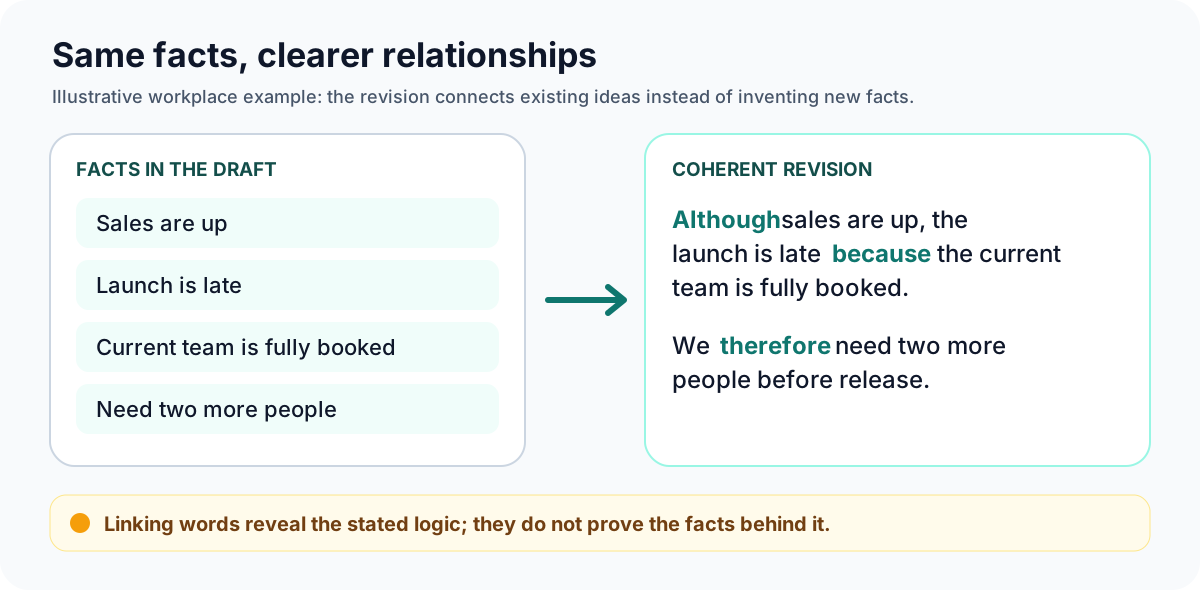
Illustrative logic map based on the hypothetical example above. The image does not verify the scenario's facts. Open the full-size diagram.
Coherent Emails: Before, After and a Tool Check
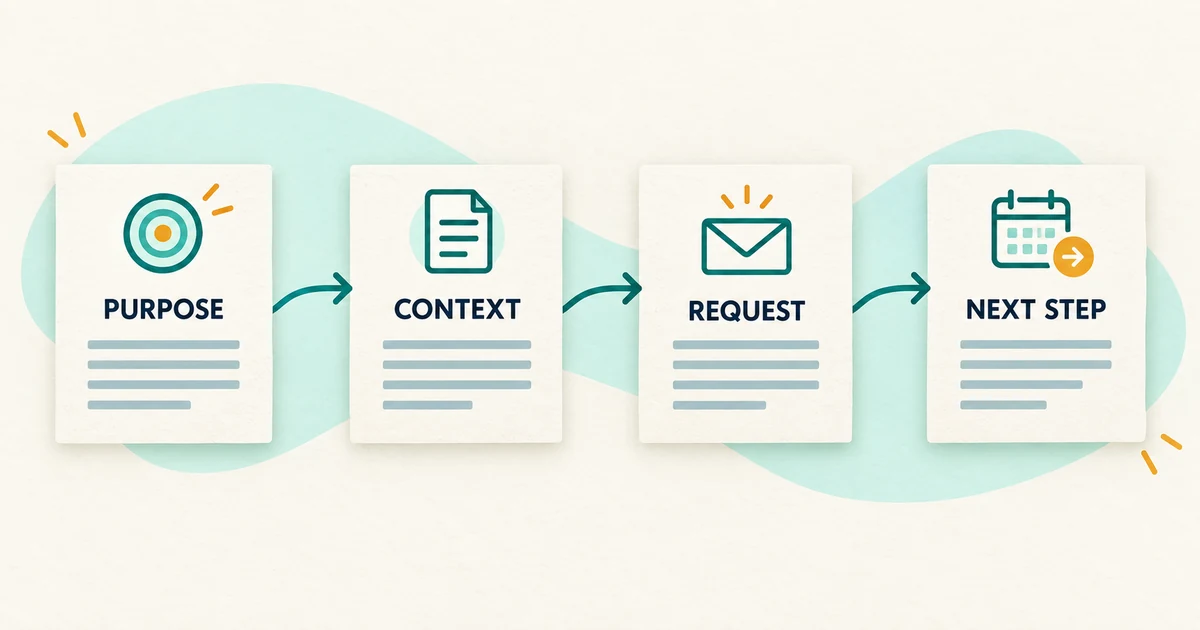
A coherent email usually follows purpose → relevant context → request → deadline or next step. The recipient should know what you need without piecing it together from disconnected sentences. Our email clarity checklist covers the other checks to make before sending.
Here is a real local test of Grammar Buddy’s Email Improver on 27 September 2026, using its Professional tone and UK English setting. We entered this fictional draft:
Hi Maya, The proposal draft is attached. The client asked for it yesterday. We are one day behind. Please review the pricing section by 3 pm today. Then I can send the final version. Thanks, Arun.
The tool returned the subject line “Proposal Draft for Client Review - Action Required by 3 PM Today” and this email:
Dear Maya,
Please find the proposal draft attached. The client requested this yesterday, and we are currently one day behind schedule.
Could you please review the pricing section by 3:00 PM today? This will allow me to send the final version to the client promptly.
Thank you for your assistance.
Best regards,
Arun
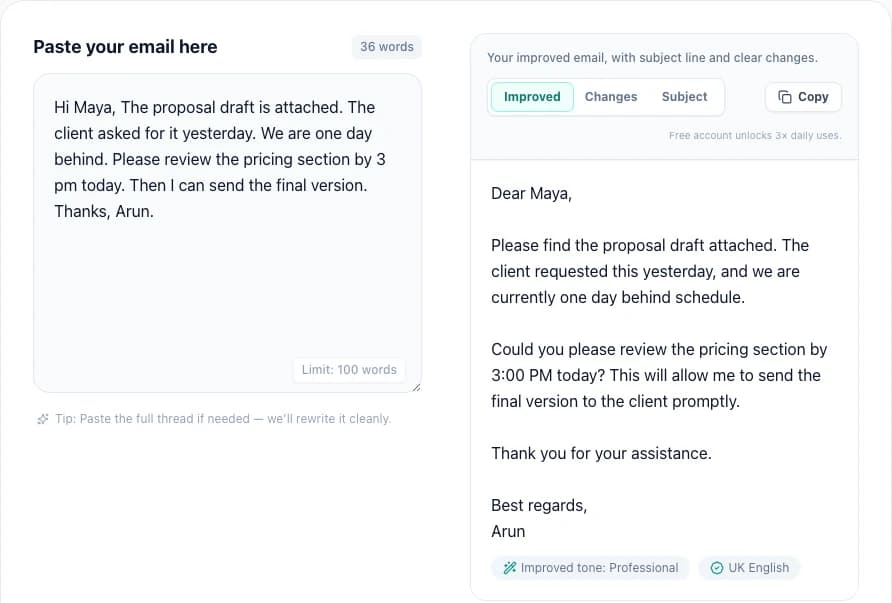
Email Improver test recorded on 27 September 2026 using a fictional draft, Professional tone, Request goal and UK English. Open the full-size screenshot.
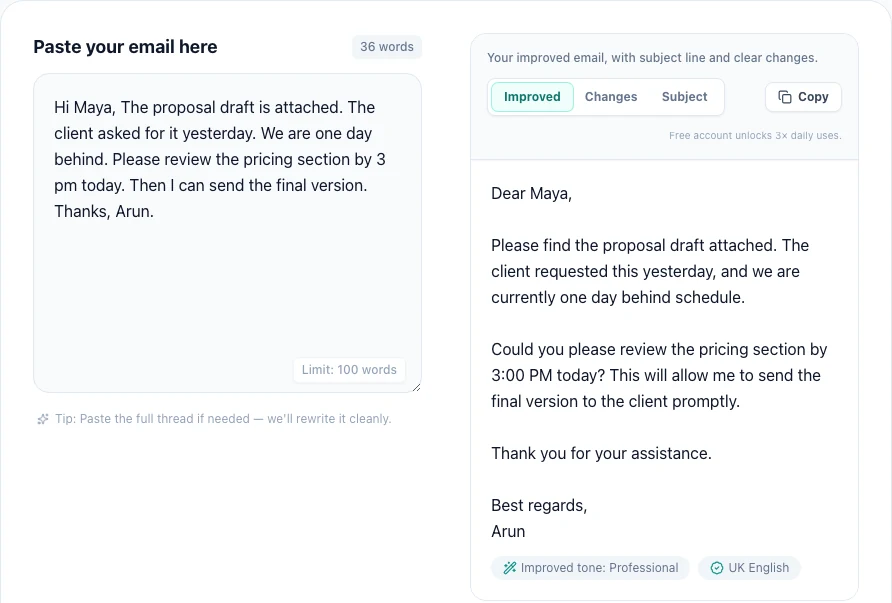
Screenshot annotations: Left — input: the client request, one-day delay, pricing review and 3 p.m. deadline. Right — output: the same facts and request, with an explicit link between the review and sending the final version.
Manual check: The rewrite kept the client request from yesterday, the one-day delay, the pricing section, the 3 p.m. deadline, and the sender. It grouped the context before the request and linked the requested review to sending the final version. Dear Maya may be more formal than needed, and promptly is optional. The writer must still confirm that the draft is actually attached. This one test shows what the tool returned for this input; it does not guarantee the same result for every email.
Why the revised email is easier to follow
- 1 · PurposePrepare the final proposal for the client
- 2 · ContextClient asked yesterday; one day behind
- 3 · RequestMaya reviews the pricing section
- 4 · Deadline and reasonBy 3 p.m., so Arun can send the final version
AI Grammar Buddy
Check the flow of your own email
Paste your draft, then verify that the rewrite keeps your facts, request and deadline.
Coherent Reports, Presentations and Proposals
Reports: connect findings to recommendations
A coherent report separates finding, evidence, implication, and recommendation. Numbers alone do not explain why a reader should act.
Before: “Tickets increased after the update because users could not log in. Response times improved. The login issue remained. We should fix the login issue.”
Better: “Although response times improved, tickets increased after the update because users could not log in. The login issue remained, so we should fix it.”
Both versions contain the same claims. The revision makes the contrast and recommendation easier to follow. A real report still needs ticket data to support the cause.
Presentations: give each slide a job
For a coherent presentation, arrange question → evidence → conclusion → next step. If the audience must approve a pilot, show the result and cost before the request. A title such as “Approve a second pilot” communicates more than “Next steps.”
Before: “Our test found the pilot reduced processing time. It cost $500. We need approval for a second test.”
Better: “The pilot reduced processing time in our test and cost $500. We now need approval for a second test.” The improvement is modest because the original facts were already related. That is fine: do not force a dramatic rewrite when a simple connection is enough.
Arguments and proposals: show your reasoning
A coherent argument states a claim, gives relevant reasons, and reaches a conclusion those reasons support. A proposal does the same for a recommended action.
Before: “The reporting team can work securely off site. We should try remote access for four weeks. We can assess output and security during the trial.”
Better: “Because the reporting team can work securely off site, we propose a four-week remote-access trial. During the trial, we can assess output and security.” The link is visible, but the security claim would still need evidence before a real policy decision.
How to Make Your Writing More Coherent
Use this six-step check after drafting:
- State one purpose early. Put the request near the start of an email and the finding near the start of a report.
- Give each paragraph one main idea. Split a paragraph if its points do not serve the same purpose.
- Order the points for the reader. Give context before conclusions that depend on it.
- Use transitions only when they are true. Because signals a cause; however signals contrast; therefore signals a consequence.
- Keep tense, viewpoint and terms consistent. Make sure “the client,” “they,” and “the users” do not accidentally refer to different groups.
- Check the last step against the evidence. A result from one team does not prove a company-wide outcome.
Common mistakes
Do not confuse coherent with grammatically correct. A polished email can still hide its point. Do not use therefore to bridge claims that have no proven link. If the logic is missing, ask for the missing fact or remove the detour. Our business email grammar rules help with sentence accuracy; coherence requires this separate flow check.
Final Takeaway
Coherent means the parts of a message fit together logically. Use it for an explanation, argument, plan, email, report, presentation, or a person’s understandable speech. To make your own writing more coherent, show how each point leads to the next and check that the relationship is supported by the facts.
About This Article
Kin
This guide checks the everyday meaning of coherent against learner dictionaries and uses labelled hypothetical workplace examples. Its Email Improver example records one local test and a manual check of the resulting draft.
Last updated 28 September 2026
Frequently Asked Questions
What does coherent mean in simple words?▼
Coherent means that the parts of an idea, explanation, or message fit together logically and are easy to follow.
What is a coherent sentence?▼
A coherent sentence expresses a complete thought whose parts fit together. In a paragraph, it should also relate to the surrounding point.
What is coherent writing?▼
Coherent writing has a clear main point, a logical order, and connections between sentences and paragraphs that readers can follow.
What is the difference between coherent and clear?▼
Clear wording is easy to understand on its own. Coherent writing connects those clear points into a sensible whole.
What is a synonym for coherent?▼
Logical and well-structured are useful alternatives for ideas or writing. Clear and consistent overlap in some contexts but do not mean exactly the same thing.
How do you make writing more coherent?▼
State your purpose, group related points, explain the real links between them, remove detours, and make the conclusion follow the evidence.
Can a person be described as coherent?▼
Yes. A coherent person is expressing thoughts in a way others can understand. In workplace feedback, describing the person's explanation is often more precise.
Keep going
Related writing guides
Related guide
Email Clarity Checklist
Check whether your message has a clear purpose and next step.
Related guide
Business Email Grammar Checker: 10 Rules + Examples
Improve sentence accuracy and flow in workplace emails.
Related guide
How to Write an Essay in English
Connect evidence and ideas in longer writing.