How to Write an Essay in English: Step-by-Step Guide & Structure
Stop staring at a blank page. Learn the exact step-by-step structure to write clear, native-sounding English essays. Includes outline templates and editing tips.
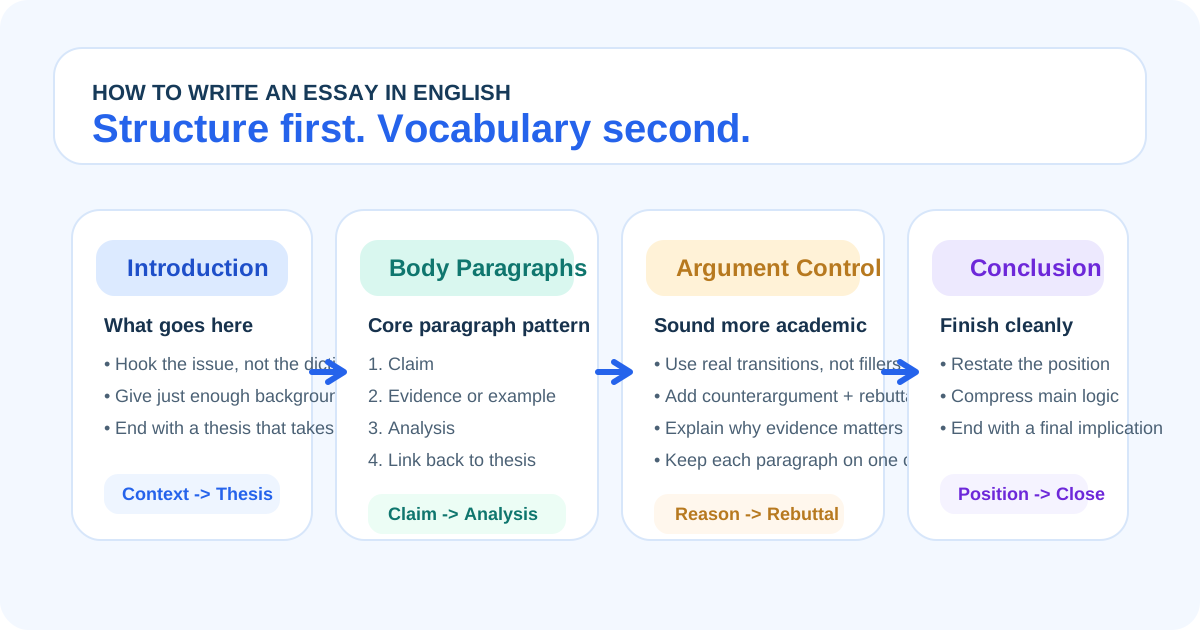
Stop staring at a blank page. Strong English essays are not built by stringing together difficult words from a thesaurus. They are built from structure. If your teacher keeps marking awkward phrasing, weak analysis, clumsy transitions, or "unclear argument," the problem is usually not your idea. It is how you frame the claim, support it, and move the reader through the paragraph.
This guide is written for English learners, international students, and anyone whose essay ideas are stronger than their written execution. It focuses on the exact steps that usually break down in real drafts: thesis statements that sound vague, body paragraphs that summarize instead of analyze, and sentences that sound translated rather than natural. If your thesis already exists but sounds flat, paste it into AI Grammar Buddy's Grammar Checker before you draft the rest of the essay.
TL;DR
To write an essay in English, decode the prompt, choose your essay type, build a clear thesis, outline each body paragraph, and edit for logic, transitions, and natural English.
Strong essays are built from structure first and vocabulary second.
Fast checklist:
- •Answer the exact prompt, not a nearby topic.
- •Write a thesis that takes a position.
- •Give each paragraph a claim, evidence, and analysis.
- •Use transitions to connect logic, not to decorate the page.
- •Proofread for awkward English before you submit.
Jump to sections
Use these anchors to jump straight to the section you need.
Quick Answer
If you want to know how to write an essay in English, follow this order:
- Decode the prompt.
- Identify the essay type.
- Write a thesis that clearly takes a position.
- Build a paragraph-by-paragraph outline.
- Draft the introduction, body paragraphs, and conclusion.
- Edit for logic, transitions, and natural English.
The biggest mistake is trying to sound "advanced" before the structure is clear. A good essay in English usually wins with precise logic, controlled paragraphs, and clean sentence flow.
How to Write an Essay in English Step by Step
1. Decode the prompt before you write anything
Weak essays often fail at the task level, not the grammar level. Students see a topic like Should universities restrict the use of generative AI in assessed coursework? and start writing general thoughts about technology in education. That loses marks immediately.
Before you outline, identify:
- the action word:
argue,compare,explain,evaluate - the scope:
universities,assessed coursework,restriction - the required position: one-sided, balanced, or comparative
If you answer a different question from the one on the page, clean grammar will not save the essay.
2. Identify the essay type
You cannot plan a strong essay if you do not know what kind of argument the prompt demands.
| Essay type | What the reader expects | Best planning question |
|---|---|---|
| Argumentative | A clear position with evidence and rebuttal | What am I trying to prove? |
| Expository | Explanation and clarity | What process or idea am I explaining? |
| Compare and contrast | Balanced comparison with criteria | What are the most meaningful points of comparison? |
| Problem-solution | Diagnosis plus practical answer | What is causing the problem, and what solves it? |
Most students under-plan this step. They draft an expository essay when the teacher asked for evaluation, or they write a list of points when the task needs a defended argument.
3. Build a thesis that actually guides the essay
A thesis statement should do more than mention the topic. It should make a defensible claim and preview the shape of the essay.
Weak thesis:
AI is changing education in many ways.
Stronger thesis:
Universities should allow limited use of generative AI for brainstorming and language support, but they should ban AI-generated final submissions because unrestricted use weakens independent thinking and makes assessment less reliable.
The stronger version works because it:
- takes a clear position
- defines the limit of the claim
- signals the two main reasons the body will develop
Not sure whether your thesis sounds academic enough? Paste the line into AI Grammar Buddy's Grammar Checker. It is a quick way to spot vague verbs, weak structure, or sentences that sound translated before you build the rest of the paper.
4. Outline by paragraph, not by topic
A vague outline like "introduction, body, conclusion" is not enough. Plan the job of each paragraph.
For the university AI prompt above, a better outline looks like this:
- Introduction
Context: AI tools are already part of student workflows.
Thesis: limited assistive use is acceptable; full AI-written submissions are not. - Body Paragraph 1
Claim: a total ban is unrealistic because students already use digital support tools. - Body Paragraph 2
Claim: unrestricted AI use weakens independent thinking and distorts assessment. - Body Paragraph 3
Counterargument and rebuttal: some argue AI improves access for weaker writers, but access support should not replace original reasoning. - Conclusion
Restate position and propose a balanced institutional policy.
When your outline is this specific, drafting becomes much faster because each paragraph already has a purpose.
5. Write an introduction with context, not filler
An effective introduction usually does three things:
- frames the issue
- narrows the context
- ends with the thesis
Example introduction:
Generative AI tools are now part of everyday academic life. Students use them to summarize readings, brainstorm ideas, and polish awkward sentences. The real question is not whether universities can remove AI from the writing process, but how far its use should be allowed. Universities should permit AI for brainstorming and language support, but they should prohibit AI-generated final submissions because unrestricted use weakens independent thinking and makes assessment less reliable.
Notice what this introduction does not do:
- it does not define "AI" like a dictionary
- it does not waste space with a grand historical opening
- it does not hide the main argument until the second page
6. Build body paragraphs around analysis, not summary
The most useful body-paragraph framework for English learners is:
Claim -> Evidence or example -> Analysis -> Link back to thesis
That fourth step is where weaker essays collapse. They provide evidence, then stop. Real academic writing explains why the evidence supports the claim.
Example body paragraph:
A complete ban on generative AI is difficult to enforce because students already rely on digital tools at multiple stages of the writing process. A student may use translation software to clarify a source, a grammar checker to fix article errors, and an AI tool to test whether a sentence sounds unnatural in English. These forms of support do not automatically replace original thinking. Instead, they show that modern academic writing already involves layered digital assistance. For that reason, universities should regulate the purpose of AI use rather than pretend they can remove it entirely.
This paragraph works because the analysis goes beyond the example. It interprets what the example means for the argument.
7. Use transitions that move the logic forward
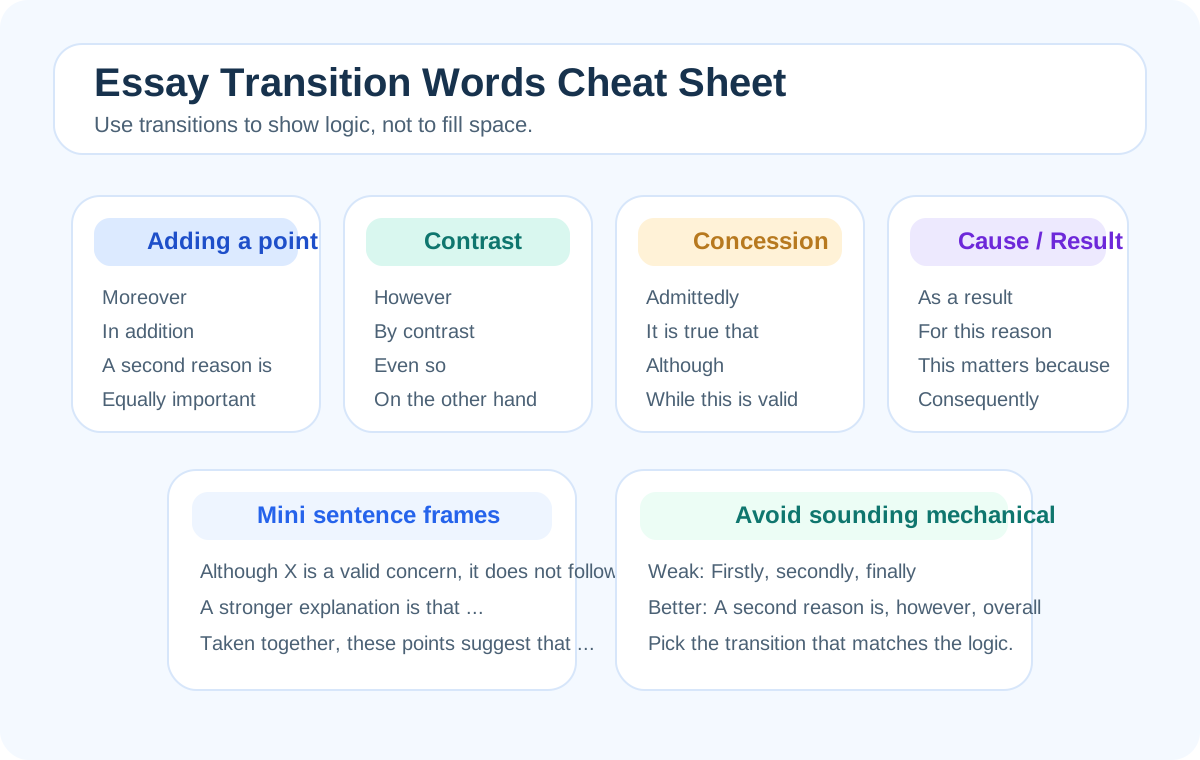
Weak transitions sound like a school checklist: firstly, secondly, lastly. Stronger transitions show the relationship between ideas.
| Function | Better transition options |
|---|---|
| Adding a point | Moreover, In addition, A second reason is |
| Showing contrast | However, By contrast, Even so |
| Conceding a point | Admittedly, It is true that, Although |
| Explaining cause or result | As a result, For this reason, This matters because |
| Drawing a conclusion | Overall, Taken together, The strongest conclusion is |
If your last paragraph always ends the same way, check out 10 better ways to say "in conclusion". It helps you close the essay cleanly without sounding repetitive.
8. Learn one counterargument-and-rebuttal pattern
Higher-value essays do not just list your side. They show that you understand the strongest objection.
A simple framework:
Counterargument:Some readers may argue that ...Concession:This concern is valid when ...Rebuttal:However, this does not mean ...
Example:
Some lecturers argue that any use of generative AI should count as academic dishonesty. This concern is understandable when students submit AI-written paragraphs as their own work. However, that does not mean all assistive use is equally unethical. A student who checks whether a sentence sounds awkward in English is not doing the same thing as a student who outsources the argument itself.
That structure instantly makes the essay sound more analytical and less one-dimensional.
9. Edit for natural English, not just for spelling
Many English learners revise only surface errors. That is not enough. The final draft also needs to sound natural.
Check for:
- direct translation from your first language
- repeated sentence openings
- vague verbs like
is,does,showswhen a sharper verb exists - overused linking words
- body paragraphs that describe evidence without analyzing it
Do not rely entirely on standard spell-checkers. If you want help choosing a tool that catches contextual phrasing rather than just typos, read our guide on choosing the right grammar checker for academic-style writing.
Examples
Here is a university-level example you can adapt.
Essay prompt:
Should universities restrict the use of generative AI in assessed coursework?
Thesis statement:
Universities should allow limited use of generative AI for brainstorming and language support, but they should prohibit AI-generated final submissions because unrestricted use weakens independent thinking and makes assessment less reliable.
Outline:
- Introduction: frame the issue and present the policy position
- Body Paragraph 1: total bans are unrealistic
- Body Paragraph 2: unrestricted AI use damages assessment integrity
- Body Paragraph 3: address the access and inclusion counterargument
- Conclusion: defend a regulated middle position
Sample introduction:
Generative AI tools are now embedded in student writing habits, from idea generation to sentence-level editing. Universities therefore face a practical policy problem rather than a purely theoretical one. They must decide which uses of AI support learning and which uses replace it. Universities should allow limited use of generative AI for brainstorming and language support, but they should prohibit AI-generated final submissions because unrestricted use weakens independent thinking and makes assessment less reliable.
Sample body paragraph with analysis:
A total ban on generative AI is difficult to enforce because students already use a range of digital support tools when they write in English. Translation tools, grammar checkers, and sentence-revision tools all shape the drafting process, especially for multilingual students. Treating every form of digital assistance as equally dishonest ignores how academic writing already works in practice. The better question is whether the tool supports the student's own reasoning or replaces it. Once universities make that distinction, a regulated policy becomes more realistic than a blanket ban.
Sample counterargument and rebuttal:
Admittedly, some educators worry that allowing any AI use gives students an unfair advantage. This concern matters when access to paid tools is unequal or when students use AI to generate whole paragraphs. However, banning all support tools would mainly punish students who need language assistance rather than argument assistance. A more defensible policy is to permit editing support while banning AI-written content that substitutes for original analysis.
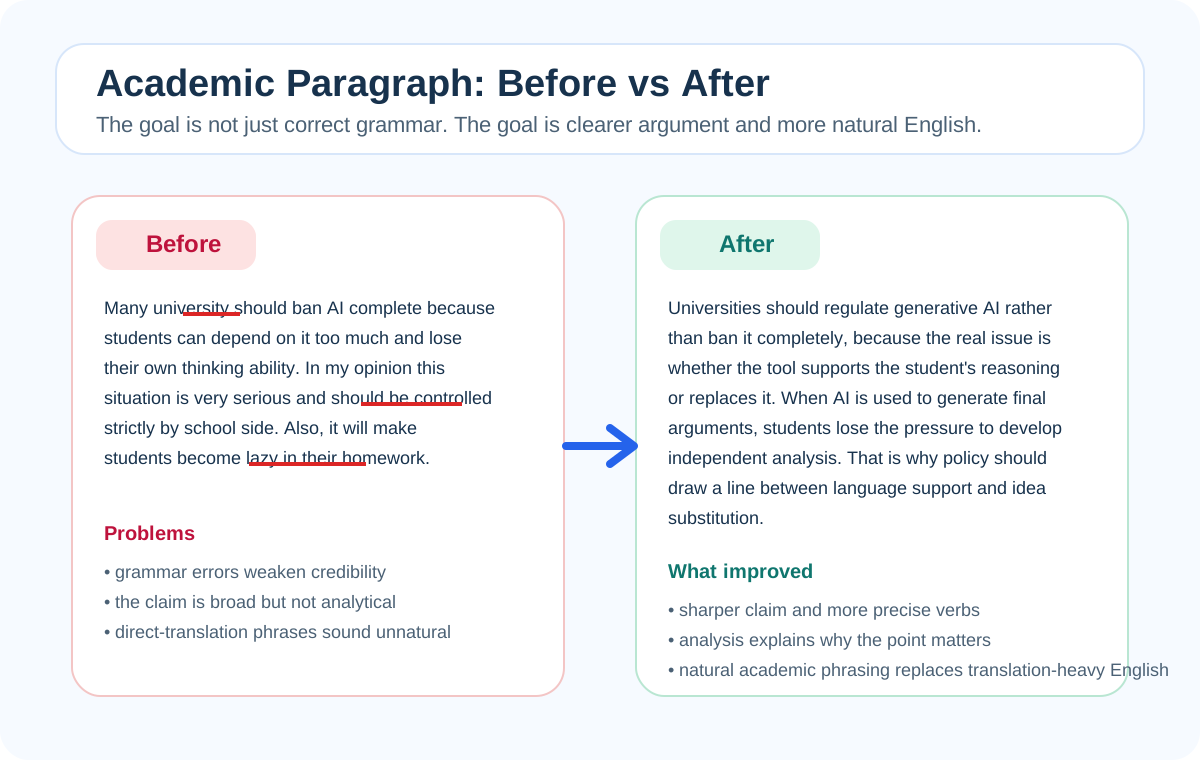
At this stage, the fastest quality jump usually comes from paragraph-level revision. Paste one full paragraph into AI Grammar Buddy's Grammar Checker and check whether the claim, verb choice, and transitions sound natural before you revise the whole paper.
Common Mistakes
Writing a thesis that only names the topic
This essay will discuss AI in education. is not a useful thesis. It tells the reader nothing about your position or logic.
Confusing evidence with analysis
Quoting a fact or giving an example is not analysis. You still need to explain what the evidence proves and why it matters to the argument.
Using advanced vocabulary that does not fit
English learners often replace a simple correct word with a more "academic" word that sounds wrong in context. That hurts credibility more than it helps.
Advanced words do not make a good essay; correct usage does. Instead of guessing whether a synonym fits, use AI Grammar Buddy's Grammar Checker to catch awkward phrasing, forced collocations, and sentences that sound translated rather than natural.
Repeating weak transitions
If every paragraph starts with First, Second, or Besides, the essay starts to sound mechanical. Use transitions to show logic, not just order.
Writing paragraphs that do not stay on one claim
If one paragraph covers three different ideas, your reader has no stable thread to follow. Split the paragraph or rewrite the topic sentence so the focus stays tight.
Proofreading only for typos
Typos matter, but awkward English, vague verbs, and weak sentence rhythm are often bigger issues in essays written by non-native speakers. Sentence-level polish affects how "native" the essay feels.
For a reusable sentence-by-sentence editing order, follow this guide on how to check grammar mistakes in eight steps before your final essay review.
How AI Grammar Buddy Can Help
AI Grammar Buddy is most useful at the exact moments where English learners usually get stuck:
- when the thesis sounds vague
- when the paragraph structure is logical but the English feels stiff
- when the transitions are correct but repetitive
- when the sentence is grammatical but still sounds like direct translation
One practical workflow:
- Draft your thesis and first body paragraph.
- Run them through AI Grammar Buddy's Grammar Checker.
- Fix awkward phrasing before you repeat the same sentence pattern across the entire essay.
- Use the revised paragraph as the style model for the rest of the paper.
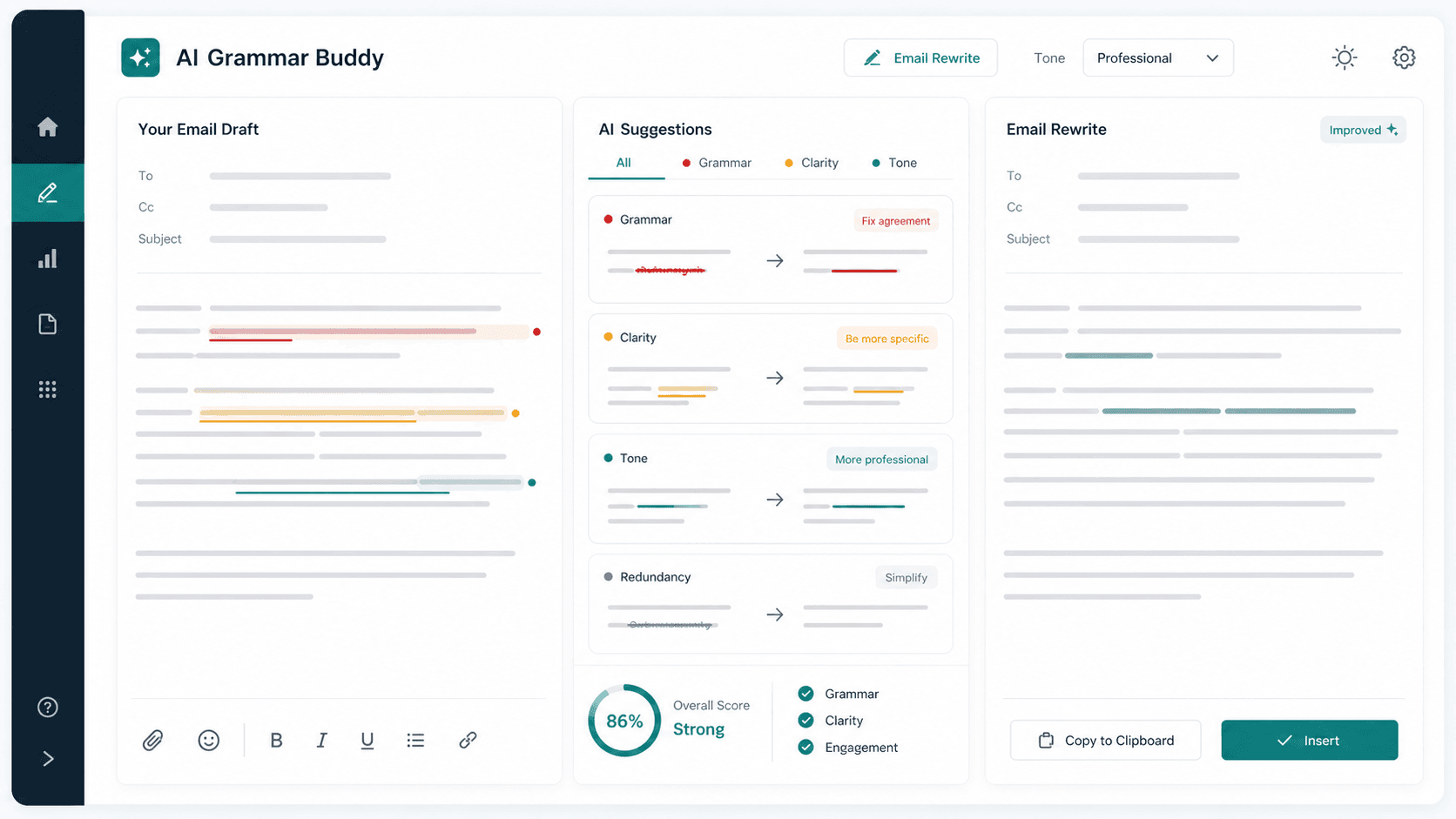
If you are comparing tools, our guide to a free alternative to Grammarly explains what generic grammar tools often miss when non-native writers need contextual help rather than basic typo correction.
If you enjoy the final error-checking stage, our guide to becoming a proofreader with no experience explains how to turn that interest into practice samples without overstating your background.
Final Takeaway
Writing a strong essay in English is not about sounding complicated. It is about controlling structure. Decode the prompt, choose the right essay type, write a thesis with direction, build paragraphs around analysis, and revise for natural English rather than only for spelling.
If your ideas are already solid but the writing still sounds flat, translated, or repetitive, that is a sentence-level editing problem. Fix that layer early, and the entire essay becomes easier to strengthen.
If you find that you enjoy explaining these writing patterns to other learners, read our beginner guide to TEFL certification for English writers to see how writing knowledge can become a teaching foundation.
About This Article
AI Grammar Buddy Editorial Team
Reviewed by the AI Grammar Buddy editorial team
The AI Grammar Buddy editorial team creates practical writing guides for non-native English writers and focuses on recurring sentence-level problems such as weak thesis statements, awkward transitions, and direct-translation phrasing.
Last updated 4 July 2026
Frequently Asked Questions
What is the difference between a thesis statement and a topic sentence?▼
A thesis statement gives the central argument of the whole essay. A topic sentence gives the controlling idea of one body paragraph. If the thesis is the essay's roadmap, the topic sentence is the signpost for one section.
How many body paragraphs should an English essay have?▼
There is no fixed magic number. Short classroom essays often use 2 to 3 body paragraphs, while longer academic papers use as many as the argument requires. What matters is that each paragraph develops one clear point.
How do I make my essay sound more academic without using unnatural vocabulary?▼
Use precise verbs, stronger transitions, and clearer analysis before you chase harder words. Academic tone comes from control, not from sounding like a thesaurus. If you want a faster edit, run your draft through AI Grammar Buddy's Grammar Checker to catch awkward phrasing and weak sentence structure.
How do I avoid Chinglish or direct-translation phrasing in essays?▼
Read each sentence and ask whether it sounds like spoken or written English, not a word-for-word translation from your first language. Watch for unusual collocations, missing articles, and over-literal transitions. A grammar checker that catches contextual wording problems helps more than a basic spell-checker.
Next step
Check your sentence instantly
Get grammar, wording, and clarity fixes in one pass.
Keep going
Continue with AI Grammar Buddy
AI Grammar Buddy
Grammar Checker
Run a fast grammar, wording, and clarity check on your sentence.
Check My SentenceRelated guide
Conserve Meaning in English: Preserve vs Conserve in Emails
Conserve meaning in English: use something carefully so it is not wasted. See workplace email examples, conserve vs preserve, reserve, and save.
22 August 2026
Related guide
How to Become a Proofreader With No Experience (2026)
No degree or clients yet? Learn skills, markup, a 3–5 sample portfolio, free tools, and realistic job steps—plus what proofreading courses actually require.
29 July 2026
Related guide
How to Check Grammar Mistakes in 8 Steps
Learn how to check grammar mistakes in English with an 8-step process, common error examples, a reusable checklist, and tips for using an online checker.
26 July 2026