"Please Check and Revert" Meaning — Why It Confuses & 10 Clearer Alternatives
"Please check and revert" means "review this and reply" in Singapore — but confuses clients in the US, UK & Australia. See why it misfires and grab 10 copy-paste alternatives.

A client forwarded me a vendor email last year with one question in the subject line: "What does this even mean?" The email ended with "please check and revert meaning you agree with the terms." The vendor was in Singapore. The client was in Toronto. Neither one of them got what they needed.
"Please check and revert" is one of the most widely used email phrases in Southeast Asian offices — and one of the most reliably misunderstood ones the moment it crosses a time zone. This guide explains exactly why it misfires, when it's fine to keep it, and gives you 10 ready-to-use alternatives that work on every continent.
AI Grammar Buddy
Rewrite this phrase in context
Paste your sentence and AI Grammar Buddy will turn it into clearer professional English.
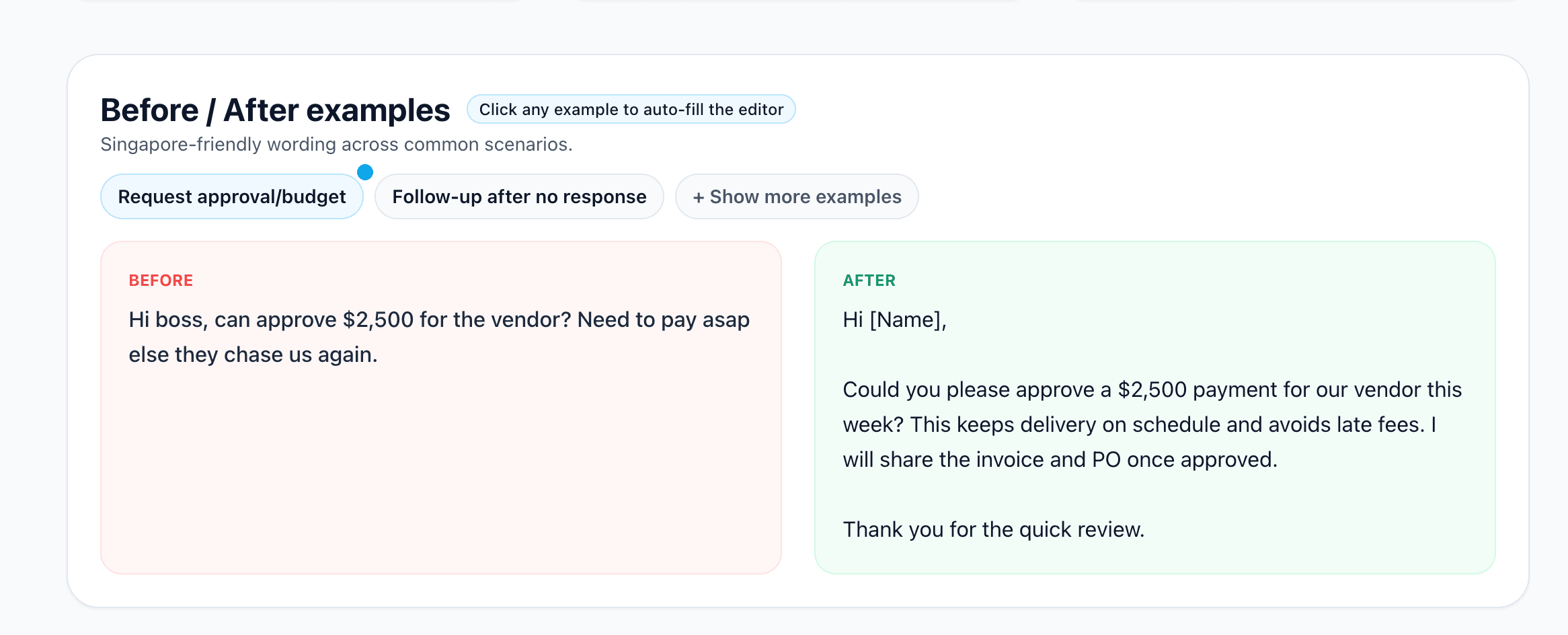 Email Improver catches Singlish phrases like 'please check and revert' in real time.
Need to fix your email tone instantly? Try our free AI Email Improver to polish your drafts in seconds.
Part of our Singapore & Asian Workplace Email Phrases guide. Also see: What Does "Please Revert" Mean?
Jump to sections
Use these anchors to jump straight to the section you need.
🎧 Prefer to listen? Emily and Daniel break it down in this 8-minute episode:
"Please Check and Revert" Meaning in Email
In the context of Singapore and Southeast Asian business English, "please check and revert" simply means "please review this and reply to me."
It is a direct request for two actions:
- Check the information or attachment provided.
- Reply with an answer, confirmation, or feedback.
If the same message also asks you to “do the needful,” see how to reply to “kindly do the needful” without repeating the vague wording.
For the British informal variant, compare “do the necessary” meaning and clearer email requests.
Why Is It So Common in Singapore?
The usage of "revert" as a synonym for "reply" is a hallmark of post-colonial English varieties (like Singlish and Indian English). It likely stems from a desire to sound formal and bureaucratic. In local government or corporate settings, "revert" feels weightier and more "official" than a simple "reply" or "get back to me."
Another formal request closing with the same regional-to-global tone gap is “kindly oblige”, which usually means “please do the favour I asked for.”
Over decades, it has become the default phrase for closing an email, regardless of the recipient.
The Problem: Why It Confuses US/UK Readers
Here is where the trouble starts. In Standard English (US, UK, Australia, Canada), the word revert does not mean "reply."
Standard Definition of Revert: To return to a previous state, condition, or practice.
Examples of Standard Usage:
- "If you don't save the file, the document will revert to the original version."
- "After the holiday, we will revert to our standard operating hours."
- "The property ownership will revert to the state."
The Misunderstanding
When you write "Please check and revert," a client in London or New York might literally interpret it as: "Please check this and go back to how you were before."
At best, it sounds like odd, archaic legal jargon. For practical ways to sound more professional in client emails, see our guide on how to apologize professionally in email. At worst, it sounds demanding or nonsensical. They usually figure out what you mean from context, but it marks your writing as non-standard, which can subtly impact your professional credibility.
For a deeper dive on this specific word, check out our article on please revert meaning in Singapore.
When Is It OK to Use?
Is it strictly "wrong"? Language evolves, and in Singapore, it is effectively standard usage. However, context is key.
| Context | Verdict | Why? |
|---|---|---|
| Internal Team (SG/SEA) | ✅ Acceptable | Everyone understands it; it’s efficient shorthand. |
| Local Vendors/Govt | ✅ Acceptable | It is the expected norm in many local administrative bodies. |
| International Clients | ❌ Avoid | It causes confusion and sounds "off" to native speakers. |
| New Prospects | ❌ Avoid | First impressions matter. Use standard English to sound global. |
| Urgent Requests | ⚠️ Risky | "Revert" is passive. Specific calls to action work better. |
For more on the nuances of local usage, read our guide on please revert meaning in Singapore.
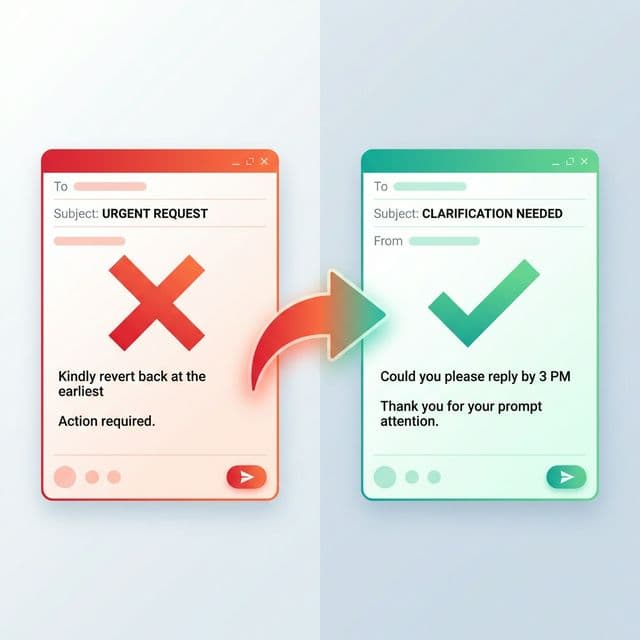 Quick reference: when to use it and when to switch.
10 Better Alternatives to "Please Check and Revert"
Instead of using a phrase that might confuse people, use action-oriented language. Here are 10 alternatives categorized by tone.
Group 1: Polite & Standard (Safe for Everyone)
Use these for clients, managers, or external partners.
1. "Please review and let me know if you have any questions." Why it works: It’s clear, friendly, and covers all bases.
2. "Could you take a look and share your thoughts?" Why it works: "Take a look" softens the request, making it feel less like a chore.
3. "Please check the attached and get back to me when you can." Why it works: "Get back to me" is the most natural phrasal verb for "reply" in global English.
4. "I’d appreciate your feedback on this draft." Why it works: It focuses on the value (feedback) rather than the action (checking).
Group 2: Firm & Direct (For Deadlines)
Use these when you need a specific answer by a specific time.
5. "Please review and confirm by [Date/Time]." Why it works: It sets a clear deadline. There is no ambiguity.
6. "Kindly sign off on this by Friday so we can proceed." Why it works: It explains why the deadline exists ("so we can proceed").
7. "Please check the data and reply with your approval." Why it works: It tells them exactly what to reply with (approval), saving back-and-forth.
Group 3: Urgent (When You Need Speed)
Use these sparingly for high-priority items.
8. "Please review this ASAP and let me know if we are good to go." Why it works: "Good to go" implies a quick yes/no check is all that's needed.
9. "Please take a quick look—we need to finalize this by noon." Why it works: "Quick look" suggests it won't take much time, encouraging them to do it now.
10. "Can you verify these figures immediately? We are holding the print run." Why it works: It provides the urgent context (holding the print run).
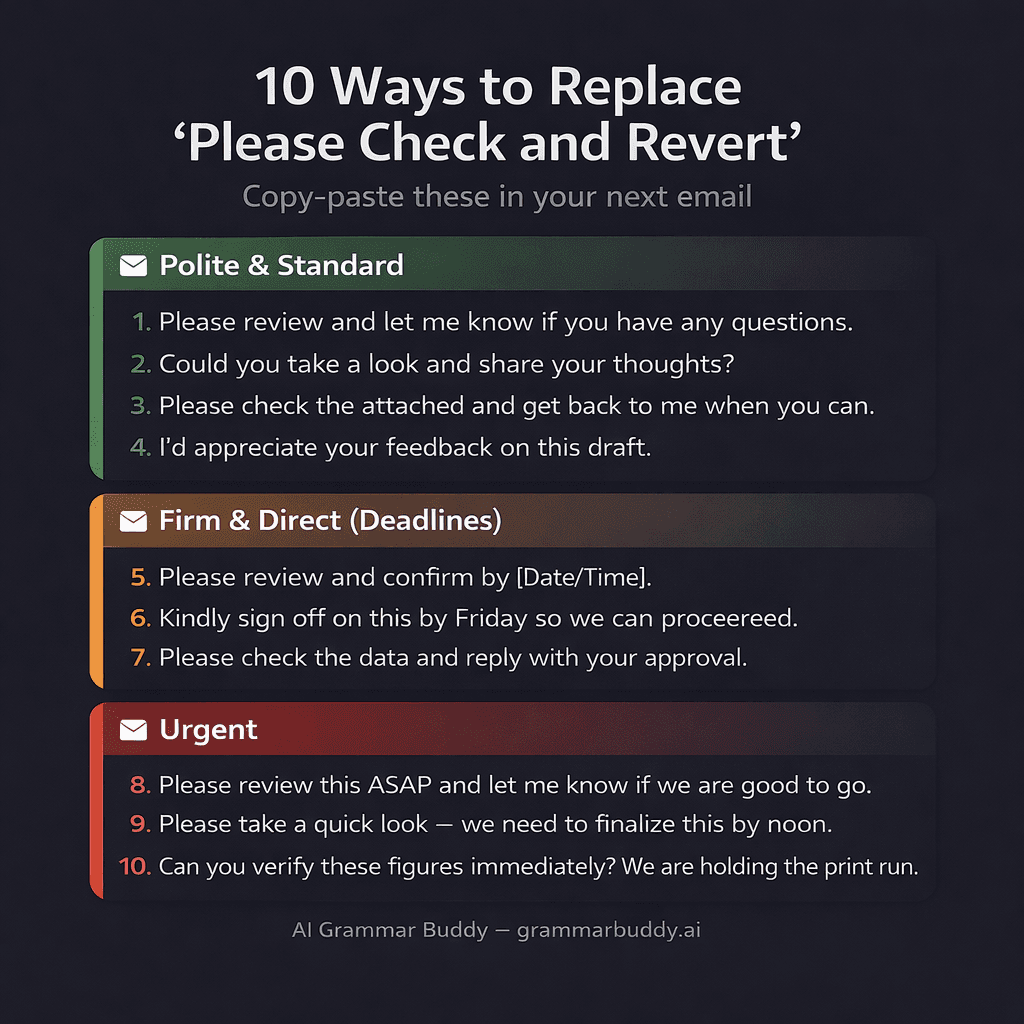 Save this: 10 ready-to-use replacements for 'please check and revert'.
Before vs. After: Email Makeovers
Here is how swapping out "please check and revert" improves clarity in real scenarios.
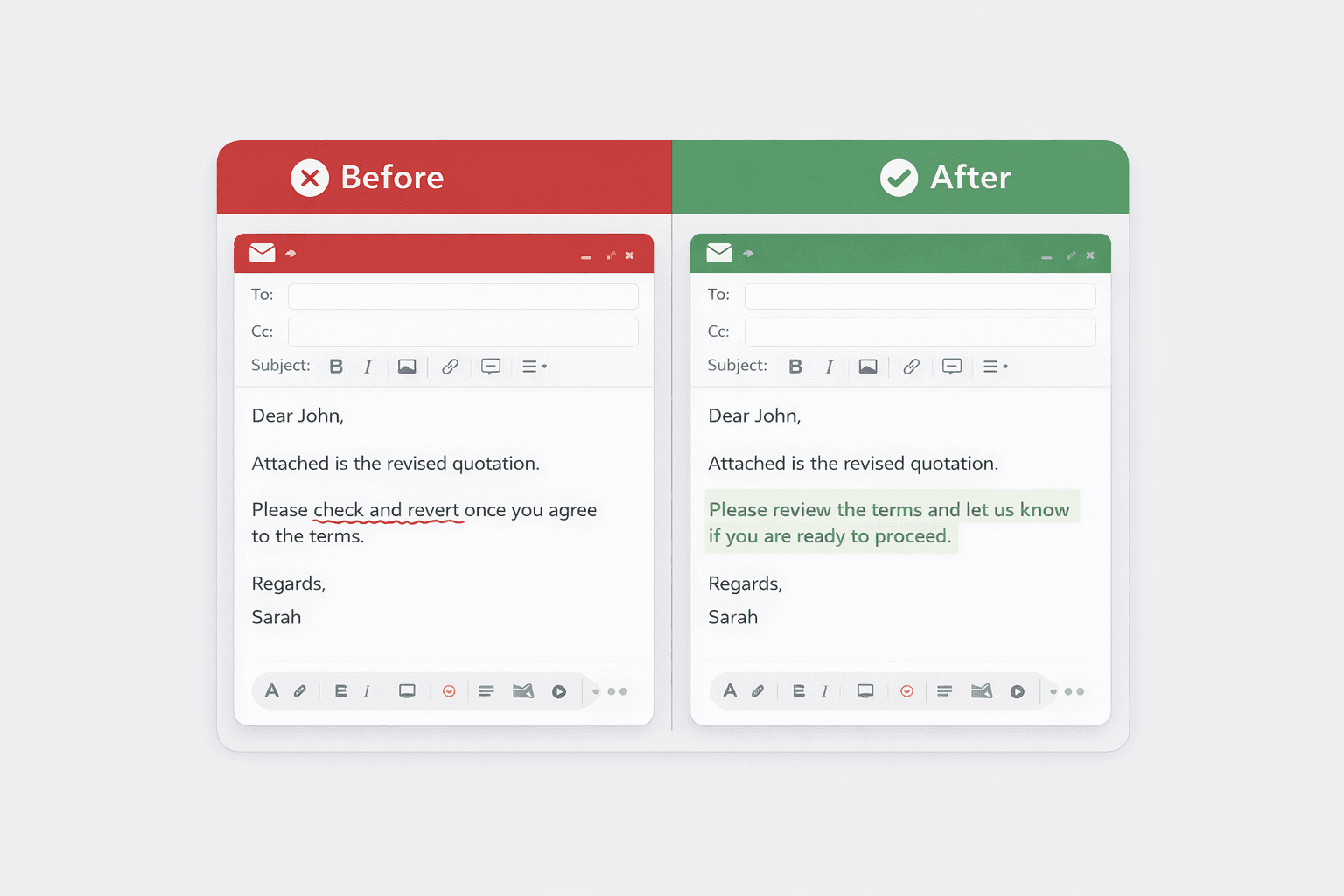 Before and after: one phrase change makes your email clear to any reader.
Scenario 1: Sending a Quotation to a Client
Before:
Dear John, Attached is the revised quotation. Please check and revert once you agree to the terms. Regards, Sarah
After:
Dear John, Attached is the revised quotation. Please review the terms and let us know if you are ready to proceed. Regards, Sarah
Scenario 2: Asking a Manager for Approval
Before:
Hi Dave, I have updated the slide deck. Please check and revert soonest. Thanks, Ali
After:
Hi Dave, I have updated the slide deck. Could you review the changes and approve them by 3 PM? Thanks, Ali
Scenario 3: Clarifying Data with a Colleague
Before:
Hi Team, The Q3 figures look odd. Please check and revert.
After:
Hi Team, The Q3 figures look odd. Can you verify the source data and get back to me with the correct numbers?
Conclusion
There's nothing wrong with "please check and revert" if your entire team is in Singapore and your clients never leave Southeast Asia. But the moment your email goes international, the phrase becomes a liability — not because of bad intentions, but because "revert" means something completely different to the person reading it in London, Toronto, or Sydney.
Pick any of the 10 alternatives in this guide. They're shorter, clearer, and leave no room for misinterpretation. That's not a stylistic preference — it's the difference between a reply and radio silence.
If you want to ensure your emails always sound polished and professional, try our Email Improver tool. It catches Singlish phrasing and suggests globally understood alternatives instantly.
Ready to upgrade your team's writing skills? Check out our Pricing plans for corporate training and bulk access.
This article is part of our complete Singapore workplace email phrases guide.
Related reads
- Is "Noted with Thanks" Rude?
- How to Fix Singlish in Business Emails
- "Please Find Attached": 7 Professional Alternatives
Frequently Asked Questions
What does "please check and revert" mean?▼
In Singapore and Southeast Asia, "please check and revert" means "please review this and reply to me." It is a two-step request: check the document or information, then send a response. To Western colleagues, "revert" means "return to a previous state" — causing confusion. Use "please review and reply" instead.
Is "please check and revert" correct English?▼
"Please check and revert" is grammatically correct but uses "revert" in the Singaporean sense (meaning reply). In Standard English, "revert" means to return to a previous condition. For global emails, replace it with "please review and let me know" or "please check and reply."
How do I say "please check and revert" professionally?▼
Use: "Please review the attached and share your feedback by [date]." Or: "Could you check this and reply with your thoughts?" Or: "Please confirm once you have reviewed." Each is clear to both local and international colleagues.
Is "please check and revert" rude?▼
No, it is not intentionally rude — but it can sound demanding or confusing to Western readers who do not recognise "revert" as meaning "reply." In Singapore and India it is standard and polite. For international emails, rephrase to be clearer.
What is a better alternative to "please check and revert"?▼
"Please review and reply by [date]," "Could you take a look and let me know your thoughts?", or "Please confirm receipt and share any questions." These work globally and leave no room for misinterpretation.
Can I use "please check and revert" in a formal email to a client?▼
It's best to avoid it. For formal client emails, you want to sound polished and clear. Instead of "check and revert," use phrases like "Please review the attached document and advise on the next steps."
Next step
Rewrite this phrase in context
Paste your sentence and AI Grammar Buddy will turn it into clearer professional English.
Keep going
Continue with AI Grammar Buddy
AI Grammar Buddy
Email Improver
Paste your draft and rewrite it for clearer, more professional English.
Rewrite This PhraseRelated guide
What Does Inherent Mean? Meaning, Examples and Business English Uses
What does inherent mean? Learn the meaning, inherent in vs to, and practical sentence examples for reports, emails and everyday English.
28 September 2026
Related guide
What Does Coherent Mean? Meaning, Examples and Business English Uses
Learn what coherent means, see natural sentence examples, compare coherent vs clear, and improve the flow of your emails and reports.
27 September 2026
Related guide
What Does Persist Mean? Meaning, Grammar and Examples
Persist means to continue despite difficulty or to keep existing. Learn how to use persist in, persist with, and persist correctly with workplace examples.
23 August 2026