Alleviate Meaning: Grammar, Synonyms and Examples
AI-assisted article. Dictionary sources and recorded product tests are disclosed below.
Alleviate Meaning in Simple English
Alleviate means to make pain, stress or another unpleasant condition less severe. It is a formal verb followed by a direct object: alleviate pressure, alleviate pain or alleviate a burden. For example, extra support may alleviate pressure on a team, but that does not mean the underlying problem is solved.
Pronunciation and spelling
Say uh-LEE-vee-ayt, with the stress on LEE: /əˈliː.vi.eɪt/ in UK and US English. Cambridge’s alleviate entry includes pronunciation audio and labels the verb formal and transitive. Spell it a-l-l-e-v-i-a-t-e, with two ls.
Jump to sections
Use these anchors to jump straight to the section you need.

How to Use Alleviate in a Sentence
Use subject + alleviate + problem. Name the difficulty that becomes less severe:
- “The revised schedule alleviates pressure on the support team.”
- “Additional buses alleviated congestion near the station.”
- “The grant may alleviate financial hardship for eligible students.”
Use may alleviate for a possible benefit and aims to alleviate for an intended benefit. Help alleviate describes a contribution to relief; it does not by itself make the claim uncertain. “The extra cover helped alleviate pressure” can describe an observed result.
Add by + -ing to name the action: “The new process aims to alleviate the administrative burden by removing duplicate forms.” This tells the reader what will change.
Does alleviate need a preposition?
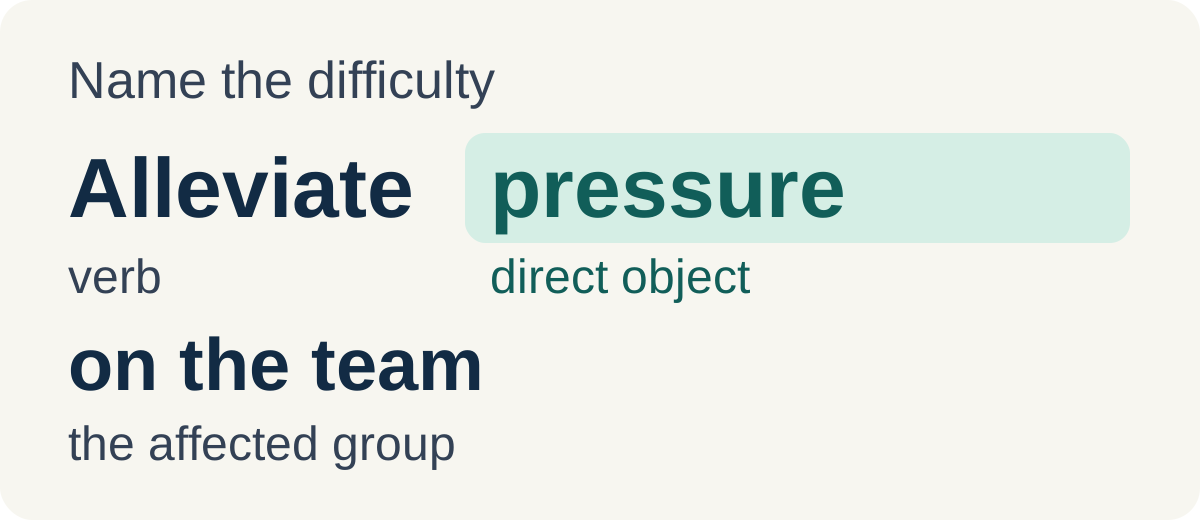
Put the object directly after the verb: alleviate stress, rather than alleviate from stress or alleviate of stress. A later preposition belongs to another part of the sentence:
- alleviate pressure on the team — pressure is the object; on the team identifies who is affected.
- alleviate the effects of a delay — effects is the object; of a delay identifies their cause.
“Alleviate the team’s stress” works; “alleviate the team” does not name the difficulty. Write ease the team’s workload or relieve the team of some tasks. See our business email grammar guide for checking the rest of your sentence.
Common combinations include alleviate pain, alleviate stress, alleviate pressure, alleviate a burden, alleviate a shortage, alleviate congestion and alleviate poverty. Collins’ usage examples show several of these patterns.
Alleviate vs Relieve, Mitigate, Reduce and Solve
Choose the word that matches what changed:
| Word | Useful emphasis | Example |
|---|---|---|
| alleviate | Make an unpleasant condition less severe; formal | “The extra cover may alleviate staffing pressure.” |
| relieve | Ease distress; also free someone from a duty | “Maya will relieve Arun of the reporting task.” |
| mitigate | Make harm or negative effects less serious | “The backup supplier may mitigate the impact of a delay.” |
| reduce | Make an amount or degree smaller; direct | “The change reduced the number of duplicate forms.” |
| solve | Find an answer or remedy for a problem | “Replacing the broken sensor solved the fault.” |
Alleviate vs relieve
Both can describe easing pain, stress and pressure. Alleviate usually sounds more formal. The grammar differs when you name a person: relieve someone of a responsibility, but alleviate the burden.
Merriam-Webster’s synonym discussion associates alleviate with temporary or partial lessening. Treat this as a nuance: context determines the duration and degree of relief. Relieve does not always mean the problem disappears completely.
Alleviate vs mitigate
Mitigate often fits risks, damage and negative effects; alleviate often fits a burden or distress. Their meanings overlap: Merriam-Webster’s mitigate entry also includes suffering, so “mitigate is only preventive” is too restrictive.
In a risk report, use “mitigate the risk of disruption.” In a staffing update, use “alleviate pressure on the team.” For an inherent risk, mitigation describes reducing the risk or its effects, without promising elimination.
Alleviate Examples for Workplace Emails
Use alleviate to describe easing a specific difficulty. For a routine request, ease or reduce may be clearer.
Offering help
Vague: “I can help alleviate your issue.”
Specific: “I can take over the weekly report to help alleviate your workload pressure.”
Plainer: “I can take over the weekly report to ease your workload.”
The revised versions name the action. Follow the same principle in your email clarity checklist: say what you can do.
Want to revise a similar email? Try AI Grammar Buddy’s Email Improver, then check that the rewrite keeps your intended meaning.
Explaining a proposed change
“We propose combining the two approval forms to alleviate the administrative burden on branch managers.”
Propose identifies a plan. Once it is in use, name the observed change: “The combined form removes one approval step” is more concrete than a general claim about reducing stress.
Describing partial progress
“The temporary cover has alleviated some pressure on the team, but the recruitment gap remains.”
Some limits the claim; the second clause names the unresolved problem. See our guide to persist meaning and usage for describing a problem that remains after some relief.
A verified rewrite that makes a request more polite
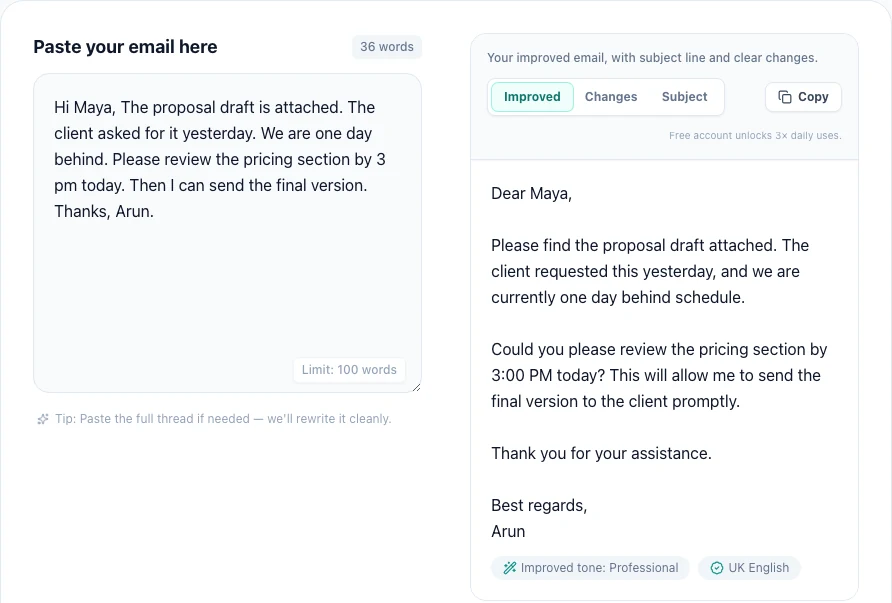
In a real local Email Improver test on 27 September 2026, a fictional proposal email used Professional tone, Request goal and UK English:
Actual input excerpt: “Please review the pricing section by 3 pm today.”
Actual output excerpt: “Could you please review the pricing section by 3:00 PM today?”
The rewrite softens the request while keeping the task, time and day. This is a separate recorded example of tone revision; it does not test the word alleviate. View its recorded input and output.
A real alleviate rewrite: check certainty and dates
A second local UI test on 1 October 2026 used Professional, Request and US English. The actual staffing-email rewrite improved the greeting and closing and kept the unresolved shortage, but changed two details that needed correction.
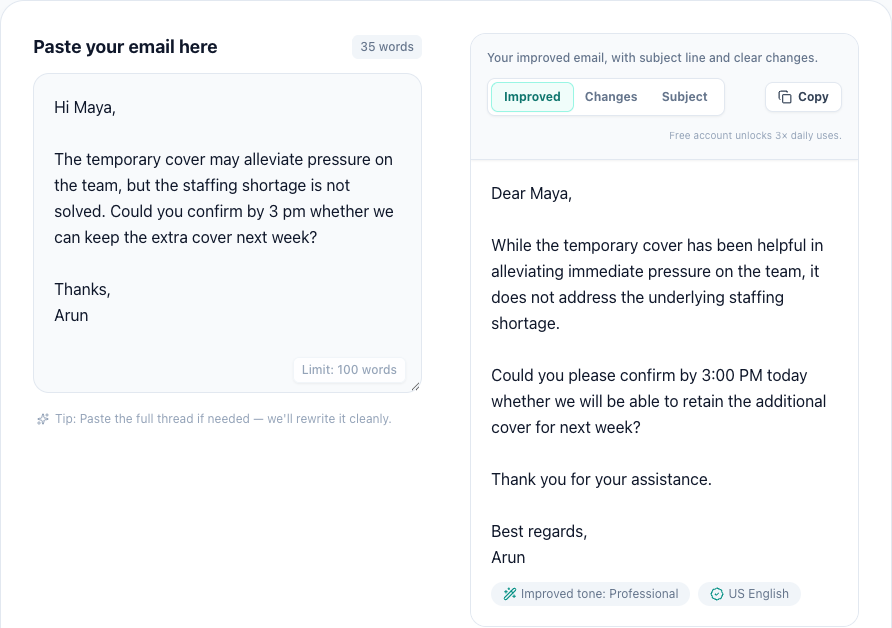
Certainty: The input said “The temporary cover may alleviate pressure on the team.” The output said “While the temporary cover has been helpful in alleviating immediate pressure on the team.” A possible benefit became an asserted result.
Deadline: The input said “by 3 pm”; the output said “by 3:00 PM today”. The day was added without being specified.
Editorial revision: “The temporary cover may alleviate pressure on the team, but the underlying staffing shortage remains.” This manual correction is separate from the tool output. Add the intended day to the request yourself.
These two runs demonstrate specific wording changes, not typical performance or guaranteed accuracy.
Paste your draft into AI Grammar Buddy’s Email Improver and choose a tone and UK or US English. Review the suggested wording, certainty and dates before you use it.
Word Forms and Common Mistakes
The verb forms are alleviate, alleviates, alleviated and alleviating. The noun is alleviation: “The proposal focuses on the alleviation of financial hardship.” In everyday writing, “The proposal aims to reduce financial hardship” is simpler.
| Wording to revise | Better wording | Reason |
|---|---|---|
| “This should alleviate from the stress.” | “This should alleviate the stress.” | Use a direct object. |
| “We need to alleviate the customer.” | “We need to alleviate the customer’s concerns.” | Name the difficulty. |
| “The patch alleviated the fault completely.” | “The patch resolved the fault.” | If the fault has ended, say so. |
| “We want to alleviate sales.” | “We want to increase sales.” | Sales is not the difficulty being eased. |
For an opposite, use aggravate, worsen or intensify, as appropriate: a delay may aggravate a shortage.
Quick practice: alleviate or solve?
- Extra cover reduces the backlog, but the staffing gap remains. “The cover helped ___ pressure on the team.”
- Replacing a faulty sensor ends the fault. “Replacing the sensor ___ the problem.”
Show answers and reasons
1. alleviate: pressure is reduced. 2. solved: the stated problem has ended. Choose the verb from the change you can support.
About This Article
Grammar Buddy
Grammar Buddy is responsible for this AI-assisted guide. No independent human expert review is claimed. For corrections, contact ai-grammar-buddy@outlook.com via our About page.
Last updated 1 October 2026
Frequently Asked Questions
What does alleviate mean in simple words?▼
Alleviate means make something unpleasant less severe or easier to bear. It can describe reducing pain, stress, pressure, a shortage or another problem. It does not by itself mean the problem is gone.
How do you pronounce alleviate?▼
Say uh-LEE-vee-ayt, with the main stress on LEE. Cambridge gives /əˈliː.vi.eɪt/ for both UK and US English.
What is an example of alleviate in a sentence?▼
The extra support will help alleviate pressure on the customer service team. Here, alleviate means reduce the pressure rather than remove every task.
Is alleviate followed by from or of?▼
Alleviate takes a direct object: alleviate stress or alleviate the burden. A later preposition may belong to the noun phrase, as in alleviate pressure on the team. Use relieve someone of a burden when the person is the object.
Does alleviate mean solve?▼
No. Alleviate means make a problem less severe. Solve means find an answer or remedy for the problem. If you mean the problem has ended, say solved, resolved or eliminated, as appropriate.
Is alleviate formal?▼
Yes, dictionaries label it formal. It fits reports and professional writing, but ease or reduce can be clearer in a short everyday message.
Sources and Example Method
Language guidance was checked on 1 October 2026 against the linked dictionaries, including Oxford’s meaning and grammar notes. Unlabelled sentences and the editorial revision are original teaching examples; the two dated product excerpts are actual test outputs from fictional emails.
The hero is a generated illustration; the sentence diagram is an editable teaching graphic. Dictionary sources support usage, without endorsing the article or its product.
Keep going
Related writing guides