What Does Inherent Mean? Meaning, Examples and Business English Uses
Quick Answer
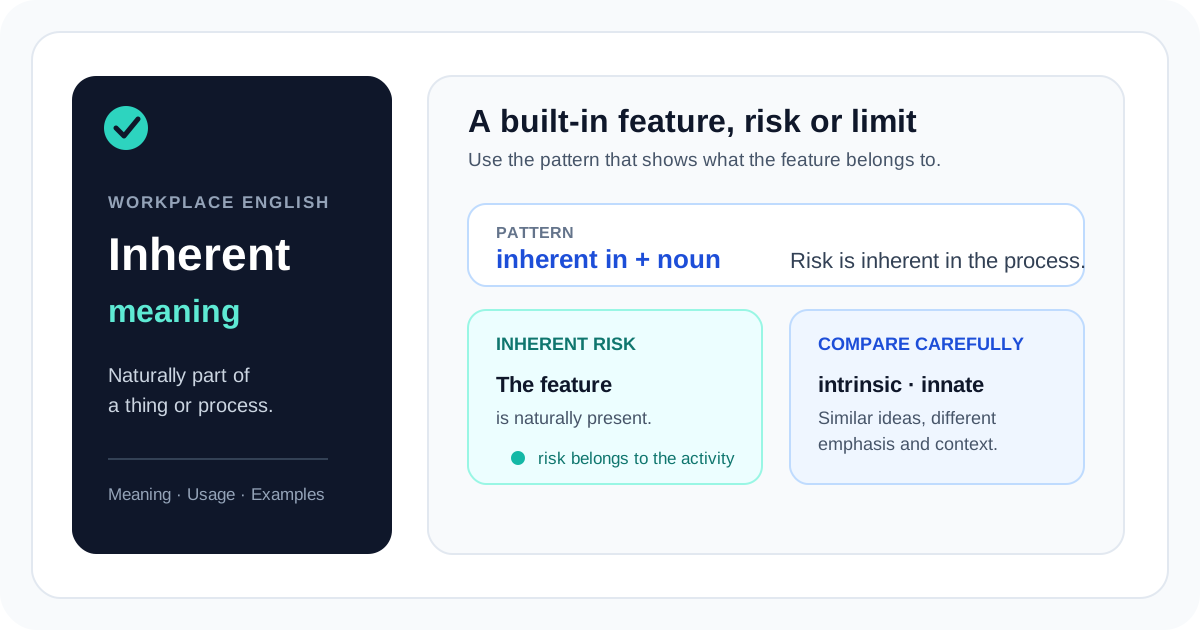
Inherent means naturally part of something. In ‘Uncertainty is inherent in forecasting,’ uncertainty belongs to forecasting itself. Use ‘inherent in’ to connect a feature to its source, or place inherent before a noun: ‘an inherent limitation.’ An inherent risk does not guarantee a harmful outcome.
Jump to sections
Use these anchors to jump straight to the section you need.
Inherent Meaning in Simple English
Inherent is an adjective for a quality, condition, risk or limitation; its adverb is inherently, as in “The system is inherently complex.” The word can describe something beneficial, neutral or undesirable.
The stress is on the second syllable. Cambridge Dictionary and Oxford Learner’s Dictionaries include pronunciation and usage information; Cambridge provides UK and US audio. Possible Chinese translations include 固有的, 內在的 and 本身存在的; choose the wording that fits the noun and context.
How to Use “Inherent”
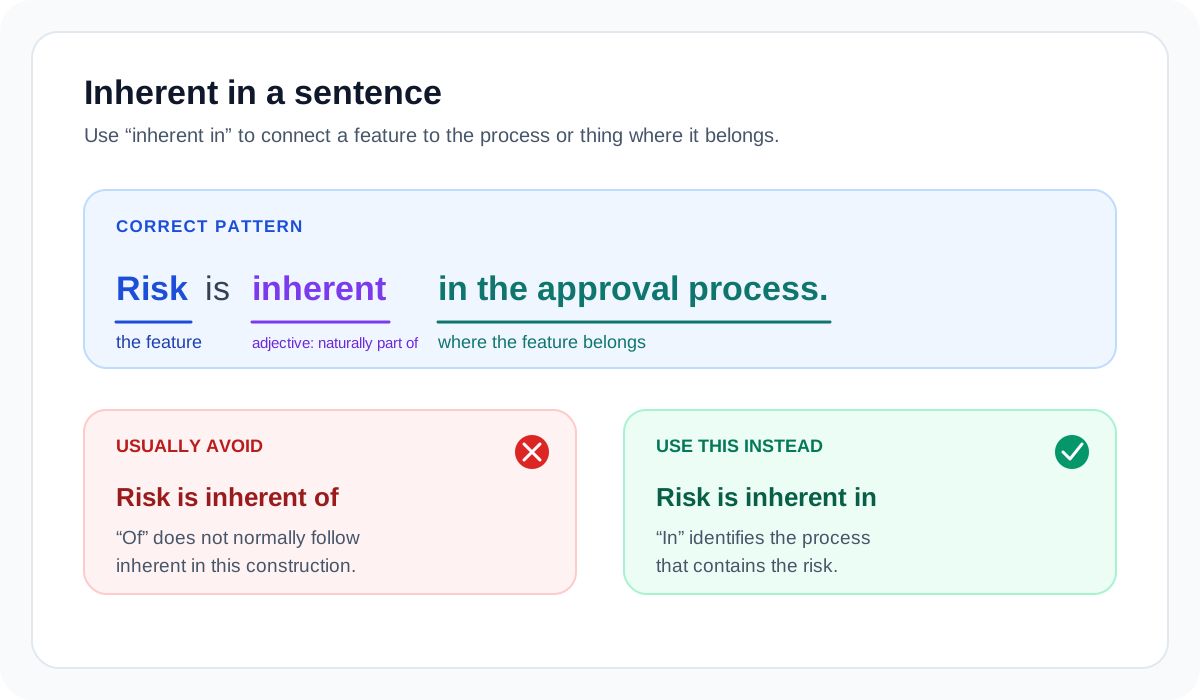
The common pattern is inherent in + noun: “Risk is inherent in the process.” Here, in connects the feature (risk) to the process that contains it. You can also put the adjective before a noun: “an inherent limitation in the method.” Inherent to also occurs, as in “Flexibility is inherent to the role”; it is not accurate to label every use wrong. For formal workplace writing, inherent in is a well-established choice.
Do not use inherent of when you mean that a feature belongs to something. Compare the preposition attached to inherent with the one attached to the noun risk:
| Wording | Why it works or needs a change |
|---|---|
| Risk is inherent of the approval process. | The adjective does not normally take of in this construction. |
| Risk is inherent in the approval process. | In identifies the process in which the risk exists. |
| The risks of the approval process need review. | Here, of belongs to the noun phrase risks of the process. |
If you are checking your own sentence, the Grammar Checker can help you review grammar and structure. Check that any suggested rewrite preserves the relationship and meaning you intended.
Inherent in a Sentence: Work and Everyday Examples
These original examples show how inherent describes features of activities, systems and everyday situations.
| Context | Example | What is built into it? |
|---|---|---|
| Vendor management | “There is an inherent risk in relying on a single supplier.” | Depending on one source creates exposure if it cannot deliver. |
| Research | “A limitation inherent in the survey is that it records stated preferences.” | Self-reported answers are not the same as observed purchases. |
| Teamwork | “Coordination is inherent in teamwork.” | Working with others requires people to align tasks and information. |
| Technology | “Some complexity is inherent in integrating older software.” | Differences between systems can require extra coordination. |
| Product testing | “Iteration is inherent in testing an early prototype.” | The method includes learning and revision. |
| Everyday life | “A degree of uncertainty is inherent in predicting the weather.” | A prediction concerns conditions that have not happened yet. |
For another workplace adjective with a different meaning, see our guide to coherent meaning. Coherent describes how ideas connect; inherent describes a feature that belongs to something.
What Does Inherent Risk Mean in Business?
In general workplace English, inherent risk means exposure that belongs to an activity or process before additional controls are considered. It describes a possibility to assess, not a prediction that harm will occur. A team may identify the risk and then decide how to reduce or manage it. In technical fields, follow the definition used by the relevant standard. For example, the NIST glossary defines inherent risk in relation to the severity of risk before direct management action changes it.
The same adjective can describe more than risk. Pair it with a precise noun and explain the practical point:
| Phrase | Example |
|---|---|
| inherent limitation | “The method has an inherent limitation: it cannot show what caused the change.” |
| inherent complexity | “Some inherent complexity comes from the system’s three approval stages.” |
| inherent advantage | “An inherent advantage of the shared format is that every team sees the same fields.” |
| inherent value | “The archive has inherent value as a record of earlier decisions.” |
When describing a risk in a report or proposal, name what it affects and the next action. Our email clarity checklist helps make a request specific, while the business email grammar guide covers sentence structure and workplace wording.
When Does a Work Document Need an Editor?
A word lookup and a full-document edit solve different problems. Use a definition or sentence example for one word; consider a professional editor only when a whole client-facing document needs broader review.
| Your need | A sensible next step |
|---|---|
| You are unsure what one word means. | Check a learner dictionary and compare the examples in this guide. |
| One sentence sounds awkward or unclear. | Review the grammar pattern, then use the Grammar Checker as a sentence-level aid. |
| A report, proposal or CV needs consistent wording throughout. | Compare editing services and confirm that the scope covers the kind of review you need. |
The service labels matter: proofreading usually focuses on surface errors in a near-final text; copyediting also checks consistency, usage and sentence-level clarity; substantive or structural editing addresses organisation and development. Providers may define these terms differently, so read the service description. Before choosing, compare the document type and word count, English variant, turnaround, number of revisions, and whether the scope includes the kind of review you need. A single sentence rarely needs the same service as a whole proposal.
Inherent vs Intrinsic vs Innate
These words overlap, but they do not fit every sentence equally well. Oxford lists intrinsic as a synonym of inherent; in use, intrinsic often highlights essential nature or value, while inherent commonly describes a built-in feature, risk or limitation. Innate usually means present from birth.
| Word | Typical emphasis | Example |
|---|---|---|
| inherent | A feature that naturally belongs to a thing or process | “The approval process has an inherent limitation.” |
| intrinsic | Essential nature or value | “The work has intrinsic value.” |
| innate | A quality or ability present from birth | “She has an innate sense of rhythm.” |
These are tendencies, not absolute rules. Keep established expressions such as inherent risk and intrinsic value, and avoid calling a quality innate unless you specifically mean inborn.
Common Mistakes With “Inherent”
- Treating inherent as common. A delay may happen often without being built into every instance of a process.
- Treating inherent risk as an inevitable outcome. The risk exists; the harmful event may never happen.
- Using inherent without naming what contains the feature. Instead of “The limitation is inherent,” identify the method, design or process and explain the effect.
- Writing inherent of. Use inherent in the method or an inherent limitation of the method. In the latter, of follows the noun limitation.
- Making an unsupported claim. Calling a system’s weakness inherent is a strong statement. Point to the feature that causes it or choose more cautious wording.
If you enjoy spotting unclear wording, read our beginner proofreading guide before considering training.
Final Takeaway
Use inherent for a feature that belongs naturally to a thing or process. Inherent in is a reliable pattern; pair the adjective with a specific noun, and distinguish a risk from an outcome that is certain to happen.
About This Article
Kin
Senior Business English Editor
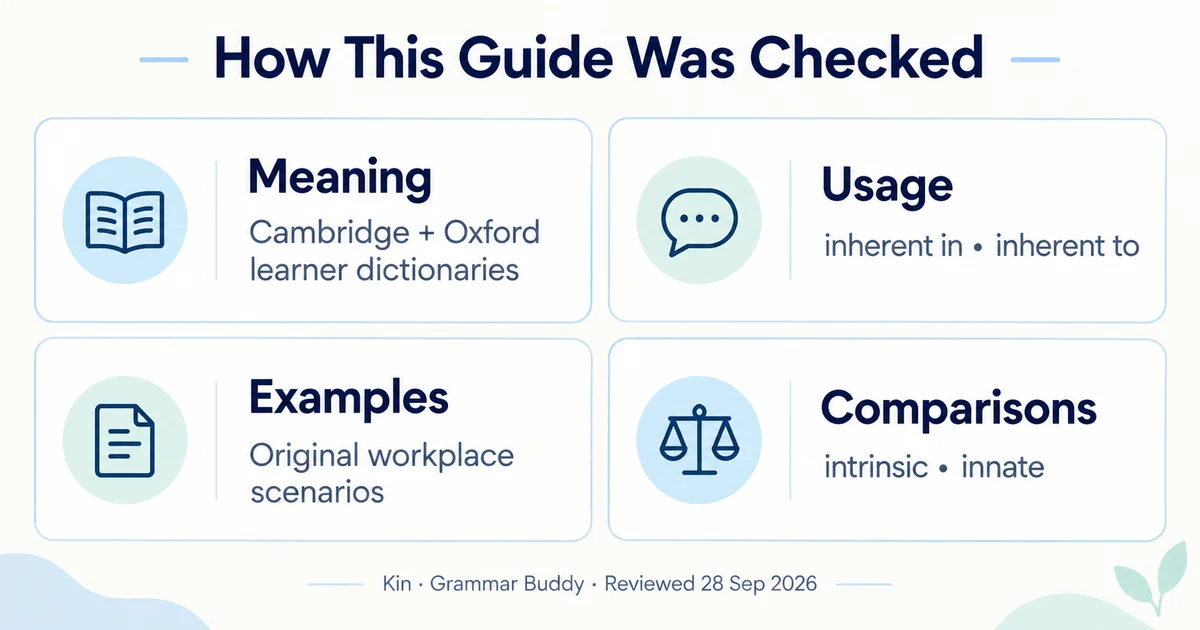
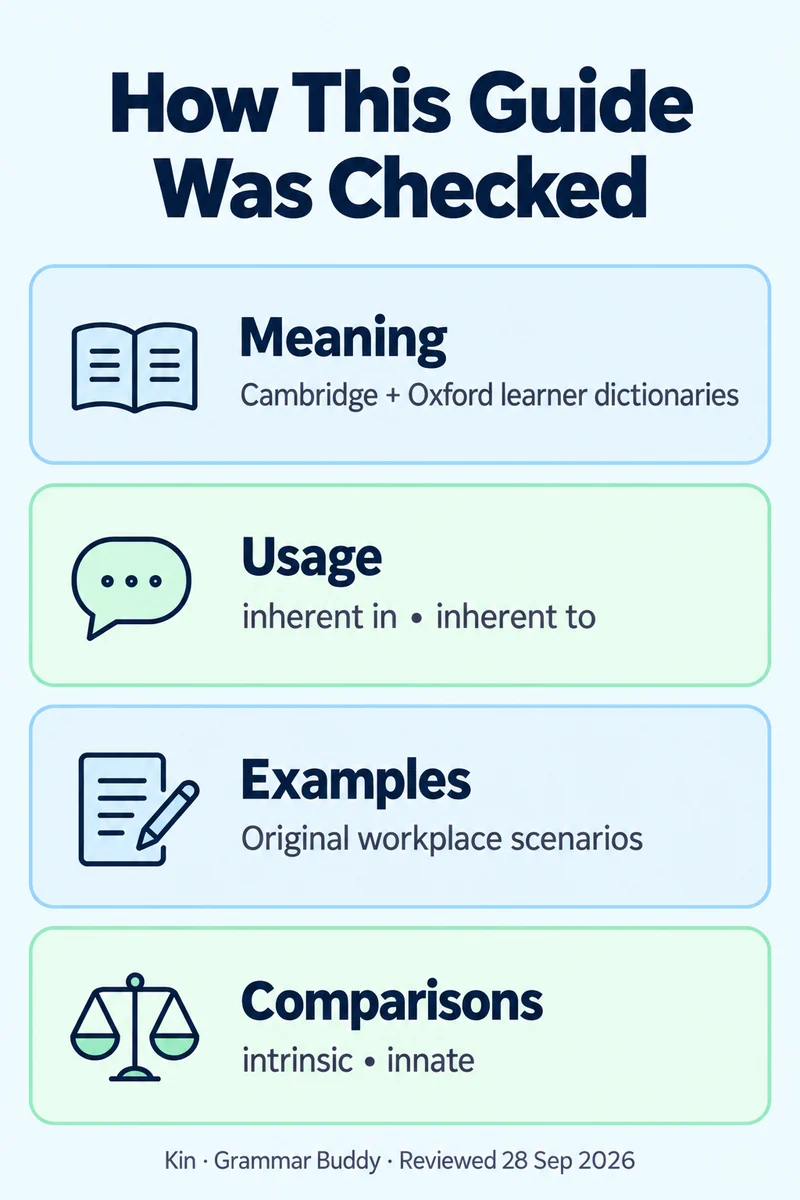
Kin edits AI Grammar Buddy’s workplace and academic English guides, with particular attention to grammar, tone and context. The workplace sentences in this guide are original, illustrative examples.
Last updated 28 September 2026
Frequently Asked Questions
What does inherent mean in simple words?▼
Inherent means naturally part of something. The feature, quality or risk belongs to the thing itself rather than being added from outside.
What is an example of inherent?▼
Some uncertainty is inherent in forecasting. Forecasts concern the future, so uncertainty is part of the activity.
How do you use inherent in a sentence?▼
You can write ‘Risk is inherent in international expansion’ or ‘There is an inherent risk in international expansion.’
What does inherent risk mean?▼
In general business English, it is a risk that belongs to an activity or process before extra controls are considered. Specialist fields may define the term more precisely.
Is it inherent in or inherent to?▼
Both forms occur. ‘Inherent in’ is the established, very common pattern and is a safe choice in formal workplace writing.
What is the difference between inherent and intrinsic?▼
They overlap. Inherent often points to a quality or risk naturally present in a process or thing; intrinsic often highlights its essential nature or value. Context decides which sounds better.
What is the difference between inherent and innate?▼
Innate usually describes a quality present from birth, such as a natural talent. Inherent works more broadly for systems, processes, properties, risks and limitations.
What is the opposite of inherent?▼
External and extrinsic are useful opposites when the contrast is inside versus outside. Acquired, added or incidental can work in other contexts.
Keep going
Related writing guides
Related guide
Coherent Meaning: Definition and Workplace Examples
Learn how ideas connect in clear workplace writing.
Related guide
Business Email Grammar
Make professional sentences more accurate and natural.
Related guide
Forecast Meaning in Business: Uses and Examples
Understand forecast and uncertainty in workplace English.