How to Chase an Email Politely: 10 Templates That Work
Struggling to follow up without sounding pushy? Get 10 copy-paste email chasing templates, timing rules, and tone tips used by professionals in Singapore and beyond.
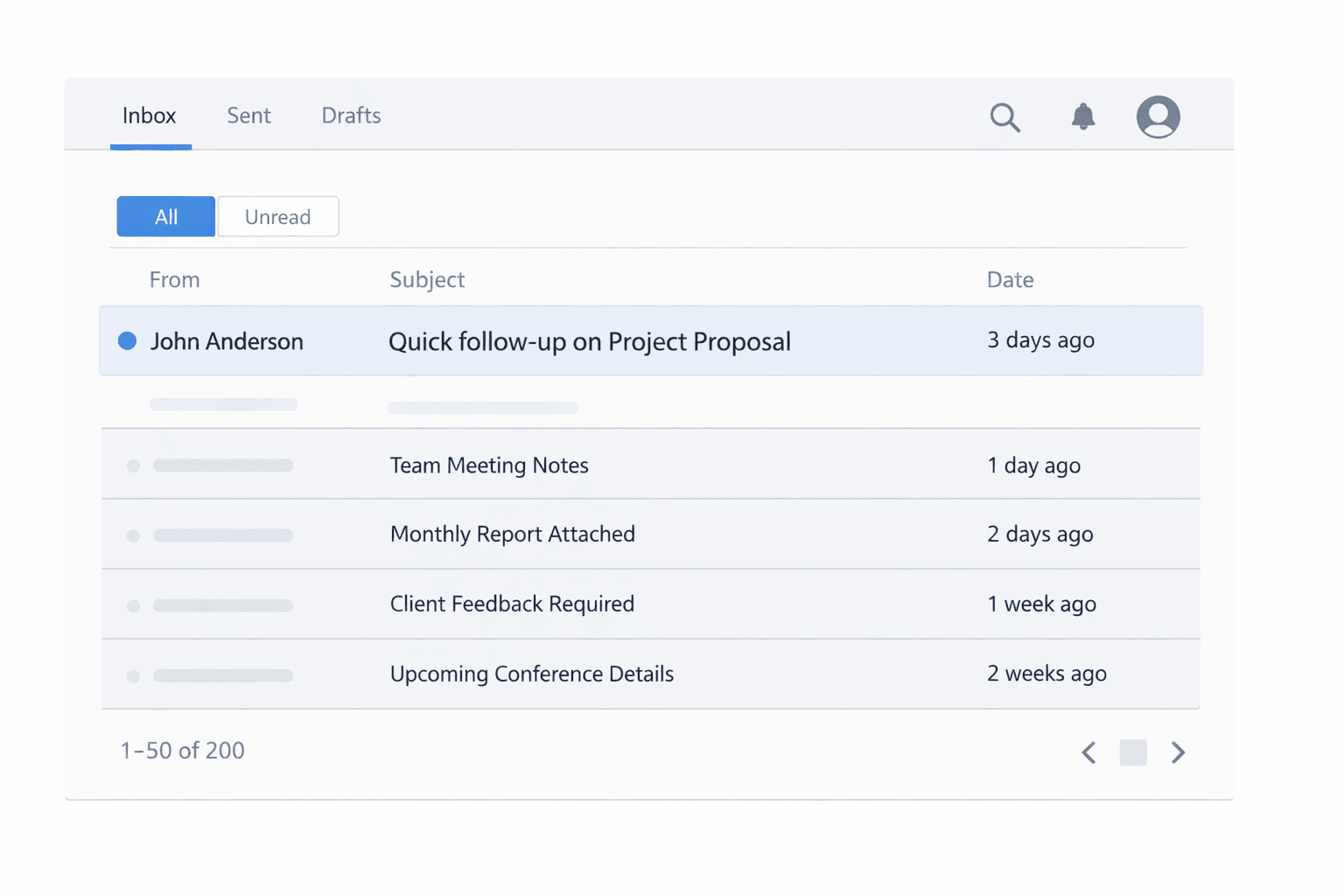
You sent the email. Three days passed. Nothing. You've refreshed your inbox six times. You know they've seen it. The real problem isn't the delayed reply - it's the dread of sending a follow-up that makes you sound needy or aggressive. I've refined dozens of follow-up emails across client work, sales, and hiring. The difference between a reply and silence almost never comes down to whether you follow up - it's how you phrase that first sentence.
If you want a practical playbook on how to chase an email politely, this guide gives you exactly that: timing rules, tone rules, and copy-paste templates you can use today.
AI Grammar Buddy
Turn this template into your email
Start with the example, then rewrite it for your real situation.
Jump to sections
Use these anchors to jump straight to the section you need.
When Should You Chase an Email?
Most follow-ups fail because they are either too early or too vague. Timing does half the work for you.
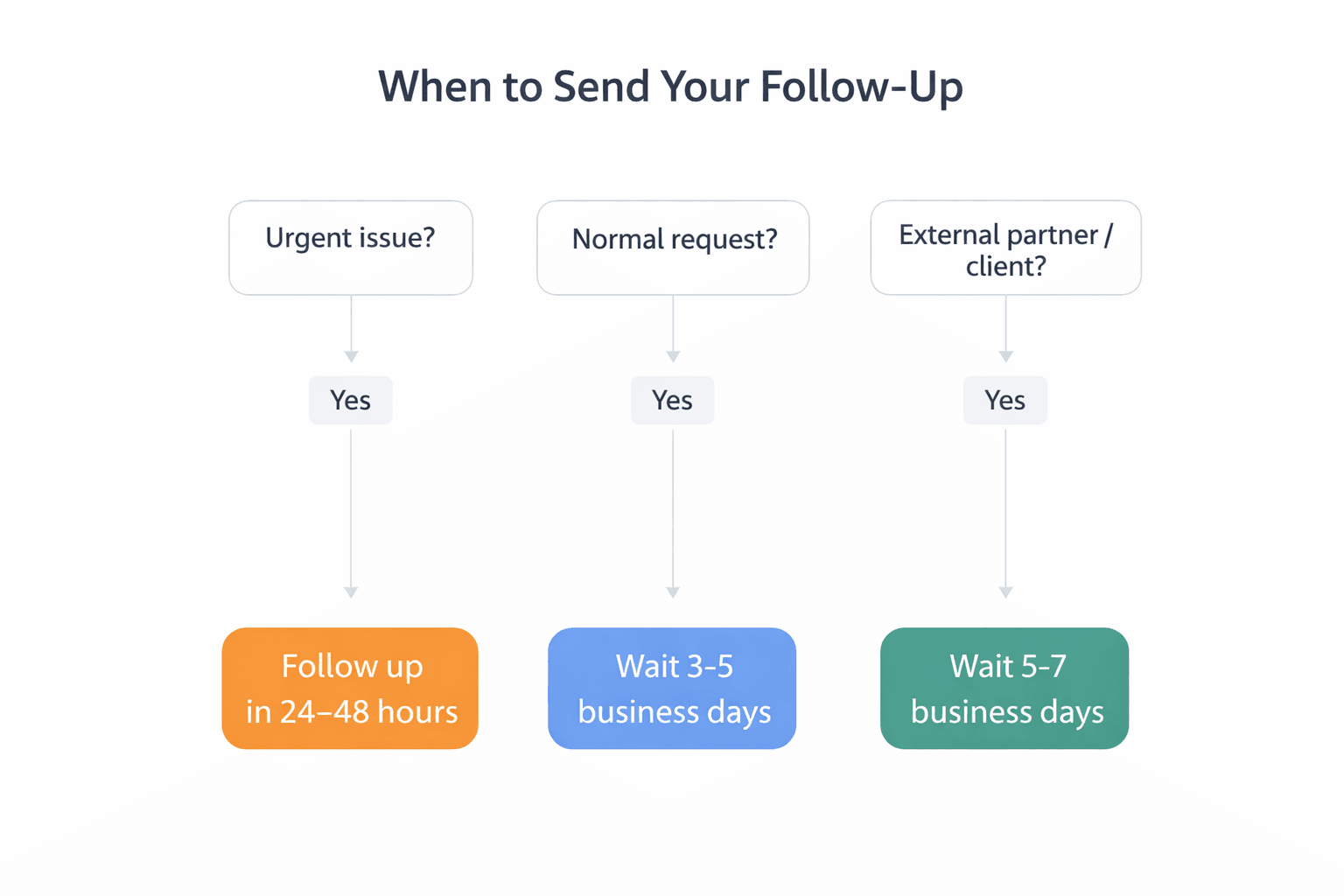
- Urgent items: follow up in 24-48 hours
- Normal requests: follow up in 3-5 business days
- External stakeholders (clients/vendors): follow up in 5-7 business days
In my experience, the biggest mistake people make is following up based on anxiety, not urgency. If you're serious about how to chase an email politely, wait long enough to be respectful, then be clear and specific when you do follow up.
How to Follow Up on Email Professionally (Tone & Timing)
If you're asking how to follow up on email professionally, use these three rules every time:
- Assume positive intent. Most people are overloaded, not avoiding you.
- Keep it short. Four to eight lines is usually enough. Long follow-ups feel emotional.
- Ask for one clear action. "Could you confirm by Thursday 3 PM?" beats "Any update?" every single time.
I've found that adding a specific deadline to your ask increases reply rates significantly, especially for approvals and decisions. If you are tempted to replace the deadline with a polite but vague phrase, compare the meaning of “at your earliest convenience” and clearer alternatives first.
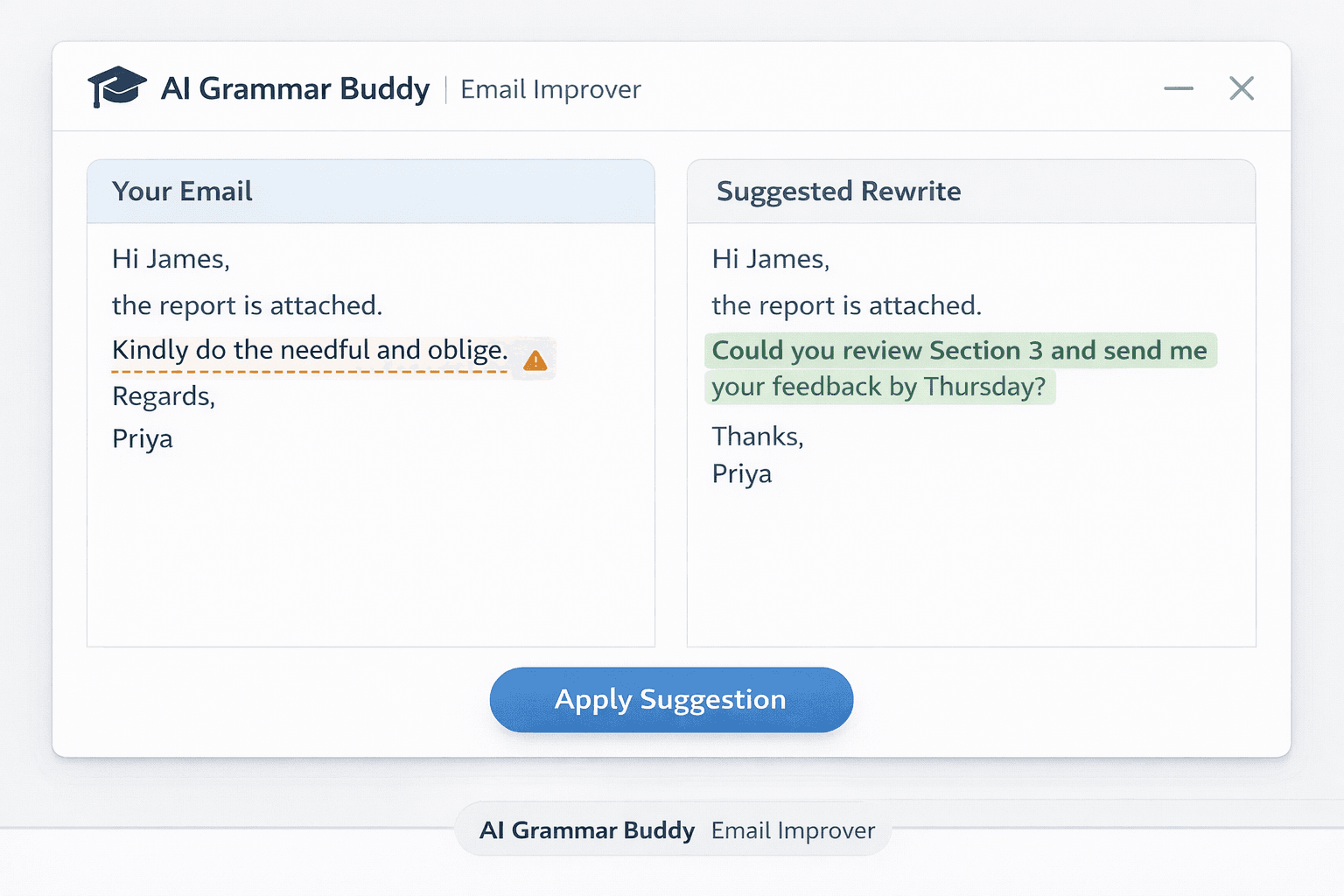
Not sure if your tone is striking the right balance? Paste your draft into AI Grammar Buddy's Email Improver - it flags overly passive or aggressive phrasing before you hit send.
Singapore-Specific Follow-Up Etiquette
If you are chasing emails at work in Singapore or across Asia, tone calibration matters even more than in many Western teams.
- Softer phrasing is often better received, especially with senior stakeholders.
- Hierarchy matters. Be respectful when following up upward.
- WhatsApp can support email, but use it as a light nudge, not a replacement for documented requests.
- Be polite and specific at the same time: warm tone, clear ask, clear timeline.
A quick tone example:
- Western direct style: "Please advise by Friday."
- Singapore/Asia-friendly style: "Could you advise when convenient? We'd appreciate an update by Friday if possible."
Both are professional. The second typically feels less confrontational while still moving things forward.
For a broader list of professional email phrases used across Asian workplaces, see our guide to workplace email phrases for Singapore and Asia.
These templates work as-is, but every situation is slightly different. If you've tweaked the wording and want a second opinion on tone, AI Grammar Buddy can review your version in seconds.
10 Polite Email Chasing Templates (Copy & Paste)
Use these as follow up email examples you can adapt fast. Think of them as reliable polite follow-up email templates for real business situations.
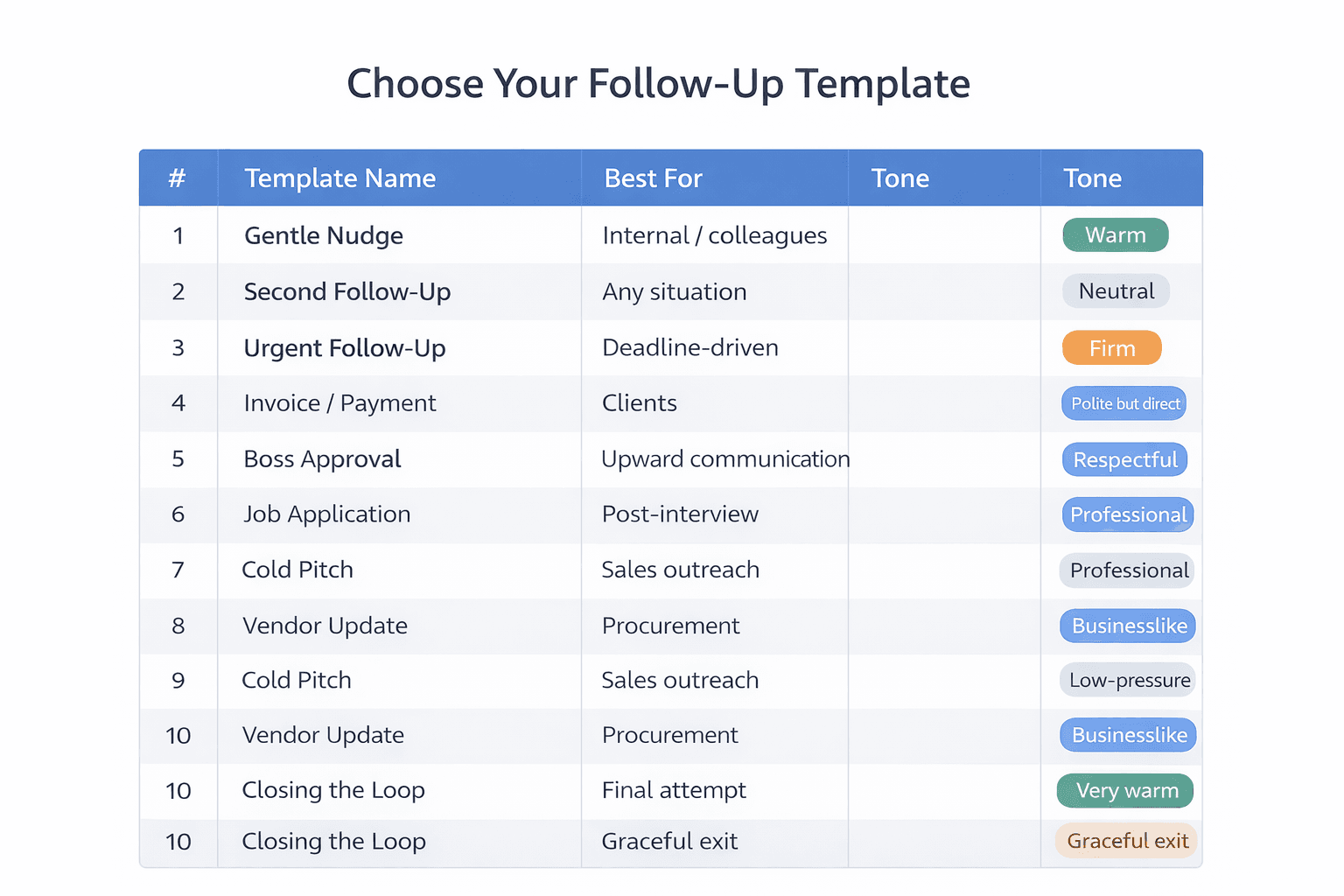
1) Gentle Nudge After 3 Days
Best for: Following up on an internal request after 3 business days. Tone: Warm and non-pressuring. Works well for: Colleagues, managers, cross-team requests.
Subject: Quick follow-up on [topic]
Hi [Name],
I hope you are well. Just a gentle follow-up on my email below about [topic].
When you have a moment, could you share your thoughts?
Thanks so much, [Your Name]
2) Second Follow-Up After 1 Week
Best for: Cases where your first follow-up got no response and you still need movement. Tone: Neutral and organized. Works well for: Internal and external contacts when the request is still active.
Subject: Second follow-up: [topic]
Hi [Name],
Just checking in again on [topic] in case my earlier note got buried.
Would you be able to share an update by [day/date]?
Best, [Your Name]
3) Urgent Follow-Up (Deadline Approaching)
Best for: Deadline-driven work where delay creates project risk. Tone: Firm, calm, and action-focused. Works well for: Project stakeholders, clients, and decision-makers.
Subject: Urgent follow-up: [topic] needed by [date/time]
Hi [Name],
I am following up as the deadline for [project/task] is [date/time].
Could you please confirm [specific item] by [time] so we can stay on track?
Thank you, [Your Name]
When I was managing client accounts, this was the template I reached for most because it makes urgency explicit without sounding accusatory.
4) Chasing a Client for an Invoice/Payment
Best for: Payment reminders that need to stay professional and relationship-safe. Tone: Polite but direct. Works well for: Agencies, freelancers, service providers.
Subject: Friendly reminder: Invoice [#] due [date]
Hi [Name],
I hope you are doing well. This is a friendly reminder that Invoice [#] for [amount] was due on [date].
Could you let me know the payment status or expected transfer date?
Many thanks, [Your Name]
5) Chasing Your Boss for Approval
Best for: Upward follow-up when your next step is blocked by approval. Tone: Respectful and concise. Works well for: Managers, directors, senior approvers.
Subject: Follow-up on approval request: [document/project]
Hi [Boss Name],
Following up on the approval request I sent on [date] for [document/project].
Once approved, we can proceed with [next step]. Could you advise when convenient?
Thank you, [Your Name]
6) Following Up on a Job Application After an Interview
Best for: Post-interview status check-ins after the stated timeline passes. Tone: Professional and interested, not desperate. Works well for: Recruiters, hiring managers, interview panels.
Subject: Follow-up on [Role Title] interview
Dear [Interviewer Name],
Thank you again for speaking with me on [date]. I enjoyed learning more about the role and team.
I am writing to check whether there are any updates on the hiring timeline.
Kind regards, [Your Name]
7) Following Up After No Response to a Cold Pitch
Best for: Outreach where you want to re-open the conversation without pressure. Tone: Low-pressure and practical. Works well for: Sales, partnerships, outbound business development.
Subject: Quick follow-up: [outcome] for [Company]
Hi [Name],
I wanted to briefly follow up on my previous note about helping [Company] with [specific outcome].
If this is not a priority right now, no problem. I am happy to reconnect later.
Would a short 10-minute call next week be useful?
Best regards, [Your Name]
8) Chasing a Vendor for an Update
Best for: Delivery, procurement, or implementation updates with dependencies. Tone: Businesslike and clear. Works well for: Vendors, suppliers, operations partners.
Subject: Status update request: [PO/Project/Delivery]
Hi [Vendor Name],
Could I get a quick status update on [order/project], originally planned for [date]?
Please share current status, any risks, and revised ETA if needed.
Thank you, [Your Name]
9) The "Checking In" Soft Follow-Up
Best for: Sensitive threads where relationship matters as much as speed. Tone: Very warm and flexible. Works well for: Long-term clients, senior peers, collaborative partners.
Subject: Checking in on [topic]
Hi [Name],
Just checking in on [topic] when you have a moment.
Happy to work around your timeline. Please let me know what works best.
Thanks, [Your Name]
10) The Final "Closing the Loop" Email
Best for: Final follow-up when you need closure and clean inbox management. Tone: Graceful and professional. Works well for: Unresponsive leads, inactive stakeholders, stalled requests.
Subject: Closing the loop on [topic]
Hi [Name],
I have followed up a few times regarding [topic], so I will close the loop for now.
If this becomes relevant later, I would be glad to reconnect.
Thank you for your time, [Your Name]
Email Chasing Taboos: What NOT to Do
-
Passive-aggressive language: "As mentioned many times..." kills goodwill fast.
❌ "As I've mentioned multiple times, I'm still waiting on this." ✅ "Just a quick follow-up - could you advise by [date]?"
-
Vague follow-ups: "Any updates?" gives no context, no priority, no action.
❌ "Any updates?" ✅ "Could you share a status update on [topic] by [date/time]?"
-
Over-chasing: Multiple follow-ups within 24 hours (for non-urgent issues) feels pushy.
❌ [Sending 3 follow-ups within 24 hours] ✅ "I'll follow up again in 3 days if I don't hear back - no rush on your end."
-
Guilt phrasing: "I guess this isn't important to you" damages trust immediately.
❌ "I guess this isn't a priority for you." ✅ "Happy to reconnect when the timing works better for you."
These errors are why people think follow-ups are rude. Usually, the issue is not the follow-up itself - it is the tone and structure.
Frequently Asked Questions (FAQ)
How do you say "I am following up on my previous email" politely?
Say it directly and add context: "I hope you're well. I'm following up on my previous email regarding [topic]. Could you share an update when convenient?" This wording is polite because it is brief, specific, and non-accusatory, while still making a clear request for next action.
Is it rude to send a follow-up email after 2 days?
It is not rude if the matter is time-sensitive or operationally urgent. For routine requests, 3-5 business days is usually better to avoid sounding impatient. The best rule: match your follow-up speed to business impact, not personal anxiety, and include a clear reason for the timing.
What is the best time to send a follow-up email?
Tuesday to Thursday mornings, between 8 AM and 10 AM local time, consistently produce the best open and reply rates for follow-up emails. Avoid Mondays (inbox overload) and Fridays (pre-weekend drop-off). If you are following up across time zones, align to the recipient's local morning - not yours.
How do you gently chase someone for a reply?
Use a short follow-up that assumes they are busy, not uncooperative. Restate the request in one line, ask for one specific action, and add a reasonable timeline. That combination keeps your message calm and professional while increasing the chance of a response on the next touchpoint.
Most follow-up failures aren't about persistence - they are about phrasing. For the word choice and tone of persist, see our meaning and tone guide. After refining dozens of these emails in real client and sales contexts, the pattern is clear: a specific ask, a reasonable deadline, and a non-accusatory tone almost always gets a reply. If you want a second pair of eyes on your draft before you send, AI Grammar Buddy's Email Improver flags tone issues in seconds - and has saved more than a few professional relationships in the process. Try it free →
Next step
Turn this template into your email
Start with the example, then rewrite it for your real situation.
Keep going
Continue with AI Grammar Buddy
AI Grammar Buddy
Email Improver
Paste your draft and rewrite it for clearer, more professional English.
Rewrite My EmailRelated guide
50 Professional Email Templates for Work (With Examples)
Professional email templates for work with examples and quick rewrites from AI Grammar Buddy.
17 March 2026
Related guide
Essential Client & Vendor Email Templates: Apology Email to Customer, Quotations and More
Copy, personalize, and send practical apology email to customer templates, request for quotation email examples, payment reminders, complaint replies, and vendor follow-ups.
13 March 2026
Related guide
Interview Invitation Email: 18 HR Templates That Work in 2026
Interview invitation email, job rejection, meeting minutes & confirmation templates. 18 copy-paste HR samples for modern workplace communication.
12 March 2026