How to Check Grammar Mistakes in 8 Steps
Learn how to check grammar mistakes in English with an 8-step process, common error examples, a reusable checklist, and tips for using an online checker.
You read the sentence three times and still miss the error. That is normal: familiar wording makes it easy to see what you expected to write. To learn how to check grammar mistakes, stop asking only, “Does this look right?” Give each reading one job—meaning, subject and verb, tense, articles, nouns, prepositions, sentence boundaries, then punctuation.
Use the examples and checklist below for emails, assignments, and everyday English.
Fast path—choose what you need:
Check now: Run one sentence through the free grammar checker, then confirm that each suggestion preserves your meaning.
Learn the method: Follow the eight manual passes below before using the tool.
TL;DR
Check one error type per pass: meaning, subject and verb, tense, articles, nouns, prepositions, sentence boundaries, then punctuation.
Do the manual pass first; use a grammar checker as a second opinion.
Jump to sections
Use these anchors to jump straight to the section you need.
Quick Answer
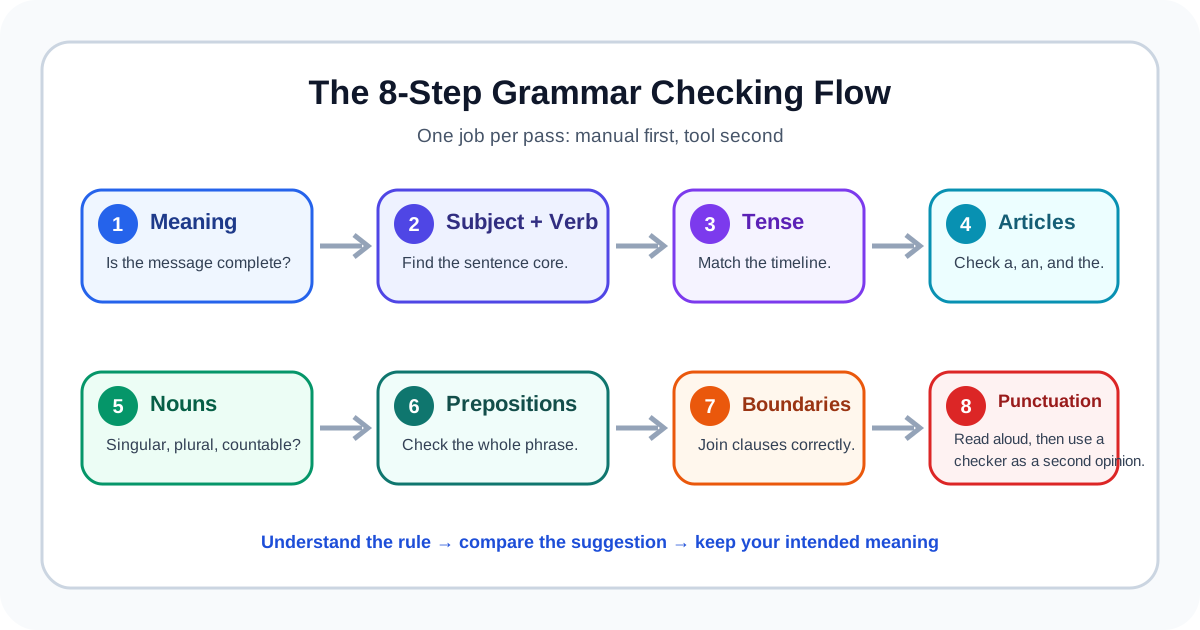
To check English sentence grammar, make eight short passes instead of trying to find every error at once:
- Read for meaning and completeness.
- Find the subject and main verb.
- Check the verb tense.
- Review articles.
- Check singular, plural, and uncountable nouns.
- Review prepositions as part of full phrases.
- Fix fragments, run-ons, and unclear connections.
- Check punctuation and capitalization, then read aloud.
Understand the intended meaning before editing. After this manual pass, compare the sentence with AI Grammar Buddy’s suggestion and keep only changes that preserve the message.
What Grammar Mistakes Should You Check?
Start with errors that affect the sentence structure, then move to smaller details. The main categories are:
- Sentence completeness — Is there a subject, a verb, and a complete thought?
- Agreement — Does a singular subject use a singular verb?
- Time — Do the verb forms show a clear and consistent timeline?
- Determiners and nouns — Are “a,” “an,” and “the” used correctly? Is the noun singular or plural?
- Word relationships — Does the preposition fit the verb, adjective, time, or place?
- Sentence boundaries — Are two complete thoughts joined correctly?
- Mechanics — Are punctuation and capitalization accurate?
Spelling is not always grammar. Both organise and organize can be correct; choose one English variety and stay consistent. See organize vs organise for the regional difference.
How to Check Grammar Mistakes Step by Step
Use this process for one sentence or repeat it paragraph by paragraph for a longer draft.
Step 1: Read for meaning
Ask: What happened? Who did it? When did it happen? If you cannot answer those questions, the sentence may be vague or incomplete.
Step 2: Find the subject and verb
Underline the person or thing doing the action. Circle the main verb. This reveals missing verbs and agreement errors quickly.
Step 3: Mark the timeline
Look for time words such as yesterday, since, now, and next week. Make sure the verb form matches that time.
Step 4: Check nouns and their helper words
Review each countable noun. Does it need a, an, the, a number, or a plural ending?
Article and noun mistakes are easy to skim past. If you are unsure about a, an, or the, use the free grammar checker for a second opinion, then match its suggestion to the rule.
Step 5: Check how ideas connect
Words such as because, although, and, and but show relationships. Confirm that each clause connects logically and that no clause is left unfinished.
Step 6: Check the sentence boundary
If the sentence contains two complete thoughts, join them with suitable punctuation and a connector, or separate them.
Step 7: Check the small details
Review commas, apostrophes, end punctuation, capital letters, and spelling consistency.
Step 8: Read once more—with help if useful
Read the sentence aloud, confirm the meaning, then check your English sentence for grammar mistakes as a second opinion.
Subject–Verb Agreement
A singular subject normally takes a singular verb in the present tense; a plural subject takes a plural verb.
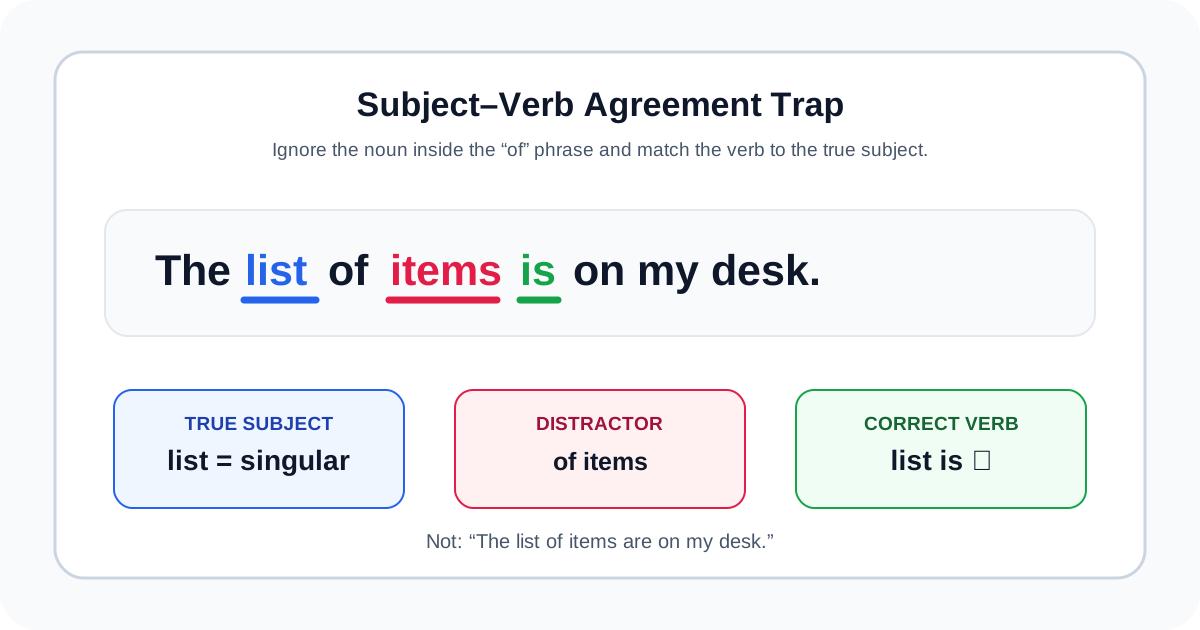
Incorrect: The list of items are on my desk.
Correct: The list of items is on my desk.
The subject is list, not items. Ignore the prepositional phrase between the subject and verb when you test agreement.
Words such as each, every, everyone, and nobody are normally treated as singular:
Incorrect: Each of the students have a notebook.
Correct: Each of the students has a notebook.
Verb Tense Consistency
Choose verb tenses according to the real timeline, not because one form “sounds more advanced.”
Incorrect: Yesterday, I finish the report and send it to Maya.
Correct: Yesterday, I finished the report and sent it to Maya.
Both completed actions happened yesterday, so both use the simple past. A change of tense is correct only when the time changes:
I finished the report yesterday, and Maya is reviewing it now.
When checking a paragraph, draw a simple timeline if several events happen at different times.
Articles: A, An, and The
Use a or an for one non-specific countable noun. Use the when the reader knows which particular person or thing you mean.
Incorrect: She gave me an useful suggestion.
Correct: She gave me a useful suggestion.
Choose a or an by sound, not spelling. Useful begins with a “y” sound, so it takes a.
Incorrect: Please open window beside the door.
Correct: Please open the window beside the door.
The phrase beside the door identifies a specific window, so the is appropriate.
Singular and Plural Nouns
Check whether a countable noun refers to one item or more than one. Then check the determiner and verb around it.
Incorrect: I received three useful feedbacks.
Correct: I received three useful pieces of feedback.
Feedback is normally uncountable, so use pieces of feedback when counting separate comments.
Also watch nouns with irregular plural forms, such as child/children, person/people, and analysis/analyses.
Prepositions
Prepositions often depend on a fixed pattern, so literal translation can produce a sentence that sounds unnatural.
Incorrect: We discussed about the new schedule.
Correct: We discussed the new schedule.
The verb discuss takes a direct object; it does not need about.
Incorrect: She is responsible of customer support.
Correct: She is responsible for customer support.
When unsure, check the whole phrase—such as responsible for—rather than checking the preposition alone.
Sentence Fragments and Run-on Sentences
A fragment is presented as a sentence but does not express a complete thought.
Fragment: Because the meeting ended late.
Complete sentence: We took a taxi because the meeting ended late.
A run-on joins complete thoughts without the correct boundary.
Run-on: The file is ready you can send it now.
Correct: The file is ready, so you can send it now.
You could also write two sentences: The file is ready. You can send it now. Choose the version that shows the relationship most clearly.
Punctuation and Capitalization
Punctuation helps the reader see where one idea ends and another begins. Check end marks first, then commas and apostrophes.
Incorrect: After lunch we reviewed the clients comments.
Correct: After lunch, we reviewed the client’s comments.
The comma separates the opening phrase. The apostrophe shows that the comments belong to one client. If several clients made the comments, write the clients’ comments.
Capitalize the first word of a sentence, proper names, days, months, languages, and official titles used with a name. Do not capitalize ordinary nouns simply because they feel important.
If the sentence belongs to a job application, use the cover letter grammar mistakes checklist for tense, apostrophes, spelling consistency, and common application errors.
Before-and-After Grammar Examples
The table below brings the main checks together. On a phone, scroll sideways to compare all three columns.
Use it as a practice set: correct each line yourself, then paste the table examples into AI Grammar Buddy to see which error patterns you still miss.
| Incorrect sentence | Corrected sentence | Reason |
|---|---|---|
| My brother work from home. | My brother works from home. | Singular subject and verb agreement |
| They was waiting outside. | They were waiting outside. | Plural subject needs were |
| I have seen her yesterday. | I saw her yesterday. | Finished past time needs simple past |
| He bought new laptop. | He bought a new laptop. | Singular countable noun needs an article |
| We need more informations. | We need more information. | Information is uncountable |
| There are five box on the shelf. | There are five boxes on the shelf. | Plural noun after a number |
| She depends of her phone for work. | She depends on her phone for work. | Correct phrase is depend on |
| Although the price was high. | Although the price was high, we bought it. | Fragment needs a main clause |
| I called Sam he did not answer. | I called Sam, but he did not answer. | Join complete thoughts correctly |
| Lets meet on monday. | Let’s meet on Monday. | Apostrophe and capital letter |
| Where did you put the keys. | Where did you put the keys? | A direct question needs a question mark |
| The plan is simple however it may take time. | The plan is simple; however, it may take time. | Correct boundary between two clauses |
A Practical Grammar Checklist
Copy this checklist into your notes and use it from top to bottom:
- Does every sentence express a complete thought?
- Can I identify the subject and main verb?
- Does the verb agree with the subject?
- Does each verb match the intended time?
- Does each singular countable noun have a suitable determiner?
- Are singular, plural, and uncountable nouns used correctly?
- Do the prepositions fit their phrases?
- Are complete clauses joined or separated correctly?
- Are commas, apostrophes, and end marks correct?
- Are proper names and sentence openings capitalized?
- Is spelling consistent in one English variety?
- Does the final version preserve my meaning?
For a longer assignment, check structure before sentence-level grammar. Our guide on how to write an essay in English explains how to review the thesis, paragraph logic, and transitions. For workplace messages, use the more focused business email grammar guide.
A quick workplace email pass
After checking grammar, confirm the action, owner, and deadline with this email clarity checklist for work messages.
When to Use an Online Grammar Checker
If you want to run a grammar check online, do it after the checklist—not before. Your manual review helps you notice recurring patterns; the tool then becomes a second opinion instead of a substitute for understanding the rule.
A free online grammar check is especially useful when:
- you have revised the same text many times and no longer notice small errors;
- English is not your first language and you want to test an article or preposition;
- you need to proofread a short email, application, or assignment;
- you want to compare a correction with your original wording.
Treat every result as a suggestion. Check that names, technical terms, quotations, tone, and meaning remain accurate. For high-stakes writing, such as a contract or a final academic submission, a qualified human reviewer may still be necessary.
How AI Grammar Buddy Can Help
AI Grammar Buddy works best after your own reading. Paste the sentence, compare the corrected version with the original, and review the listed issues.
Original: The documents is ready. I send it yesterday.
Suggested correction: The documents are ready. I sent them yesterday.
Your review: Accept are because the subject is plural and sent because yesterday marks completed time. Keep them only if it clearly refers to the documents.
Workplace email example:
Original: Please check the attached and revert by Friday.
Suggested correction: Please review the attached file and reply by Friday.
Your review: Accept the clearer actions; keep Friday only if it is the real deadline.
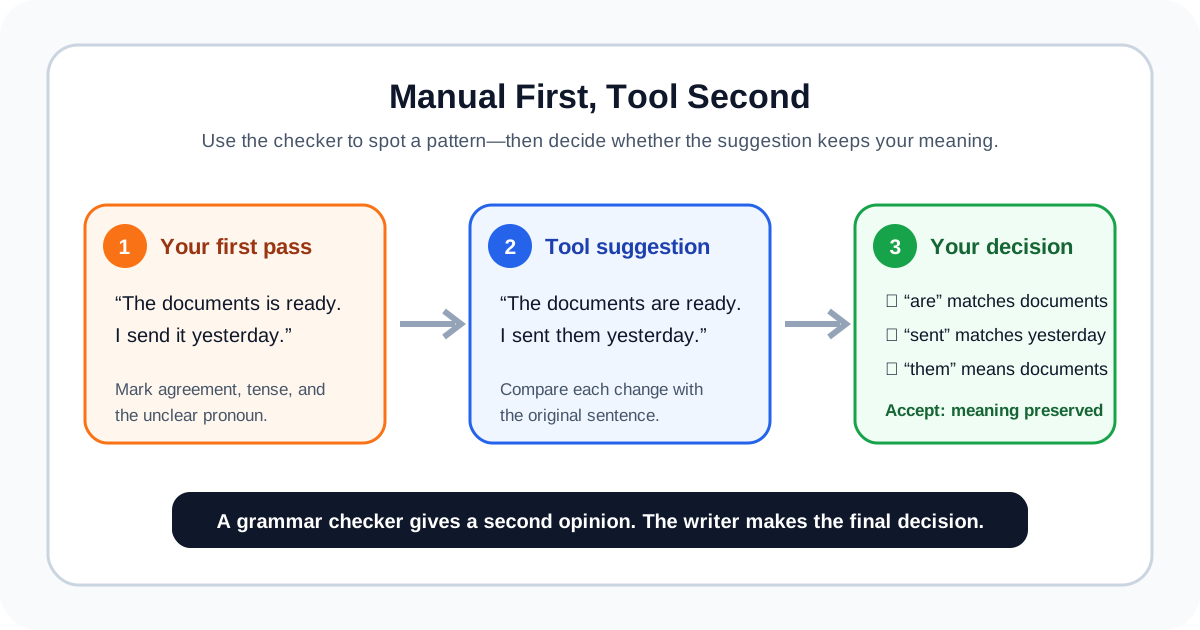
The final decision remains yours. Keep a suggestion only when it preserves your meaning, names, technical terms, and formality.
Final Takeaway
Grammar checking is a repeatable process. Check meaning, structure, agreement, tense, nouns, articles, prepositions, sentence boundaries, and punctuation. Finally, read aloud and confirm that the correction preserves your meaning.
If you want to turn that manual-first habit into a freelance skill, follow the portfolio and job steps in our guide to becoming a proofreader with no experience.
If you want a quick second pass after using the checklist, use our free grammar checker, review the suggested changes, and keep the corrections that make your sentence both accurate and clear.
About This Article
Kin
Senior Business English Editor
Kin reviews practical English guides for AI Grammar Buddy. She focuses on sentence-level corrections that help non-native English writers understand the rule, preserve their meaning, and write with more confidence.
Last updated 26 July 2026
Frequently Asked Questions
How can I check grammar mistakes in a sentence?▼
Read the sentence once for meaning, find the subject and main verb, and then check agreement, tense, articles, noun number, prepositions, sentence boundaries, punctuation, and capitalization. Make one type of correction at a time and read the revised sentence again.
Can I check my sentence grammar without a teacher?▼
Yes. A checklist, a trusted grammar reference, and an online checker can help you find many common errors. For important academic, legal, or high-stakes professional writing, ask a qualified human reviewer to check meaning and context as well.
What is the fastest way to check English sentence grammar?▼
Use two short passes. In the first pass, check the subject, verb, tense, and sentence completeness. In the second, check articles, noun forms, prepositions, punctuation, and capitalization. Then review the sentence in context.
Should I accept every correction from an online grammar checker?▼
No. Read each suggestion and confirm that it keeps your intended meaning, tone, names, technical terms, and preferred English variety. Automated suggestions can be useful, but the writer still makes the final decision.
What is the difference between grammar checking and proofreading?▼
Grammar checking focuses on rules such as agreement, tense, articles, and sentence structure. Proofreading is broader: it also checks spelling, punctuation, formatting, consistency, missing words, and small presentation errors.
Keep going
Continue with AI Grammar Buddy
AI Grammar Buddy
Grammar Checker
Run a fast grammar, wording, and clarity check on your sentence.
Check My SentenceRelated guide
Business Email Grammar Checker: 10 Rules + Examples
Fix agreement, tense, articles, sentence structure, and unclear requests in workplace emails.
30 June 2026
Related guide
How to Write an Essay in English: Step-by-Step Guide & Structure
Plan and edit clear English essays with practical advice on structure, transitions, and sentence-level revision.
4 July 2026
Related guide
Singapore English Grammar Checker: How to Choose the Right Tool
Learn how to review local phrasing, grammar, and audience fit when writing for Singapore and global readers.
29 June 2026