10 Better Ways to Say "In Conclusion" for Essays & Emails
Need a better way to say "in conclusion"? Compare 10 alternatives by tone, with essay paragraphs, professional email endings, and mistakes to avoid.
Looking for a better way to say "in conclusion"? The phrase is correct—but once readers see it, they may skim the takeaway. That can make an otherwise strong essay sound formulaic and a client email feel like homework.
Below are 10 better ways to say "in conclusion," organized by tone and purpose. You will also see when not to use each one, complete essay and email endings, and a quick rule for choosing without guessing.
TL;DR
Use "in summary" for essays, "overall" or "ultimately" for reports and professional emails, and "to wrap up" for conversational writing. The strongest conclusion states the takeaway or next step instead of merely announcing that the text is ending.
Choose by purpose first: summarize, judge, recommend, or request action.
Fast choices:
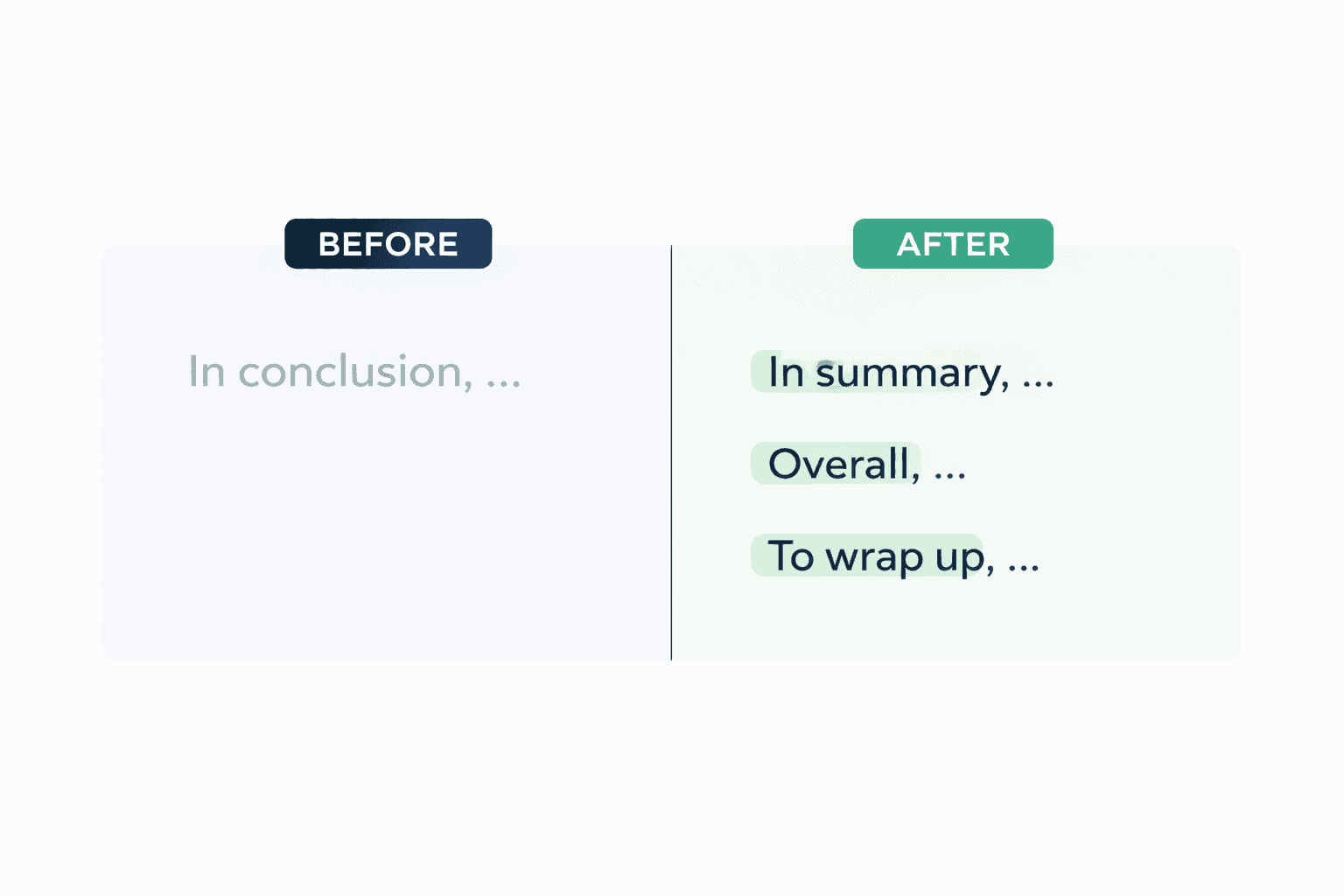
- •"In summary" — a safe formal choice for essays and reports.
- •"Overall" — a natural default for evaluations and work updates.
- •"Ultimately" — best when you are stating a final judgment.
- •"To wrap up" — suitable for talks, blogs, and informal messages.
Not sure which tone fits? Paste your final paragraph into AI Grammar Buddy's Email Improver and compare formal, professional, and natural rewrites.
Jump to sections
Use these anchors to jump straight to the section you need.
Quick Answer: A Better Way to Say In Conclusion
A better way to say "in conclusion" is in summary for formal essays, overall for reports and professional emails, ultimately for a final judgment, or to wrap up for a conversational ending. You can also skip the transition completely and begin with the conclusion itself: "The evidence therefore supports a phased rollout."
These alternatives to in conclusion are useful because they signal different jobs, not because they sound fancier. The best in conclusion synonyms tell the reader whether you are summarizing, judging, reflecting, or requesting action.
| Phrase | Tone | Best use | Avoid when | One-line example |
|---|---|---|---|---|
| In summary | Formal | Essays, reports, research summaries | You are introducing a new idea | In summary, the evidence supports the original claim. |
| In closing | Formal, ceremonial | Speeches, letters, presentations | A routine work email needs a direct next step | In closing, I would like to thank the project team. |
| Ultimately | Analytical | Recommendations and final judgments | Several points still need to be summarized | Ultimately, the lower-risk option offers better value. |
| To sum up | Neutral | Explainers, reports, general business writing | The document is highly academic | To sum up, the pilot met all three targets. |
| On a final note | Warm | Newsletters, talks, friendly professional messages | You need a firm decision or urgent action | On a final note, thank you for your thoughtful feedback. |
| Overall | Professional | Evaluations, updates, balanced reviews | You mean "eventually" rather than "considering everything" | Overall, the revised proposal is ready for review. |
| The bottom line is | Direct | Executive summaries and decisive recommendations | The topic is sensitive or the audience expects formality | The bottom line is that we need two more weeks. |
| To wrap up | Conversational | Presentations, webinars, blogs, team messages | A formal academic paper | To wrap up, please send your comments by Friday. |
| In the end | Reflective | Narratives and personal commentary | You are summarizing research findings | In the end, the simpler process proved more reliable. |
| All things considered | Measured | Comparisons, trade-offs, evaluations | There were no competing factors to weigh | All things considered, option B is the practical choice. |
Not sure which tone fits? Paste your final paragraph into AI Grammar Buddy's Email Improver and compare a formal rewrite with a more natural professional version.
10 Better Ways to Say "In Conclusion"
The options below are not interchangeable. Choose the phrase that describes what your final sentence is doing: summarizing evidence, giving a judgment, thanking an audience, or asking for action.
1. In summary
Best for: academic essays, reports, research summaries, and formal presentations.
Do not use it when: the next sentence adds evidence or introduces a new argument. A summary should only bring together points the reader has already seen.
Complete example: "In summary, the survey results support flexible scheduling because employees reported higher focus without a decline in team response times."
This is the safest formal replacement because it tells the reader to expect a concise synthesis. It sounds natural only when the sentence actually summarizes.
2. In closing
Best for: speeches, formal letters, presentations, and prepared remarks.
Do not use it when: you are ending a routine email. It can sound ceremonial where a direct request would be clearer.
Complete example: "In closing, I would like to thank the volunteers whose time and local knowledge made the programme possible."
Use this phrase when the ending includes thanks, recognition, or a final appeal to an audience.
3. Ultimately
Use "ultimately" when the conclusion must answer a decision question such as "Which option should we choose?" or "What matters most?" It points to the deciding idea rather than promising a recap of every finding.
Too vague: "Ultimately, option B is better."
Stronger: "Ultimately, option B is the stronger choice because it reduces implementation risk without increasing the annual cost."
If the reader still needs a summary of several separate findings, use "in summary" first and save "ultimately" for the judgment that follows.
4. To sum up
Best for: explainers, presentations, reports, and neutral business writing.
Do not use it when: your institution expects a highly formal academic register. "In summary" or a direct claim may fit better.
Complete example: "To sum up, the pilot finished on time, stayed within budget, and produced a measurable improvement in response time."
It is clear and friendly, but the points after it should be genuinely concise.
5. On a final note
Best for: newsletters, blog posts, talks, and warm professional messages.
Do not use it when: the final sentence contains an urgent deadline, refusal, or firm decision. The warmth can soften information that should be direct.
Complete example: "On a final note, thank you for testing the new process and documenting the issues you found."
This phrase works well when you are shifting from the main discussion to a brief thank-you, reminder, or encouraging thought.
6. Overall
Best for: balanced assessments, performance reviews, project updates, and client emails.
Do not use it when: you mean "finally" or "after a long time." "Overall" means considering the whole situation.
Complete example: "Overall, the campaign performed well, although the mobile landing page still needs a shorter form."
For workplace writing, this is often the most natural default. It sounds professional without calling too much attention to the transition.
7. The bottom line is
"The bottom line is" creates emphasis, so reserve it for executive summaries, budget discussions, and decisions where one fact truly determines the outcome.
Blunt: The bottom line is that your team caused the delay.
Firm but constructive: The bottom line is that we need final copy by Tuesday to protect the launch date.
Avoid this phrase in a sensitive client or employee message when it could sound dismissive. State the constraint and next step without assigning blame.
8. To wrap up
Best for: webinars, meetings, blog posts, training sessions, and informal team updates.
Do not use it when: you are writing a dissertation, research paper, legal document, or other formal text.
Complete example: "To wrap up, please add your comments to the shared document before our Thursday meeting."
It sounds natural in speech and conversational writing because it signals both closure and a final action.
9. In the end
Best for: reflective writing, narratives, personal essays, and lessons learned.
Do not use it when: you are presenting an objective summary of data. It may suggest a story unfolding over time.
Complete example: "In the end, the team's willingness to simplify the process mattered more than the software it selected."
Choose it when the ending reflects on an outcome, not when you are listing findings.
10. All things considered
"All things considered" tells the reader that you weighed genuine trade-offs. It fits comparisons, reviews, and measured recommendations:
All things considered, renewing the current contract is less disruptive than changing suppliers this quarter. It costs slightly more, but it avoids retraining and a six-week migration.
Do not use it when there were no competing factors to consider. In that case, "overall" or a direct recommendation is more accurate.
How to Choose the Right Conclusion Phrase
Use the job of the final sentence as your filter:
- Summarizing several points? Use "in summary" or "to sum up."
- Giving a final judgment? Use "ultimately" or "overall."
- Weighing advantages and disadvantages? Use "all things considered."
- Ending a talk or informal update? Use "to wrap up" or "on a final note."
- Requesting action? You may not need a transition at all. State the next step directly.
The last option is easy to overlook. Compare:
In conclusion, we need your approval.
Please approve the revised budget by 3 p.m. Thursday so we can keep the Monday launch date.
The second ending is stronger because it tells the reader what to do, by when, and why. If you are writing an assignment, the same principle applies: your conclusion should state what the evidence proves. Our guide to writing an essay in English explains how to connect that final claim to the thesis.
Examples: Complete Essay and Email Endings
A one-sentence synonym list cannot show whether an ending actually works. These complete examples demonstrate how the transition, takeaway, and final implication fit together.
Academic essay conclusion
Weak version
In conclusion, social media has advantages and disadvantages. This essay has discussed both sides. It is an important topic.
Stronger version
Taken together, the evidence suggests that social media's effect on student learning depends less on screen time alone than on how the platforms are used. Structured peer discussion can support participation, while constant notifications disrupt sustained attention. Schools should therefore teach purposeful use rather than treating every platform as equally harmful.
Why it works: the paragraph synthesizes the argument, adds no new evidence, and ends with a clear implication. It does not need a stock conclusion starter.
Client recommendation email
Weak version
In conclusion, we think package B is better. Please advise.
Stronger version
Overall, package B is the stronger fit because it includes onboarding support and keeps the first-year cost within budget. If you approve this option by Wednesday, we can reserve the 12 August start date.
Why it works: "overall" signals a judgment, while the second sentence gives the client a specific next step. For a full message structure, use these professional email templates.
Writing a client update? Try the same ending in the Email Improver before you send it. The useful change is not merely swapping the first two words; it is matching the explanation and request to the reader.
Internal project update
Weak version
In conclusion, these are all the updates for this week.
Stronger version
To wrap up, design will deliver the revised screens on Tuesday, and engineering will confirm the new estimate on Wednesday. Please flag any dependency we have missed in the project channel today.
Why it works: the conversational transition suits an internal update, and the ending assigns clear owners, dates, and action.
Professional email conclusion versus sign-off
Do not confuse the final body paragraph with the sign-off:
Overall, the revised draft addresses the three points from your review. Please send any final changes by Friday.
Kind regards, Maya
"Overall..." begins the email conclusion. "Kind regards" is the sign-off. If you want a less repetitive request before the sign-off, compare these "looking forward to hearing from you" alternatives.
Common Mistakes
Swapping the phrase but keeping a weak conclusion
Changing "in conclusion" to "ultimately" does not improve a vague sentence:
Ultimately, this essay has shown many important things.
Name the finding instead:
Ultimately, the evidence supports targeted subsidies because they reach low-income households at a lower total cost.
Choosing a phrase that is too casual
"In a nutshell" and "long story short" can work in conversation, but they usually sound out of place in a formal essay. Match the register of the rest of the document.
The same rule applies at work: a polished phrase cannot rescue a hesitant or overly casual message. See how to sound more senior in emails for clearer recommendation and next-step wording.
Introducing new evidence
A conclusion can explain the significance of evidence, but it should not surprise the reader with a new statistic, source, or argument. Move that material into the body, then synthesize it at the end.
Repeating the introduction word for word
A conclusion should return to the main claim at a higher level. Show what the discussion has established instead of copying the thesis sentence.
Using "finally" when you mean "overall"
"Finally" usually introduces the last item in a sequence. "Overall" gives an assessment of the whole. Use:
- "Finally, the team tested the checkout flow" for the last step.
- "Overall, the test produced positive results" for the final assessment.
Ending an email without a next step
A professional email conclusion should make the action visible. Replace "Please advise" or "Let me know your thoughts" with the decision, information, or deadline you need. An email clarity checklist can help you catch a missing owner or date.
If the ending still feels vague, paste the whole final paragraph into the Email Improver and ask for a clearer next step.
How AI Grammar Buddy Can Help You Rewrite the Ending
Paste the complete final paragraph—not only the opening phrase—into AI Grammar Buddy. You can then compare a formal essay version, a professional email version, and a direct workplace version:
For example:
Original: In conclusion, option two is better.
Formal essay: Taken together, the evidence supports option two because it offers the greatest long-term benefit.
Professional email: Overall, option two is the stronger choice because it is faster to implement and stays within budget.
Direct workplace update: We recommend option two. Please confirm your approval by Friday.
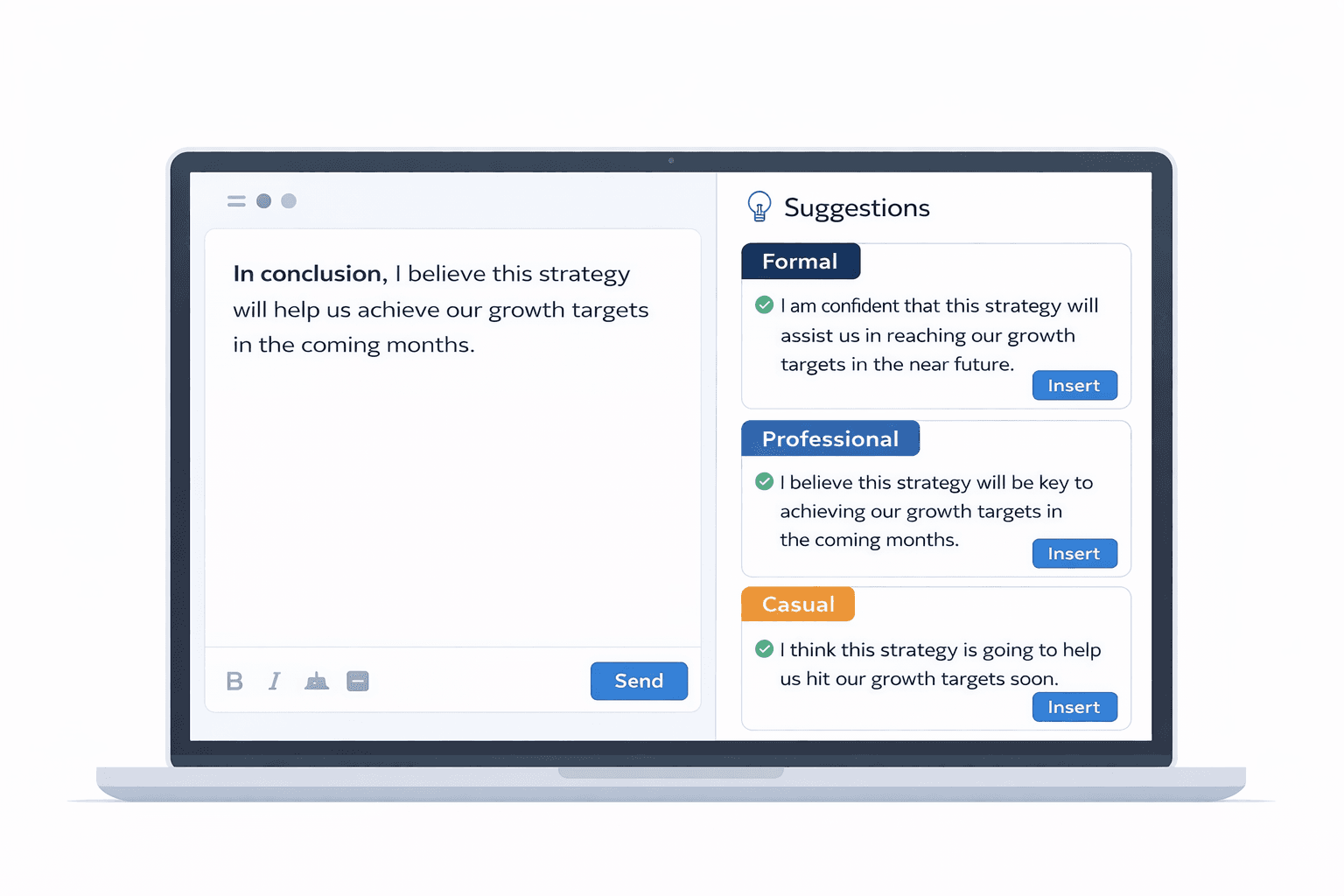
These rewrites change the purpose and tone, not just the opening phrase. Paste your own ending into AI Grammar Buddy's Email Improver to test a clearer, more polite, or more professional version.
Final Takeaway
The best conclusion does more than announce that the writing is about to end. Use "in summary" to synthesize, "ultimately" to judge, "overall" to assess, and "to wrap up" for a conversational close. When the reader needs to act, skip the transition and state the next step directly.
"In conclusion" is not wrong. It is simply one option—and often not the most precise one.
About This Article
Kin
Senior Business English Editor
Kin reviews business email drafts, essay wording, and tone problems for AI Grammar Buddy. She focuses on practical rewrites that help English learners sound clear and natural without replacing simple words with needlessly formal ones.
Last updated 24 July 2026
Frequently Asked Questions
What is a better way to say "in conclusion"?▼
Common alternatives to in conclusion include "in summary" for an academic essay, "overall" for a report or professional email, and "to wrap up" for a presentation or casual article. The best option depends on tone and purpose, so the complete final sentence matters more than the transition alone.
Can I still use "in conclusion" in an essay?▼
Yes. "In conclusion" is grammatically correct and clear. It becomes weak only when it is used automatically or followed by a vague summary. In a short essay, you can often omit the transition and begin with your main finding instead.
What is the best conclusion starter for an academic essay?▼
"In summary" is a safe, formal choice. For an argumentative or evaluative essay, a claim-led opening such as "Taken together, the evidence suggests..." is usually more precise because it states what the evidence proves.
Do you need a transition phrase at the start of a conclusion?▼
No. The final paragraph's position and content can signal the conclusion without a label. For example, "The evidence therefore supports a phased rollout" is often stronger than "In conclusion, a phased rollout is best."
Is an email conclusion the same as an email sign-off?▼
No. The conclusion is the final message in the body, such as a takeaway, request, or next step. The sign-off is the short phrase before your name, such as "Best regards" or "Kind regards." A professional email normally needs both.
Should I put a comma after "in summary" or "overall"?▼
Usually, yes. When "in summary," "overall," or "ultimately" introduces the final sentence, follow it with a comma: "Overall, the proposal is ready." No comma is needed when "overall" modifies a noun, as in "the overall result."
Keep going
Continue with AI Grammar Buddy
AI Grammar Buddy
Email Improver
Paste your draft and rewrite it for clearer, more professional English.
Improve My ToneRelated guide
How to Write an Essay in English: Structure & Examples
Build a clear introduction, body, and conclusion step by step.
Related guide
15 "Looking Forward to Hearing From You" Alternatives
End professional emails with a clearer request or next step.
Related guide
50 Professional Email Templates for Work
Use complete workplace email examples for common situations.
Related guide
Email Clarity Checklist
Check the action, owner, deadline, and tone before you send.