"Noted with Thanks" Meaning: Professional Use & Email Examples
Learn the "noted with thanks" meaning, professional use, email examples, tone, and natural alternatives such as "noted, thank you" and "acknowledged."
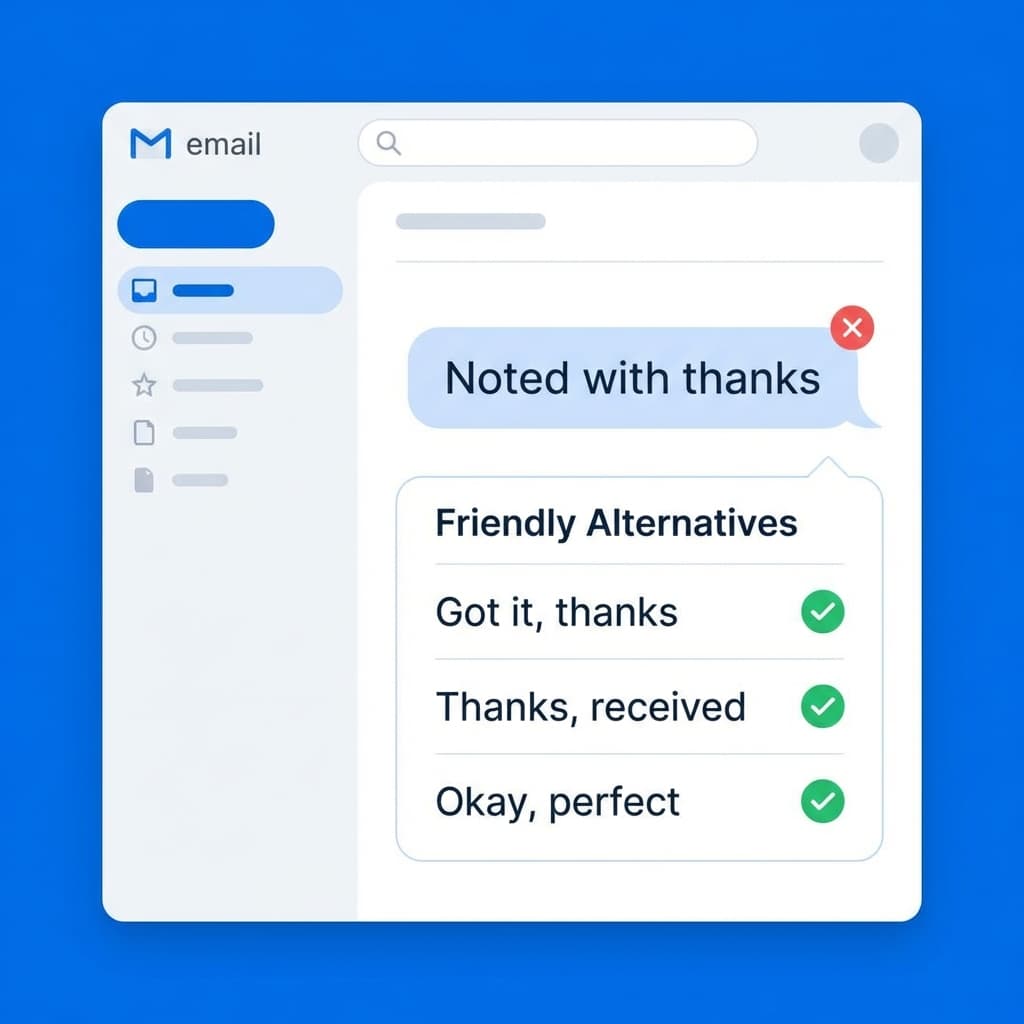
“Noted with thanks” means “I have received and understood your message, and I appreciate you sending it.” It is grammatically correct and professional, particularly in Singapore, Malaysia, Hong Kong, and other Asian workplaces. However, it is brief and formulaic, so a warmer reply may work better with international clients or when an email requires action.
This guide explains the phrase’s meaning and tone, shows how to use “noted with thanks” in an email, and compares it with “noted, thank you,” “acknowledged,” and “duly noted.”
TL;DR
"Noted with thanks" means "I have received and understood your message, and I appreciate it." It is grammatically correct and professional, especially in Asian workplaces, but it can sound brief or formulaic in some international emails.
Top alternatives:
- •"Thank you for letting me know." — warm and widely natural
- •"Understood, thank you. I’ll complete this by Friday." — confirms action
- •"I’ve noted the update. Thank you." — clear and slightly more formal
AI Grammar Buddy
Make this sound professional
Improve tone for work emails without changing your meaning.
Jump to sections
Use these anchors to jump straight to the section you need.
What Does "Noted with Thanks" Mean?
“Noted with thanks” is a short acknowledgement used mainly in workplace emails. It has two parts:
- “Noted” means “I have received, understood, or recorded your message.”
- “With thanks” expresses appreciation for the information or update.
Together, the phrase tells the sender that their message has been received and understood. It does not necessarily mean that you agree with the message or have completed any requested action.
Example: “Noted with thanks. I will send the revised schedule by Friday.”
The first sentence acknowledges the message; the second confirms what will happen next. That combination is clearer than a bare acknowledgement when the sender expects action.
Is "Noted with Thanks" Grammatically Correct?
Yes, “noted with thanks” is grammatically correct.
“Noted” is a past participle used in an elliptical construction—shorthand for “Your message has been noted,” with the subject and auxiliary verb omitted. This type of shortening is common in professional communication, just as people write “Received” instead of “Your document has been received.”
“With thanks” adds gratitude to the implied statement. The question is therefore not whether the phrase is correct, but whether its tone fits the reader and situation.
If you are comparing it with another regional acknowledgement, see our guide to “well noted” meaning in email.
Is "Noted with Thanks" Professional?
Yes. “Noted with thanks” is professional, but it is also short and slightly formulaic.
It is common and natural in workplace English in Singapore, Malaysia, Hong Kong, India, and other parts of Asia. In these settings, it often functions as an efficient, polite acknowledgement of a routine update.
In some US or UK business communication, the phrase is less common and may sound stiff. A reader may prefer one of these alternatives:
- “Thanks for letting me know.”
- “I’ve noted the update.”
- “Understood, thank you.”
- “Thank you for the information.”
None of these choices makes “noted with thanks” wrong. The most professional version is the one that matches your workplace, relationship, and the amount of detail the sender needs.
Is "Noted with Thanks" Rude?
No, it is not rude by itself. It can, however, feel cold or dismissive when the message deserves more than a routine acknowledgement.
“Noted with thanks” usually works well for a meeting-time change, an FYI message, or a simple file delivery. It is less suitable for a detailed client request, difficult news, or feedback that took effort to prepare. In those cases, mention the subject or state your next step.
Compare these replies:
- Brief but professional: “Noted with thanks.”
- Warmer and more useful: “Thanks for the detailed feedback. I’ll revise the proposal and send it back by tomorrow.”
Both acknowledge the email, but the second shows engagement. If your draft may sound too direct, use the Email Improver to make the tone warmer while keeping your intended meaning.
Is “Noted and Thank You” Correct?
“Noted and thank you” is understandable, but it is not the most natural way to combine these ideas. “Noted” is a shortened acknowledgement, while “thank you” is a separate expression. Joining them with and makes the sentence feel uneven.
Use a comma or two complete sentences instead:
| Version | Assessment | Tone |
|---|---|---|
| “Noted and thank you.” | Understandable, but unnatural | Slightly awkward |
| “Noted, thank you.” | Correct and natural | Brief, polite |
| “Noted. Thank you.” | Correct, with stronger separation | Direct, neutral |
| “I’ve noted the update. Thank you.” | Complete and polished | Professional, slightly formal |
| “Thanks, I’ve noted the change.” | Natural and conversational | Friendly, professional |
“Noted, thank you” works well for routine instructions or information from a colleague. For a client or a more important request, “Thank you. I’ve noted the changes and will send the revision by Thursday” sounds more engaged.
Can I Say “Noted, Thank You”?
Yes. “Noted, thank you” is a correct and natural short reply. It is suitable when you need to confirm a clear instruction, schedule change, or routine update without starting a longer discussion.
The phrase can still feel too brief if the sender expects action, reassurance, or empathy. Choose the version that communicates enough:
- “Noted, thank you.” Brief and polite; best for routine internal messages.
- “Understood, thank you.” Confirms that an instruction is clear; useful when you have been assigned a task.
- “Thanks for letting me know.” Warmer and more conversational; a safe choice for most updates.
- “I’ve noted the update. Thank you.” Slightly more formal and explicit; useful with clients or senior colleagues.
When a deadline or deliverable is involved, add it: “Noted, thank you. I’ll complete the review by 4 PM.”
How to Use “Noted with Thanks” in an Email
The phrase works best when you add enough detail to remove uncertainty. The following replies are short enough for real workplace use but specific enough to be helpful.
1. Replying to Your Manager’s Instructions
Situation: Your manager asks you to update a report by Friday.
Suggested reply:
Noted, thank you. I’ll update the report and send it to you by Friday afternoon.
Why it works: It confirms that you understand both the task and the deadline. It also sounds more dependable than “Noted” alone.
2. Confirming a Meeting Time
Situation: A colleague moves a meeting from 2 PM to 3 PM.
Suggested reply:
Noted with thanks. I’ll join the call at 3 PM.
Why it works: A routine schedule change needs only a brief acknowledgement. Repeating the new time prevents confusion.
3. Confirming Receipt of a Document
Situation: A colleague sends the signed agreement you requested.
Suggested reply:
Thank you. I’ve received the signed agreement and will review it this afternoon.
Why it works: It identifies the document and states the next step. For more receipt confirmations, see these acknowledge-receipt email examples.
4. Replying to a Client Update
Situation: A client tells you that the launch date has changed.
Suggested reply:
Thanks for the update. I’ve noted the new launch date and will adjust the project plan accordingly.
Why it works: It sounds warm, shows that you read the update, and explains its effect. This is often more natural than a formulaic two-word reply to a client.
5. Confirming a Deadline or Work Arrangement
Situation: Your team lead confirms that you will work remotely on Friday and submit the draft by noon.
Suggested reply:
Understood, thank you. I’ll work remotely on Friday and submit the draft by 12 PM.
Why it works: It restates both parts of the arrangement, giving the sender a chance to correct any misunderstanding.
Before sending an important reply, you can also use the free grammar checker to catch punctuation and sentence-level errors.
To: Sarah Chen (London Office)
To: Sarah Chen (London Office)
When "Noted with Thanks" Works—and When to Avoid It
Use it when a brief acknowledgement is genuinely enough:
- a simple notification or meeting change
- an FYI email with no action required
- a routine internal message from a familiar colleague
- confirmation that a file or document arrived
Choose a fuller reply when:
- a client or senior manager sends a detailed request
- the message contains bad news or a sensitive issue
- the sender needs to know what you will do next
- the request is unclear and you need to ask a question
For an instruction such as “kindly do the needful,” confirm the exact task and timeline rather than sending a bare acknowledgement. Our guide explains how to reply to “kindly do the needful”.
8 Professional Alternatives to "Noted with Thanks"
| Alternative | Best used when | Example |
|---|---|---|
| “Thank you for letting me know.” | Almost any update | “Thank you for letting me know. I’ll adjust the timeline.” |
| “Understood, thank you.” | A clear instruction | “Understood, thank you. I’ll send the draft by Wednesday.” |
| “Thanks for the update.” | An FYI message | “Thanks for the update. I’ll keep this in mind for the presentation.” |
| “Received, thank you.” | Confirming delivery | “Received, thank you. I’ll review the attachment shortly.” |
| “Thanks for flagging this.” | An issue or risk | “Thanks for flagging this. I’ll check with the vendor today.” |
| “Acknowledged.” | Formal or procedural communication | “Acknowledged. We will respond within two business days.” |
| “Got it, thanks!” | Informal internal chat | “Got it, thanks! I’ll update the shared document.” |
| “I’ve noted the update. Thank you.” | A polished, explicit acknowledgement | “I’ve noted the revised date. Thank you for the information.” |
The safest general choice is “Thank you for letting me know.” When action is required, add a specific next step and deadline.
For copy-ready replies organised by manager, colleague, client, vendor, and schedule situations, use the Singapore workplace alternatives guide. If the question is specifically whether the phrase sounds rude in a Singapore office, continue to the Singapore office tone guide.
Noted vs Acknowledged
Both words confirm awareness, but their emphasis and formality differ.
| Word | Meaning | Best use | Natural email example |
|---|---|---|---|
| Noted | You have seen, understood, or recorded the information | Everyday workplace updates and instructions | “Noted, thank you. I’ll update the calendar.” |
| Acknowledged | You formally confirm receipt or awareness | Formal, regulated, contractual, or procedural communication | “Your request has been acknowledged. We will reply within two business days.” |
“Acknowledged” can sound official or impersonal in an ordinary team email. “Noted” is more natural for day-to-day work, especially when followed by thanks or a next step.
What Does “Duly Noted” Mean?
“Duly noted” means properly acknowledged and taken into consideration. It is grammatically correct and often appears in formal, official, or procedural communication.
Its tone can create distance. A reply consisting only of “Duly noted” may sound cold, impatient, or even sarcastic, especially after criticism or disagreement. That does not make the phrase inherently rude; context and relationship determine how it is heard.
For a friendlier tone, write:
- “Thanks for pointing that out.”
- “I’ve noted your feedback.”
- “Understood. I’ll take that into account.”
- “Thank you for raising this. I’ll review it.”
Is "Okay Noted" Acceptable?
“Okay, noted” is common and easily understood in spoken conversation and internal chats, including in Singapore workplaces. With the comma, it is also grammatically acceptable.
In formal email, however, it can feel casual or abrupt. “Noted, thank you” is more polished while remaining brief. If you want a fuller explanation of agreement, acknowledgement, and “noted on this,” read our guide to “OK, noted” meaning in email.
Final Takeaway
“Noted with thanks” is correct and professional. It is particularly familiar in Asian workplace English, while some international readers may find it brief or formulaic. You do not need to avoid it; simply match the reply to the situation.
For a routine update, “Noted with thanks” may be enough. For an instruction, client request, or important deadline, add what you understood and what you will do next. A few extra words can make your email clearer, warmer, and more useful.
About This Article
Last updated 3 August 2026
Frequently Asked Questions
Is "noted with thanks" professional?▼
Yes. "Noted with thanks" is professional, but it is brief and slightly formulaic. It is especially common in Singapore, Malaysia, Hong Kong, and other Asian workplaces. In some US or UK business emails, "Thanks for letting me know" or "I’ve noted the update" may sound warmer and more natural.
Is "noted with thanks" formal?▼
It is moderately formal: more professional than "Got it, thanks," but less formal than a complete acknowledgement such as "Thank you for the information. I have noted the revised deadline." It suits routine workplace updates. For a client, senior stakeholder, or sensitive message, add a specific next step to make the reply more considerate.
Is it correct to say "noted and thank you"?▼
"Noted and thank you" is understandable, but the conjunction sounds unnatural because it joins a shortened acknowledgement with a separate expression of thanks. "Noted, thank you" is the more natural version. You can also write "I’ve noted the update. Thank you" when you want a complete, slightly more formal sentence.
Can I reply "noted, thank you" to my boss?▼
Yes, especially when your boss gives a simple instruction and no further detail is needed. If the task has a deadline or could be misunderstood, make the reply more useful: "Noted, thank you. I’ll send the revised file by 3 PM." This confirms both your understanding and the action you will take.
Is replying with "noted" rude?▼
Not automatically, but "Noted" alone can feel abrupt because it shows no warmth or next step. It is usually acceptable in quick internal chats and routine exchanges. In an email to a client or manager, soften it with thanks or context, such as "Noted, thank you. I’ll update the schedule today."
What can I say instead of "noted with thanks"?▼
Choose an alternative that matches the situation: "Thanks for letting me know" for a friendly update, "Understood, thank you" for instructions, "I’ve received the document, thank you" for an attachment, or "Thank you for the information" for a formal reply. Add your next step when the sender expects action.
What is the difference between "noted" and "acknowledged"?▼
"Noted" means you have seen, understood, or recorded information. "Acknowledged" is a more formal confirmation that you have received or become aware of it. "Noted, I’ll update the plan" sounds natural in everyday work email; "Receipt of your request is acknowledged" suits formal or procedural communication.
What does "duly noted" mean?▼
"Duly noted" means that something has been properly acknowledged and considered. It has a formal, impersonal tone and can create distance. Because people sometimes use it sarcastically, a short "Duly noted" may sound cold or impatient. Friendlier options include "Thanks for pointing that out" and "I’ve noted your feedback."
Next step
Make this sound professional
Improve tone for work emails without changing your meaning.
Keep going
Continue with AI Grammar Buddy
AI Grammar Buddy
Email Improver
Paste your draft and rewrite it for clearer, more professional English.
Improve My ToneRelated guide
Business Trip English Phrases: Airport, Hotel & Meetings
Learn practical business trip English phrases for airports, immigration, hotels, meetings, and delays, with mini dialogues and ready-to-use examples.
30 July 2026
Related guide
OK Noted Meaning in Email: Rude? Better Replies
What does OK noted mean in email? Is okay noted rude? Why noted on this is wrong, plus clearer professional replies you can copy.
18 July 2026
Related guide
AI Email Rewriter for Professional Emails (Before & After)
Turn rough drafts into professional emails. See before-and-after rewrites, better prompts, and common mistakes that affect tone, clarity, and structure.
17 June 2026