15 Polite Ways to Say No (Work & Email Examples)
15 ways to say no politely with workplace and email examples, common mistakes, and a quick reference table. Paste your draft into AI Grammar Buddy to make it sound more professional and natural.
Every workday, you have to turn something down: overtime, last-minute requests, extra reports, or one more meeting. If you handle it badly, you sound either unprofessional or too soft. These 15 examples of a polite way to say no help you refuse clearly while protecting the relationship.
If your draft sounds blunt or overly apologetic, run it through AI Grammar Buddy's Email Improver once before sending so you can check the tone before it reaches a client, manager, or colleague.
Jump to sections
Use these anchors to jump straight to the section you need.
Quick Answer
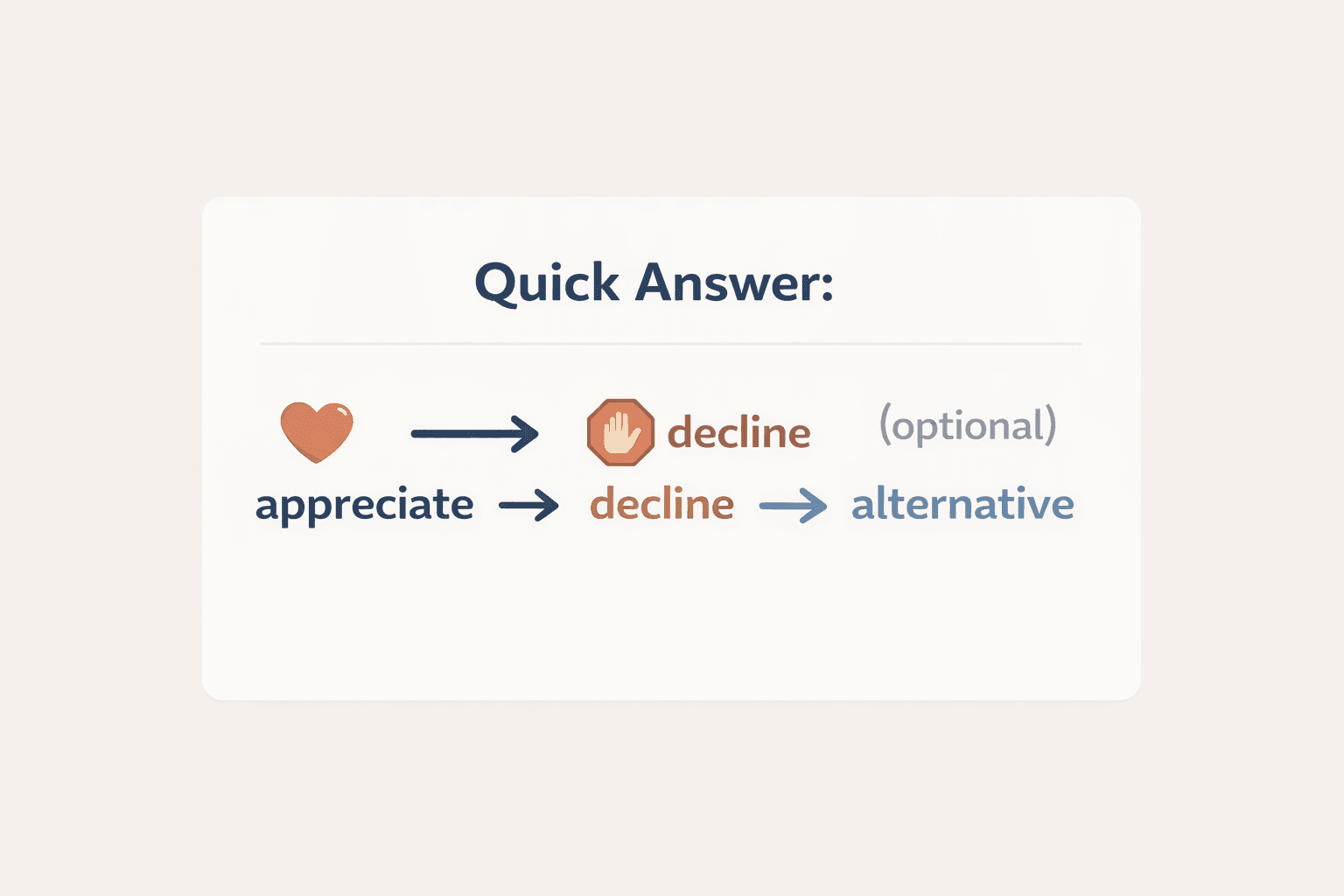
A polite way to say no acknowledges the request, gives a clear refusal, and offers a realistic alternative only when you mean it. Example: "Thanks for asking, but I can't take this on today. I can review it tomorrow morning if that still helps."
If you want a quick tone check before you send anything, paste the draft into AI Grammar Buddy's Email Improver and compare your original with the rewrite.
How do you say no politely at work?
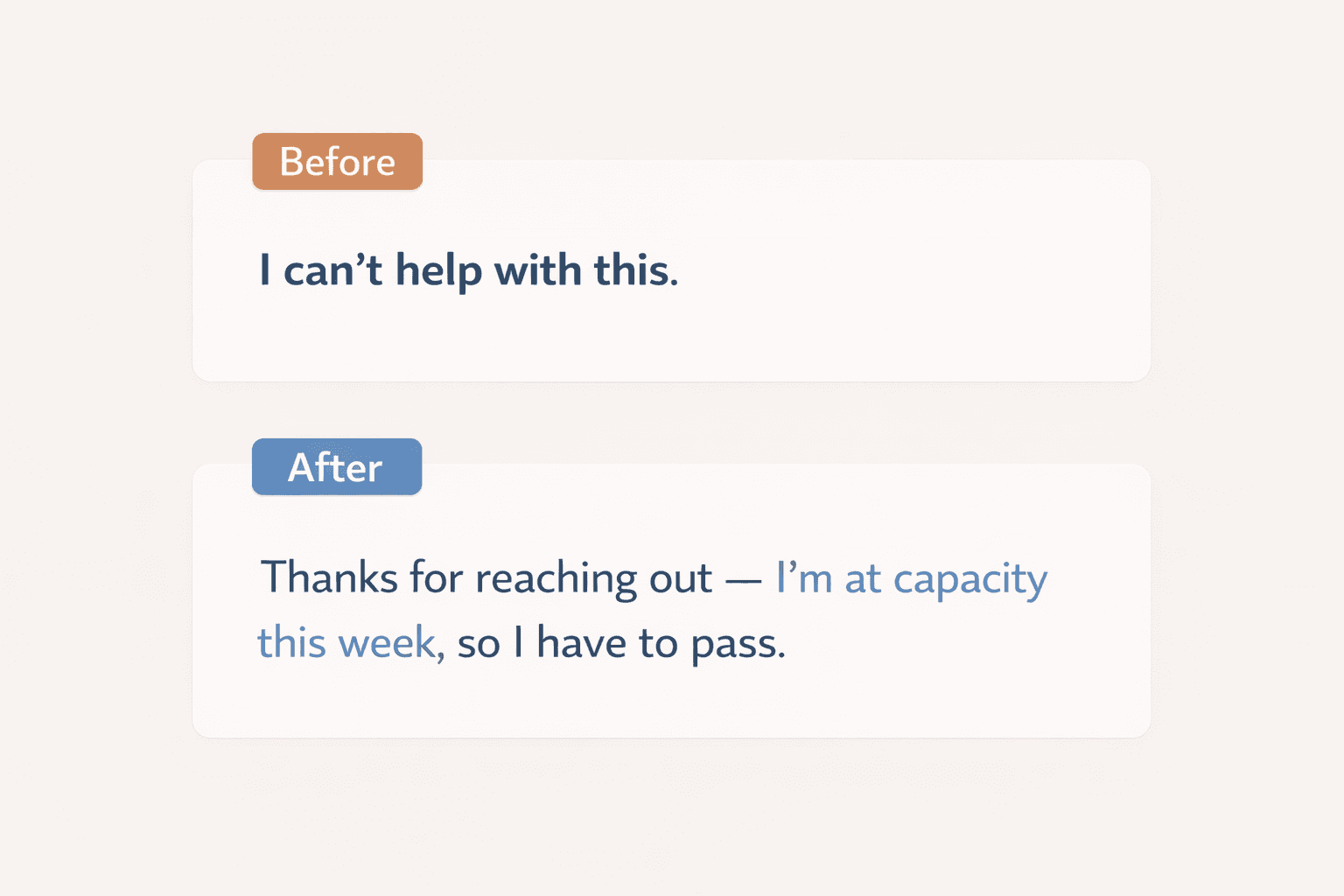
A polite refusal at work is short, specific, and easy to understand. Start with appreciation, say no clearly, and explain the limit in one sentence. For example: "Thanks for asking. I can't join this project this week because I'm already covering month-end work."
This matters because vague refusals create follow-up questions, while blunt refusals create friction. A useful refusal does three jobs:
- protects your workload and deadlines
- avoids overcommitting
- sets a clear boundary
- leaves the other person with a usable next step
If you want more workplace wording beyond this article, see our guide to professional email phrases for Singapore and Asia.
If the conversation continues after your first reply, this guide on follow-up email after no response can help you keep the tone steady without sounding pushy.
15 Polite Ways to Say No
1. I appreciate the offer, but I can't commit right now.
Why it works: It sounds respectful and honest without creating false hope.
Example sentence: I appreciate the offer, but I can't commit right now because I'm focused on two urgent deadlines this week.
2. I'd love to help, but I'm currently at capacity.
Why it works: This is a professional way to say no when your schedule is already full.
Example sentence: I'd love to help, but I'm currently at capacity and would not be able to give this the attention it deserves.
3. Unfortunately, I won't be able to take this on.
Why it works: Clear, neutral, and easy to use in most business situations.
Example sentence: Unfortunately, I won't be able to take this on before Friday.
4. I'm not the best person for this, but I can point you to someone else.
Why it works: You decline while still being helpful.
Example sentence: I'm not the best person for this, but I think Daniel from operations would be a better fit.
5. I can't meet that deadline, but I can deliver it by Thursday.
Why it works: Useful when the answer is not a full no, but a no to the current expectation.
Example sentence: I can't meet that deadline, but I can deliver the revised version by Thursday afternoon.
6. That won't be possible for me right now.
Why it works: Soft, professional, and suitable for email.
Example sentence: That won't be possible for me right now, as we are closing month-end reporting.
7. I need to decline, but thank you for thinking of me.
Why it works: Good for invitations, side projects, and optional requests.
Example sentence: I need to decline, but thank you for thinking of me for the panel discussion.
8. I won't be able to attend, but I appreciate the invitation.
Why it works: A polite default for events, calls, and meetings.
Example sentence: I won't be able to attend, but I appreciate the invitation and hope it goes well.
9. I have to pass on this one.
Why it works: Short and natural, especially when you want a warmer tone.
Example sentence: I have to pass on this one, as my schedule is already full this week.
10. I'm unable to approve this as it stands.
Why it works: Useful when you need to reject an idea, draft, or proposal without sounding emotional.
Example sentence: I'm unable to approve this as it stands, but I'm happy to review a revised version.
11. I can't support that approach, but I can support this alternative.
Why it works: Strong choice when you need to disagree professionally.
Example sentence: I can't support that approach, but I can support a phased rollout next month.
If you need to state a firm requirement rather than decline, see when “insist” is appropriate in professional English.
12. I'm afraid I need to say no this time.
Why it works: Softens the refusal while keeping it clear.
Example sentence: I'm afraid I need to say no this time because our team is already committed elsewhere.
13. I can't commit to that level of involvement.
Why it works: Helpful when someone expects more time or ownership than you can give.
Example sentence: I can't commit to that level of involvement, but I can review the final draft.
14. I need to prioritize other deadlines at the moment.
Why it works: A very common and professional way to say no in busy office settings.
Example sentence: I need to prioritize other deadlines at the moment, so I won't be able to join the working group.
15. That doesn't work for me right now, but let's revisit it later.
Why it works: This keeps the door open without saying yes.
Example sentence: That doesn't work for me right now, but let's revisit it next quarter.
How do you say no politely in email?
To say no politely in email, keep the message short, give the answer early, and make the next step obvious. A strong refusal email usually thanks the reader, declines in one clear sentence, and offers either a brief reason or one realistic alternative.
Example 1 - Declining extra work
Subject: Re: Support with the presentation
Hi Melissa,
Thanks for thinking of me. I'd love to help, but I'm currently at capacity with the client rollout this week, so I won't be able to take this on properly.
If helpful, I can take a quick look next Monday or share a template you can use.
Best,
James
Example 2 - Declining an invitation
Subject: Re: Team dinner on Friday
Hi Aaron,
Thank you for the invitation. I won't be able to attend on Friday, but I appreciate you including me.
I hope everyone has a great evening.
Best regards,
Nina
If you need more invitation wording, you may also like this guide on a polite way to decline an invitation.
Example 3 - Declining a meeting
Subject: Re: Proposed catch-up meeting
Hi Priya,
Thanks for sending this over. I need to decline this meeting, as I am tied up with deadline work that morning.
If it helps, feel free to send the key points by email and I will reply by the end of the day.
Best,
Daniel
For more ready-to-use formats, see our broader collection of email templates.
Still feels too sharp or too long? Paste it into AI Grammar Buddy's Email Improver and let it shorten the draft, reduce the edge, and leave you with a cleaner version to polish.
What are mistakes to avoid when saying no?
The most common mistakes are being too blunt, giving a long defensive explanation, or avoiding the answer altogether. Each one creates extra work: blunt messages sound rude, long messages sound uncertain, and silence forces the other person to chase you for clarity.
Being too blunt
Messages like "No, I can't" or "That won't work" can sound cold unless you already have a very direct working relationship. A short softener such as "Thanks for asking" or "I appreciate the invite" usually makes the tone safer.
Over explaining
A long defense often makes you sound uncomfortable or uncertain. One short reason is usually enough. The goal is clarity, not self-justification.
Ignoring requests
Silence is rarely a professional solution. Even a brief response is better than leaving someone waiting. If you know the answer is no, say it clearly and early.
The safest formula is simple:
- acknowledge the request
- give a clear no
- offer an alternative only if you genuinely want to
What’s a professional alternative to "no"?
The best professional alternatives to "no" keep the refusal clear while softening the tone. They work well when you are declining a request from a client, manager, or colleague but still want to sound cooperative and calm.
- I'm afraid that won't be possible.
- I'm not able to take this on.
- That won't work for me right now.
- I won't be able to commit to that.
- I'm unable to support this request at the moment.
- I need to decline for now.
- I can't approve this in its current form.
- I have to pass on this opportunity.
These are useful when you want a more polished, professional way to say no without sounding stiff or robotic.
If tone is part of the problem, it also helps to compare your reply with common office phrases like noted with thanks and decide whether your message sounds too abrupt, too formal, or just right.
Quick Reference Table
| Phrase | Tone | Best Situation |
|---|---|---|
| I appreciate the offer, but I can't commit right now. | Warm and professional | New request, project, favor |
| I'd love to help, but I'm currently at capacity. | Polite and firm | Extra work from a colleague |
| Unfortunately, I won't be able to take this on. | Neutral | General business refusal |
| I need to decline, but thank you for thinking of me. | Friendly | Invitation or optional opportunity |
| I won't be able to attend, but I appreciate the invitation. | Courteous | Events and meetings |
| I'm unable to approve this as it stands. | Direct and professional | Drafts, proposals, decisions |
| I need to prioritize other deadlines at the moment. | Calm and practical | Workload conflicts |
| That doesn't work for me right now, but let's revisit it later. | Diplomatic | Future opportunities |
Improve Your Email Tone with AI Grammar Buddy
Sometimes the draft says the right thing in the wrong way. One version sounds abrupt. Another sounds like an apology with no clear answer. A rewrite helps when you need to keep the no, but improve the wording.
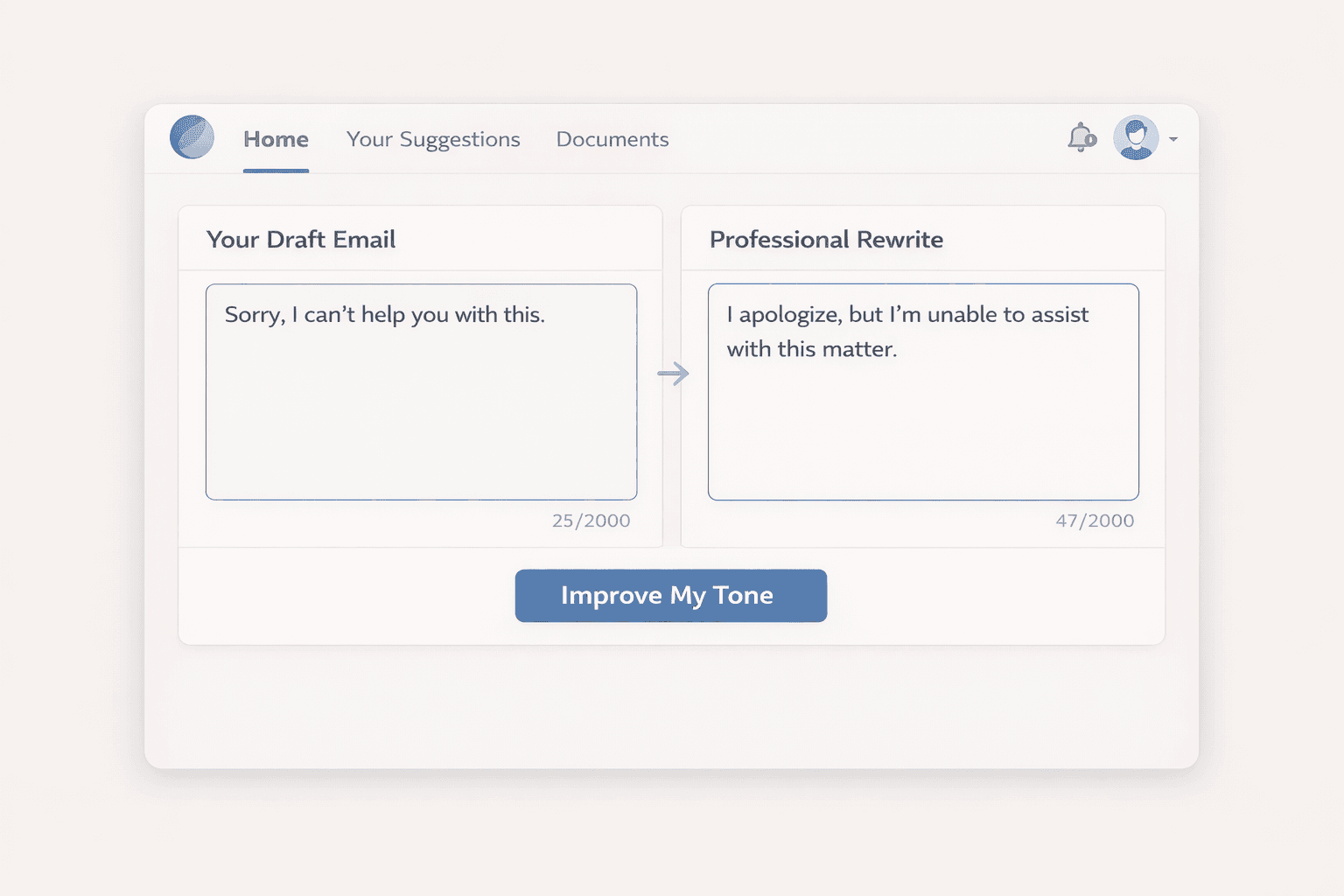
Improve tone with AI Grammar Buddy when you want to soften a refusal, tighten an email, or make your wording sound more confident without becoming rude.
Refusal Rewrite Demo
Before: "No, I can't do this. I'm too busy."
AI Grammar Buddy rewrite: "Thanks for checking with me. I'm at capacity today, so I won't be able to take this on. If it helps, I can review it tomorrow morning."
After (human tweak): "Thanks for checking with me. I'm at capacity today, so I won't be able to take this on before tomorrow. If it helps, I can review the draft at 10 AM."
Improve My Tone
Paste your message into AI Grammar Buddy and instantly get a more professional version.
Conclusion
A polite way to say no is clear, brief, and specific. You do not need a long apology. You need a sentence the other person can understand quickly, act on, and respect.
If you want a last pass before sending, check the draft in AI Grammar Buddy's Email Improver and compare it against guides like how to say no professionally in workplace email phrases or a polite way to decline an invitation.
About This Article
AI Grammar Buddy Editorial Team
Business English Editorial Team
AI Grammar Buddy's editorial team writes and reviews workplace English guides for professionals and non-native English speakers, with a focus on tone, clarity, and practical email communication.
Last updated 14 March 2026
Frequently Asked Questions
What is the most polite way to say no at work?▼
A polite way is to thank the person, clearly decline, and give one short reason or alternative. For example: 'Thanks for thinking of me. I'm at capacity this week, so I have to pass.'
How do you say no politely in email?▼
Keep the email short and direct. Start with appreciation, state the no clearly, and offer an alternative only if you genuinely want to. That sounds more professional than a long apology.
Should you give a reason when saying no?▼
Usually yes, but keep it brief. One sentence is enough. The point is to make your refusal understandable without turning it into a long defense.
What should you avoid when declining a request?▼
Avoid being too blunt, over-explaining, or ignoring the request. A short, clear reply is usually more respectful and easier for the other person to understand.
Keep going
Continue with AI Grammar Buddy
AI Grammar Buddy
Email Improver
Paste your draft and rewrite it for clearer, more professional English.
Improve My ToneRelated guide
Business Trip English Phrases: Airport, Hotel & Meetings
Learn practical business trip English phrases for airports, immigration, hotels, meetings, and delays, with mini dialogues and ready-to-use examples.
30 July 2026
Related guide
OK Noted Meaning in Email: Rude? Better Replies
What does OK noted mean in email? Is okay noted rude? Why noted on this is wrong, plus clearer professional replies you can copy.
18 July 2026
Related guide
AI Email Rewriter for Professional Emails (Before & After)
Turn rough drafts into professional emails. See before-and-after rewrites, better prompts, and common mistakes that affect tone, clarity, and structure.
17 June 2026