Prepone Meaning: Is It Correct English? 10 Alternatives
Prepone means move an event to an earlier time. Learn its Indian English context, preponed meaning, prepone vs postpone, and clear email alternatives.

Prepone means to move a scheduled event to an earlier time or date. It is a recognised verb in Indian English and the opposite of postpone. In a global business email, some readers may not recognise it, so move earlier, bring forward, or reschedule for an earlier time is usually clearer.
The word is not a grammar mistake. It is a regional English word whose familiarity changes with the audience. This guide explains prepone, preponed, the difference from postpone, and ten alternatives you can use in international emails.
TL;DR
Prepone means to move a scheduled event to an earlier time or date. It is a recognised Indian English verb and the opposite of postpone; for global emails, use move earlier, bring forward, or reschedule for an earlier time.
Top alternatives:
- •Move earlier — clear and natural for any audience
- •Bring forward — especially common in British English
- •Reschedule for an earlier time — precise in formal emails
AI Grammar Buddy
Rewrite this phrase in context
Paste your sentence and AI Grammar Buddy will turn it into clearer professional English.
Jump to sections
Use these anchors to jump straight to the section you need.
Prepone Meaning: What Does It Mean?
In Indian English, prepone means "to bring something forward to an earlier time."
It is the direct opposite of postpone (to move to a later time).
- Prepone: Wednesday ← Friday (move earlier)
- Postpone: Friday → Monday (move later)
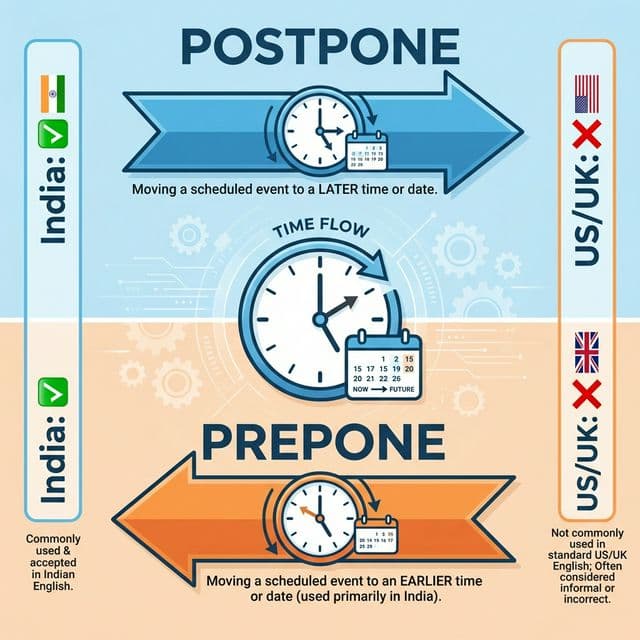
Examples of common Indian usage:
- "Can we prepone the meeting from 3 PM to 1 PM?"
- "The submission deadline has been preponed."
- "We need to prepone our travel plans."
For clearer language when a flight delay changes a client schedule, use these business trip English phrases and rescheduling examples.
If a proposed meeting date is still a hold rather than a commitment, compare it with this tentative meaning in emails and meetings guide.
In an Indian workplace, one word replaces longer phrases such as "bring forward" or "reschedule to an earlier time."
The Cambridge English Dictionary defines prepone as an Indian English verb meaning to do something earlier than planned. That regional label matters: the word is established and understandable in India, but it is not the safest default for an international audience.
English “Prepone” vs Spanish “Prepone”
The spelling prepone also appears in Spanish, but it is not the English scheduling verb. The two words belong to different languages and have different meanings and pronunciations.
| English prepone | Spanish prepone | |
|---|---|---|
| Grammar | Verb used mainly in Indian English | A present-tense form of the verb preponer |
| Meaning | Move an event to an earlier time or date | He, she, or formal “you” puts something before something else or gives it priority |
| Pronunciation | /priːˈpəʊn/ or /priːˈpoʊn/ | Approximately /pɾeˈpone/ |
| Example | “Can we prepone the meeting to Tuesday?” | “Ella prepone la seguridad al coste.” (“She puts safety before cost.”) |
If a Spanish dictionary or translator shows a different definition, it is describing the conjugated form of Spanish preponer, not correcting the Indian English word.
Preponed Meaning: Past Tense and Examples
Preponed is the past tense and past participle of prepone. It means that an event, deadline, appointment, or release was moved to an earlier time or date.
| Form | Example in Indian English | Clear global alternative |
|---|---|---|
| Present: prepone | “Can we prepone the meeting?” | “Can we move the meeting earlier?” |
| Past: preponed | “The meeting was preponed to Tuesday.” | “The meeting was moved up to Tuesday.” |
| -ing form: preponing | “We are preponing the review.” | “We are bringing the review forward.” |
In other words, preponed meaning is not “cancelled” or “finished early.” It specifically describes a scheduled change to an earlier point in time.
Prepone vs Postpone
The difference is the direction of the schedule change:
| Word | Meaning | Example |
|---|---|---|
| Prepone | Move an event earlier | “We preponed the meeting from Friday to Wednesday.” |
| Postpone | Move an event later | “We postponed the meeting from Friday to Monday.” |
Both words describe a change to an existing plan. The important detail is whether the new date comes before or after the original date. If your readers are unfamiliar with prepone, say “move earlier” instead of relying on the prefix to explain it.
Is "Prepone" Correct English?
The answer depends entirely on where you are.
In India: Yes, It Is Established
In Indian English, the term is correct and widely understood. It appears in newspapers, official notices, and workplace communication.
- The Oxford Advanced Learner's Dictionary lists it as "Indian English."
- It is accepted in the Cambridge Dictionary (again, marked as "Indian English").
If you're emailing a colleague in Hyderabad or chatting with a vendor in Pune, using it is perfectly fine. It's professional, efficient, and widely understood.
In the US/UK: Recognised, but Uncommon
Cambridge and Oxford list prepone as an Indian English verb, but it is not a normal default in American or British business writing.
If you say "prepone" to a client in New York or London:
- Americans may need to infer the meaning from context because the word is uncommon in their business writing.
- British people might guess what you mean because the logic (pre- vs post-) is sound, but they will usually say "bring forward" instead.
Why the Difference?
The modern scheduling sense of prepone is strongly associated with Indian English because it fills a useful gap. Global English has a single word for moving something later (postpone) but normally uses a phrase for moving it earlier.
Indian English speakers adopted a concise word that fills this lexical gap.
American and British English already use phrases such as "advance", "move up", and "bring forward", so those remain the familiar choices in those varieties.
The Logic Behind "Prepone"
Logically, it makes perfect sense.
-
Prefix Logic:
- Post- means "after" (as in post-war, post-script).
- Pre- means "before" (as in pre-war, preview).
- If Postpone = put after, then Prepone = put before. The logic is flawless.
-
Efficiency: Saying "Can we prepone?" (3 words) is much faster than saying "Can we reschedule to an earlier time?" (7 words). In the fast-paced environment of Indian IT parks and business hubs, efficiency wins.
-
Regional usage: English develops differently across regions. Prepone is not “bad” English; it is an established word in one recognised variety of English and less familiar in others.
How to Say "Prepone" in a Professional Email
When writing to US, UK, or mixed international teams, replace prepone with a phrase that states the new time directly. The most natural choice depends on your audience and how formal the email needs to be.
Before: “Can we prepone the client call to Tuesday?”
After: “Could we move the client call to Tuesday instead?”
Before: “The deadline has been preponed to 5 June.”
After: “The deadline has been moved up to 5 June.”
Before: “Please prepone your arrival by 30 minutes.”
After: “Could you arrive 30 minutes earlier?”
For a formal update, use: “The review has been brought forward to Thursday.” For a direct scheduling request, use: “Could we reschedule the meeting for an earlier time?” These alternatives preserve the meaning without requiring the reader to know Indian English.
If you are unsure whether your sentence sounds too regional or too direct, paste it into AI Grammar Buddy’s Email Improver for a quick tone and clarity check.
10 Alternatives to “Prepone” for Global Emails
When the audience may be unfamiliar with Indian English, choose a phrase that makes the time change explicit.
| ❌ Indian English | ✅ US/UK English | Example |
|---|---|---|
| Can we prepone the meeting? | Can we move the meeting earlier? | "Can we move the meeting earlier to 2 PM?" |
| Can we bring the meeting forward? | "Can we bring the meeting forward to Monday?" | |
| Can we reschedule to an earlier time? | "Can we reschedule to 10 AM instead?" | |
| Can we advance the meeting? | "Can we advance the meeting by one hour?" (Formal) | |
| Can we set an earlier time? | "Could we set an earlier time for the review?" | |
| The deadline is preponed | The deadline has been moved up | "The deadline has been moved up to Friday." |
| The deadline is now earlier | "The deadline is now earlier than planned." | |
| We're moving the deadline forward | "We're moving the deadline forward by two days." | |
| Please prepone your arrival | Please arrive earlier | "Could you please arrive 30 minutes earlier?" |
| Please come earlier than planned | "Please come at 9 AM instead of 10 AM." |
Why These Work Better
- "Move up" is very common in American English. (e.g., "Let's move up the deadline.")
- "Bring forward" is standard in British English. (e.g., "The meeting has been brought forward.")
- "Advance" is formal but universally understood.

Real Email Examples: India Office to Global Teams
Here are 4 real-world fixes:
Example 1: Meeting Request (India to US)
❌ Before (Standard Indian English):
"Hi Team,
Due to the client call, can we please prepone our sync to 11 AM?
Thanks, Raj"
✅ After (Global English):
"Hi Team,
Due to a client call, could we move our sync meeting earlier to 11 AM?
Thanks, Raj"
Why it works: "Move earlier" is instantly clear to any English speaker, removing any risk of confusion.
Example 2: Changing a Deadline
❌ Before:
"Dear Sarah,
We have preponed the submission date to Thursday. Please do the needful.
Regards, Priya"
✅ After:
"Dear Sarah,
We have moved up the submission date to Thursday. Please proceed accordingly.
Regards, Priya"
Why it works: "Moved up" is the standard American phrase for making a deadline earlier. (Also, we replaced "do the needful" for extra clarity!).
Example 3: Event Rescheduling
❌ Before:
"Hi everyone,
The town hall is preponed by 30 minutes.
Best, Amit"
✅ After:
"Hi everyone,
The town hall will begin 30 minutes earlier than scheduled.
Best, Amit"
Why it works: "Begin 30 minutes earlier" is precise and avoids any jargon.
Example 4: Travel Plans
❌ Before:
"Boss, can I prepone my flight to avoid the storm?"
✅ After:
"Boss, can I move my flight to an earlier time to avoid the storm?"
Why it works: It takes a few more words, but "move to an earlier time" is unambiguous.
Frequently Asked Questions
Q: Is "prepone" grammatically correct? A: In Indian English, yes. It is listed as an Indian English verb in dictionaries such as Cambridge and Oxford. For international communication, use "move earlier" or "bring forward" because those phrases are more familiar in US/UK business writing.
Q: Do British people understand "prepone"? A: They might guess the meaning from context, but they don't use the word. It's better to use standard phrases like "bring forward."
Q: Why is "prepone" uncommon in US/UK English? A: American and British English already use phrases like "move up," "advance," and "bring forward" for the same idea. Prepone is recognised but strongly associated with Indian English, so it is less familiar to international readers.
Q: Can I use "prepone" with my Indian colleagues? A: Absolutely! Within India, "prepone" is perfectly acceptable and widely understood.
Q: What's the opposite of "postpone" in English? A: English doesn't have a single-word opposite. Use phrases like "bring forward," "move earlier," or "advance."
Q: Is "prepone" used in other countries? A: Rarely. It's primarily an Indian English word, though you might hear it occasionally in Singapore or Malaysia due to Indian influence.
Q: Will my email sound wrong if I use "prepone" with foreigners? A: They might not understand it immediately, which can cause confusion. Using clearer phrases ensures your message is understood the first time.
Q: How can I check if my email uses Indian English expressions? A: Paste the full message into AI Grammar Buddy’s Email Improver and compare the rewrite with your original. For prepone, choose a version that states the new date or time directly.
Check the Full Email, Not Just One Word
Regional phrases often appear together. For example, “Can we prepone the call? Please do the needful and revert back” may be clearer as “Could we move the call earlier? Please confirm whether 2 p.m. works.” You can paste the full message into AI Grammar Buddy’s Email Improver to check its clarity and tone before sending.
Final Thoughts
"Prepone" is brilliant. It's logical, efficient, and fills a real gap in English. Honestly, American and British English are missing out.
But global business communication isn't about perfect logic—it's about instant clarity.
Swap "prepone" for "move earlier" or "bring forward," and your emails become clear to any English speaker. No follow-up questions. No confusion.
Your English isn't wrong. It's regionally specific. One small word change makes it universally understood.
If you are still deciding between two versions, use AI Grammar Buddy’s Email Improver and choose the rewrite that states the new date or time most directly.
About This Article
Last updated 2 August 2026
Frequently Asked Questions
Is 'prepone' grammatically correct?▼
In Indian English, yes. Cambridge and Oxford list it as an Indian English verb meaning to move something earlier. It is less familiar in US/UK business English, so use 'move earlier' or 'bring forward' for international readers.
Do British people understand 'prepone'?▼
They might guess the meaning from context, but they don't use the word. It's better to use standard phrases like 'bring forward.'
Why is 'prepone' uncommon in US/UK English?▼
US and UK English already use phrases like 'move up,' 'advance,' and 'bring forward' for the same idea. Prepone is recognised in dictionaries but is strongly associated with Indian English, so many international readers may not use it themselves.
Can I use 'prepone' with my Indian colleagues?▼
Absolutely! Within India, 'prepone' is perfectly acceptable and widely understood.
What's the opposite of 'postpone' in English?▼
English doesn't have a single-word opposite. Use phrases like 'bring forward,' 'move earlier,' or 'advance.'
What does 'preponed' mean?▼
'Preponed' is the past tense and past participle of 'prepone' in Indian English. It means an event was moved to an earlier time or date. In global business English, use 'was moved up,' 'was brought forward,' or 'was rescheduled for an earlier time.'
What is the difference between prepone and postpone?▼
Prepone means move something earlier; postpone means move it later. For example, you prepone a meeting from Friday to Wednesday, but postpone it from Friday to Monday.
How do you say prepone in a professional email?▼
For a global audience, write 'Could we move the meeting to 2 PM?' or 'The meeting has been brought forward to Tuesday.' Use 'prepone' only when your readers are familiar with Indian English.
Is 'prepone' used in other countries?▼
Rarely. It's primarily an Indian English word, though you might hear it occasionally in Singapore or Malaysia due to Indian influence.
Will my email sound wrong if I use 'prepone' with foreigners?▼
They might not understand it immediately, which can cause confusion. Using clearer phrases ensures your message is understood the first time.
How can I check if my email uses Indian English expressions?▼
Paste the full message into Grammar Buddy’s Email Improver and compare the rewrite with your original. For prepone, choose a version that states the new date or time directly.
Next step
Rewrite this phrase in context
Paste your sentence and AI Grammar Buddy will turn it into clearer professional English.
Keep going
Continue with AI Grammar Buddy
AI Grammar Buddy
Email Improver
Paste your draft and rewrite it for clearer, more professional English.
Rewrite This PhraseRelated guide
What Does Inherent Mean? Meaning, Examples and Business English Uses
What does inherent mean? Learn the meaning, inherent in vs to, and practical sentence examples for reports, emails and everyday English.
28 September 2026
Related guide
What Does Coherent Mean? Meaning, Examples and Business English Uses
Learn what coherent means, see natural sentence examples, compare coherent vs clear, and improve the flow of your emails and reports.
27 September 2026
Related guide
What Does Persist Mean? Meaning, Grammar and Examples
Persist means to continue despite difficulty or to keep existing. Learn how to use persist in, persist with, and persist correctly with workplace examples.
23 August 2026