For Your Reference Meaning in Email + Alternatives
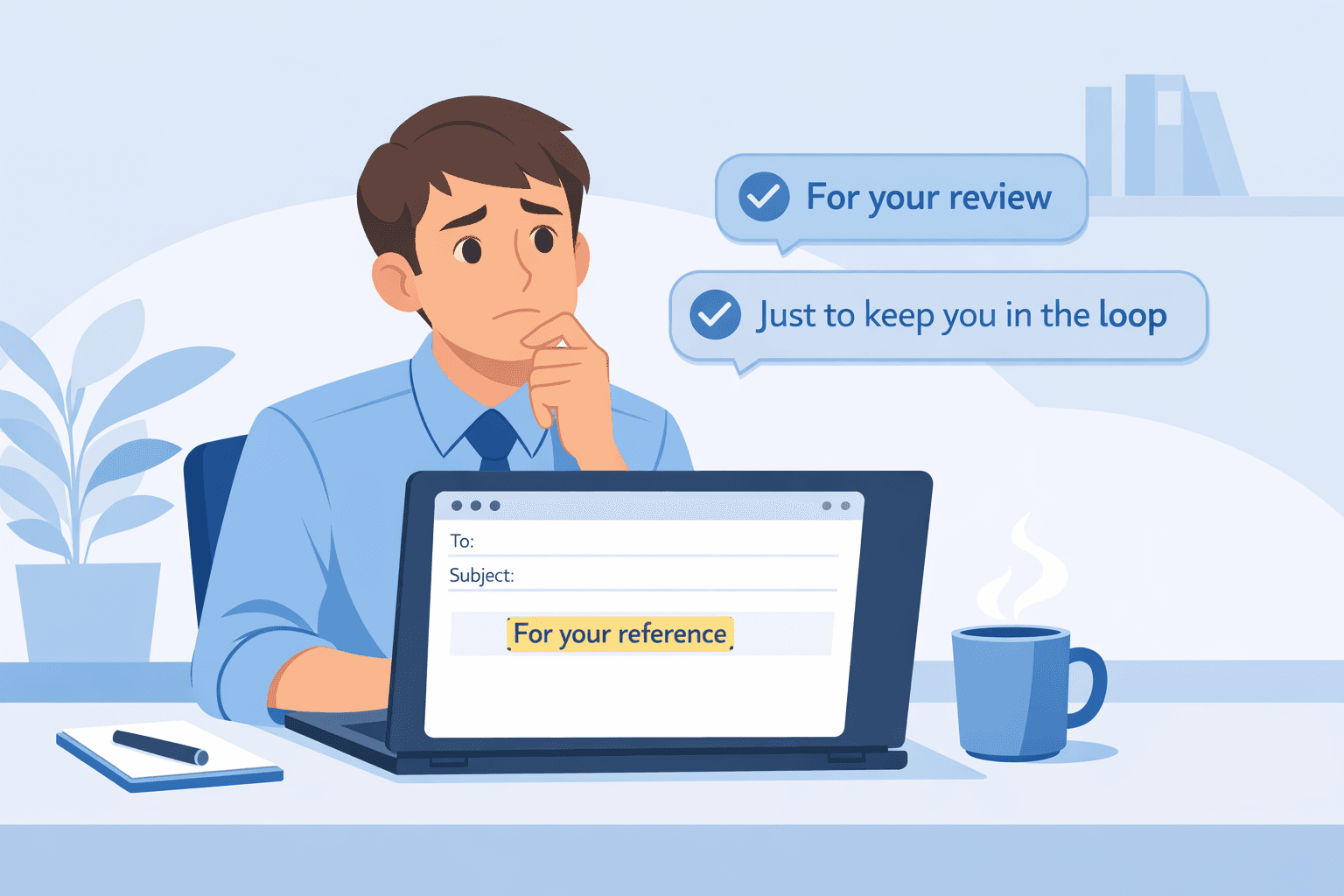
Your manager writes “for your reference” on a report. You archive it. Days later, they ask why you never reviewed it.
The problem is not English grammar. It is a hidden expectation: is this background only, or a quiet request? This guide explains for your reference meaning in email, when the phrase is safe, and what to write when you need action.
TL;DR
"For your reference" means information is being shared for possible future use, and no immediate action or reply is usually required.
Top alternatives:
- •No action needed — I am sharing this for context.
- •I have attached the signed copy for your records.
- •Please review the attached draft and send your comments by Friday.
Jump to sections
Use these anchors to jump straight to the section you need.
Quick Answer
“For your reference” means “I am sharing this information in case it is useful now or later.” In an email, it usually signals that no immediate action or reply is required.
The phrase is polite and grammatically correct. Use it for background material, records, links, or previous correspondence. Do not rely on it when you need the recipient to review, approve, sign, or respond. State that action directly.
If your draft still hides the real request, paste it into the Email Improver and rewrite “for your reference” as a clear request, record, or FYI.
“For Your Reference” Meaning in Email
In professional email, “for your reference” introduces information the recipient may consult if needed. The word reference means a source of information, so the phrase treats the document, link, or message as something useful to keep or look back at.
It commonly appears when someone is:
- attaching meeting notes or a signed document
- forwarding an earlier email thread
- sharing a policy, report, or link as background
- providing figures that explain a decision
- sending material that may be useful later
For example:
I have attached the final project schedule for your reference.
The natural interpretation is: keep or consult the schedule if you need it; I am not asking for a response right now.
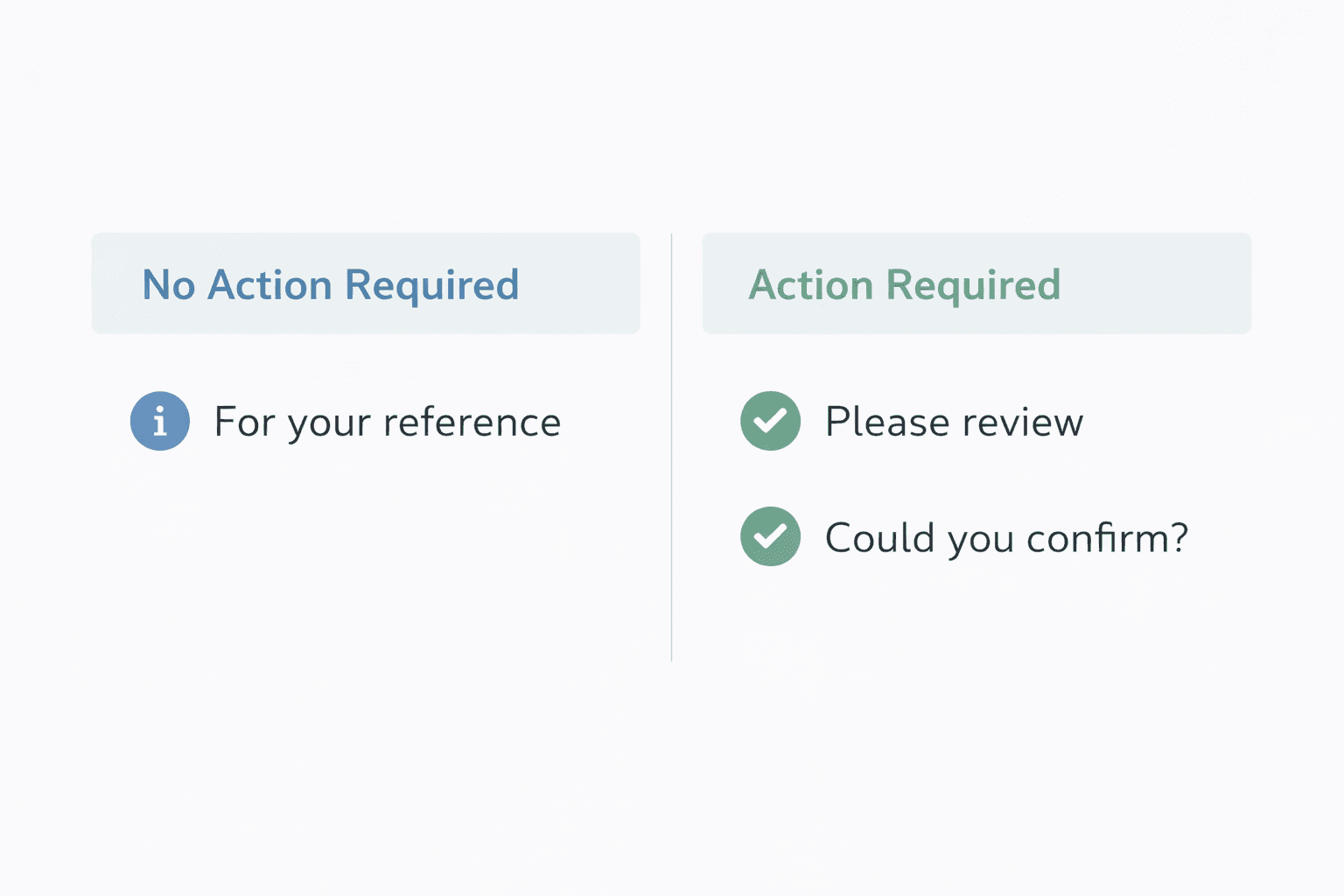
Does “for your reference” require action?
Usually, no. That is the most important distinction to understand.
| If you mean… | Write… |
|---|---|
| No action is needed | “Sharing the updated policy for your reference. No action is needed.” |
| Keep this document | “I have attached the signed agreement for your records.” |
| Read and comment | “Please review the attached draft and send your comments by Friday.” |
| Approve a request | “Please approve the attached budget by 3 p.m. Thursday.” |
| Use this as background | “I have included the earlier email thread for context.” |
If you need action, “for your reference” is not enough. Name the task, owner, and deadline instead.
That is the key difference between reference and review. Our guide to what “for your review” means in email explains when feedback, approval, or acknowledgement is expected.
Is “for your reference” polite or rude?
“For your reference” is polite, neutral, and professional. It is not inherently rude or passive-aggressive.
However, it may sound stiff in a casual team chat. It can also frustrate a reader when the rest of the message suggests an unstated request. For example, sending a contract “for your reference” and later expecting a signature creates an avoidable mismatch.
The issue is therefore clarity, not politeness.
“For your reference” vs “for your information”
These phrases overlap, but they emphasize different things:
- For your reference points to material the reader may consult later: a document, link, table, or email thread.
- For your information (FYI) tells the reader something they should know. It often introduces an update rather than a resource.
Compare:
I have attached the installation guide for your reference.
For your information, the installation has moved to Monday.
Neither sentence normally asks for a reply. If the difference does not matter, “for context” or “no action needed” is often clearer.
For another regional variation, see what “for your kind information” means and why FYI is usually safer with an international audience.
“For your reference” vs “for future reference”
For your reference provides useful material. For future reference tells someone what they should remember or do next time.
For your reference, I have attached the current expense policy.
For future reference, please submit expenses within 30 days.
Be careful with the second phrase. “For future reference” can sound corrective, especially after a mistake. A softer version is: “For next time, please submit expenses within 30 days so Finance can process them promptly.”
Better Alternatives to “For Your Reference”
The best alternative depends on what you want the reader to do. More options are not automatically better; a more exact signal is better.
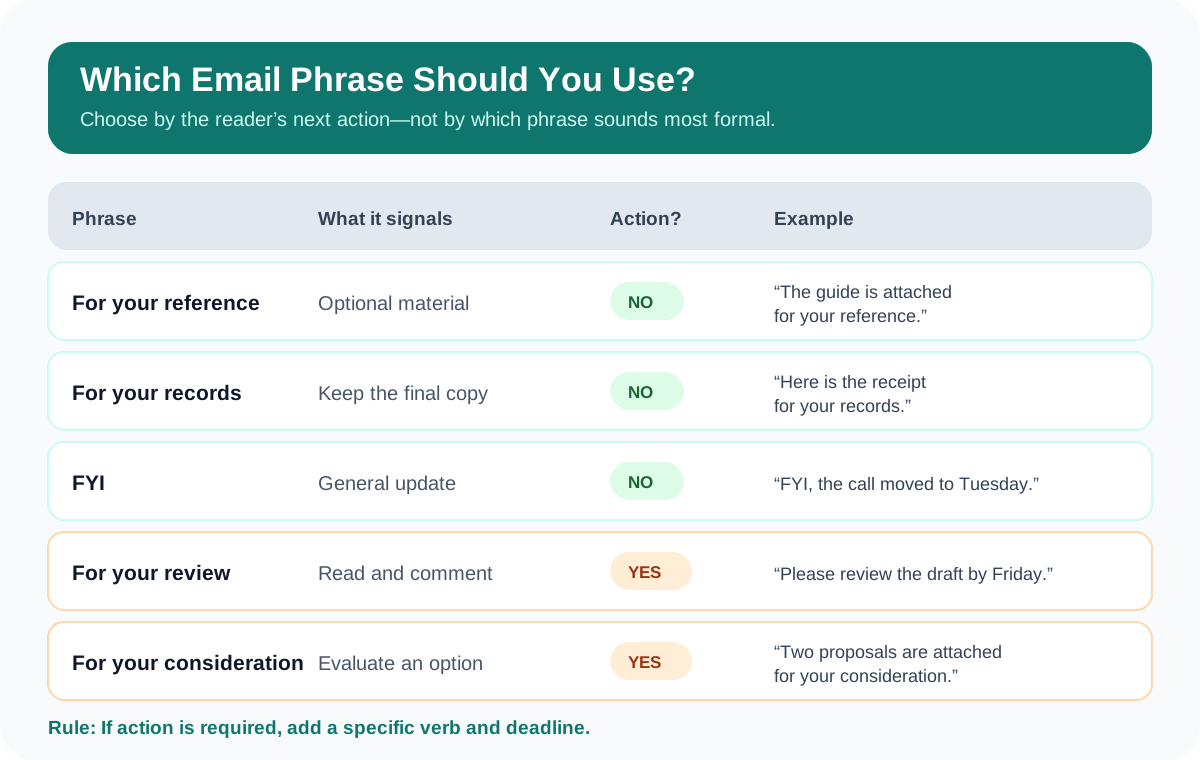
| Alternative | Use it when… | Example |
|---|---|---|
| For your records | the recipient should keep a final document | “I have attached your receipt for your records.” |
| For context | background will help explain a decision | “I have included last quarter’s figures for context.” |
| For your information / FYI | you are sharing a general update | “FYI, the client moved the call to Tuesday.” |
| For your awareness | the recipient should know about an issue | “For your awareness, the release may be delayed.” |
| In case it is useful | the resource is optional | “Here is the checklist in case it is useful.” |
| To keep you in the loop | you want a conversational internal update | “To keep you in the loop, legal has approved the wording.” |
| For your review | you expect the reader to examine it | “The draft is attached for your review.” |
| For your consideration | you want the reader to evaluate an option | “I have included two proposals for your consideration.” |
| Please see attached | you simply need to identify an attachment | “Please see the attached invoice.” |
| No action needed — sharing for context | you want zero ambiguity | “No action needed — sharing the notes for context.” |
“For your review” and “for your consideration” are not exact synonyms for “for your reference” because they imply attention or action. Use them only when that is what you mean.
For more attachment-specific wording, see these professional alternatives to “please find attached”.
Not sure which row matches your intention? Drop the full email into AI Grammar Buddy and rewrite it for one clear purpose: no action, for records, for review, or for approval.
Examples
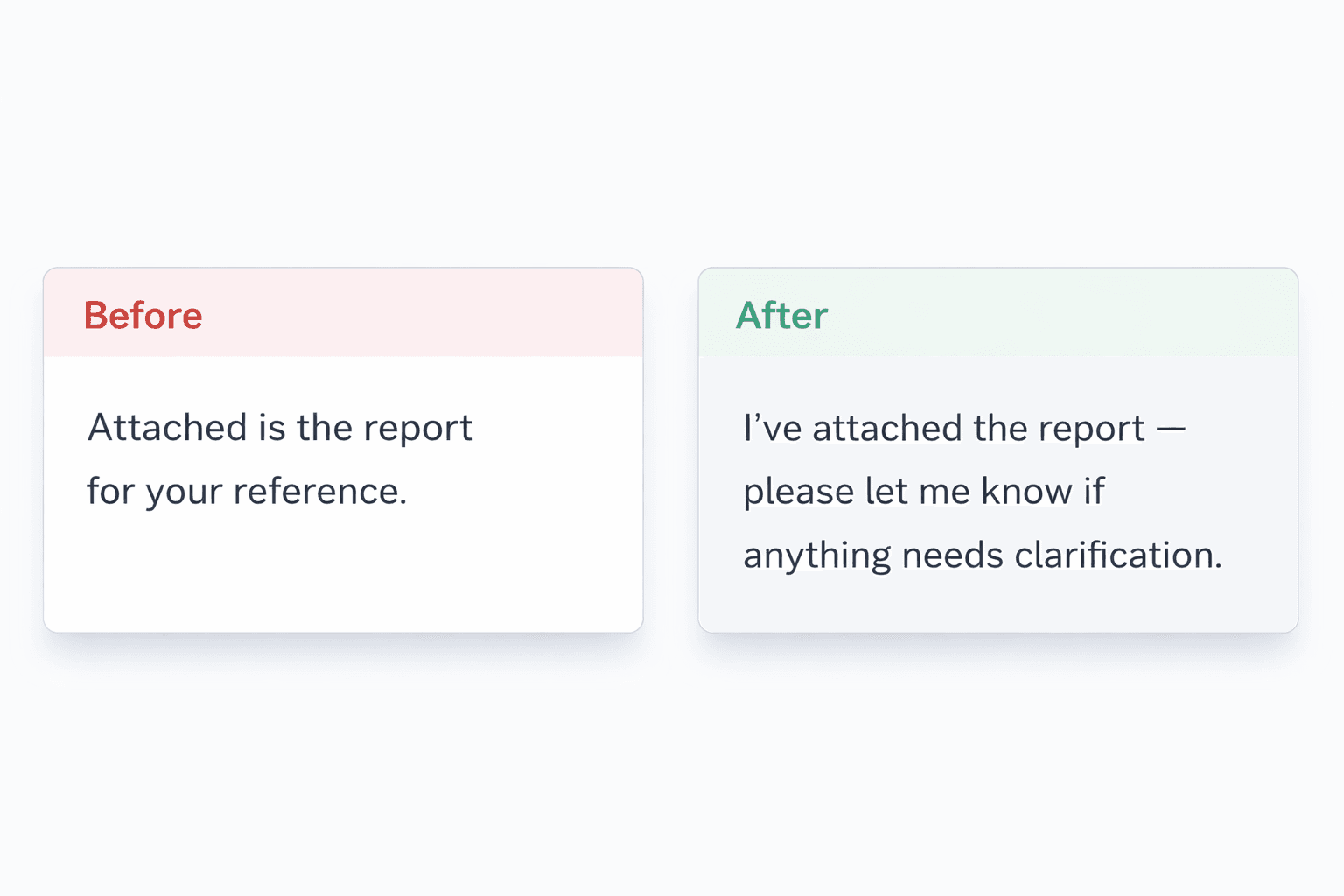
These before-and-after examples show how one specific instruction can change the message.
Example 1: No action required
Vague:
Please see the meeting notes for your reference.
Clearer:
I have attached the meeting notes for context. No action is needed.
Example 2: Feedback required
Vague:
Attached is the proposal for your reference.
Clearer:
Please review sections 2 and 3 of the attached proposal and send your comments by Friday.
Example 3: A document for filing
Vague:
Sharing the signed contract for your reference.
Clearer:
I have attached the signed contract for your records.
Example 4: Background for a decision
Vague:
For your reference, please see the thread below.
Clearer:
I have included the original thread below to explain why the delivery date changed.
Example 5: Complete professional email
Subject: Updated Q3 timeline — no action needed
Hi Maya,
I have attached the updated Q3 timeline for your reference. The only change is the testing date on page 2. No action is needed at this stage; I will send the approval request after Thursday’s review.
Best,
Daniel
This example keeps the phrase but removes uncertainty by explaining what changed and what will happen next.
Common Mistakes
1. Using it when approval or a reply is required
“Attached for your reference” does not mean “please approve this.” Use a direct request: “Please approve the attached quotation by Wednesday.”
Vague attachment wording is a classic silent-request failure. Before sending it, rewrite the sentence with a specific verb and deadline.
2. Failing to name the attachment
“Please find attached for your reference” makes the reader guess what the file is. Write: “I have attached the April invoice for your records.”
3. Treating every alternative as a synonym
“For your review” asks for attention. “For your records” asks the reader to keep something. “For your reference” normally leaves use optional. Choose by intent, not variety.
4. Using FYR with an unfamiliar audience
FYR is used in some companies and is familiar to many professionals in Singapore, Hong Kong, Malaysia, and other Asian markets. In an internal Hong Kong finance team, “FYR: signed invoice” may be immediately understood as a filing note. A new US client, however, may read FYR as an unexplained company acronym.
It is less universally recognized than FYI, so write the phrase in full when communicating with global clients or new colleagues. The same audience check applies to regional formal wording such as “for your kind perusal”.
5. Adding a deadline that does not match the phrase
“For your reference, please respond by noon” sends mixed signals. If a reply is needed, lead with it: “Please confirm by noon. I have attached the earlier thread for context.” Our guide to setting a clear email deadline has more examples.
How AI Grammar Buddy Can Help
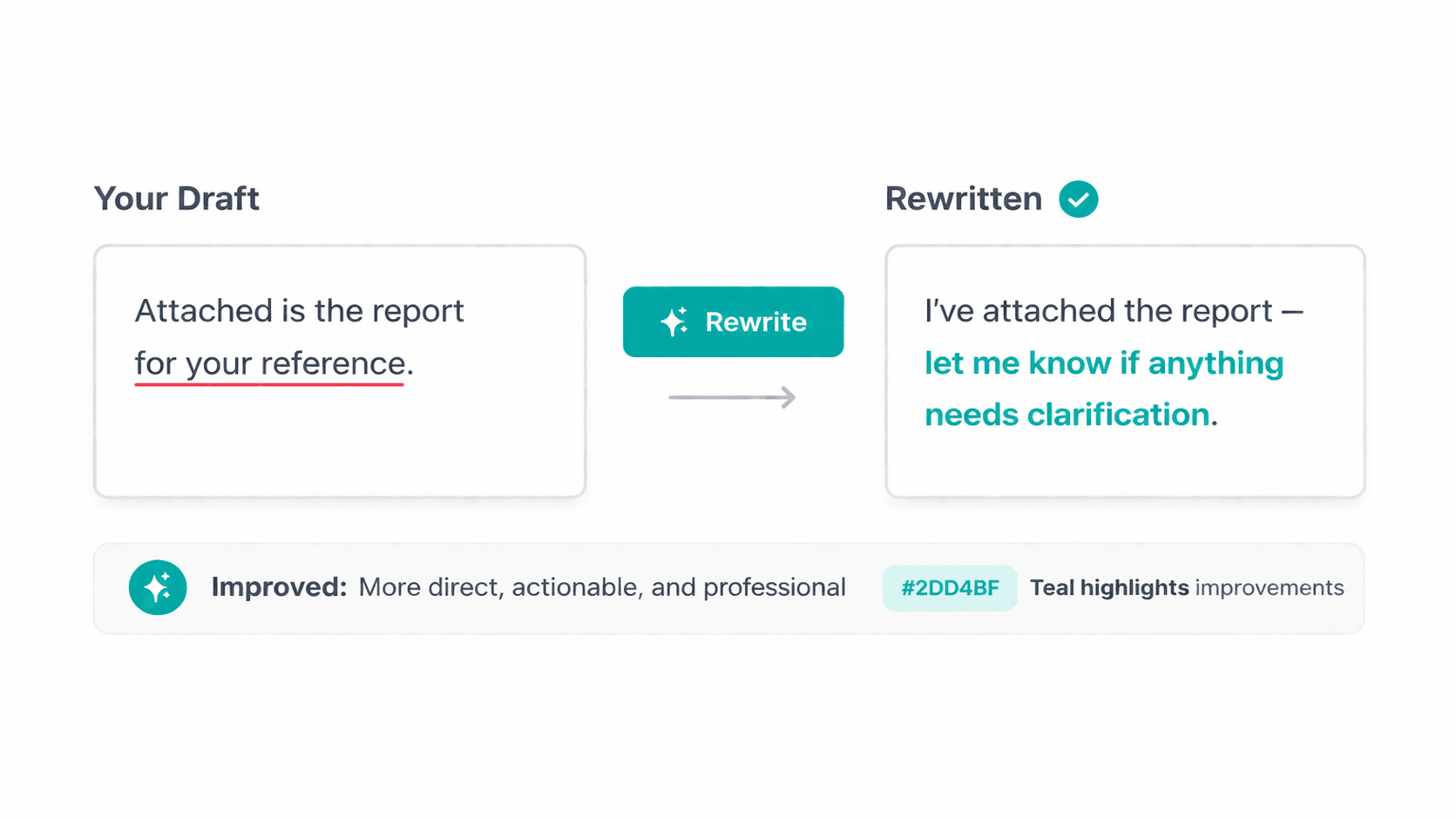
AI Grammar Buddy can check more than whether “for your reference” is grammatically correct. It can rewrite the sentence around your real intent: sharing context, requesting feedback, asking for approval, or sending a final record.
For example, paste:
Please find the report attached for your reference.
Then add the missing intention:
I need my manager to review the risks on page 4 by Thursday.
A useful rewrite is:
I have attached the report. Please review the risks on page 4 and send your comments by Thursday.
If a reference-only message still deserves a polite reply, use one of these professional acknowledgement email examples.
Final Takeaway
“For your reference” means the information may be useful, but no immediate action is normally expected. The phrase is correct, polite, and professional when that is your intention.
If you need the recipient to do something, replace the vague signal with a specific verb: review, approve, sign, confirm, or reply. One clear instruction is more useful than a more formal phrase.
Before sending your next attachment email, use AI Grammar Buddy’s Email Improver to check whether the action, tone, and deadline are clear.
Make the next action unmistakably clear.
Paste your email draft into AI Grammar Buddy and turn vague phrases like "for your reference" into a clear request, update, or record.
Please find the attached report. For your reference.
Regards.
Free to try. No credit card required.
About This Article
Kin
Senior Business English Editor
Kin reviews workplace English for clarity, tone, and cross-cultural communication. She helps professionals replace vague email phrases with specific requests and useful context.
Last updated 22 July 2026
Frequently Asked Questions
What does "for your reference" mean?▼
"For your reference" means the sender is providing information that may be useful now or later. It normally does not ask the recipient to reply or take immediate action.
Is "for your reference" polite and professional?▼
Yes. It is a polite, neutral phrase in professional email. However, it can be unclear if the sender actually expects a review, approval, or reply.
When should I use "for your reference" in an email?▼
Use it for background information, records, links, meeting notes, or documents that the recipient may need later. If action is required, state the action and deadline instead.
What can I say instead of "for your reference"?▼
Use "for your records" for filing, "for context" for background, "for your review" when feedback is expected, or "no action needed" when you want to remove all doubt.
Can I use FYR instead of "for your reference"?▼
FYR is understood in some workplaces, especially in parts of Asia, but it is less universal than FYI. Write the phrase in full or explain the purpose when emailing an international audience.
Keep going
Continue with AI Grammar Buddy
AI Grammar Buddy
Email Improver
Paste your draft and rewrite it for clearer, more professional English.
Rewrite This PhraseRelated guide
"For Your Review" Meaning in Email (+ 5 Better Alternatives)
Learn when a document needs feedback, approval, or a response instead of reference-only wording.
Related guide
Please Find Attached: Meaning, Is It Professional? 10 Alternatives
Write clearer attachment emails with modern alternatives for records, review, and action.
Related guide
What Does "For Your Kind Perusal" Mean? Better Alternatives
Understand this formal regional phrase and replace it with a clearer instruction when needed.