As Discussed Meaning in Email: Is It Rude? 10 Better Alternatives
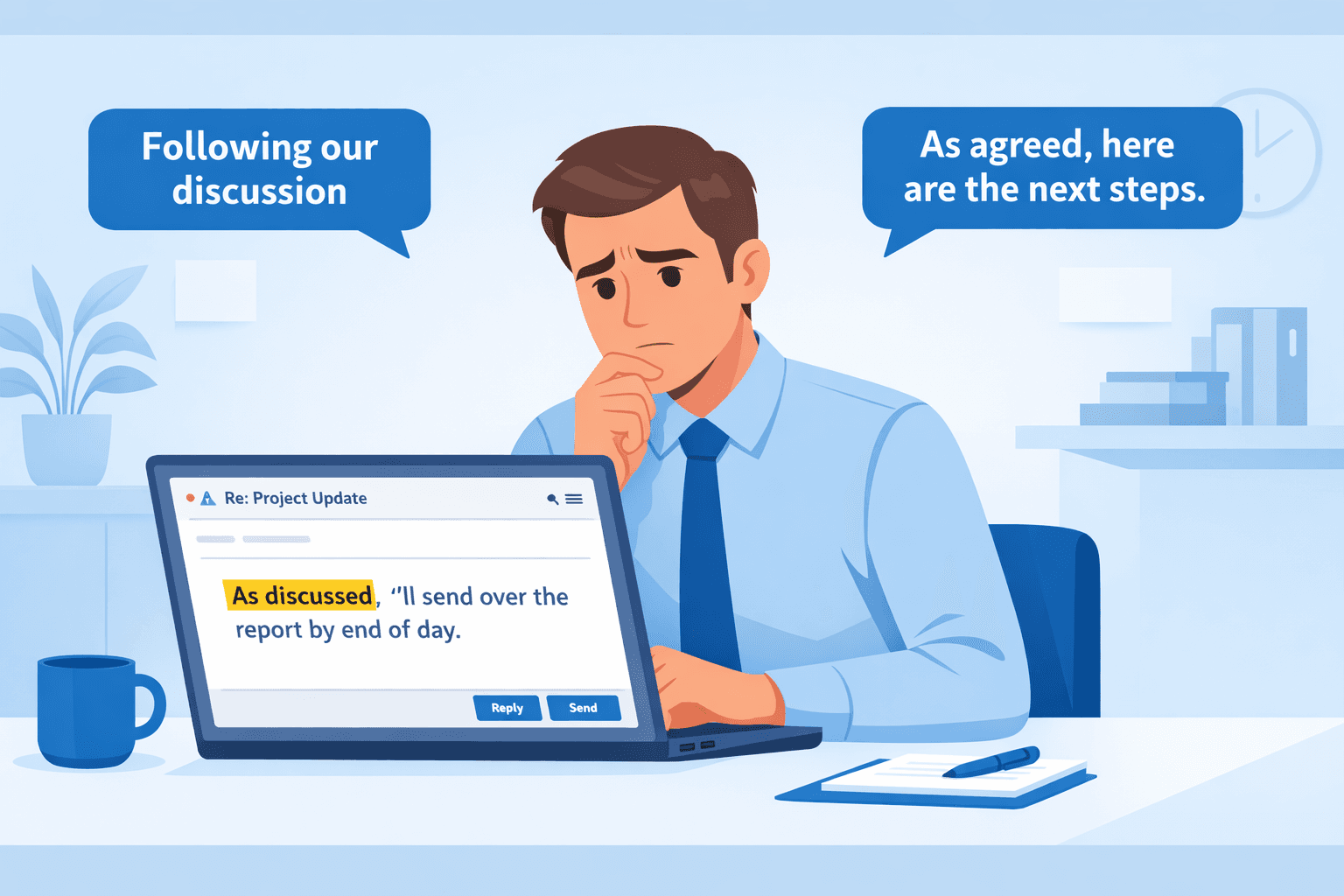
"As discussed" is the single most flagged email opener in AI Grammar Buddy's Email Improver — and the reason is always the same: the sentence that follows it gives the reader nothing to act on.
If you have ever searched "as discussed meaning in email", you already suspect that the phrase is doing less work than you think. You are right. In reviewing thousands of flagged email phrases through the Email Improver, "as discussed" consistently ranks among the top 5 vague openers — almost always because the surrounding sentence provides no actionable context.
The phrase is not wrong. But it is almost never enough on its own. This guide breaks down exactly what it means, when it backfires, and what to write instead.
Jump to sections
Use these anchors to jump straight to the section you need.
TL;DR
"As discussed" meaning in email: you are referencing a prior conversation or agreement. It is not rude, but it is often vague enough to cause confusion — or silence.
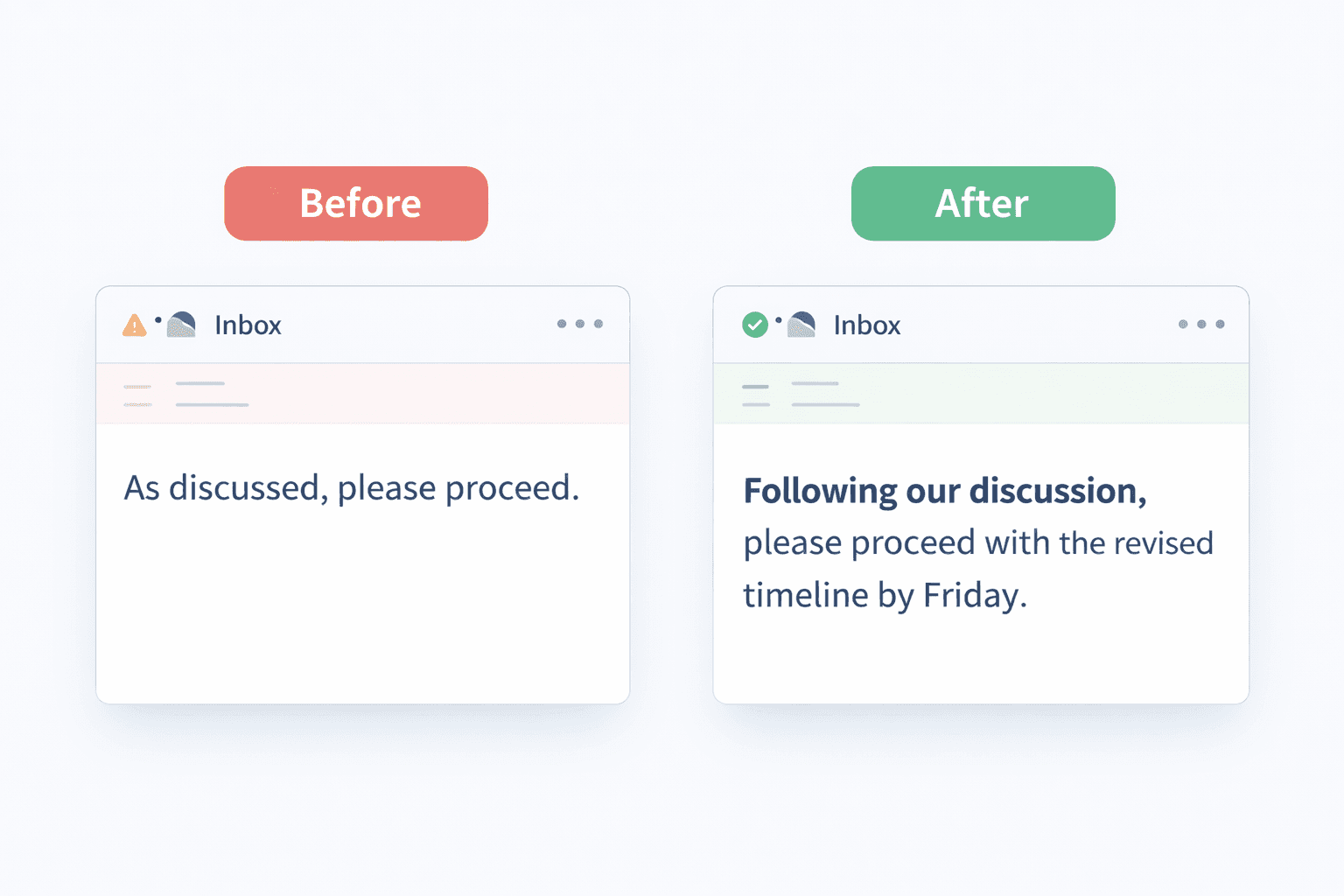
Instead of: "As discussed, please proceed." Try: "Based on our call this morning, please proceed with the revised proposal by Thursday."
Or: "As we agreed in Tuesday's meeting, I'm attaching the updated contract for your review."
The fix is almost always the same: add one sentence of context — a date, a topic, or an action item.
When the date in that thread is still provisional, see tentative meaning in emails and meetings for a clearer way to state the condition and confirmation date.
Quick Answer: What Does "As Discussed" Mean in Email?
"As discussed" signals that your email connects to a previous conversation — a meeting, call, or prior email thread. It implies a shared understanding already exists. The phrase works when context is obvious. It fails when the reader has to search their memory or inbox to understand what you mean.
Is "As Discussed" Rude or Passive-Aggressive?
Not on its own. The phrase is neutral in tone and widely used in formal English.
But context changes everything. "As discussed" can feel:
- Vague — if the reader cannot immediately recall the conversation
- Passive — it shifts the burden to the reader to remember
- Cold — especially in short, command-style emails ("As discussed. Please advise.")
- Passive-aggressive — in tense threads where it reads as "you should already know this"
The comparison most people make is to "per my last email" — a phrase that has become shorthand for professional frustration. "As discussed" carries a similar undertone when the surrounding message is terse or when the reader senses impatience behind it.
What we have found when analysing common email openers is that the problem is rarely the phrase itself. It is the missing context around it. A two-word opener that forces the reader to reconstruct a conversation from memory will always feel heavier than intended.
The fix is not to stop using the phrase. It is to make sure the next sentence does the actual work.
What Does "As Discussed" Mean in Email?
In most professional emails, the phrase needs at least one supporting detail to be useful. It is shorthand for: "I am referring back to something we talked about, and I expect you to remember it."
That expectation is where most problems start.
In practice, "as discussed" can mean several things:
- Referencing a prior conversation — "We spoke about this on Monday's call."
- Confirming an agreement — "We both agreed to X, and I'm following up."
- Reminding someone of a commitment — "You said you would handle this."
- Summarising a decision — "We landed on Option B; here is the next step."
As discussed in email examples:
- "As discussed, please send the report by end of day." → References a request made in conversation.
- "As discussed in our meeting, the launch date is now April 10." → Confirms a decision.
- "As discussed with your team, these are the revised terms." → Connects to a third-party conversation.
Each of these reads identically to the recipient. Without added context, "as discussed" leaves the reader guessing which conversation you mean — and whether they should already know the answer.
When Should You Avoid Using "As Discussed"?
Skip it in these situations:
1. Short emails with no supporting context If your entire email is "As discussed, please proceed," the reader has nothing to anchor to. You have created a follow-up email before the first one even landed.
2. Client or external communication Clients manage multiple vendor relationships. They may not recall your specific conversation from last Tuesday. Adding a brief reference — date, topic, outcome — shows professionalism, not weakness.
3. When giving instructions Instructions should stand alone. If someone needs to recall a previous meeting to understand what action to take, the instruction has failed before they even start.
4. When the conversation was heated or unresolved In a tense thread, "as discussed" reads as an accusation. It implies the reader is not holding up their end. Even if true, that framing escalates instead of resolves.
5. When you want a specific response by a deadline "As discussed, please advise" tells the reader nothing about urgency. Be direct — use a date.
10 Better Alternatives to "As Discussed"
These are the most effective alternatives to "as discussed" — each adds context, reduces ambiguity, and lands better in professional inboxes.
1. As we discussed
Why it works: A small shift from "as discussed" to "as we discussed" makes the ownership mutual. It feels less like a reminder and more like a shared reference.
Example: "As we discussed on the call, I'm attaching the revised scope of work for your review."
2. Following our conversation
Why it works: It signals a direct connection to a specific exchange without sounding like a reminder or correction.
Example: "Following our conversation this morning, here are the next steps I'll be handling on my end."
3. As agreed
Why it works: Cleaner and more direct. It confirms a shared commitment without revisiting the full history.
Example: "As agreed, the deliverable will be submitted by Friday 5 PM."
4. As mentioned earlier / as mentioned in our call
Why it works: Softer than "as discussed." It reminds without implying the reader should have acted already.
Example: "As mentioned in our call last week, the timeline has moved up by two days."
5. Based on our discussion
Why it works: Frames the current message as a logical outcome of what you talked about. Neutral and professional.
Example: "Based on our discussion, I've revised the proposal to reflect the budget constraints."
6. Following up on our meeting
Why it works: Explicitly anchors the email to a meeting context. Useful when you want to summarise multiple points from a longer conversation.
Example: "Following up on our meeting yesterday — here are the three action items we landed on."
7. Here are the next steps we aligned on
Why it works: Skips the backward reference entirely and goes straight to value. The reader does not need to remember the conversation because you are restating the outcome.
Example: "Here are the next steps we aligned on: (1) procurement review by March 31, (2) legal sign-off by April 7."
8. To confirm what we agreed
Why it works: Creates a written record of the agreement. Especially useful after verbal decisions that need a paper trail.
Example: "To confirm what we agreed: the payment schedule will shift to quarterly starting Q2."
9. As outlined in our last meeting
Why it works: More specific than "as discussed." Anchors the message to a defined event rather than a vague memory.
Example: "As outlined in our last meeting, the rollout is planned for the first week of April."
10. Circling back on what we covered
Why it works: Casual but clear. Good for internal team communication where formality would feel stiff.
Example: "Circling back on what we covered Thursday — I need the updated figures before EOD Monday."
"As Discussed" in Email: Before vs After Examples
Seeing the difference side by side makes it easier to spot the pattern in your own writing.
Before: "As discussed, please proceed."
After: "Based on our call this morning, please proceed with the revised quote and send it to the client by Thursday EOD."
Why it is better: The reader knows the source, the action, and the deadline. No follow-up needed.
Before: "As discussed, kindly share the updated files."
After: "Following our meeting on Tuesday, could you share the updated project files by Wednesday noon so I can prepare the brief?"
Why it is better: Adds timing, context, and a reason — all in one sentence.
Before: "As discussed with your team, please review and revert."
After: "As outlined in our discussion with your team last Friday, please review the attached contract and share your comments by April 2."
Why it is better: Specifies the team conversation, names the document, and gives a deadline.
Before: "As discussed, the deadline is Friday."
After: "To confirm what we agreed on our call: the first draft is due Friday, March 29 by 6 PM."
Why it is better: Converts an assumption into a confirmed, written commitment.
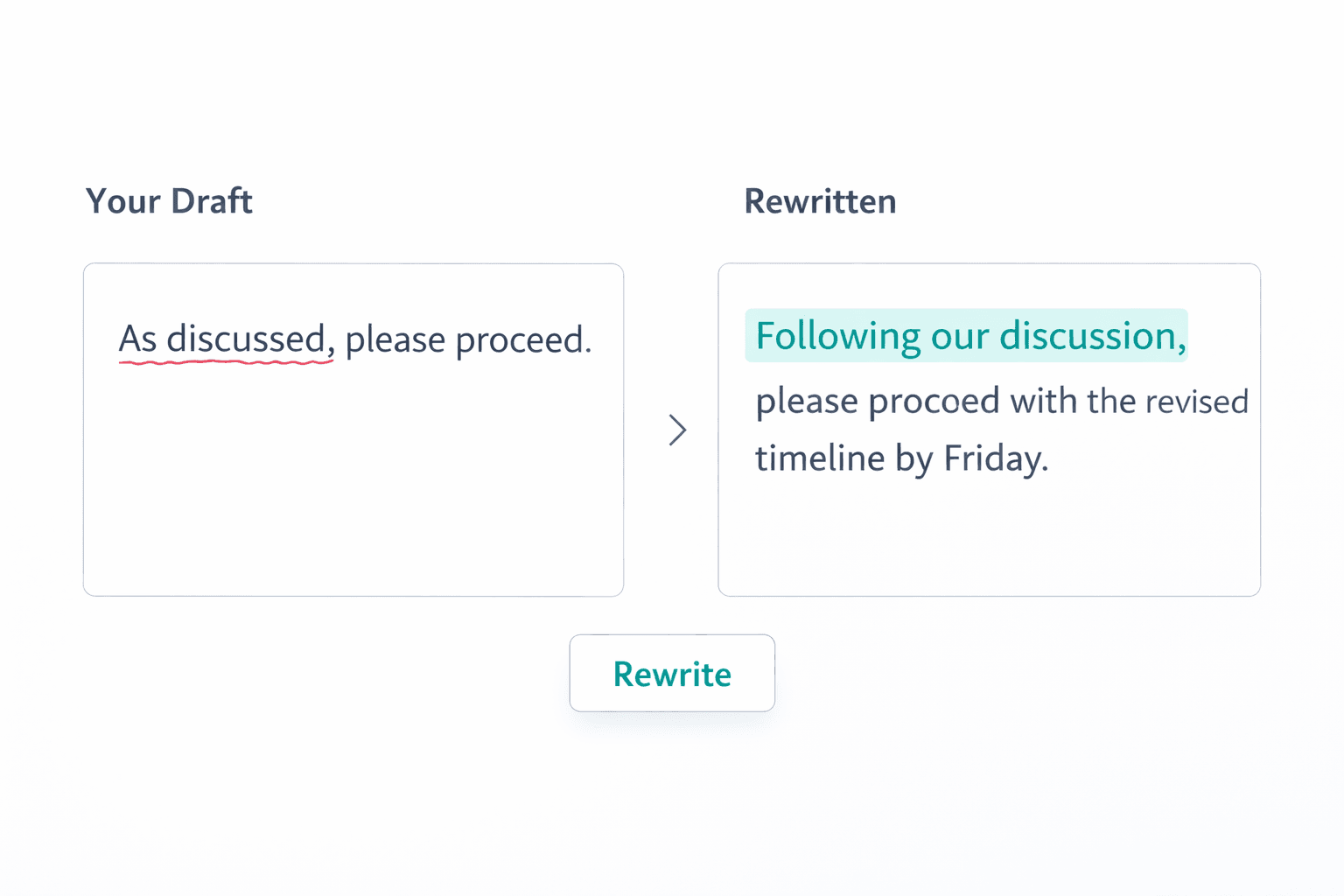
Spotting this pattern in your own writing is harder than it looks. Paste your draft into AI Grammar Buddy's Email Improver — it automatically flags vague openers like "as discussed" and suggests rewrites with specific dates, context, and action items built in.
For more follow-up email situations, see our guide on follow-up email after no response.
When to Use Each Alternative (Quick Reference)
| Situation | Best Phrase |
|---|---|
| Client follow-up after a call | "Following our conversation on [date]..." |
| Confirming a team decision | "To confirm what we agreed..." |
| Giving instructions after a meeting | "Here are the next steps we aligned on:" |
| Summarising a verbal commitment | "As agreed, [specific action] by [date]" |
| Informal internal update | "Circling back on what we covered..." |
| Written record of a verbal agreement | "As outlined in our last meeting..." |
| Referencing a prior email or document | "As mentioned in my [date] email..." |
| Multi-point follow-up after a long meeting | "Following up on our meeting — here are the action items:" |
If you are working on email tone more broadly, our professional email templates guide covers the 50 most commonly used business email formats.
Common Mistakes When Using "As Discussed"
Mistake 1: Using it with no context "As discussed, please advise." — The reader cannot act on this. They do not know what was discussed, what decision was made, or what you need from them now.
Mistake 2: Overusing it across multiple emails If every follow-up starts with "as discussed," the phrase becomes noise. Readers start skimming past it — and past whatever you wrote after it.
Mistake 3: Using it to signal frustration In tense threads, "as discussed" reads as "we already talked about this and you still haven't done it." If that is your intent, be direct about it. If it is not, choose a phrase that does not carry that implication.
Mistake 4: Skipping the outcome Even if you reference the discussion, you still need to state what you want. "As discussed, please note" adds nothing. "As discussed, please note that the payment is now due on the 15th, not the 30th" actually informs.
If you are unsure whether your email is giving enough context, AI Grammar Buddy will catch it before your reader has to.
Also worth reviewing: "please advise" in email carries similar risks — it sounds like a request but often reads as a non-specific complaint. And if you are tempted to write "at your earliest convenience", consider whether a specific date would serve your reader better.
Final Takeaway
"As discussed" is not wrong. It is just incomplete.
Every time you write it, ask: would my reader know immediately what I am referring to? If the answer is no — even slightly — add one sentence of context. A date, a topic, an outcome.
Clear requests get clear responses. Vague phrases get silence, confusion, or unnecessary follow-ups.
The standard is not politeness. It is precision.
Before you hit send, run your email through AI Grammar Buddy's Email Improver. It turns every vague phrase — including "as discussed" — into a clear, specific, professional message. No guesswork. No follow-up confusion.
About This Article
Kin
Kin has reviewed over 500 professional email templates and writes about the phrases that sound polite but kill response rates. She covers business English, email tone, and workplace communication for AI Grammar Buddy.
Frequently Asked Questions
What does "as discussed" mean in an email?▼
"As discussed" means you are referencing a previous conversation — a meeting, phone call, or prior email exchange — and connecting it to whatever you are writing now. It signals that both parties already agreed on something, and this message is a follow-up or confirmation of that. The phrase works in formal contexts but can feel vague if the reader has no clear memory of the conversation it references.
Is "as discussed" rude or passive-aggressive?▼
"As discussed" is not inherently rude. But it can come across as cold, passive, or slightly confrontational depending on the context. If you use it without a clear reference to what was discussed, the reader may feel confused or put on the spot. In tense email threads, it can read as a subtle accusation — implying the other person forgot or failed to act. Replacing it with a brief summary usually solves this.
What is a better alternative to "as discussed"?▼
The best alternative depends on the situation. "Following our conversation on [date]" adds context. "As we agreed" emphasises a shared commitment. "Based on our discussion" feels neutral and professional. For instructions or next steps, "here is what we aligned on" is clearest. The key is to add enough context so the reader knows immediately what you are referencing — no memory required.
When should you avoid using "as discussed" in an email?▼
Avoid it in short emails where there is no supporting context. Avoid it in client-facing messages where the reader may not remember the specific conversation. Avoid it when giving clear instructions — readers should not have to recall a prior meeting to understand what you want. If the reader needs to search back through their inbox to understand your email, the phrase is doing more harm than good.
What is the difference between "as discussed" and "per my last email"?▼
"Per my last email" explicitly points to a written message — it has a paper trail. "As discussed" can reference any conversation, including verbal ones. Both can sound passive-aggressive in tense threads. The difference is that "per my last email" implies the reader should have seen the information already, while "as discussed" implies they were part of a conversation. Neither adds context on its own — both need supporting detail to land well.
Keep going
Continue with AI Grammar Buddy
AI Grammar Buddy
Email Improver
Paste your draft and rewrite it for clearer, more professional English.
Rewrite This PhraseRelated guide
What Does Inherent Mean? Meaning, Examples and Business English Uses
What does inherent mean? Learn the meaning, inherent in vs to, and practical sentence examples for reports, emails and everyday English.
28 September 2026
Related guide
What Does Coherent Mean? Meaning, Examples and Business English Uses
Learn what coherent means, see natural sentence examples, compare coherent vs clear, and improve the flow of your emails and reports.
27 September 2026
Related guide
What Does Persist Mean? Meaning, Grammar and Examples
Persist means to continue despite difficulty or to keep existing. Learn how to use persist in, persist with, and persist correctly with workplace examples.
23 August 2026