Is "Please Advise" Rude? What It Really Means + Better Alternatives

You typed "please advise." You sent it. Nobody replied.
The phrase isn't rude — technically. But in most inboxes, it lands as lazy. It hands the reader a vague problem and asks them to figure out both the question and the answer.
Here's what it actually signals, when it backfires, and what to write instead.
Jump to sections
Use these anchors to jump straight to the section you need.
Quick Answer
"Please advise" is not inherently rude, but it often sounds vague, cold, or passive — especially in short emails with no clear context. It shifts the burden of thinking to the reader without specifying what kind of response is needed. In formal emails with full context, it works fine. Otherwise, replace it with a specific ask.
Not sure if your closer sounds clear? Paste your email into AI Grammar Buddy — it flags vague phrases and rewrites them in seconds.
What Does "Please Advise" Actually Mean?
The please advise meaning is simple: tell me what to do next, share your recommendation, or let me know your decision.
It's a request for input — but a deliberately open-ended one. That's the problem.
When you ask someone to "advise," you're not telling them:
- What kind of answer you need (approval, opinion, decision, information)
- How urgently you need it
- What specifically you're stuck on
Used in the right context — a long, detailed email where the situation is fully laid out — it works as a clean closer. Used at the end of two sentences? It reads like a shrug.
For a deeper breakdown of how the phrase is used across different email types, see our full guide on please advise meaning in professional email.
Why "Please Advise" Can Sound Rude
It's rarely the words themselves. It's what they imply.
- Vague request. The reader doesn't know what kind of response you're looking for. Approval? Instructions? An opinion? When everything is possible, nothing is clear.
- No clear action. "Please advise" asks for something without specifying what. It turns a simple question into a puzzle the other person has to solve before they can even answer.
- Sounds passive. In tense or time-sensitive email threads, "please advise" can read as disengaged — as though you've handed the problem back and washed your hands of it.
- Shifts the burden. If you need a decision, ask for a decision. If you need feedback, ask for feedback. "Please advise" makes the reader guess which one you actually want.
The result: the reader either replies with a vague answer (because the question was vague), asks a clarifying question (delaying things), or doesn't reply at all.
In reviewing common email patterns, vague closers like "please advise" consistently generate one of three outcomes: a delayed reply, a clarifying question that adds another round-trip, or no reply at all. Specific asks — ones that name the action, the decision, or the deadline — tend to resolve in a single exchange.
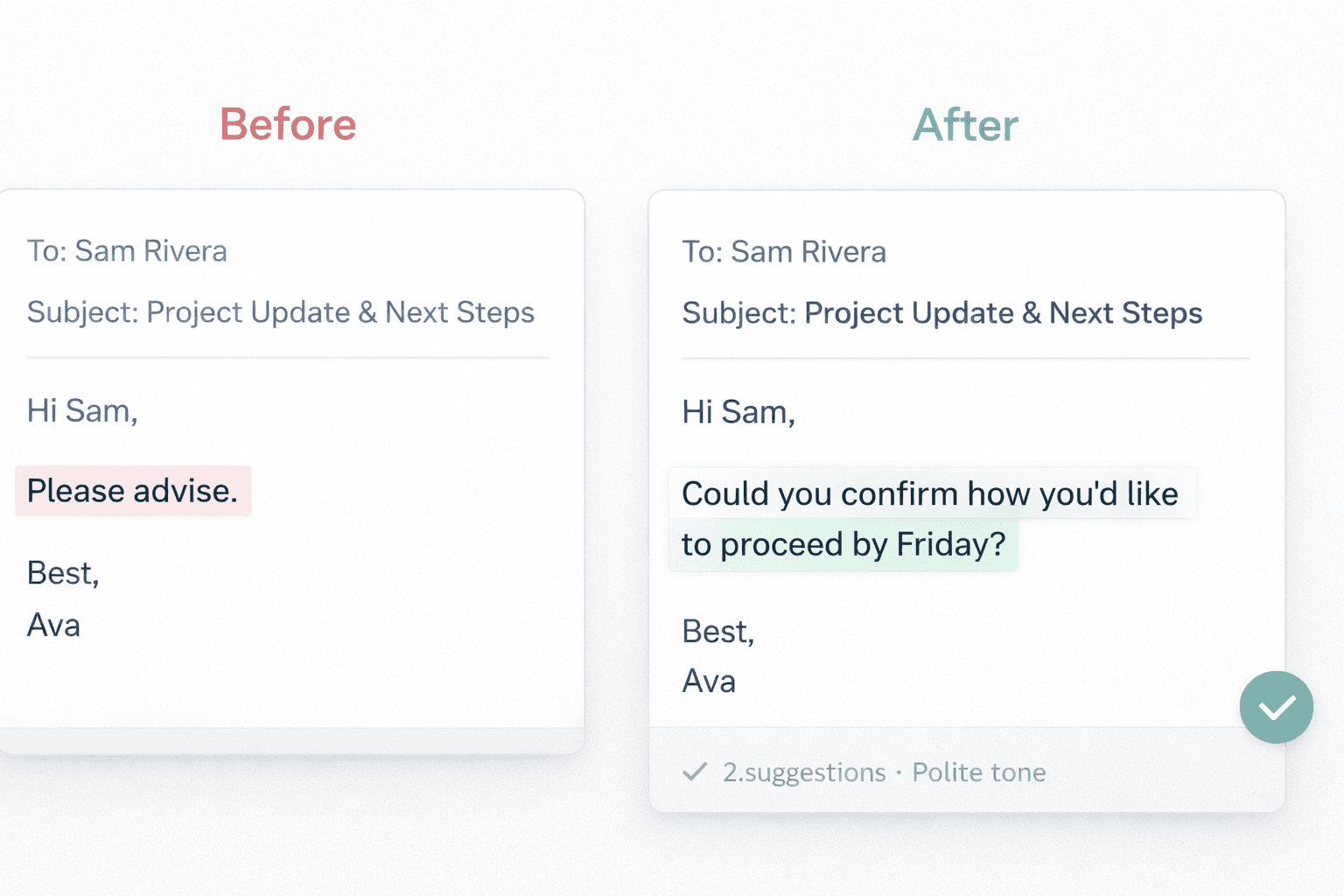
For more real-world rewrites, see the Before vs. After Examples section below.
When "Please Advise" Is Not Rude
Context changes everything.
- Formal environments. In legal, compliance, or government communication, "please advise" is standard. Nobody reads it as cold. It's part of the register.
- Clear context. If your email is detailed — full background, specific options laid out, clear stakes — "please advise" works as a clean way to hand it over. The reader knows exactly what they're advising on.
- Longer email chains. When the thread already carries all the context, a short "please advise" at the end is efficient rather than lazy.
| Situation | Email length | Formality | Use "Please Advise"? |
|---|---|---|---|
| Legal / compliance notice | Any | Very formal | ✅ Fine |
| Detailed brief with clear options | Long | Formal | ✅ Fine |
| Routine request between colleagues | Short | Semi-formal | ⚠️ Consider replacing |
| Client communication, waiting on a decision | Short | Formal | ❌ Avoid |
| Tense or escalating email thread | Any | Any | ❌ Avoid |
The phrase isn't the problem. The combination of vagueness and short context is.
10 Better Alternatives to "Please Advise"
These please advise alternatives give the reader an exact signal of what you need.
1. Could you share your feedback? Use when you've submitted work and need a review — approval, edits, or objections.
2. Please let me know if you approve this. Use when you need a clear yes or no before you can move forward.
3. Could you confirm the next step? Use when direction is unclear and the other person owns the decision.
4. Let me know how you'd like to proceed. Use when you've presented a situation and want the reader to choose the path.
5. What would you recommend here? Use when you genuinely want judgment or expertise, not just a sign-off.
6. Could you advise on [specific issue]? Use when "please advise" is the right register but you need to narrow the scope.
7. Please let me know your thoughts by [day]. Use when you need feedback on a deadline — adds urgency without pressure.
8. Could you confirm whether we should go ahead? Use when you've done the groundwork and just need approval to act.
9. What's your preference on this? Use when there are two or more options and the other person needs to choose.
10. I'd appreciate your guidance on [specific point]. Use in formal or upward communication where you want to sound respectful, not vague.
Every one of these tells the reader what kind of response you're looking for. "Please advise" tells them nothing.
If you need more options, we've put together 15 please advise alternatives with full context for each one — including which situations each phrase works best in.
Paste your email into AI Grammar Buddy and instantly rewrite vague phrases into clear, professional requests.
Before vs. After Examples
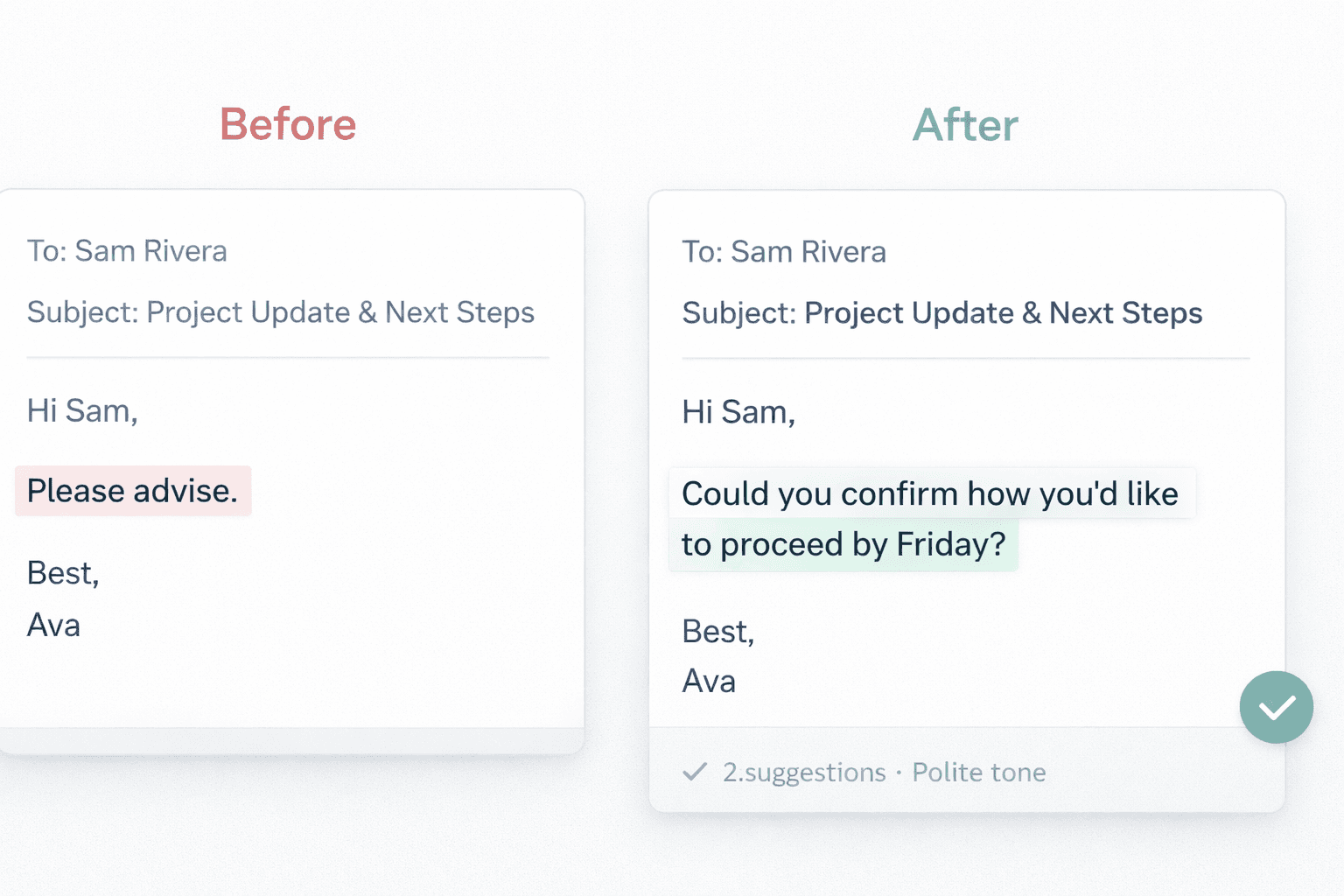
Example 1 — Approval needed
| ❌ Before | "Hi Sarah, attached is the updated proposal. Please advise." |
| ✅ After | "Hi Sarah, attached is the updated proposal. Could you confirm if you're happy for me to send this to the client by Thursday?" |
Example 2 — Unclear next step
| ❌ Before | "The vendor has come back with two options. Please advise." |
| ✅ After | "The vendor has come back with two options — Option A (faster, $2K more) or Option B (standard timeline, within budget). Which would you prefer we proceed with?" |
Example 3 — Waiting on a decision
| ❌ Before | "We haven't heard back from the client. Please advise." |
| ✅ After | "We haven't heard back from the client since Tuesday. Should I send a follow-up, or would you prefer to reach out directly?" |
The pattern is consistent: strong alternatives include a specific action, a timeframe, or both.
When You Should Avoid "Please Advise"
Some situations make the phrase actively work against you.
Short emails with no context. If your email is two sentences, "please advise" at the end signals that you haven't thought through what you actually need. Write the question instead.
Client communication. Clients interpret vagueness as unprofessionalism. A request that's clear and specific projects confidence. "Please advise" does the opposite.
Unclear or emotional threads. In a tense email chain — a missed deadline, an escalation, a complaint — "please advise" reads as cold. It can come across as passing the problem back without engaging with it.
When you already know what you need. If you need approval, say so. If you need a decision, say so. "Please advise" is a hedge. Use it only when you genuinely don't know which direction you need guidance on — and even then, narrow it down.
If you've already sent a vague email and received no reply, the issue may go beyond phrasing — read our guide on how to write a follow-up email after no response.
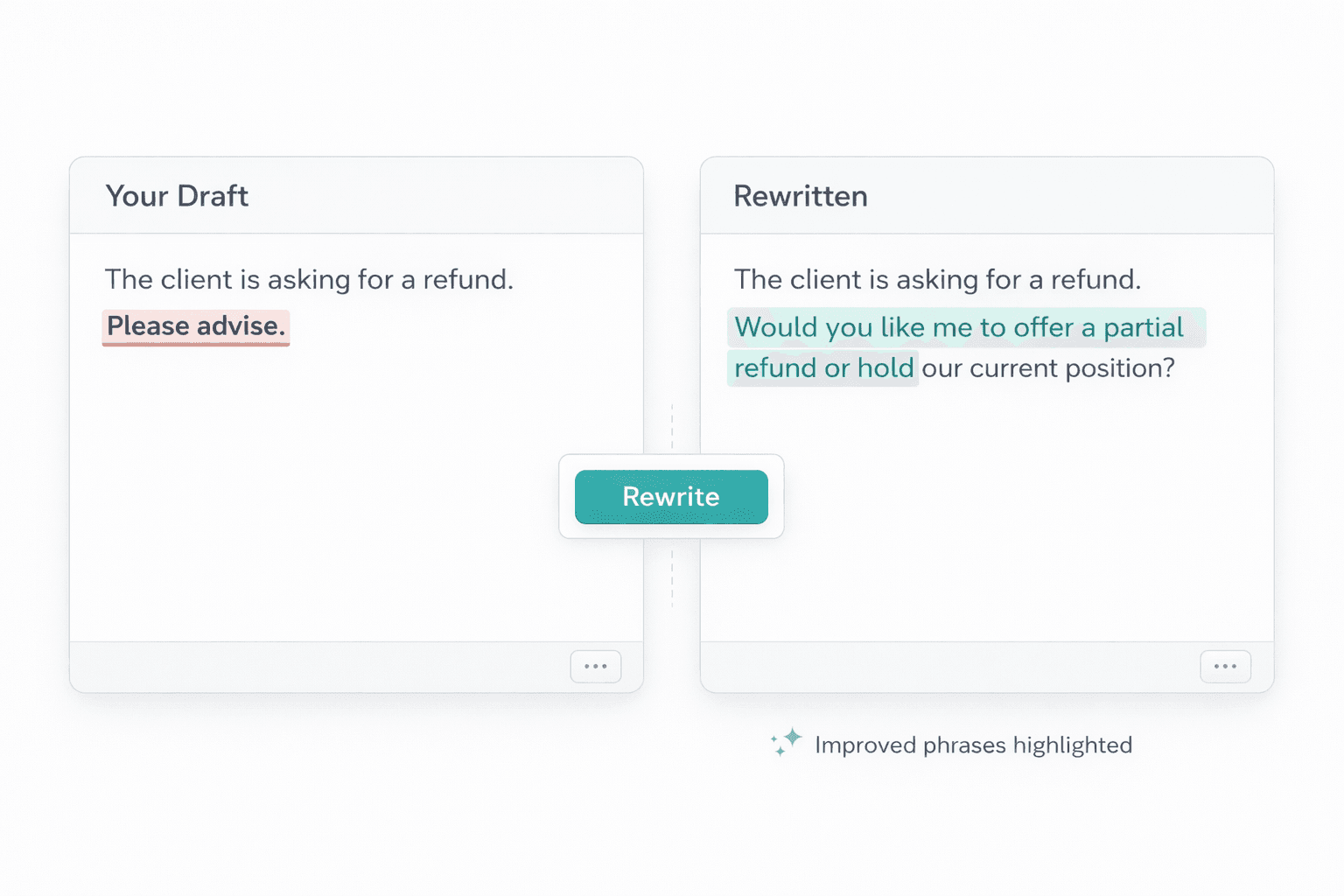
If you're unsure whether your email sounds vague or cold, AI Grammar Buddy flags these phrases before you send and suggests clearer alternatives in seconds.
A Note on Related Phrases
The same problem shows up in other common email closers.
"At your earliest convenience" sounds professional, but gives the reader no real deadline — which often means no urgency and no reply. If you use this phrase often, read our full guide on "at your earliest convenience" meaning and alternatives.
"Per my last email" is technically neutral, but in most email threads it reads as passive-aggressive — especially in tense exchanges. See: "per my last email" — what it really signals and when to avoid it.
The pattern across all three phrases is the same: they feel safe to write, but create friction in the inbox. If you're unsure how a phrase lands, paste your email into AI Grammar Buddy before sending.
Final Takeaway
"Please advise" isn't rude — but it's often lazy.
Clear emails get replies. Vague ones get ignored, misread, or replied to with another question. The fix takes ten seconds: swap the open-ended closer for a specific ask, add a date if the timing matters, and send.
Every alternative in this article does one thing "please advise" doesn't: it tells the reader exactly what you need from them.
Not sure whether your email sounds clear or vague? Paste it into AI Grammar Buddy and get an instant rewrite — free.
Related Reads
About This Article
Kin
Kin is a business English writer at AI Grammar Buddy, specialising in professional email tone and workplace communication. She has written over 40 guides on email phrasing, covering everything from polite refusals to follow-up strategy. Her focus: phrases that sound safe in the drafting stage but create friction once they reach a real inbox.
Frequently Asked Questions
Is "please advise" rude?▼
"Please advise" is not inherently rude. In formal or longer emails with clear context, it works fine. The problem is when it appears at the end of a short, vague email — it can sound cold, passive, or like you're shifting the burden of thinking to the reader.
What does "please advise" mean?▼
"Please advise" means "tell me what you recommend, what decision you want, or how I should proceed." In practice, it asks for guidance, approval, or next steps. The problem is it rarely specifies which.
What is a better way to say please advise?▼
Better alternatives include: "Could you confirm the next step?", "Please let me know how you'd like to proceed", "Could you share your feedback on this?", or "What would you recommend here?" Each gives the reader a clearer signal of what kind of response you need.
When should you avoid "please advise"?▼
Avoid it in short emails with no context, in client-facing communication where tone matters, and when the recipient might not know what exactly you're asking for. The vaguer the email, the worse "please advise" lands.
Is it rude to say "please be advised"?▼
"Please be advised" is different from "please advise" — it's a formal notice, not a request. It's standard in legal or compliance communication and rarely reads as rude. The tone issue only appears when "please advise" is used as a vague request at the end of an email.
How do you politely say "please advise"?▼
Replace it with a specific request that tells the reader what kind of response you need. For example: "Could you let me know your decision by Thursday?" or "What would you recommend here?" The more specific the ask, the faster the reply.
Keep going
Continue with AI Grammar Buddy
AI Grammar Buddy
Email Improver
Paste your draft and rewrite it for clearer, more professional English.
Rewrite This PhraseRelated guide
What Does Inherent Mean? Meaning, Examples and Business English Uses
What does inherent mean? Learn the meaning, inherent in vs to, and practical sentence examples for reports, emails and everyday English.
28 September 2026
Related guide
What Does Coherent Mean? Meaning, Examples and Business English Uses
Learn what coherent means, see natural sentence examples, compare coherent vs clear, and improve the flow of your emails and reports.
27 September 2026
Related guide
What Does Persist Mean? Meaning, Grammar and Examples
Persist means to continue despite difficulty or to keep existing. Learn how to use persist in, persist with, and persist correctly with workplace examples.
23 August 2026