10 Cold Email Templates That Get Replies in Singapore (B2B Sales Guide)
Copy these 10 proven cold email templates for Singapore B2B sales. From introductions to follow-ups, get higher response rates with professional, localized examples.

Jump to sections
Use these anchors to jump straight to the section you need.
Quick Answer
Looking for a high-converting cold email template Singapore professionals will actually read? In Singapore's formal yet efficient business culture, a successful cold email must be remarkably concise, personalized, and value-driven. Unlike casual Western styles, your email needs to establish credibility immediately. Decision-makers here are busy; if you don't clearly state "what's in it for them" within the first two sentences, your email will likely be deleted. The best cold email template Singapore sales teams use combines professional courtesy with a direct call to action.
AI Grammar Buddy
Turn this template into your email
Start with the example, then rewrite it for your real situation.
Why Cold Emails Work (When Done Right) in Singapore
Singapore is Asia's premier business hub, home to thousands of regional headquarters and decision-makers. B2B professionals here are accustomed to receiving outreach, but the volume is overwhelming. An average executive receives over 120 emails daily.
Despite the noise, cold email remains one of the most effective B2B channels in Singapore. Why?
- Professionalism: Unlike a LinkedIn DM which can feel intrusive or informal, a well-crafted email is seen as a standard business protocol.
- Direct Access: It bypasses gatekeepers often present in phone calls.
- Scalability: You can reach multiple prospects with tailored messages efficiently.
However, the "spray and pray" method (sending generic emails to hundreds of people) does not work here. Singaporean professionals value relevance. They will reply if—and only if—you demonstrate that you understand their specific business context or challenges. A highly personalized cold email signals that you are a serious partner, not just a spammer.
The Anatomy of a High-Converting Cold Email
Before we get to the templates, you need to understand the structure. A high-converting cold email isn't magic; it's a formula.
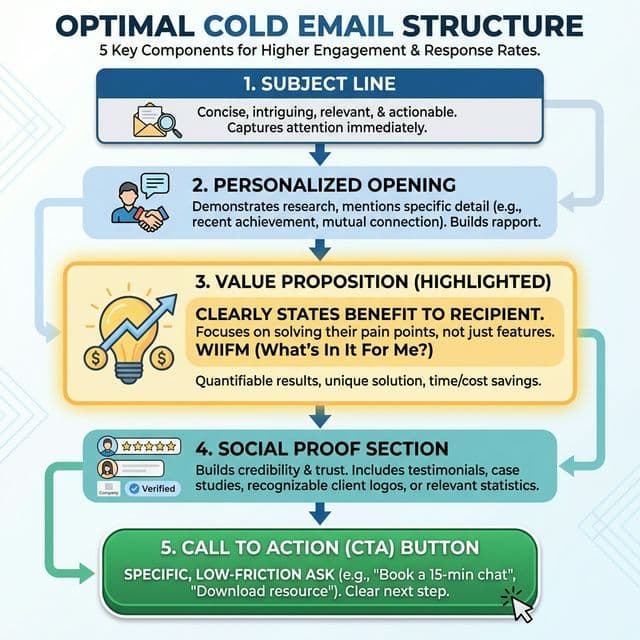
Every successful cold email has these 5 components:
- Subject Line (The Gatekeeper): It must be specific and under 50 characters to fit on mobile screens. Avoid clickbait.
- Personalized Opening ( The Hook): Show you've done your homework. Reference a recent post, news, or mutual connection to build instant rapport.
- Value Proposition (The "WIIFM"): WIIFM = "What's In It For Me?" Explain clearly how you solve a problem or drive growth in one sentence.
- Social Proof (The Credibility): Drop a recognizable name or a specific result you achieved for a similar company.
- Clear CTA (The Ask): Ask for one specific thing—usually a short call or a yes/no response.
10 Best Cold Email Template Singapore Examples (Copy & Paste)
Here are 10 cold email templates tailored for the Singapore market. Remember to replace the bracketed text [ ] with your specific details.
Template 1: The Mutual Connection Intro
Subject: [Mutual Connection Name] suggested I reach out
Hi [First Name],
[Mutual Connection Name] mentioned you're working on [specific project/challenge] at [Company].
I recently helped [Similar Company] achieve [specific result] by [brief method]. Given your current focus, I thought this might be relevant to your team as well.
Would it make sense to explore if we could do something similar for [Their Company]?
Happy to send over a quick case study if you're interested.
Best regards, [Your Name]
When to use: When you have a mutual connection on LinkedIn or in real life. Why it works: Trust transfer. The recipient trusts the mutual contact, so that trust extends to you.
Template 2: The Problem-Solution Approach
Subject: Quick idea to help [Company] with [specific goal]
Hi [First Name],
I was researching [Company] and noticed you are currently expanding your [Department/Region].
Usually, when companies scale like this, they struggle with [Common Pain Point]. We recently helped [Competitor/Similar Company] solve this exact issue, resulting in a [X%] increase in [Metric].
I have a few ideas on how [Company] could avoid these bottlenecks. Are you open to a 10-minute chat next Tuesday morning to hear them?
Best, [Your Name]
When to use: When you have identified a likely problem based on their company growth or news. Why it works: It leads with value (ideas) rather than a sales pitch.
Template 3: The Case Study Hook
Subject: How [Similar Company] increased [metric] by [%]
Hi [First Name],
I saw that [Company] is focusing on [Strategic Initiative].
We recently worked with [Similar Client], a company in the [Industry] space, to streamline their [Process], which helped them save [Amount/Time] in just 3 months.
I've put together a one-page case study breaking down exactly how they did it.
Would you like me to send it over?
Cheers, [Your Name]
When to use: When you have a strong, relevant case study. Why it works: Everyone wants to know what their competitors are doing. It asks for permission (low friction) rather than a meeting (high friction).
Template 4: The Quick Value Offer
Subject: [Specific benefit] for [Company Name]?
Hi [First Name],
I'm writing to you because I noticed [Observation about their website/process].
My team specializes in [Your Service], and I've already drafted a preliminary [Audit/Report/Mockup] for [Company] to show where you might be leaving money on the table.
It’s completely free—I just want to show you what's possible.
Mind if I send the report over for you to review?
Best, [Your Name]
When to use: When you can provide a small sample of work upfront (e.g., SEO audit, design mockup). Why it works: The law of reciprocity. You give something valuable first, making them more likely to respond.
Template 5: The Industry Insight Approach
Subject: [Industry Trend] affecting [Their Industry] in Singapore
Hi [First Name],
With the recent [Regulatory Change/Market Shift] in Singapore, many [Job Roles] I speak with are concerned about [Specific Impact].
We've been helping companies like [Client A] and [Client B] navigate this by [Your Solution]. It's allowed them to remain compliant while actually reducing costs by [X%].
If this is a priority for you right now, I'd love to share some insights on how they handled the transition.
Do you have any availability for a brief call this Thursday?
Regards, [Your Name]
When to use: When there is a major industry shift or news in Singapore. Why it works: It positions you as an industry expert/consultant rather than just a salesperson.
Template 6: The Follow-Up (After No Reply)
Subject: Re: [Original Subject]
Hi [First Name],
I know email inboxes can get crazy, so I wanted to float this to the top just in case it got buried.
I'm still confident we could help [Company] improve [Metric] similarly to how we helped [Client].
If this isn't a priority right now, no worries at all. Just let me know if I should close the file for now?
Best, [Your Name]
When to use: 3-4 days after your first email if you haven't heard back. Why it works: It's polite, acknowledges they are busy, and offers a "way out" which often prompts a reply.
Template 7: The Breakup Email (Last Attempt)
Subject: Should I close your file?
Hi [First Name],
I'm writing to follow up one last time regarding [Topic].
Since I haven't heard back, I'm assuming this isn't a priority for [Company] at the moment. That's completely fine.
I won't follow up again, but please feel free to reach out if your needs change in the future.
Best of luck with [Current Project], [Your Name]
When to use: As a final attempt (usually email #4 or #5). Why it works: Loss aversion. The "breakup" signals that the opportunity is going away, which often triggers a "Wait, I am interested!" response.
Template 8: The Referral Request
Subject: Quick question about [Their Department]
Hi [First Name],
I’m trying to find the best person at [Company] to speak with regarding [Specific Topic/Problem].
Based on your LinkedIn profile, it looks like you might be involved, but I wanted to double-check.
If you aren't the right person, would you mind pointing me in the direction of the colleague who handles [Topic]?
Thanks for your help, [Your Name]
When to use: When you are unsure if you have the right decision-maker. Why it works: People generally like to be helpful. Even if they aren't the buyer, they can refer you to someone who is.
Template 9: The Partnership Proposal
Subject: Partnership opportunity: [Your Company] + [Their Company]
Hi [First Name],
I've been following [Company] for a while and love what you're doing with [Product/Initiative].
My company, [Your Company], works with similar clients in the [Industry] space. I see a strong synergy where we could potentially [Specific Benefit of Partnership] for our shared customers.
I'd love to explore a potential partnership that could drive [Benefit] for both of us.
Are you open to a 15-minute introductory chat next week?
Best, [Your Name]
When to use: For biz dev or strategic partnerships rather than direct sales. Why it works: It frames the relationship as a win-win collaboration between equals.
Template 10: The Event/Content Hook
Subject: Thought this might interest you: [relevant resource]
Hi [First Name],
I saw you recently posted about [Topic] on LinkedIn.
It reminded me of a [Whitepaper/Webinar/Article] our team just published on [Related Topic]. It covers [Key Point 1] and [Key Point 2], which I think aligns with your views.
Here is the link: [Link]
No ask—just thought you might find it valuable!
Best, [Your Name]
When to use: To build a relationship ("warm up") before asking for anything. Why it works: It delivers pure value with zero friction. It builds reciprocity for a future ask.
Cold Email Mistakes to Avoid in Your Cold Email Template Singapore Strategy
Singaporean professionals are efficient and have a low tolerance for fluff. Avoid these 7 common mistakes:
- Being Too Casual: Singapore business culture is formal. Avoid greetings like "Hey man" or "What's up." Stick to "Hi [Name]" or "Dear [Name]."
- Writing Too Long: If your email is longer than 150 words, it won't be read. Get to the point.
- No Personalization: "Dear Sir/Madam" or generic templates are instant deletes. You must show you know who they are.
- Vague Value Proposition: "I'd love to chat" is weak. About what? Why? Value must be specific (e.g., "Discuss how to save 20% on logistics").
- Multiple CTAs: Don't ask them to "Check our website," "download a PDF," AND "book a call." Ask for one thing only to avoid decision paralysis.
- Sending at the Wrong Time: Avoid Monday mornings (inbox clean-up time) and Friday afternoons (checking out for the weekend). mid-week (Tue-Thu) mornings are best.
- No Follow-Up: 80% of sales require 5+ touchpoints, yet 44% of salespeople give up after one email. Persistence is key.
How to Personalize Cold Emails (Singapore Context)
Personalization goes beyond just using their first name. Here are 5 ways to show you've done your homework:
- Reference Their Content: "I loved your recent LinkedIn post about [Topic]..."
- Company News: "Congrats on [Company]'s recent Series B funding / expansion into Vietnam..."
- Local Context: "With Singapore's recent push toward [Smart Nation / Green Plan 2030]..." (Shows you understand the local market).
- Role-Specific: "As a [Job Title], you probably deal with [Specific Challenge] daily..."
- Industry Knowledge: "I noticed many [Industry] firms in Singapore are struggling with [Regulation/Trend]..."
Cold Email Follow-Up Strategy
One email is rarely enough. You need a sequence. Here is a proven timeline for Singapore B2B sales:
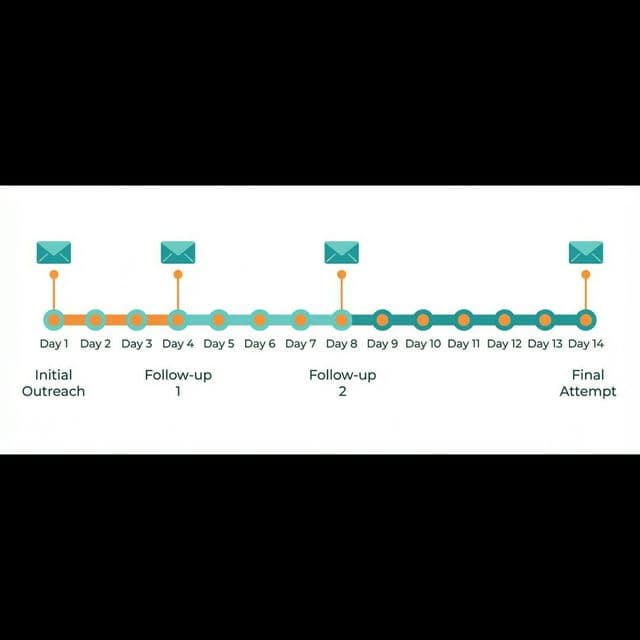
- Day 1: Send the initial cold email (The Hook).
- Day 4: Follow-up #1 (The "Bump"). Keep it short. "Just bumping this to the top of your inbox."
- Day 8: Follow-up #2 (New Value). Share a case study or a different angle. "Thought you might find this article relevant..."
- Day 14: The Breakup Email. "Haven't heard back, so I'll assume this isn't a priority."
Sample Follow-Up Sequence: Consistency is key. Use an email automation tool if necessary, but keep the personalization high.
Before You Hit Send: Cold Email Checklist
Run your email through this checklist before sending:
- ☐ Subject line is specific and under 50 characters
- ☐ Opening sentence shows personalization (no generic fluff)
- ☐ Value proposition is clear in the first 3 sentences
- ☐ Entire email is under 150 words
- ☐ One clear, low-friction Call to Action (CTA)
- ☐ Professional sign-off with full contact info (Name, Title, Company, Link)
- ☐ Grammar and spelling checked (Typos kill credibility)
Pro Tip: Use Grammar Buddy to check your cold email tone before sending — professional tone matters immensely in Singapore business culture.
FAQ: Cold Emails in Singapore
Q1: Is cold emailing legal in Singapore?
Yes, B2B cold emailing is legal in Singapore under the PDPA, as long as you provide a way to unsubscribe and identify yourself clearly. However, if you are contacting individuals (B2C) or using phone numbers, you must check the Do Not Call (DNC) Registry.
Q2: What's the average response rate for cold emails in Singapore?
The average is between 1% and 5%. However, with high personalization and a strong value proposition, you can see response rates rise to 10-15%.
Q3: Should I use "Dear" or "Hi" in cold emails?
"Hi [Name]" is the best balance of professional and modern. "Dear" can feel too stiff, while "Hey" is too casual for a first interaction in Singapore.
Q4: How many follow-ups should I send?
We recommend a sequence of 3 to 4 emails. Most replies actually come from the 2nd or 3rd email, not the first.
Summary
Cold emailing in Singapore is a powerful tool for generating B2B leads, but it requires finesse. By focusing on personalization, brevity, and clear value, you can cut through the noise of a busy executive's inbox. Use the templates above as a starting point, but always adapt them to your specific prospect.
Remember: You aren't asking for a favor; you are offering a solution.
Related Articles
Next step
Turn this template into your email
Start with the example, then rewrite it for your real situation.
Keep going
Continue with AI Grammar Buddy
AI Grammar Buddy
Email Improver
Paste your draft and rewrite it for clearer, more professional English.
Rewrite My EmailRelated guide
50 Professional Email Templates for Work (With Examples)
Professional email templates for work with examples and quick rewrites from AI Grammar Buddy.
17 March 2026
Related guide
Essential Client & Vendor Email Templates: Apology Email to Customer, Quotations and More
Copy, personalize, and send practical apology email to customer templates, request for quotation email examples, payment reminders, complaint replies, and vendor follow-ups.
13 March 2026
Related guide
Interview Invitation Email: 18 HR Templates That Work in 2026
Interview invitation email, job rejection, meeting minutes & confirmation templates. 18 copy-paste HR samples for modern workplace communication.
12 March 2026