For Your Perusal Meaning in Email (Kind Perusal)
What does “for your kind perusal” mean in email? See if it is professional and get 10 clearer alternatives with copy-paste templates.
You just typed—or just received—“Please find attached for your kind perusal.” It sounds polite. Then nothing happens: no comments, no approval, no signature.
Here is the plain meaning, whether it still sounds professional, and ten replacements sorted by what you actually need the reader to do next.
TL;DR
The phrase is polite but vague. For a clearer email, name the document, state whether you need feedback, approval, or a signature, and add a deadline when timing matters.
Top alternatives:
- •For your kind perusal = Please read this (use: 'Please review the attached report')
- •For your kind perusal and necessary action = Please read and act (use: 'Please review and approve by Friday')
- •Kindly peruse = Please read carefully (use: 'Please take a look and share your comments')
AI Grammar Buddy
Rewrite this phrase in context
Paste your sentence and AI Grammar Buddy will turn it into clearer professional English.
Jump to sections
Use these anchors to jump straight to the section you need.
Quick Answer
Perusal means reading or examining something, usually carefully. In an email, “for your perusal” means “for you to read and review.” “For your kind perusal” means the same thing — “kind” adds deference but does not change the request. Both are formal and polite; clearer alternatives include “for your review” or “please review and share your feedback.”
Perusal Meaning: Definition, Pronunciation, Synonyms, and Examples
| Dictionary detail | Answer |
|---|---|
| Part of speech | Noun (formal) |
| Pronunciation | /pəˈruː.zəl/ — puh-ROO-zuhl |
| Definition | Perusal is a formal noun for the act of reading or examining something, often with care and attention. In everyday English, it can describe either a quick look or a close review, depending on the words around it. |
| Synonyms | reading, review, examination, inspection, study |
| General example | “The contract is available for public perusal.” |
| Email example | “I have attached the revised proposal for your perusal.” |
The surrounding sentence tells you how thorough the reading should be. “A quick perusal” means a brief look, while “careful perusal” means close examination. In a business email, it is clearer to name the expected action—such as review, comment, approve, or sign—rather than rely on perusal alone. You can also compare the Cambridge Dictionary entry for perusal.
"For Your Perusal" vs "For Your Kind Perusal"
| For your perusal | For your kind perusal | |
|---|---|---|
| Meaning | Please read and review this | Please read and review this |
| Tone | Formal | Very formal, deferential |
| Does "kind" change the meaning? | — | No — it adds politeness, not a different request |
| Common in | Formal writing globally (but uncommon in everyday email) | Indian English, Singapore business English |
| Modern perception | Stiff but understood | Can sound overly ornate to international readers |
| Simpler alternative | "For your review" or "please take a look" | "For your review" or "please take a look" |
The short version: "for your perusal" and "for your kind perusal" mean the same thing. The only difference is register. "Kind" softens the request and signals respect for the reader — a convention rooted in South and Southeast Asian business culture. If you are writing to international colleagues, "for your review" communicates the same intent without the formality. Do not confuse it with “for your kind information”, which usually shares an update without asking the reader to review a document.
What Does "For Your Kind Perusal" Mean?
The for your kind perusal meaning becomes clear when you break the wording apart:
- Peruse — to read through carefully
- Kind — a respectful modifier, equivalent to "please be so kind as to"
- For your — directing the action toward the recipient
Together, the phrase says: I am sharing this document and respectfully asking you to read it.
You will see it most often in sentences like these:
"Please find attached the quarterly report for your kind perusal."
"I am sharing the revised proposal for your kind perusal and necessary action."
In email, the phrase almost always accompanies an attachment. You send a file and want the recipient to read it before the next step. It almost never appears in spoken English or informal writing. If the attachment line itself feels dated, compare these professional alternatives to “please find attached”.
When Is It Typically Used?
- Sending a report to a manager or senior stakeholder
- Forwarding a contract for review before signing
- Sharing meeting minutes after a discussion
- Submitting a project proposal to a client
The phrase functions as a handoff — a polite way of saying, "Here is the document; it is now with you."
Is "For Your Kind Perusal" Professional or Outdated?
Short answer: It is professional in intent, but it can sound overly formal — and often unclear — in modern business writing.
Why it persists (and why that is understandable)
In Indian business English and Singapore professional correspondence, politeness markers are part of the culture. Adding "kind" softens a request and signals respect for the reader's time. Phrases like this grew from British colonial administrative English and have remained part of formal communication across South and Southeast Asia. If your organisation uses this phrase and your recipients expect it, there is nothing inherently wrong with it. Our comparison of Indian English and global business English explains why the same respectful wording can land differently across teams.
If you work in Singapore or Indian business culture, you may also recognise similar phrases that follow the same pattern — like "do the needful".
Why it can fall short today
1. It is vague about the required action. "Please peruse" tells the reader to read — but not whether to approve, comment, sign, or simply acknowledge. Modern business communication values clarity: what exactly do you need the reader to do next?
2. "Peruse" is uncommon outside formal Asian business English. Most English speakers in the UK, US, Australia, and Canada would not use "peruse" in a standard business email. International recipients may find the phrasing unnecessarily ornate.
3. "Kind" can feel redundant in global English. In global business writing, "please review" already carries the appropriate level of politeness. Adding "kind" can read as overly deferential to readers who are not familiar with this convention.
The verdict: If you are writing within an organisation where this phrase is the cultural norm, keep it — but always add a specific action. If you are writing to international clients or anyone outside South and Southeast Asia, drop it entirely. "Please review the attached" is shorter, clearer, and needs no cultural footnote.
Common Mistakes — And Why They Happen
1. Writing "kindly peruse" as a standalone request
"Kindly peruse the attached document" — "Kindly peruse" pairs a polite adverb with an unusually formal verb. The result sounds stiff rather than respectful — and "please review" communicates the same meaning without the extra weight. The kindly peruse meaning is essentially "please read carefully."
Better: "Please review the attached document and let me know your thoughts."
The same double-softening appears in phrases such as “requesting you to kindly”, where a direct but polite verb is easier to understand.
2. Using the phrase without naming the document
❌ "Please find attached for your kind perusal."
The reader does not know what they are being asked to peruse. Always name the document.
✓ "Please find attached the signed MOU for your kind perusal."
3. Not specifying the required action
❌ "Attached is the draft contract for your kind perusal."
Does the reader need to sign it? Comment on it? Approve it by a certain date? The phrase alone leaves this entirely open.
✓ "Attached is the draft contract for your review. Please share your comments by Wednesday."
Not sure how direct to sound? Paste the sentence into Email Improver and turn the vague handoff into a clear action and deadline.
4. Adding "and necessary action" without explaining what the action is
"For your kind perusal and necessary action" is a common extension of the phrase — and a common source of confusion. "Necessary action" is decided by the reader, which effectively transfers your responsibility to them.
When the wording focuses on taking a task rather than reading a document, see what “for your kind action” means and how to rewrite it.
✓ "Please review and approve before the 25th."
These mistakes happen because the phrase is used as a courtesy filler — a polite way to hand something off — without thinking through what the reader needs to do next. The fix is always the same: be specific.
10 Better Alternatives
Category 1: Just Review
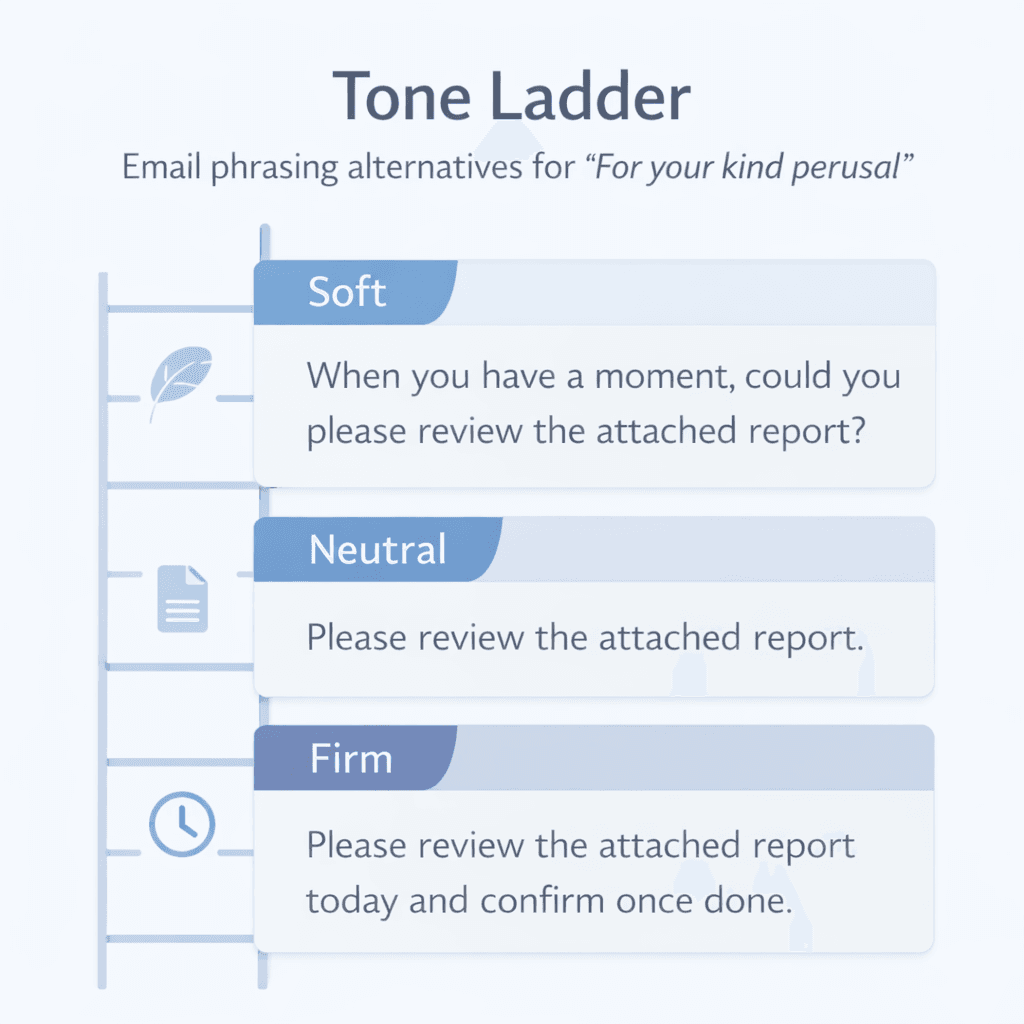
Use these when you only need the reader to look at the document — no immediate decision required.
| # | Alternative | Example sentence |
|---|---|---|
| 1 | Please review the attached | "Please review the attached project timeline." |
| 2 | Attached for your reference | "Attached for your reference is the updated scope document." |
| 3 | Please take a look at the attached | "Please take a look at the attached report when you have a moment." |
| 4 | I am sharing this for your reference | "I am sharing this for your reference as you prepare for tomorrow's meeting." |
Category 2: Review + Feedback
Use these when you need comments, input, or suggestions from the reader.
| # | Alternative | Example sentence |
|---|---|---|
| 5 | Please review and share your feedback | "Please review the draft proposal and share your feedback by Thursday." |
| 6 | I would appreciate your thoughts on | "I would appreciate your thoughts on the attached report before we proceed." |
| 7 | Please let me know if you have any comments | "Please review the attached and let me know if you have any comments or corrections." |
Category 3: Review + Action / Approval
Use these when you need a decision, approval, or signature.
| # | Alternative | Example sentence |
|---|---|---|
| 8 | Please review and approve | "Please review and approve the attached purchase order at your earliest convenience." |
| 9 | Please confirm once reviewed | "Please confirm once you have reviewed the minutes so we can circulate the final version." |
| 10 | Please review, sign, and return | "Please review, sign, and return the attached agreement by Friday." |
Need a version that fits an internal Singapore team or an international client? Rewrite the line in Grammar Buddy and compare a softer tone with a more direct one.
Examples: 3 Copy-Paste Email Templates
Template 1: Sending a Report
Subject: Q3 Sales Report — Please Review
Hi [Name],
Please find attached the Q3 Sales Report for your review.
The report covers performance against targets, regional breakdowns, and key recommendations for Q4. I would appreciate your feedback by [date]. Please let me know if you have any questions or would like to discuss the findings.
Best regards, [Your Name]
For more ready-to-send structures, see these professional email templates for work.
Template 2: Sending a Contract
Subject: Draft Service Agreement — Review and Approval Needed
Dear [Name],
I have attached the draft Service Agreement for your review.
Please go through the terms and let us know if any changes are needed. Once you are satisfied with the document, we can proceed to signing. We would appreciate your confirmation by [date] to keep us on schedule.
Thank you for your time.
Best regards, [Your Name]
Template 3: Sending Meeting Minutes
Subject: Meeting Minutes — [Meeting Name], [Date]
Hi [Name],
Please find attached the minutes from our [meeting name] held on [date].
Could you review and confirm that everything has been captured accurately? If you have any corrections, please reply by [date]. We will circulate the finalised minutes to all attendees once confirmed.
Thank you.
Best regards, [Your Name]
Quick Rewrite Rules
Apply this checklist every time you send a document by email:
- Name the document — Do not just say "the attached." Say "the attached Q3 report" or "the signed NDA."
- Specify the action — What do you need? Review only? Comments? Approval? A signature?
- Add a deadline — "By Friday" or "by end of month" removes ambiguity and helps the reader prioritise.
- Ask for confirmation — "Please confirm receipt" or "let me know if you have questions" keeps the conversation moving. Use an acknowledgement of receipt when confirmation is the only action you need.
These four steps transform a vague courtesy phrase into a clear, actionable request — which is what professional communication is for.
How AI Grammar Buddy Can Help
Not sure whether your rewrite hits the right tone? Here is what happens when you paste a typical "for your kind perusal" sentence into Grammar Buddy's Email Improver:
Before (original draft):
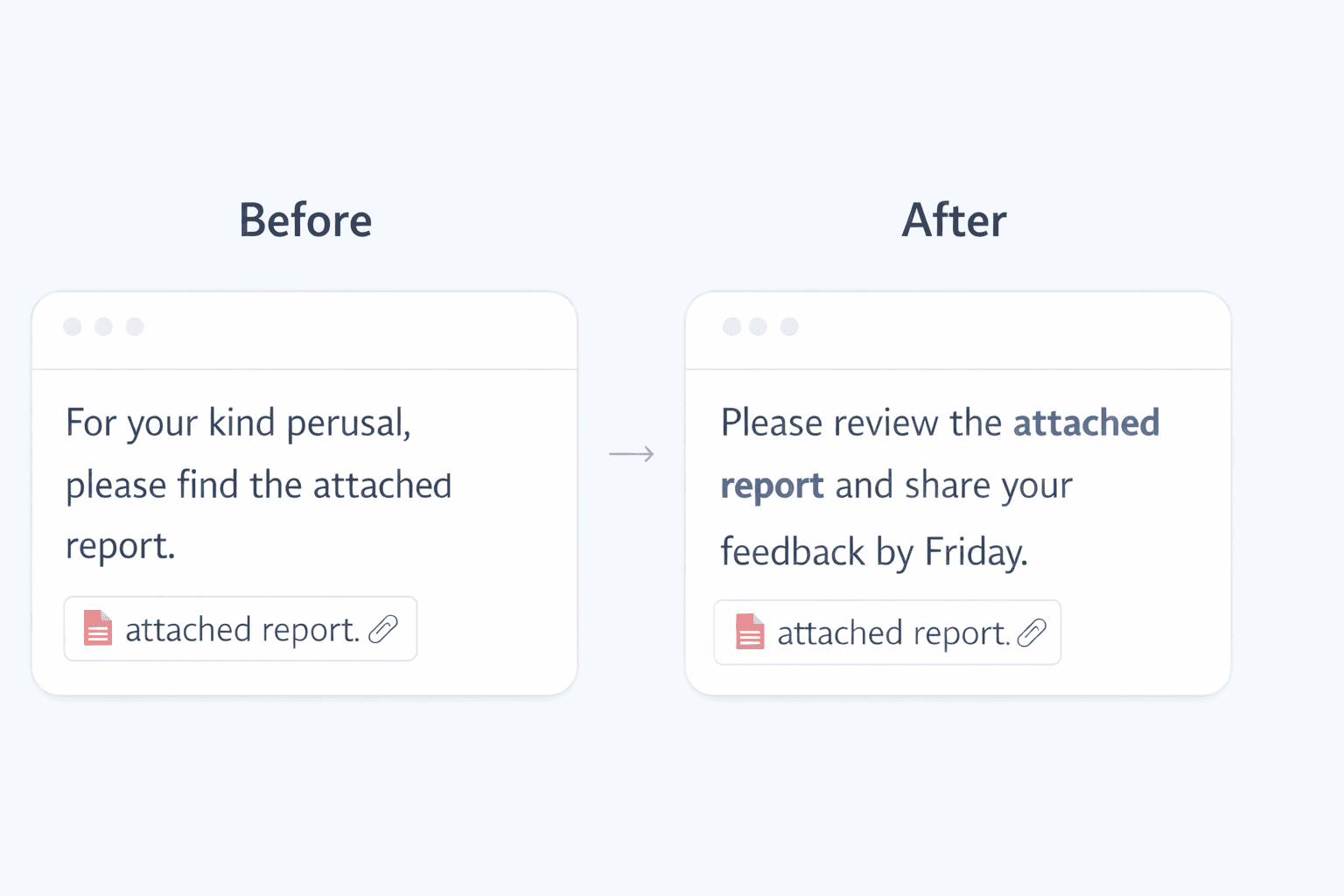
"Please find the attached for your kind perusal and necessary action."
After (Grammar Buddy suggestion):
"Please review the attached contract and confirm approval by Friday."
Grammar Buddy identifies the missing action verb, the missing deadline, and the register mismatch — then rewrites the sentence for your specific audience, whether that is a formal client, an internal team, or an international partner.
Rewrite My Email Tone → Check My Email for Tone and Clarity →
If you found this guide useful, you might also enjoy:
- Do the needful alternatives — the same treatment for another common Indian and Singapore email phrase.
- Please revert meaning — what "please revert" really means in Singapore business English and what to say instead.
Final Takeaway
- "For your kind perusal" is a polite, formal phrase meaning "please read and review this document." It is well established in Indian and Singapore business English and is not incorrect — but it can sound dated to international readers.
- The main weakness is vagueness. The phrase does not tell the reader what action to take next. Always pair an attachment request with a specific action (review, approve, sign) and a deadline.
- Cleaner alternatives — such as "please review and share your feedback" or "please review and approve" — are more direct, more globally understood, and still entirely professional.
- Not sure if your rewrite sounds right? Grammar Buddy's Email Improver checks tone, clarity, and action specificity — paste your sentence and get a plain-English rewrite instantly.
About This Article
Kin
Senior Business English Editor
Kin reviews workplace English for clarity, tone, and cross-cultural communication. She helps professionals replace vague email phrases with specific requests and useful context.
Last updated 2 August 2026
Frequently Asked Questions
What does perusal mean?▼
Perusal means the act of reading or examining something, usually carefully. In an email, “for your perusal” means the sender is providing a document for you to read or review.
What does “for your perusal” mean?▼
“For your perusal” means “for you to read and review.” It is formal but correct. In modern business email, “for your review” is often a clearer alternative.
What does "for your kind perusal" mean in an email?▼
It means "please read and review this document." It is a formal, polite phrase common in South and Southeast Asian business English, typically used when sharing an attachment.
Is "please find attached for your kind perusal" correct?▼
Yes, it is grammatically correct and widely used in Indian and Singapore business email. However, it has two weaknesses: it does not name the document being attached, and it does not specify what the reader should do next. A clearer version would be: "Please find attached the [document name] for your review. Please share your comments by [date]."
Is "for your perusal" the same as "for your kind perusal"?▼
Yes — "for your perusal" and "for your kind perusal" have the same core meaning: please read and review this. The word "kind" adds deference and politeness but does not change what is being asked. "For your perusal" is formal; "for your kind perusal" is very formal. Both can sound dated to international readers. A modern alternative for either is "for your review."
What does "kindly peruse" mean?▼
"Kindly peruse" means "please read carefully." It is grammatically correct but doubly formal. In most modern business emails, "please review" is a cleaner alternative.
What does "for your kind perusal and necessary action" mean?▼
It means the reader should read the document and take whatever action is required. However, "necessary action" is vague. It is always clearer to specify the action — for example, "please review and approve" or "please review, sign, and return."
Is "for your kind perusal" used outside India and Singapore?▼
Rarely. The phrase is strongly associated with Indian English and Singapore business English. In the UK, US, Australia, and most of Europe, "please review the attached" is the standard equivalent.
When should I avoid "for your kind perusal"?▼
Avoid it when writing to international clients unfamiliar with the phrasing, when you need a specific action such as approval or signature, or when your organisation favours plain, direct language. If you are unsure how direct to sound, AI Grammar Buddy can rewrite the request for your audience.
What are the best alternatives to "for your kind perusal"?▼
The most versatile alternatives are: "please review the attached," "please review and share your feedback," and "please review and approve." See the full list of 10 alternatives in this article.
Next step
Rewrite this phrase in context
Paste your sentence and AI Grammar Buddy will turn it into clearer professional English.
Keep going
Continue with AI Grammar Buddy
AI Grammar Buddy
Email Improver
Paste your draft and rewrite it for clearer, more professional English.
Rewrite This PhraseRelated guide
“For Your Review” Meaning in Email + Better Alternatives
Know when this modern alternative asks for feedback, approval, or a response.
Related guide
“Please Find Attached” Alternatives for Professional Email
Replace another dated attachment phrase with clear, natural wording.
Related guide
Indian English vs Global Business English
Compare 20 regional email phrases and make them clearer for international teams.