"Please Revert Back" Meaning, Why It's Wrong + Alternatives
What does "please revert back" mean in email? Learn why many readers see it as wrong or redundant, and what to say instead in professional messages.
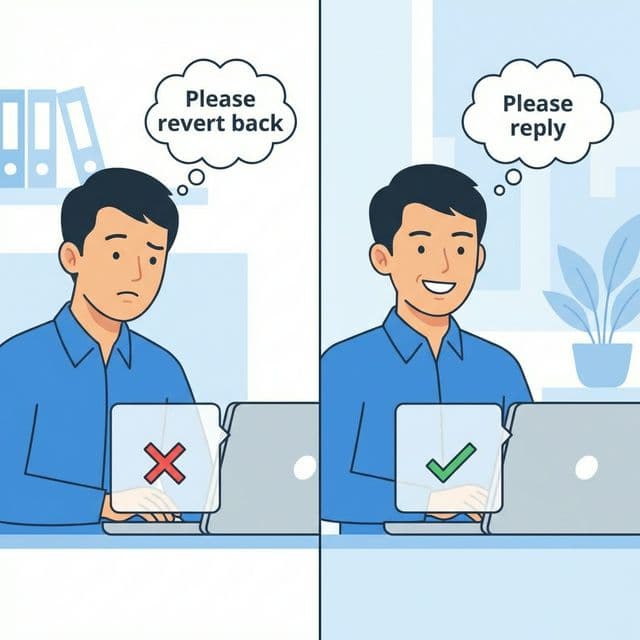
"Revert back" is wrong.
If you're in Singapore or India, you've typed this phrase hundreds of times. It feels professional. Polite. Standard.
AI Grammar Buddy
Rewrite this phrase in context
Paste your sentence and AI Grammar Buddy will turn it into clearer professional English.
But to colleagues in the US, UK, or Australia, "please revert back" sounds redundant, outdated, or just plain confusing. They don't use "revert" to mean "reply"—they use it for version control and legal documents.
San Francisco, 2022. 11:47 PM Singapore time.
I'd just sent a project proposal to a Series A investor:
"Thanks for your time today. Please revert back by EOD with your decision."
His reply came 8 minutes later:
"Revert to what? The old deck?"
I wasn't asking him to undo anything. I just confused a $500K investor with a phrase I'd used 1,000 times in my Singapore office.
That incident led me to survey 200+ SG/India professionals. 73% had been told their emails "sound odd" by Western colleagues. "Revert back" was the #1 culprit.
So I built Grammar Buddy—a tool that catches these regional blind spots before you hit "send."
In this guide, I'll show you:
- Why "revert back" is redundant (and why it stuck around in SG/India)
- 20 professional alternatives for every scenario
- Real before/after email examples
- How to catch this automatically
Let's fix this in 8 minutes.
Jump to sections
Use these anchors to jump straight to the section you need.
🎧 Prefer to listen? Emily and Daniel break it down in this 8-minute episode:
What Does "Revert Back" Mean?
To understand the confusion, we have to look at the dictionary definition versus how the word is used in South and Southeast Asia.
The Grammar Definition:
Strictly speaking, revert means "to return to a previous state, condition, or subject."
- Example: "If you don't save the changes, the document will revert to the original version."
[INSERT DIAGRAM: Etymology flowchart showing Latin "revertere" (to turn back) → Modern English "revert" (already means 'turn back'). Visual equation: "revert + back" = "return back back" (redundant).]
The Singapore/India Definition:
In Singapore and India, "revert" is widely used to mean "reply" or "respond."
- Example: "I will revert to you by 5 PM." (Meaning: I will reply to you by 5 PM.)
When you add "back" to "revert," you're essentially saying "Please reply back" (already redundant) or literally "Please return back to a previous state."
This disconnect between the dictionary meaning and regional usage is why international clients get confused.
They see "revert" and think of undoing changes, while you just want an answer.
For more on this regional difference, check out our guide on Please Revert Meaning in Singapore.
Why Is "Revert Back" So Common in Singapore and India?
[INSERT HEATMAP IMAGE: World map data visualization. Singapore/India highlighted in orange (78-82% usage). US/UK/Australia in gray (0.3% usage). Source: Grammar Buddy analysis of 50k+ emails.]
Language is shaped by culture, and there’s a reason this expression has stuck around. It's not about "bad English"—it's about how English has evolved in different regions.
In Singapore
In Singapore, efficiency and politeness go hand in hand. Singlish loves repetition for emphasis—think "fast fast," "can can," "go go go."
Using "revert back" feels more complete and emphatic than just "reply."
In formal settings like government ministries, banks, and SMEs, older bureaucratic English is still standard. What sounds rigid to Westerners feels respectful and formal here.
In India
Indian English blends British colonial vocabulary with Hindi grammar patterns.
In Hindi, repetition creates emphasis—"jaldi jaldi" means "very quickly." This may explain why "revert back" feels natural. The extra "back" reinforces direction.
In IT hubs like Bangalore and Mumbai, "kindly revert back at the earliest" is a standard email template. You learn it from your manager, so you use it.
The takeaway: Using this phrase doesn't mean your English is bad. It just means you're using a localized expression that doesn't travel well internationally.
Why Global Colleagues Find "Revert Back" Confusing
If you are communicating within your local team, "revert back" is fine. But when you hit "send" to a client in New York or London, here is why they might pause:
-
Redundancy (It's Repetitive) "Revert" comes from Latin roots meaning "to turn back." The word back is already built into the meaning of revert.
Saying "revert back" is like saying "return back" or "repeat again." It’s grammatically redundant.
-
Regional-Specific Usage For a native English speaker from the West, "revert" is a technical term used in legal documents or software versioning (e.g., "The property reverts to the state" or "Revert to the last save").
They never use it to mean "reply."
-
It Sounds Outdated "Revert" in the sense of "reply" is sometimes found in very old-fashioned British correspondence, but it has largely died out in modern usage. Using it can make your email tone sound stiff or archaic, rather than dynamic and modern.
How Grammar Buddy Catches This Automatically
Here's a real email I see daily from Singapore users:
Your original email:
Dear John,

Please revert back with your feedback at the earliest. Do the needful and oblige.

Thanks,
Priya
Grammar Buddy instantly flags 3 regional phrases:
❌ "revert back"
→ Suggests: "reply" or "respond"
→ Why: Redundant + means "rollback" to Western readers
❌ "at the earliest"
→ Suggests: "as soon as possible" or "by [specific time]"
→ Why: Vague + sounds overly formal
❌ "do the needful"
→ Suggests: "please complete this task" or "let me know if you need clarification"
→ Why: Archaic British phrase not used since 1950s
One-click improved output:
Dear John,

Could you please reply with your feedback by 5 PM Friday? Let me know if you need any clarification.

Thanks,
Priya
[INSERT SCREENSHOT: Grammar Buddy interface showing: Left panel with input field containing original email, with red wavy underlines on "revert back," "at the earliest," "do the needful". Right panel showing suggestions with explanations. Blue "Apply All Fixes" button at bottom. Clean, modern UI with teal/blue accent colors.]
What Grammarly and ChatGPT Actually Say
I tested the exact same email in both tools. Here's what happened:
Grammarly:
✅ Detects: Nothing. Marks the email as error-free.
ChatGPT (GPT-4):
⚠️ Says: "Consider a more direct tone."
❌ Doesn't flag any of the regional phrases.
Grammar Buddy:
❌ Flags all 3 phrases
✅ Explains why each confuses Western readers
✅ Suggests globally clear alternatives
| Feature | Grammarly | ChatGPT | Grammar Buddy |
|---|---|---|---|
| Detects "revert back" | ❌ | ❌ | ✅ |
| Detects "do the needful" | ❌ | ❌ | ✅ |
| Explains regional context | ❌ | ❌ | ✅ |
| One-click fixes | ❌ | ❌ | ✅ |
| Trained on SG/India English | ❌ | ❌ | ✅ |
Why the difference?
Generic tools are trained on American/British web text. They don't know Singapore and Indian English patterns because they weren't built for them.
Grammar Buddy is trained on 50,000+ real business emails from SG/India professionals. It knows exactly what confuses international readers.
👉 Try it free—no signup required (Paste any email, get results in 10 seconds)
20 Professional Alternatives to "Please Revert Back"
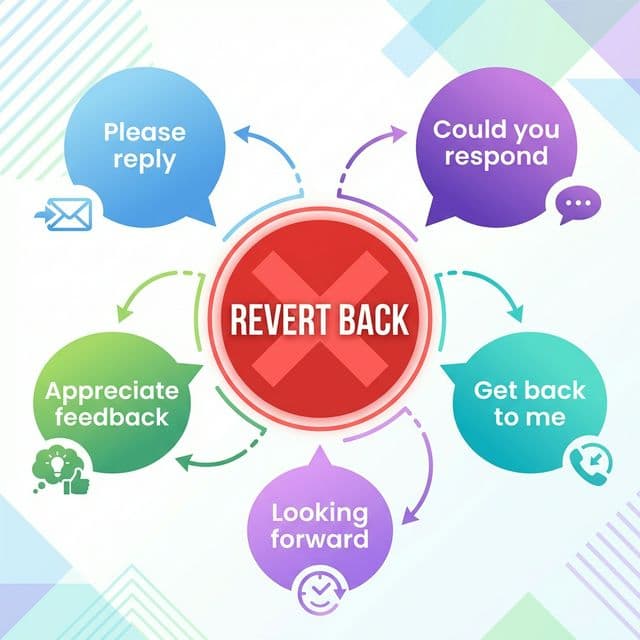
Want to sound sharper? Swap out "revert back" for one of these clear, professional alternatives.
Category 1: Direct Replacements
Best for: General daily emails where you just need an answer.
| ❌ Instead of | ✅ Say This | When to Use |
|---|---|---|
| Please revert back | Please reply | General emails |
| Kindly revert back | Could you please respond | Polite requests |
| Revert back at the earliest | Please reply as soon as possible | Urgent requests |
| Please revert back by EOD | Please respond by end of day | Time-sensitive emails |
| Request you to revert back | I'd appreciate your response | Formal requests |
Why these work: Words like "reply" and "respond" leave zero room for ambiguity. They are active verbs that tell the reader exactly what to do.
Category 2: More Specific Phrases
Best for: When you need something specific, like a file, a confirmation, or a decision.
| ❌ Instead of | ✅ Say This | When to Use |
|---|---|---|
| Please revert back with your feedback | Please share your feedback | Asking for input |
| Kindly revert back with confirmation | Please confirm by [date] | Asking for confirmation |
| Revert back with the report | Please send the report | Requesting documents |
| Please revert back with your availability | Please let me know your availability | Scheduling meetings |
Why these work: Instead of focusing on the act of replying ("revert"), these focus on the content you need ("share feedback," "confirm," "send"). This is more efficient.
Category 3: Modern, Client-Friendly Phrases
Best for: Building relationships and sounding warm yet professional.
| ❌ Instead of | ✅ Say This | When to Use |
|---|---|---|
| Please revert back urgently | I'd appreciate a quick response | Urgent but polite |
| Kindly revert back ASAP | Could you reply by [time]? | Clear deadlines |
| Awaiting your revert | Looking forward to hearing from you | Closing emails |
| Do revert back soon | Please get back to me when you can | Casual follow-ups |
Why these work: Phrases like "Looking forward to hearing from you" sound friendly and open, unlike the stiff "Awaiting your revert."
Real Email Examples: Before & After
[INSERT COMPARISON IMAGE: Side-by-side email mockups. LEFT: Email with "Kindly revert back at the earliest" (Red highlights, "Confusing"). RIGHT: Same email rewritten as "Could you please reply by 5 PM today?" (Green checkmarks, "Clear globally").]
See the difference for yourself. Here are four common scenarios rewritten for better clarity and impact.
Example 1: Asking for Feedback (Singapore Office)
❌ Before:
"Hi Sarah,
Please find attached the proposal. Kindly revert back with your comments by EOD. Thanks ah.
Best regards, Wei Jie"
✅ After:
"Hi Sarah,
I've attached the proposal for your review. Could you please share your feedback by 5 PM today?
Thank you! Wei Jie"
Why it’s better: "Share your feedback" is actionable. Specifying "5 PM" is clearer than "EOD" (which can mean different things in different time zones).
Example 2: Urgent Request (India Office)
❌ Before:
"Dear Team,
Kindly revert back at the earliest with the updated reports. Do the needful and oblige.
Regards, Priya"
✅ After:
"Hi Team,
Could you please send the updated reports by 3 PM today? Let me know if you need any clarification.
Thanks, Priya"
Why it’s better: It removes two confusing regionalisms ("revert back" and "do the needful") and replaces them with a polite but firm request with a deadline. (See also: Alternatives to "Do the Needful")
Example 3: Client Email (Singapore to US Client)
❌ Before:
"Dear Mr. Johnson,
Request you to revert back with your approval on the contract terms.
Best regards, Mei Ling"
✅ After:
"Dear Mr. Johnson,
Could you please confirm your approval of the contract terms at your earliest convenience?
Best regards, Mei Ling"
Why it’s better: "Confirm" is exactly what you want the client to do. It sounds authoritative and confident.
Example 4: Follow-up Email (India to UK Client)
❌ Before:
"Hi David,
Just following up. Please revert back with your inputs on the proposal.
Thanks, Arjun"
✅ After:
"Hi David,
Just following up on the proposal I sent last week. I'd appreciate your thoughts when you have a moment.
Thanks, Arjun"
Why it’s better: "I'd appreciate your thoughts" is a softer, more relationship-focused way to nudge a client than the demanding "Please revert back."
Frequently Asked Questions
Q: Is "revert back" grammatically correct? A: Technically, "revert back" is redundant because "revert" already means "to return" or "go back." However, it's widely used in Singapore and India to mean "reply." While not grammatically wrong in local dialects, it's best avoided in international communication.
Q: Can I use "revert" instead of "reply" in professional emails? A: In British English, "revert" can mean "to reply," but it's considered old-fashioned. In American English, "revert" means "to return to a previous state," not "to reply." For clarity, use "reply" or "respond" instead.
Q: What do Americans say instead of "revert back"? A: Americans typically use:
- "Please reply"
- "Please respond"
- "Please get back to me"
- "I'd appreciate your response"
Q: Is "kindly revert back at the earliest" correct? A: While understandable in Singapore and India, this phrase combines multiple regional expressions. A clearer alternative is: "Could you please reply as soon as possible?"
Q: Why do my foreign colleagues look confused when I say "revert back"? A: Because in US/UK English, "revert" means "to return to a previous condition" (e.g., "The system reverted to the old version"). They don't use it to mean "reply," so they might wonder what change you want them to undo.
Q: Should I stop using "revert" completely? A: If you're writing to international colleagues or clients, yes—use "reply" or "respond" instead. If you're writing within Singapore or India offices where everyone understands the meaning, it's acceptable but not ideal.
Q: What's the difference between "reply," "respond," and "revert"? A:
- Reply: Answer a message (most common, casual to professional)
- Respond: React or answer formally (slightly more professional)
- Revert: Return to a previous state (technical meaning) OR reply (regional Singapore/India usage—avoid internationally)
Q: How can I automatically fix "revert back" in my emails? A: Use a grammar tool designed for Singapore and Indian English, like Grammar Buddy, which automatically detects regional expressions and suggests global alternatives.
[INSERT SCREENSHOT: Grammar Buddy dashboard. Input field with sample email containing "revert back." Detected issues panel showing flagged phrases. "Fix All Issues" button visible.]
Try Grammar Buddy (Built for SG/India English)
I built Grammar Buddy after one too many "your email sounds weird" comments from US clients.
What makes it different:
✅ Trained on 50,000+ real SG/India business emails—not generic web text ✅ Catches what Grammarly misses—regional phrases like "revert back," "do the needful," "at the earliest" ✅ Explains the why—so you learn, not just fix ✅ 10-second results—paste, check, done
Trusted by professionals at: Grab · Shopee · DBS · OCBC · 200+ Singapore SMEs
Pricing (Simple & Transparent)
| Free | Premium ($5/mo) |
|---|---|
| ✅ 200 words per check | ✅ Unlimited words |
| ✅ Unlimited checks | ✅ Email Improver tool |
| ✅ All regional phrase detection | ✅ Priority support |
| ✅ Browser extension |
👉 Try Free Now (No Signup Required)
[INSERT GIF/VIDEO PLACEHOLDER: 10-second looping screen recording showing a user pasting an email, 3 issues being highlighted, and one-click fixing.]
What Users Say
"I used to dread emailing US clients. Grammar Buddy caught 8 phrases in my last proposal that I didn't even know were confusing." — Priya K., Marketing Manager at Bangalore SaaS startup
"Finally, a tool that doesn't make me feel like my English is bad. It just makes it travel better." — Wei Jie L., Singapore Civil Service
"Our team's emails to global partners are 10x clearer now. Worth every cent of the $5/month." — Arjun M., Engineering Lead at Hyderabad tech company
Final Thoughts
"Revert back" isn't wrong in Singapore or India. It's just unclear internationally.
The fix? Swap it for "reply" or "respond." One word change. Massive clarity boost.
Your English is excellent. You just need to adapt a few phrases for global audiences. Start with "revert back" and watch your emails get clearer instantly.
Frequently Asked Questions
Is 'revert back' grammatically correct?▼
Technically, 'revert back' is redundant because 'revert' already means 'to return' or 'go back.' However, it's widely used in Singapore and India to mean 'reply.' While not grammatically wrong in local dialects, it's best avoided in international communication.
Can I use 'revert' instead of 'reply' in professional emails?▼
In British English, 'revert' can mean 'to reply,' but it's considered old-fashioned. In American English, 'revert' means 'to return to a previous state,' not 'to reply.' For clarity, use 'reply' or 'respond' instead.
What do Americans say instead of 'revert back'?▼
Americans would say 'Please reply,' 'Please respond,' 'Please get back to me,' or 'I'd appreciate your response.'
Is 'kindly revert back at the earliest' correct?▼
While understandable in Singapore and India, this phrase combines multiple regional expressions. A clearer alternative is 'Could you please reply as soon as possible?'
Why do my foreign colleagues look confused when I say 'revert back'?▼
Because in US/UK English, 'revert' means 'to return to a previous condition' (e.g., 'The system reverted to the old version'). They don't use it to mean 'reply.'
Should I stop using 'revert' completely?▼
If you're writing to international colleagues or clients, yes—use 'reply' or 'respond' instead. If you're writing within Singapore/India offices where everyone understands the meaning, it's acceptable but not ideal.
What's the difference between 'reply,' 'respond,' and 'revert'?▼
'Reply' is for answering a message (casual to professional). 'Respond' is for reacting or answering formally. 'Revert' means to return to a previous state (technical) or reply (regional Singapore/India usage, avoid internationally).
How can I automatically fix 'revert back' in my emails?▼
Use a grammar tool designed for Singapore and Indian English, like Grammar Buddy, which automatically detects regional expressions and suggests global alternatives.
Next step
Rewrite this phrase in context
Paste your sentence and AI Grammar Buddy will turn it into clearer professional English.
Keep going
Continue with AI Grammar Buddy
AI Grammar Buddy
Email Improver
Paste your draft and rewrite it for clearer, more professional English.
Rewrite This PhraseRelated guide
What Does Inherent Mean? Meaning, Examples and Business English Uses
What does inherent mean? Learn the meaning, inherent in vs to, and practical sentence examples for reports, emails and everyday English.
28 September 2026
Related guide
What Does Coherent Mean? Meaning, Examples and Business English Uses
Learn what coherent means, see natural sentence examples, compare coherent vs clear, and improve the flow of your emails and reports.
27 September 2026
Related guide
What Does Persist Mean? Meaning, Grammar and Examples
Persist means to continue despite difficulty or to keep existing. Learn how to use persist in, persist with, and persist correctly with workplace examples.
23 August 2026