Do the Necessary Meaning: Correct? Email Alternatives
“Do the necessary” means do what is required. Is it correct English? See email examples, common mistakes, and clearer professional alternatives.

You open an email that ends with “Please do the necessary.” You know something is expected—but not what, by when, or how to confirm it is done.
The “do the necessary” meaning is do what is needed or required. It is accepted informal British English, yet it often fails in global work email because the task stays unnamed. Below you will find its meaning, whether it is correct, email examples, and clearer professional alternatives.
The same clarity issue appears in “for your kind action” meaning and email alternatives: both phrases can sound polite while leaving the reader to infer the task.
In professional writing, the best fix is usually not a fancier phrase. It is a more specific request. If you are unsure how your sentence sounds, paste it into AI Grammar Buddy’s Email Improver and compare a clearer rewrite before sending.
TL;DR
“Do the necessary” means “do what is needed or required.” It is an accepted informal British expression, but it may sound unusual or vague to some international readers. In a work email, name the exact action instead.
Top alternatives:
- •General: “I’ll do what is necessary.”
- •Request: “Please take the necessary steps.”
- •Specific: “Please approve the invoice by Friday.”
AI Grammar Buddy
Rewrite this phrase in context
Paste your sentence and AI Grammar Buddy will turn it into clearer professional English.
Jump to sections
Use these anchors to jump straight to the section you need.
Quick Answer
“Do the necessary” means “do what is needed” or “take the required action.” It is correct as an informal British expression because “the necessary” can function as a noun phrase meaning “whatever is needed.”
Still, it is not equally natural to every English speaker. In an international email, use “do what is necessary,” “take the necessary steps,” or name the exact action.
Do the Necessary Meaning in Email
To do the necessary is to perform the action that a situation requires.
For example:
The deadline is tomorrow, so I’ll do the necessary tonight.
This means the speaker will complete whatever work is needed before the deadline.
Merriam-Webster defines “the necessary” as a British, informal noun phrase for whatever is needed for a purpose. Collins records “do the necessary” as doing something necessary in a particular situation.
The phrase often leaves the task unstated because the speakers believe it is already obvious:
- A technician may mean, “I will reset the account.”
- A manager may mean, “Please approve the request.”
- A colleague may mean, “Please correct the figures and resend the file.”
That shortcut works only when both people understand the same next step.
Is “do the necessary” correct English?
Yes, it is correct in British informal English. In this expression, necessary is preceded by the and functions as a noun phrase: the necessary means the things or actions required.
Compare these patterns:
| Pattern | Example | Natural? |
|---|---|---|
| the necessary | “I’ll do the necessary.” | Correct, informal British English |
| what is necessary | “I’ll do what is necessary.” | Correct and widely understood |
| necessary + noun | “I’ll complete the necessary checks.” | Correct and specific |
| necessary alone | “I’ll do necessary.” | Incorrect in standard English |
The safest international version is “I’ll do what is necessary.” It preserves the meaning without relying on a regional expression.
“Please do the necessary” meaning in an email
“Please do the necessary” means “please take whatever action is required.” Please makes the request polite, but it does not explain the work.
Consider this message:
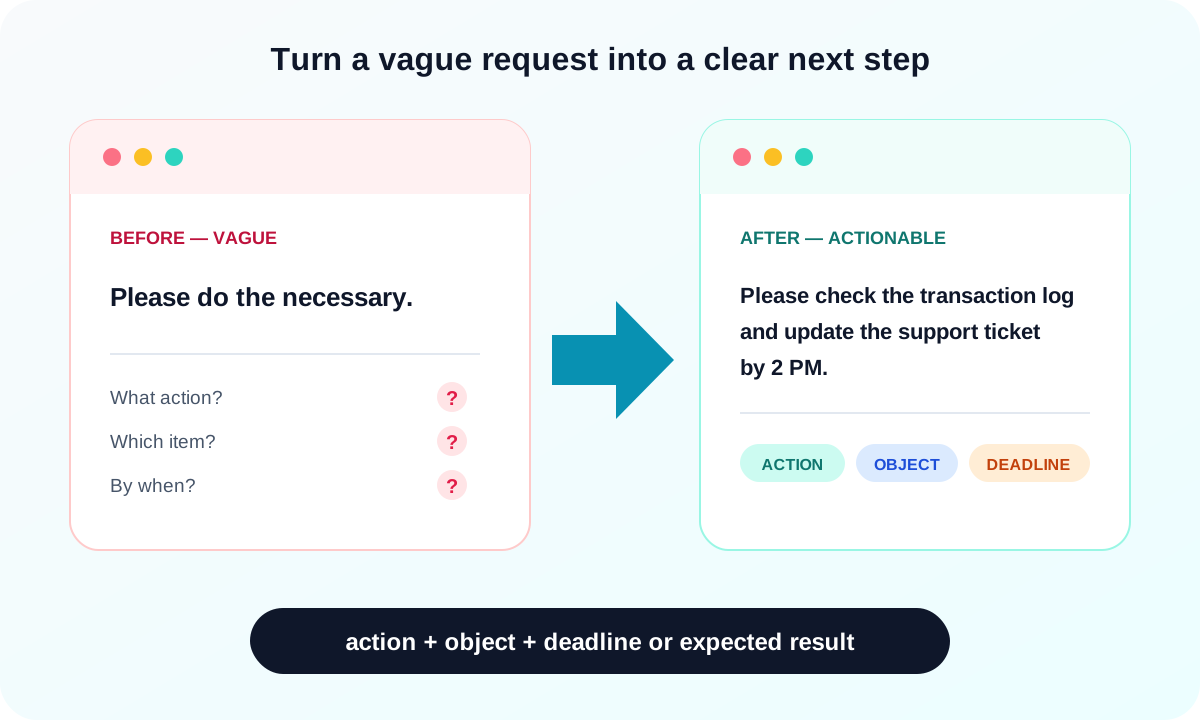
The customer has reported another payment error. Please do the necessary.
Possible actions include checking the transaction, contacting the payment provider, refunding the customer, or simply replying. The recipient has to guess.
A clearer version is:
The customer has reported another payment error. Please check the transaction log and update the support ticket by 2 PM.
The rewrite names the action, the destination, and the deadline. Politeness stays intact, while uncertainty disappears.
When a request uses kindly instead of please, the intention is usually the same. The related guide to “kindly oblige” meaning and tone explains why that formal politeness marker can travel differently across workplaces.
Examples
1. Confirming that you will handle a task
Original:
I have received the documents and will do the necessary.
Clearer:
I have received the documents and will verify the details today.
Why it works: The reader knows what will happen next.
2. Requesting corrections
Original:
Please do the necessary changes to the report.
Clearer:
Please make the necessary changes to the report.
Best:
Please correct the totals on page 4 and return the report by Thursday.
With the noun changes, standard collocation favors make changes, not do changes. Naming the edits is clearer still.
3. Asking someone to solve a problem
Original:
The login is not working. Kindly do the necessary.
Clearer:
The login is not working. Could you reset my access and let me know when I can try again?
4. Asking for approval
Original:
The quotation is attached. Please do the necessary.
Clearer:
The quotation is attached. Please approve it or send your changes by 5 PM Wednesday.
If the original still feels vague after one rewrite, paste the full thread into AI Grammar Buddy’s Email Improver and check whether the next action would be obvious to a new reader.
5. Giving a progress update
Original:
We will do the necessary to avoid another delay.
Clearer:
We will add a second review before release to avoid another delay.
If your first draft still feels too broad, try it in AI Grammar Buddy’s grammar checker. A useful rewrite should make the action visible, not merely replace one vague phrase with another.
Better alternatives by situation
| Situation | Better wording |
|---|---|
| The action is already understood | “I’ll take care of it.” |
| You want a neutral general phrase | “I’ll do what is necessary.” |
| Several steps may be involved | “Please take the necessary steps.” |
| You need someone to continue | “Please proceed with the account setup.” |
| You need a correction | “Please make the necessary changes.” |
| You need investigation | “Could you investigate the error and update me?” |
| You need confirmation | “Please confirm once the transfer is complete.” |
The strongest workplace version usually follows this formula:
action + object + deadline or expected result
Please review the revised contract and confirm your approval by Friday.
Common Mistakes
Mistake 1: Calling every regional expression “wrong”
“Do the necessary” is not automatically bad grammar. It is recorded in British English. The practical question is whether it sounds natural and clear to your audience.
If your team uses the phrase and the task is obvious, it may cause no problem. If you write to clients or colleagues across several countries, a more explicit sentence travels better.
This is a code-switching decision, not a judgment about someone’s English. Our comparison of Indian English and global business English shows how locally normal phrases can create uncertainty only when the audience changes.
Mistake 2: Writing “do necessary”
Do not remove the or what is:
- Incorrect: “I will do necessary.”
- Correct: “I will do the necessary.”
- More universal: “I will do what is necessary.”
Mistake 3: Writing “do the necessary changes”
Although readers will probably understand it, make the necessary changes is the more natural collocation:
- Less natural: “Please do the necessary changes.”
- Natural: “Please make the necessary changes.”
- Clearest: “Please update the price and delivery date.”
Mistake 4: Replacing it with another vague instruction
“Please act accordingly,” “please handle this,” and “take appropriate action” can be just as unclear. A modern-sounding phrase is not necessarily an informative one.
The same problem appears with vague uses of “please advise”: polite wording does not help if the reader cannot identify the decision or response you need. Replacing one vague phrase with another may pass a basic grammar check, so test clarity as well as correctness.
Ask yourself:
- What exactly should the reader do?
- What file, account, request, or issue does it concern?
- When should it be done?
- Should the reader confirm completion?
Mistake 5: Confusing it with “do the needful”
“Do the necessary” and “do the needful” share the basic meaning “do what is required,” but they have different usage histories.
| Phrase | Where it is especially familiar | Main concern in global email |
|---|---|---|
| Do the necessary | Informal British English | May sound unusual or incomplete |
| Do the needful | Indian English and older formal usage | May sound dated or region-specific |
| Do what is necessary | Broad international usage | Still general if the task is not stated |
For the regional history, tone, and alternatives, read our guide to “do the needful” meaning.
How AI Grammar Buddy Can Help
Grammar checkers often focus on spelling and agreement. A sentence such as “Please do the necessary” may pass those checks even when it leaves the reader unsure what to do.
AI Grammar Buddy can help you test three qualities at once:
- Grammar: Is the sentence structurally correct?
- Tone: Does it sound polite for the relationship?
- Clarity: Can the reader identify the next action?
For example:
Before: Please do the necessary and revert at the earliest.
After: Please update the delivery date in the order system and confirm by 3 PM today.
The second version does not sound less respectful. It is simply easier to act on. If you are also unsure about revert, read what “revert” means in email before you send the message.
Paste your sentence into AI Grammar Buddy’s Email Improver to make it clearer, more polite, or more professional.
Final Takeaway
“Do the necessary” means “do what is needed.” It is correct in informal British English, but it may sound vague or unfamiliar in a global workplace.
Use “do what is necessary” when you need a general expression. For a professional email, go one step further: name the action, the object, and any deadline. The clearest request is the one your reader can act on without guessing.
If the timing itself is vague, replace “at your earliest convenience” with a clear deadline too.
About This Article
Kin
Senior Business English Editor
Kin reviews workplace phrases used across British, Indian, Singaporean, and international business English. She focuses on helping writers keep their intended politeness while making every request easy to act on.
Last updated 26 July 2026
Frequently Asked Questions
What does “do the necessary” mean?▼
“Do the necessary” means to do what is needed or required in a particular situation. It is an informal British expression.
Is “do the necessary” correct English?▼
Yes. Dictionaries record “the necessary” as a British informal noun phrase meaning whatever is needed. However, “do what is necessary” is more widely natural across international varieties of English.
What does “please do the necessary” mean in an email?▼
It means “please take the action required in this situation.” The wording is polite but vague, so a professional email is clearer when it names the action, deadline, or result.
Should I say “do the necessary changes” or “make the necessary changes”?▼
Use “make the necessary changes.” English normally uses the verb “make” with the noun “changes.” You can also name the edits directly.
What is the difference between “do the necessary” and “do the needful”?▼
Both can mean “do what is required.” “Do the necessary” is recorded as informal British English. “Do the needful” is an older expression that remains especially familiar in Indian English. Both may be too vague in a global work email.
What can I say instead of “do the necessary”?▼
Use “do what is necessary,” “take the necessary steps,” or, preferably, state the exact action: “Please update the file and send it by 3 PM.”
Next step
Rewrite this phrase in context
Paste your sentence and AI Grammar Buddy will turn it into clearer professional English.
Keep going
Continue with AI Grammar Buddy
AI Grammar Buddy
Email Improver
Paste your draft and rewrite it for clearer, more professional English.
Rewrite This PhraseRelated guide
Do the Needful Meaning: Is It Correct? Professional Alternatives
Learn the phrase’s regional usage, tone, and clearer alternatives for global work emails.
Related guide
Revert Meaning in Email: Why It Can Confuse Readers
See what revert means across regional and international business English.
Related guide
At Your Earliest Convenience: Meaning and Clearer Deadlines
Replace a vague timing phrase with a polite deadline your reader can act on.