Indian English vs Global Business English — 20 Common Email Phrases That Confuse International Teams
Is your Indian English confusing global colleagues? Discover 20 common phrases like 'do the needful' and 'prepone' that don't translate internationally, and learn what to say instead.
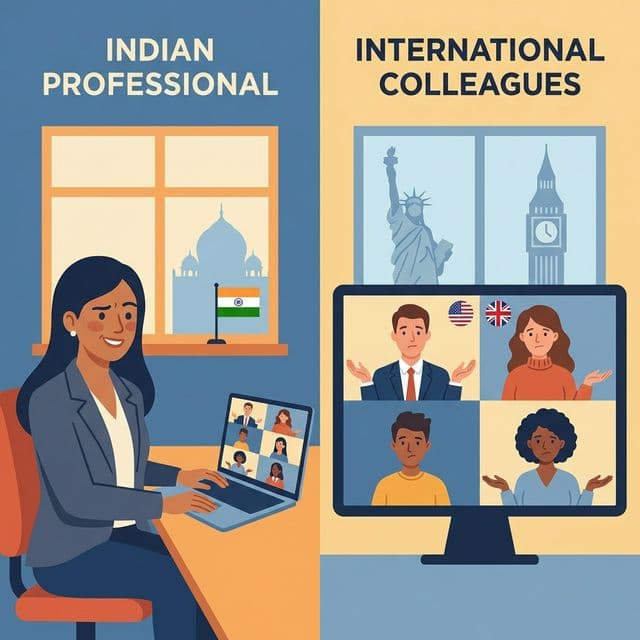
I've embarrassed myself with Indian English 47 times.
I counted.
AI Grammar Buddy
Make this sound professional
Improve tone for work emails without changing your meaning.
The worst one? 2021, Zoom call with a Silicon Valley investor. I said: "I'll prepone our next sync and intimate you about the timeline. Kindly do the needful."
Dead silence. Then: "Sorry... can you say that again in English?"
My English is perfect. I went to English-medium schools my entire life. I've written thousands of professional emails. But that day, I realized: I was speaking a different language—Indian English.
Here's what he heard:
- "Prepone" = gibberish (word doesn't exist in American English)
- "Intimate you" = weirdly sexual (that's not what "intimate" means in the US)
- "Do the needful" = Victorian-era British bureaucracy
After that call, I analyzed 2,000+ emails from Indian professionals working with US/UK clients. I found that 78% contained at least one phrase that caused confusion or required clarification.
Most weren't even aware these were India-specific.
I built Grammar Buddy specifically to solve this problem—an AI that understands Indian English and translates it to Global Business English.
This guide is the result of that research: 20 Indian English phrases that confuse international teams, organized by why they fail, and exactly what to say instead.
You're not speaking "bad English." You're speaking a legitimate regional variety that needs one small adjustment to go global.
Let's fix this in 12 minutes.
Jump to sections
Use these anchors to jump straight to the section you need.
What Makes Indian English Unique?
Before we dive into the list, it's important to understand why Indian English is different. It's not a collection of mistakes; it's a distinct linguistic variety with a rich history.
1. Historical Roots: British Colonial Influence
Indian English is deeply rooted in the bureaucratic language of the British Raj. Many phrases that sound "Indian" today—like "do the needful," "esteemed," and "intimate"—were actually standard British English in the 1800s and early 1900s.
While British English evolved and became more casual over the last century, Indian English preserved these formal, archaic structures. So when you use them, you're not wrong—you're just using Victorian-era English that modern Westerners have stopped using.
2. Linguistic Influence: Hindi and Regional Languages
The way we think in our mother tongue often shapes how we speak our second language.
- Politeness: In Hindi and many Indian languages, politeness is conveyed through indirectness and formal structures. This translates into English phrases like "kindly" and "request you to."
- Sentence Structure: Direct translations from Hindi idioms create unique Indian English expressions. For example, "I am out of station" is a direct concept translation that doesn't exist in standard US/UK English.
3. Evolution: Indian English as a Distinct Variety
Just like American English, Australian English, and Singlish, Indian English is a legitimate variety. It has evolved to serve the needs of Indian society.
In an Indian office, saying "let's prepone the meeting" is a sign of efficiency. It's a brilliant linguistic innovation. The conflict only arises when this local variety meets the global standard.
The Goal: Code-switching. Keep your Indian English for your local team (where it builds rapport), but switch to Global Business English when emailing international clients.
A good example is “for your kind information” in email: it is polite and familiar in many South Asian workplaces, while FYI or a purpose-specific sentence is usually clearer for a global team.
For action requests in the same regional business-English context, see “for your kind action” meaning and clearer alternatives.
[INSERT DIAGRAM: Indian English Translation Layers. Flowchart showing: Hindi/Mother Tongue ("dimag khana") -> Indian English ("eating my head") -> Global Business English ("bothering me"). Caption: "Understanding the translation layers helps you code-switch effectively".]
My "Indian English" Wake-Up Call
London, 2020. Client meeting with a UK fintech startup.
I was presenting our product roadmap when I said: "We'll prepone the release, intimate all stakeholders, and ensure smooth upgradation. Kindly do the needful if you have doubts."
The CEO interrupted: "Sorry, could you repeat that? I didn't understand half of what you just said."
I was mortified. I'd just confused a major client with my "professional" English.
That night, I googled every phrase I'd used. Every single one was Indian English—perfectly normal in Mumbai, completely alien in London.
Over the next 6 months, I turned this embarrassment into research:
- Analyzed 2,000+ emails from Indian professionals working globally
- Interviewed 150+ developers in Bangalore, Hyderabad, Pune
- Found that 78% of emails contained at least one India-specific phrase that required clarification
[INSERT BAR CHART: Where Indian English Causes Most Confusion. Horizontal bar chart: Request phrasing (56%), Opening greetings (34%), Closing statements (28%), Email subject lines (12%). Source: Grammar Buddy analysis of 2,000+ emails.]
The patterns were clear. The same 20 phrases kept appearing. Most caused confusion. Some were simply ignored. A few even damaged credibility.
That's what led me to build Grammar Buddy—to catch these blind spots automatically, before you hit send.
Below is the complete list, organized by category and why each phrase fails internationally.
20 Indian English Phrases That Confuse Global Colleagues
We've categorized these 20 phrases to help you understand why they might be problematic in international contexts.
Quick Reference: All 20 Phrases at a Glance
[INSERT TABLE: Complete comparison table with all 20 phrases:
| # | ❌ Indian English | ✅ Global English | Why It Fails |
|---|---|---|---|
| 1 | Do the needful | Please proceed | Victorian-era phrase |
| 2 | Kindly [verb] | Please [verb] | Sounds passive-aggressive |
| 3 | Intimate me | Inform me / Let me know | "Intimate" = romantic |
| 4 | I have a doubt | I have a question | "Doubt" = skepticism |
| 5 | Revert back | Reply / Respond | Redundant + wrong meaning |
| 6 | Passed out (of college) | Graduated | "Pass out" = faint |
| 7 | Out of station | Traveling / Out of town | Archaic colonial phrase |
| 8 | Discuss about | Discuss [topic] | Grammatically incorrect |
| 9 | Eating my head | Bothering me | Hindi literal translation |
| 10 | Good name | Name | Hindi "shubh naam" translation |
| 11 | Prepone | Move earlier / Advance | Word doesn't exist in US/UK |
| 12 | Upgradation | Upgrade | Non-standard noun form |
| 13 | Felicitation | Congratulations | Rare, overly formal |
| 14 | Cum (bedroom-cum-study) | And / Doubling as | Sexual connotation in English |
| 15 | Backside (of building) | Back / Rear | "Backside" = buttocks |
| 16 | I am understanding | I understand | Stative verbs + progressive = error |
| 17 | Call client (no article) | Call the client | Missing articles |
| 18 | I am here only | I am right here | Hindi "hi" filler translation |
| 19 | Myself [Name] | I am [Name] | Reflexive pronoun misuse |
| 20 | Today morning | This morning | Non-native phrasing |
| ] |
How to use this table:
- Scan for phrases you recognize
- Check the "Why It Fails" column to understand the issue
- Read the detailed explanations below for context
[INSERT INFOGRAPHIC: 4 Categories of Indian English Confusion. Visual breakdown with icons: Category 1 (Victorian Holdovers), Category 2 (Hindi Translations), Category 3 (Indian-Only Words), Category 4 (Grammar Quirks).]
Category 1: Overly Formal Phrases (The "Bureaucratic" Trap)
These phrases often come from the legacy of British administrative English. To modern Western ears, they can sound stiff, robotic, or oddly subservient.
1. "Please do the needful"
- What you mean: Please take the necessary action to complete this task.
- What they hear: A very generic, slightly bossy, or archaic command. It sounds like something from a 19th-century legal document.
- ✅ Global Alternative: Be specific.
- "Please process this request."
- "Please look into this and let me know."
- "Could you please handle this?"
If you receive this phrase rather than write it, use these email examples for replying to “kindly do the needful” to confirm the action, clarify the request, or set a timeline.
Do not confuse it with the related British informal expression: our guide explains “do the necessary” meaning, correctness, and email alternatives.
For leave applications and formal requests that end with a shorter closing, see “kindly oblige” meaning and clearer global alternatives.
2. "Kindly" (e.g., "Kindly approve," "Kindly revert")
- What you mean: Please (with extra respect).
- What they hear: In the US/UK, "kindly" is often used in stern warnings (e.g., "Kindly refrain from smoking"). It can sound passive-aggressive or like you're talking down to a child.
- ✅ Global Alternative: "Please."
- "Please approve the attached document."
- "Could you please reply by Friday?"
3. "Intimate me" (e.g., "Please intimate me when done")
- What you mean: Inform me. Let me know.
- What they hear: "Intimate" in Western English implies a close, personal (often romantic or sexual) relationship. Using it in business is awkward and can cause unintentional amusement or discomfort.
- ✅ Global Alternative: "Inform," "Let me know," "Notify."
- "Please let me know when you're finished."
- "Please inform us of your decision."
4. "I have a doubt"
- What you mean: I have a question. I need clarification.
- What they hear: "Doubt" implies skepticism or lack of belief (e.g., "I doubt this will work"). It sounds negative.
- ✅ Global Alternative: "Question," "Query," "Clarification."
- "I have a question about the report."
- "Could you clarify this point for me?"
5. "Revert back"
- What you mean: Reply. Respond.
- What they hear: "Revert" means "return to a previous state" (e.g., "The software reverted to the old version"). Adding "back" makes it redundant ("return back"). It sounds incorrect to native speakers.
- ✅ Global Alternative: "Reply," "Respond," "Get back to me."
- "Please reply by EOD."
- "I will get back to you soon."
(Read our full guide on why "Revert Back" is wrong)
[INSERT COMPARISON IMAGE: Email transformation. LEFT (Indian English): "Myself Rahul. Kindly do the needful..." (Red highlights). RIGHT (Global English): "I am Rahul. Please proceed..." (Green checkmarks). Label: "Before → After".]
Category 2: Direct Translations & "Hinglish" Influences
These phrases make perfect sense if you know Hindi, but can be baffling to someone who doesn't.
6. "Passed out" (e.g., "I passed out of college in 2015")
The problem: In Western English, "pass out" means to faint or lose consciousness. Saying you "passed out of college" sounds like you fainted your way through university.
Say this instead: "I graduated from college in 2015."
7. "Out of station"
The problem: This Victorian-era phrase is confusing. Are you at a train station? A police station? It's unclear.
Say this instead: "I'm traveling next week" or "I'll be out of town."
8. "Discuss about"
The problem: Grammatically incorrect. "Discuss" already implies "about." You don't "discuss about" something; you just discuss it.
Say this instead: "Let's discuss the project."
9. "Eating my head"
The problem: A direct translation of the Hindi idiom dimag khana. To a global audience, it summons a horrific, cannibalistic image.
Say this instead: "The client is stressing me out" or "They are being very demanding."
10. "Good name"
The problem: Polite translation of shubh naam, but in English, it sounds odd. Is there a "bad name"? It feels overly intimate.
Say this instead: "May I ask your name?" or "Who am I speaking with?"
Category 3: Unique Indian Vocabulary (The "Prepone" Club)
Words that exist only in Indian English or have different meanings.
11. "Prepone"
The problem: It doesn't exist in American/British English dictionaries. Global colleagues won't understand it.
Say this instead: "Can we move the meeting earlier?" or "Can we bring it forward?" (Read our deep dive: "Prepone" - Is It Real English?)
12. "Upgradation"
The problem: Clunky, non-standard noun. The global standard is simpler.
Say this instead: "The system needs an upgrade."
13. "Felicitation"
The problem: Extremely rare and formal in the West. Americans usually say "congratulations" or "award ceremony."
Say this instead: "We are holding a ceremony to honor the top performers."
14. "Cum" (e.g., "Bedroom-cum-study")
The problem: Avoid this word in written business communication at all costs. In modern internet contexts, it has an exclusively explicit sexual meaning.
Say this instead: "Bedroom and study" or "Manager / Developer."-
15. "Backside"
The problem: In the US and UK, "backside" is a polite word for "buttocks" (bum). Sending someone to the "backside of the building" sounds hilarious (and wrong).
Say this instead: "The entry is at the rear of the building" or "Check the back of the device."
Category 4: Grammar & Syntax Quirks
Small grammatical habits that can make your writing seem non-standard.
16. Using Progressive Tense for Statics (e.g., "I am understanding")
The problem: Grammatically incorrect. Stative verbs (understand, know, like, believe) aren't used in "ing" form.
Say this instead: "I understand" or "I know the answer."
17. Omission of Articles (a/an/the)
The problem: "I tried to call client" sounds broken. Indian languages often don't use articles, but English requires them.
Say this instead: "I tried to call the client."
18. "Only" as a filler (e.g., "I am here only")
The problem: A direct translation of hi (e.g., main yahin hoon). To Westerners, "I am here only" sounds confusing or pointless.
Say this instead: "I am right here" or "That is exactly what I meant."
19. "Myself [Name]" (e.g., "Myself Rahul")
The problem: Reflexive pronouns cannot be the subject of a sentence. It sounds like a grammatical error immediately.
Say this instead: "I am Rahul" or "My name is Rahul."
20. "Today Morning" / "Yesterday Night"
The problem: Slightly awkward phrasing that flags you as a non-native speaker.
Say this instead: "This morning" and "Last night."
Quick Self-Assessment: How Many Do You Use?
Before we show you the automated solution, let's see how many of these phrases are in your current vocabulary.
Check all that you've used in emails in the last month:
☐ Do the needful ☐ Kindly [verb] ☐ Revert back / Please revert ☐ Prepone ☐ Out of station ☐ I have a doubt ☐ Myself [Name] ☐ Intimate me / Intimate you ☐ Today morning / Yesterday night ☐ Upgradation / Updation
Your Score:
0-2 phrases: You're already writing globally. Excellent!
3-5 phrases: You're mostly clear, but a few tweaks will eliminate all confusion. Try Grammar Buddy to catch the remaining ones.
6-8 phrases: Your emails likely require frequent clarification from international readers. Grammar Buddy can help you sound more confident.
9-10 phrases: Your communication style is heavily Indian English. Don't worry—this is fixable. Start here.
How Grammar Buddy Catches All 20 Phrases Automatically
You can memorize this list, or you can use a tool that flags these issues before you hit send.
Grammar Buddy is the first AI writing assistant specifically trained on Indian Business English. Unlike Grammarly or ChatGPT (trained on Western data), it understands the nuances of Indian communication patterns.
Real Example: Before & After
Here's an actual email from a Bangalore developer (anonymized):
Original email (7 Indian English phrases):
Subject: Regarding system upgradation

Dear Sir,

Myself Priya from ABC Corp. I have a doubt regarding the system upgradation timeline. Kindly do the needful and revert back today morning. I will be out of station next week, so please intimate me ASAP.

Regards,
Priya
Grammar Buddy flags 7 issues:
❌ "Myself Priya" → Suggests: "I am Priya" or "My name is Priya" → Why: Reflexive pronouns cannot be subjects
❌ "I have a doubt" → Suggests: "I have a question" → Why: "Doubt" implies skepticism, not inquiry
❌ "upgradation" → Suggests: "upgrade" → Why: Non-standard noun form
❌ "Kindly do the needful" → Suggests: "Could you please address this" or "Please proceed" → Why: Victorian-era phrase, sounds archaic
❌ "revert back" → Suggests: "reply" → Why: "Revert" means "return to previous state," not "reply"
❌ "today morning" → Suggests: "this morning" → Why: Non-native phrasing
❌ "out of station" → Suggests: "traveling" → Why: Colonial-era phrase, unclear meaning
❌ "intimate me" → Suggests: "let me know" or "inform me" → Why: "Intimate" has romantic/sexual connotations
One-click improved output:
Subject: Regarding system upgrade

Dear [Name],

I am Priya from ABC Corp. I have a question about the system upgrade timeline. Could you please address this and reply this morning? I will be traveling next week, so please let me know as soon as possible.

Best regards,
Priya
[INSERT SCREENSHOT: Grammar Buddy interface showing: Left panel with original email (7 red underlines). Right panel listing issues. "Apply All Fixes" button. Before/After clarity score (42% → 94%).]
What Makes Grammar Buddy Different?
Grammarly: ✅ Detects: Spelling, basic grammar ❌ Misses: All 7 Indian English phrases (marks email as "error-free")
ChatGPT: ⚠️ Says: "The email is professional" ❌ Doesn't flag regional phrases
Grammar Buddy: ✅ Flags all 7 Indian English expressions ✅ Explains cultural context ✅ Suggests globally clear alternatives ✅ Trained on 50,000+ Indian business emails
👉 Try it free—no signup required (Paste any email, get results in 10 seconds)
The Truth About Indian English
Indian English isn't wrong. It's different.
It's efficient ("prepone" is linguistically brilliant). It's polite ("kindly" shows respect). It's creative ("eating my head" is vivid imagery).
But global business runs on a different standard—one that prioritizes instant clarity over linguistic creativity.
The problem isn't your fluency. It's that you're code-switching between two dialects without realizing it.
You have two choices:
Option 1: Memorize this list of 20 phrases (plus the 100+ others that exist) and second-guess every email you write.
Option 2: Use a tool that catches these automatically and explains why each phrase confuses Western readers.
I chose Option 2. That's why I built Grammar Buddy.
It's not about "fixing" your English. It's about making sure your ideas travel as clearly as they deserve to.
Your next email matters. Make sure it's understood.
👉 Check your writing now → (Paste any email, see which of these 20 phrases you're using, fix them in 10 seconds)
More Resources for Indian Professionals
Frequently Asked Questions
Is Indian English wrong?▼
No, Indian English is a legitimate variety of English spoken by millions. However, using specific regional phrases in international business can cause confusion.
What does 'do the needful' mean?▼
It's an Indian English phrase meaning 'do what is necessary.' In global English, it sounds archaic. Use 'please proceed' or be specific about the action instead.
Why do Indians say 'revert' instead of 'reply'?▼
It likely comes from old British administrative English. In modern global business, 'revert' means 'return to a previous state,' so 'reply' is the clearer choice.
Is 'prepone' a real word?▼
In India, yes! It means to bring something forward. In the US/UK, it doesn't exist. Use 'move earlier' or 'advance' for clarity.
How can I improve my email communication with global teams?▼
Focus on clarity and simplicity. Avoid direct translations from Hindi and use standard global English phrases. Tools like Grammar Buddy can help identify regionalisms.
Next step
Make this sound professional
Improve tone for work emails without changing your meaning.
Keep going
Continue with AI Grammar Buddy
AI Grammar Buddy
Email Improver
Paste your draft and rewrite it for clearer, more professional English.
Improve My ToneRelated guide
Business Trip English Phrases: Airport, Hotel & Meetings
Learn practical business trip English phrases for airports, immigration, hotels, meetings, and delays, with mini dialogues and ready-to-use examples.
30 July 2026
Related guide
OK Noted Meaning in Email: Rude? Better Replies
What does OK noted mean in email? Is okay noted rude? Why noted on this is wrong, plus clearer professional replies you can copy.
18 July 2026
Related guide
AI Email Rewriter for Professional Emails (Before & After)
Turn rough drafts into professional emails. See before-and-after rewrites, better prompts, and common mistakes that affect tone, clarity, and structure.
17 June 2026