Kindly Oblige Meaning: Is It Polite? Better Email Lines
“Kindly oblige” means “please do this favour.” See if it sounds rude, common email mistakes, and clearer modern alternatives with examples.

If your leave request ends with “Kindly oblige,” a manager in Singapore, London, or New York may understand the politeness — and still not know what to do.
The kindly oblige meaning is please do the favour I asked for. The closing is common in Indian and other South Asian formal-English letters. It is grammatical and well-intended, but in modern international email it often sounds old-fashioned and vague. Below, you will see when it works, when it fails, and exact lines to use instead.
TL;DR
“Kindly oblige” means “please do the requested favour” or “please comply with this request.” It is polite in intention but often sounds old-fashioned, vague, or overly formal in modern international emails.
Use it only when the requested action is already obvious. In most work emails, name the action instead.
Clearer alternatives:
- •Could you please approve the request by Friday?
- •Please send the signed form by 3 p.m.
- •I would appreciate your help with this.
Jump to sections
Use these anchors to jump straight to the section you need.
Quick Answer
“Kindly oblige” means “please do the requested favour” or “please comply with this request.” It is polite in intention, but a global reader may find it formal or vague unless the requested action is already obvious. In most emails, name the action and deadline instead.
In this phrase:
- kindly works like please
- oblige means help someone by doing what they ask
For example, “Kindly oblige by returning the form” means “Please return the form.” The shorter version is usually better because it names the action immediately.
If you are unsure whether your wording sounds polite or dated, paste the complete sentence into AI Grammar Buddy’s Email Improver. It can keep your intended respect while making the action clearer.
Kindly Oblige Meaning in Email and Indian Formal Letters
The relevant meaning of oblige is “to help or please someone by doing something they have asked.” This is the help-or-favour sense listed by Cambridge Dictionary, Oxford Learner’s Dictionaries, and Merriam-Webster.
That makes these patterns possible:
- oblige someone by doing something: “Could you oblige me by closing the window?”
- oblige someone with something: “Could you oblige me with a copy of the report?”
- be happy to oblige: “She asked for another example, and I was happy to oblige.”
“Kindly oblige” is often a shortened closing in Indian and South Asian applications. The writer assumes the requested action is already clear from the previous sentence:
I request two days of leave to attend a family event. Kindly oblige.
The intended meaning is:
Please approve my request.
The original is understandable, especially in traditional formal-letter styles. The rewrite is clearer because it identifies the action: approve. This regional difference is part of a wider pattern covered in our guide to Indian English vs global business English. A related information-only formula is “for your kind information”, which normally does not ask for action unless the sender adds one.
When we review leave-request and document-request drafts, the most common issue is not grammar. It is that the final line asks the reader to “oblige” without naming whether they should approve, send, sign, or confirm something.
“Kindly … and oblige” in leave applications
Searchers often meet the phrase in school or workplace applications:
Kindly grant me leave from 4 to 6 August and oblige.
The sentence means:
Please approve my leave from 4 to 6 August.
The traditional version is associated with formal application writing in India and South Asia. It may be familiar and acceptable within that context. For a modern workplace email — especially one sent to an international manager — the direct version is easier to act on.
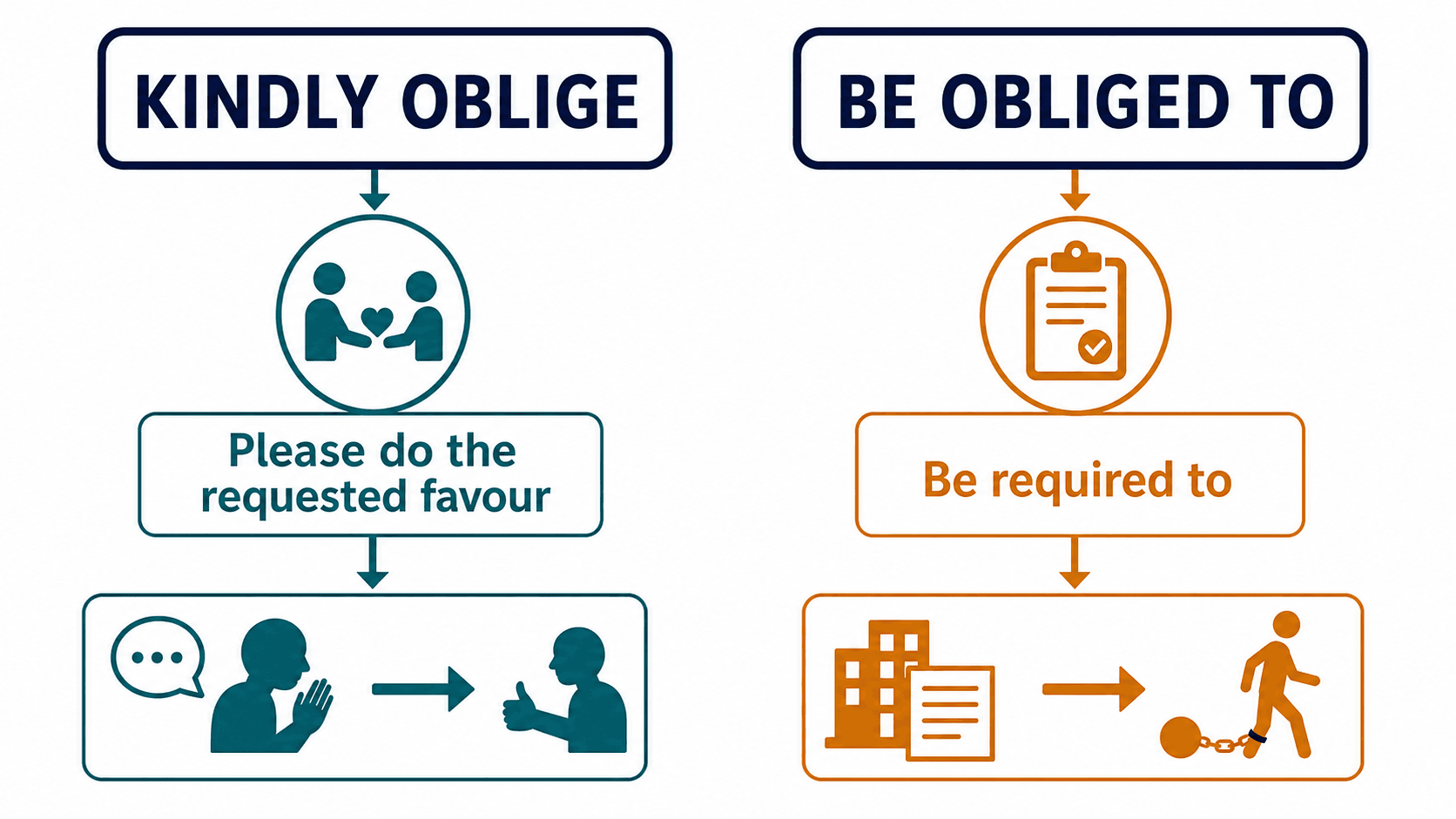
Is “kindly oblige” the same as “be obliged to”?
No. Oblige has two common meanings, and mixing them up causes confusion.
| Form | Meaning | Example |
|---|---|---|
| kindly oblige | please help or do the requested favour | “Kindly oblige by sending a copy.” |
| be obliged to | be required or forced to do something | “Employers are obliged to follow the law.” |
| happy to oblige | willing to help | “You needed a later appointment, and we were happy to oblige.” |
| much obliged | grateful; thank you | “Much obliged for your assistance.” |
Is “kindly oblige” polite or rude?
It is polite in intention, not inherently rude. The sender is using kindly to soften the request and oblige to frame the action as a favour.
However, tone depends on the reader and the situation. In a modern international workplace, the phrase can sound:
- old-fashioned
- overly formal
- vague
- slightly command-like when no choice is offered
The safest approach is not to remove politeness. It is to combine politeness with a clear action:
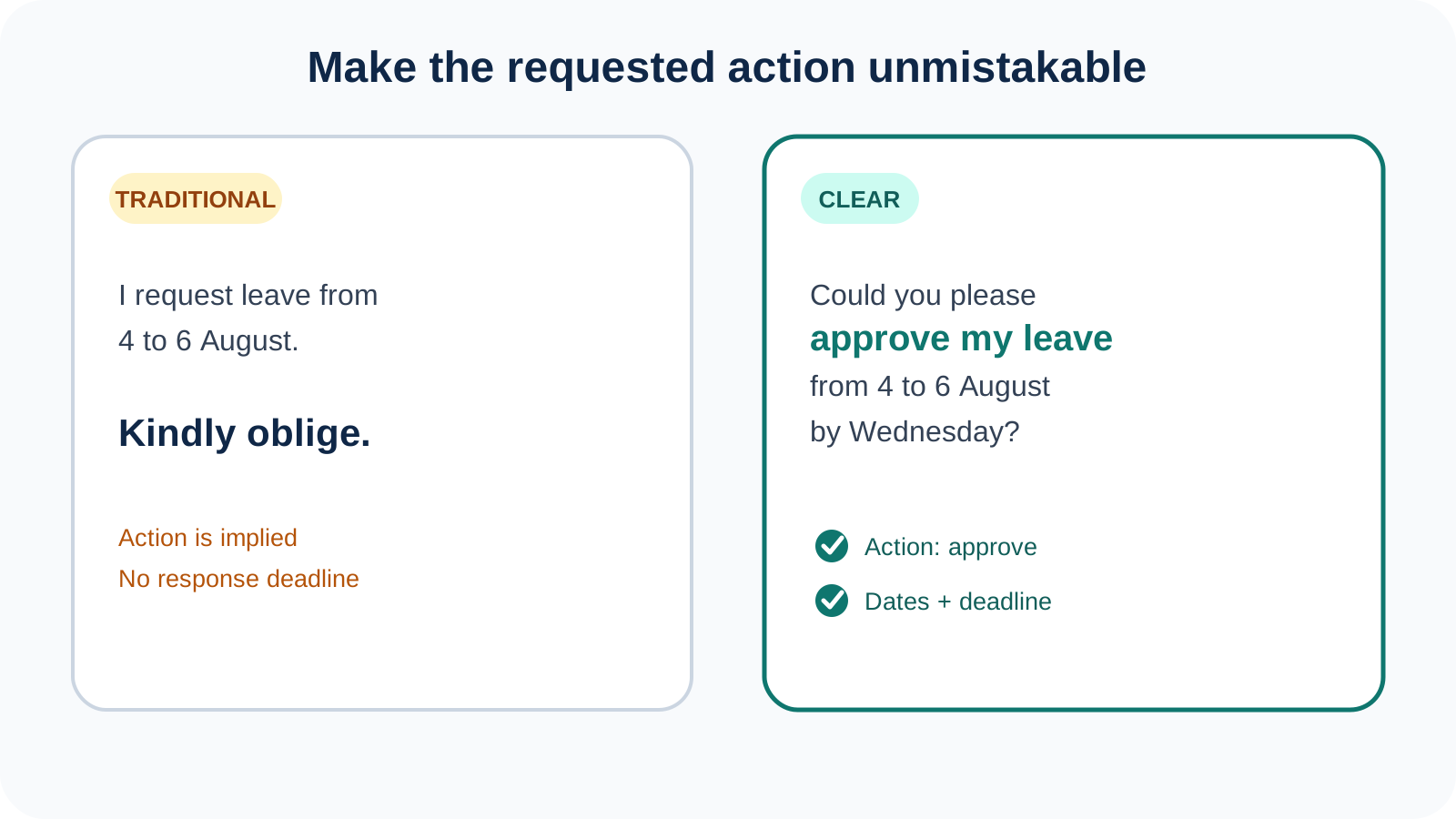
Could you please approve my leave request by Wednesday?
This gives the reader the task, deadline, and respectful tone in one sentence. The same principle applies to other formal phrases. Our guide to “requesting you to kindly” shows how extra politeness words can make a request heavier rather than warmer.
If you are deciding whether a request sounds helpful or slightly demanding, compare it with our guide to whether “please advise” sounds rude.
Not sure how your full leave email lands? Paste it into AI Grammar Buddy’s Email Improver and check the tone before you send.
Examples
Leave request
Traditional:
I request three days of leave. Kindly oblige.
Clearer:
Could you please approve three days of leave from 4 to 6 August?
The clearer version includes the action and dates.
Copy-paste leave request email
Subject: Leave request — 4 to 6 August
Hi Maya,
I would like to request annual leave from 4 to 6 August for a family commitment.
I have completed this week’s client report and asked Daniel to cover urgent queries while I am away.
Could you please approve the leave request by Wednesday?
Thank you, Priya
Requesting a document
Traditional:
Kindly oblige me with a copy of the invoice.
Natural:
Could you please send me a copy of the invoice?
Both are grammatical. The second sounds more natural in most present-day emails.
Copy-paste document request email
Subject: Signed supplier form needed by Friday
Hi Marcus,
Could you please send me the signed supplier form by 3 p.m. Friday?
We need it to complete the vendor setup before Monday.
Please let me know if any information is missing.
Thanks for your help, Aisha
Want the whole email rewritten, not just the last line? Try the Email Improver on your draft.
Asking someone to complete a task
Traditional:
Kindly oblige by completing the attached form.
Direct and polite:
Please complete the attached form by Friday.
Responding to a request
Here, oblige can sound natural:
“Could we move the meeting to 3 p.m.?” “Of course. I’m happy to oblige.”
“Happy to oblige” remains a useful expression because it clearly signals willingness to help. It does not have the same vague closing problem as a standalone “Kindly oblige.”
Choosing the right alternative
| What you need | Instead of “kindly oblige” | Clear alternative |
|---|---|---|
| approval | “Kindly oblige.” | “Could you please approve the request?” |
| a document | “Kindly oblige me with the file.” | “Could you send me the file?” |
| action by a deadline | “Kindly oblige at the earliest.” | “Please complete this by 3 p.m. Thursday.” |
| general help | “Please kindly oblige.” | “I would appreciate your help with this.” |
| confirmation | “Kindly oblige and revert.” | “Please confirm once this is complete.” |
If you want more action-based rewrites, see our guide to “do the needful” meaning and alternatives.
For timing language, compare “at your earliest convenience” with a real deadline. If the request asks someone to “revert,” see what “revert” means in email before using it with a global audience.
Common Mistakes
1. Leaving the requested action unclear
Please look into this and kindly oblige.
What should the reader do: investigate, fix, approve, reply, or simply acknowledge? Replace oblige with the real action:
Please investigate the login error and tell me the expected fix time.
Vague closings like “kindly oblige” are exactly what a useful rewrite pass should flag: replace the hidden request with an action + owner + deadline.
2. Writing “please kindly oblige”
In requests, please and kindly do similar work. Using both can sound excessive:
Please kindly oblige by sending the report.
Use one:
Please send the report.
3. Confusing “oblige” with “obliged”
Use oblige for the action:
Could you oblige me with a quick reply?
Use obliged when someone is required to act:
We are legally obliged to keep these records.
4. Assuming formal always means more polite
Longer wording can create distance or pressure. “Would you be so kind as to oblige me with…” is formal, but “Could you please send…” is usually easier to understand and no less respectful.

How AI Grammar Buddy Can Help
A dictionary can tell you that oblige may mean do a favour. It cannot always tell you whether the whole email gives the recipient enough context.
AI Grammar Buddy reviews the sentence around the phrase. It can:
- identify the action hidden behind “kindly oblige”
- preserve a polite tone
- add a deadline or confirmation request when your draft already contains one
- explain why a simpler version is clearer
For example:
Original: “The quotation is attached. Kindly oblige.”
Possible rewrite: “Please review the attached quotation and confirm your approval by Friday.”
The rewrite should not invent facts. If the original email never mentions approval or a deadline, add those details yourself before sending. A writing tool can clarify your words, but you remain responsible for the request.
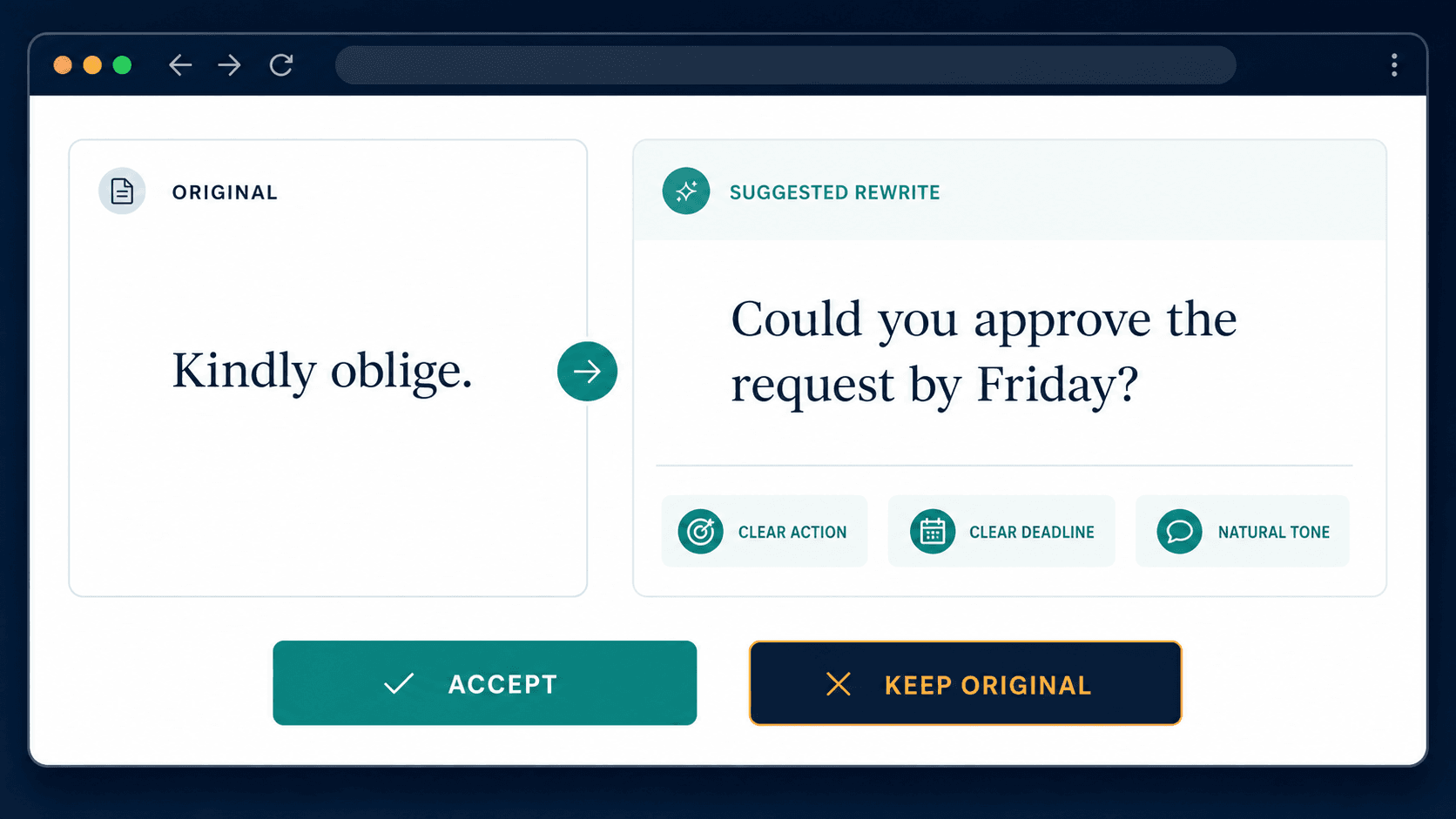
Paste your sentence into AI Grammar Buddy’s Email Improver to make it clearer, more polite, or more professional. For a broader tone check, our business email grammar guide covers vague requests, sentence structure, and common workplace errors.
Final Takeaway
The kindly oblige meaning is “please do the requested favour.” It is polite in intention and grammatically possible, but it often sounds dated or unclear in modern business English.
The most reliable rewrite is simple:
polite opener + specific action + deadline or confirmation
Instead of “Kindly oblige,” write “Could you please approve the request by Friday?” Your reader should never have to guess what favour you want.
About This Article
Kin
Editorial Lead, AI Grammar Buddy
Kin writes practical English usage guides for learners and professionals. She focuses on confusing words, email tone, and the small wording choices that make writing sound clearer and more natural.
Last updated 25 July 2026
Frequently Asked Questions
What does “kindly oblige” mean in simple English?▼
It means “please do what I have asked” or “please do me this favour.” The phrase is formal and may sound old-fashioned in modern conversation or business email.
Is “kindly oblige” polite?▼
It is polite in intention. However, because it is formal and indirect, some readers may find it stiff, vague, or slightly demanding. A specific request is usually clearer.
Is “kindly oblige” grammatically correct?▼
Yes. “Oblige” can mean to help someone by doing what they ask. Constructions such as “kindly oblige by completing the form” and “could you oblige me with a copy?” are grammatical, though quite formal.
What is a modern alternative to “kindly oblige”?▼
Name the action you want: “Please approve the request,” “Could you send the file?” or “I would appreciate your help with this.” Add a deadline when timing matters.
What is the difference between “oblige” and “be obliged to”?▼
To oblige can mean to help or do a favour. To be obliged to do something means to be required or forced to do it.
Can AI Grammar Buddy rewrite “kindly oblige”?▼
Yes. Paste the full sentence into AI Grammar Buddy’s Email Improver to get a clearer rewrite that preserves your intended level of politeness.
Keep going
Continue with AI Grammar Buddy
AI Grammar Buddy
Email Improver
Paste your draft and rewrite it for clearer, more professional English.
Rewrite This PhraseRelated guide
Do the Needful Meaning & Better Alternatives
Learn why this regional request can sound vague and what to write instead.
Related guide
Is “Requesting You to Kindly” Correct?
Replace an overly formal request opener with clearer, natural wording.
Related guide
Indian English vs Global Business English
See how familiar regional email phrases may land with international readers.