Revert Meaning in Email: Standard Definition vs Singapore Usage
What does revert mean in email? Compare its standard “return to a previous state” definition with Singapore and Indian usage meaning “reply.”
Part of our Singapore & Asian Workplace Email Phrases guide. Need phrase-level alternatives for “please revert,” “kindly revert,” or “review and revert”? Start with Please Revert Meaning in Email.
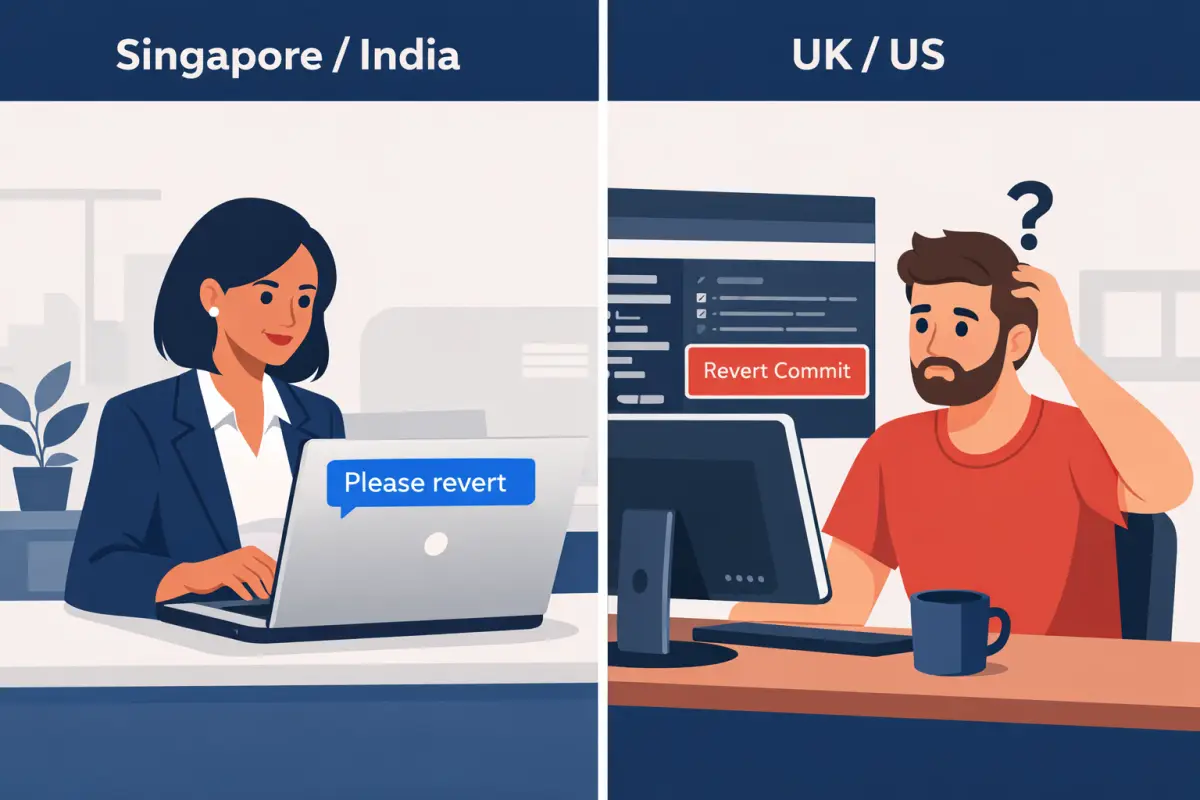
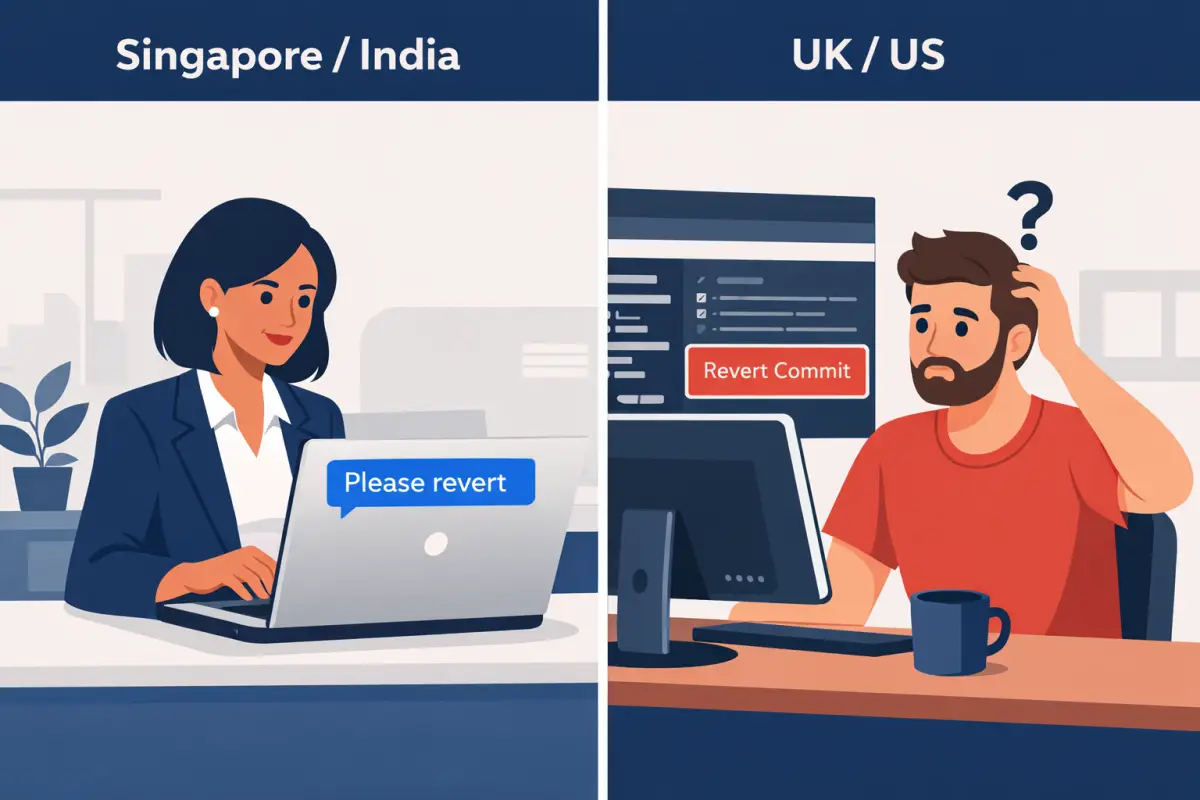
A London developer received a one-line email from a Singapore project manager after a Friday code review: "I've reviewed the latest build. Please revert."
He spent 45 minutes rolling back the production deployment. The PM spent the weekend wondering why nobody had replied.
One word. Two meanings. A wasted sprint and a very awkward Monday standup.
If you have ever typed "please revert" in a business email — or been confused by someone who did — you are not alone. The revert meaning in email depends entirely on who is writing and who is reading. This guide explains the disconnect, shows you the standard revert definition, and gives you professional alternatives that land with any audience.
TL;DR
In standard English, "revert" means "return to a previous state." In Singapore and Indian business emails, it's used to mean "reply." This regional usage confuses global colleagues — replace it with "please reply" or "please get back to me."
Top alternatives:
- •Please revert = Please reply (use: 'Please reply by Friday')
- •Kindly revert = Please get back to me (use: 'I'd appreciate your response by EOD')
- •Revert to me = Respond to me (use: 'Please let me know your thoughts')
AI Grammar Buddy
Rewrite this phrase in context
Paste your sentence and AI Grammar Buddy will turn it into clearer professional English.
Jump to sections
Use these anchors to jump straight to the section you need.
🎧 Prefer to listen? Emily and Daniel break it down in this 8-minute episode:
The Standard Dictionary Definition of "Revert"
In standard English, "revert" means to return to a previous state, condition, or practice. It has nothing to do with replying.
Here is the revert definition in context:
- "After the experiment failed, the team reverted to the original design."
- "She tried a vegetarian diet for a month but reverted to eating meat."
- "The software update caused problems, so we reverted to the previous version."
In every case, "revert" describes going back to something that existed before — not sending a message to someone.
This is how the word is understood in the United States, the United Kingdom, Australia, Canada, and most other English-speaking countries. If you write "please revert" to a colleague in any of these regions, they will read it as "please go back to a previous state" — which makes no sense in the context of an email thread.
The Special Usage in Singaporean & Indian Email English
In Singapore, India, Malaysia, and parts of Southeast Asia, "revert" has evolved to mean "reply," "respond," or "get back to me." This is such a widespread convention that most professionals in these regions do not realise the word means anything else.
Common phrases you will encounter:
- "Please revert with your feedback." (= Please reply with your feedback.)
- "Kindly revert at your earliest convenience." (= Please respond when you can.)
- "Please check and revert." (= Please review and get back to me.)
Where did this usage come from?
The roots are in colonial-era British administrative English. During the 19th and early 20th centuries, "revert" had a broader, more flexible usage in formal British correspondence. As British English evolved and narrowed the word's meaning, South Asian and Singaporean business English preserved the older, wider usage — and eventually locked it into a specific meaning: reply.
This is similar to how "do the needful" survived in India and Singapore long after it disappeared from British everyday English. These phrases are linguistic fossils — perfectly preserved in one region while extinct in another.
If an email combines both phrases, use these ready-to-send replies to “kindly do the needful” to state the action and timeline without repeating either expression.
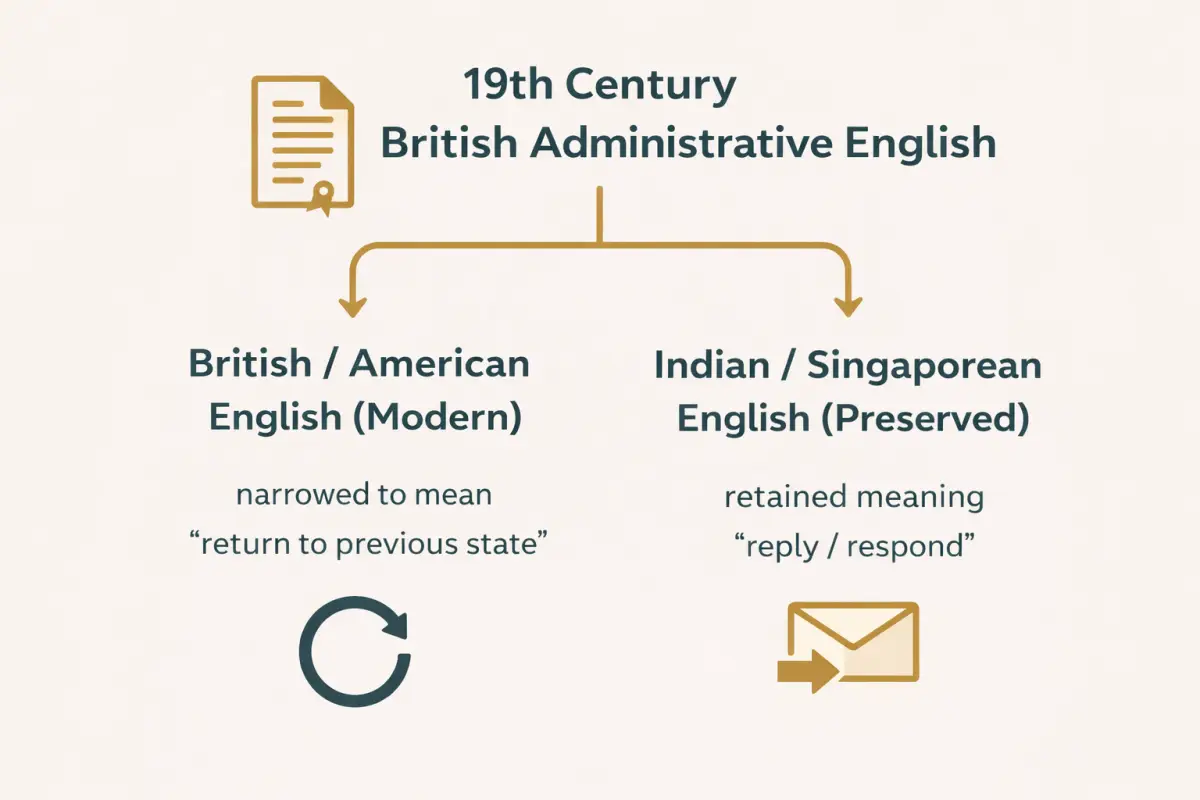
Today, "please revert" meaning "please reply" is understood by hundreds of millions of English speakers across Asia. It is not slang; it is a regional standard.
Why "Revert" Confuses Native English Speakers
When a US or UK professional reads "Please revert with your decision by Friday," the sentence parses like this in their mind:
"Please return to a previous version of yourself with your decision by Friday."
At best, it sounds bizarre. At worst, it triggers genuine confusion — especially in professional contexts where "reverting" is a real, consequential action. Here are two examples.
Legal context: A Hong Kong lawyer receives a draft contract from a Mumbai colleague. The email ends with "Please revert on the attached terms." The lawyer assumes the client wants to go back to an earlier version of the agreement. She pulls up the previous draft and spends an hour comparing clauses line by line. The Mumbai colleague just wanted a reply confirming she had read the new terms.
Design context: A UI designer in Sydney receives feedback from a Bangalore client on the latest prototype: "Design looks good. Please revert." The designer opens Figma and undoes three weeks of approved changes, reverting to an earlier mockup. The client had meant something closer to "looks great, thanks — please reply to confirm next steps."
In both cases, one word triggered the exact opposite of the intended action. The revert meaning in email mismatch does not just cause awkward conversations — it wastes hours, undoes completed work, and erodes trust between teams.
The confusion is compounded when "revert" appears alongside other regional phrases:
- "Kindly do the needful and revert." (= Please handle this and reply.)
- "Please revert back soonest." (= Please reply as soon as possible.)
To a global reader, these sentences stack three or four unfamiliar usages into a single request.
Why the Regional Email Meaning Causes Confusion
This is where the answer requires nuance.
In standard international English: No. Using "revert" to mean "reply" is not recognised by major dictionaries (Oxford, Merriam-Webster, Cambridge) in their primary definitions. It is considered incorrect usage.
In regional English (World Englishes): Yes. Linguists who study World Englishes — the academic field that examines how English is used differently across the globe — recognise "revert" as a legitimate regional variant in South Asian and Singaporean English. It follows consistent rules, is understood by millions, and has been in use for over a century.
So is it "wrong"? That depends on your audience.
- Writing to a Singapore or Indian team internally? "Please revert" is perfectly clear and appropriate.
- Writing to a US, UK, or Australian client? "Please revert" will confuse them. Use "please reply" instead.
The practical rule: match your vocabulary to your reader. Grammar is not just about what a dictionary says — it is about whether your reader understands your message the way you intended it.
I've tested hundreds of real Singapore and Indian business emails through our Email Improver — "please revert" appears in roughly 1 out of every 3. The tool flags 40+ regional phrases like this and suggests plain-English replacements in about 10 seconds. If you write to anyone outside South or Southeast Asia, it is worth a quick check before you hit send.
Revert vs Reply vs Respond (Comparison Table)
Here is a clear breakdown of revert vs reply vs respond — what each word means and when to use it.
| Word | Core Meaning | Best Used For | Example Phrase |
|---|---|---|---|
| Revert (standard) | Return to a previous state | Describing something going back to how it was before | "The policy reverted to its original form." |
| Revert (SG/India) | Reply or respond (regional) | Internal emails within South Asian or Singaporean teams | "Please revert with your comments." |
| Reply | Send an answer back | Direct, conversational responses; everyday email | "Please reply by end of day." |
| Respond | React or answer (slightly more formal) | Formal correspondence; situations requiring a considered answer | "We will respond to your inquiry within 48 hours." |
Key takeaway: "Reply" and "respond" work everywhere. "Revert" (meaning reply) only works within South Asian and Singaporean English contexts. When in doubt, choose "reply."
For more examples of regional "revert" phrasing, see our guides on please revert meaning in Singapore and why "please revert back" is wrong.

5 Professional Alternatives to "Please Revert"
If you want your emails to land well with any reader — Singapore, San Francisco, or Stockholm — replace "please revert" with one of these universally understood phrases.
1. "Please reply by [date/time]"
The simplest, clearest option. It tells the reader exactly what you need and when you need it.
"Please reply by Friday with your approval."
2. "I look forward to hearing from you"
A warm, professional closer that works in any business culture. Best for emails where you want a response but are not setting a hard deadline.
"I look forward to hearing from you on this."
3. "Please get back to me"
Conversational but professional. Good for internal emails and familiar working relationships.
"Please get back to me once you've reviewed the proposal."
4. "Could you let me know your thoughts?"
Polite and collaborative. This phrase invites discussion rather than demanding a response, which makes it effective for emails to seniors or clients.
"Could you let me know your thoughts on the revised timeline?"
5. "Please confirm by [date]"
Best when you need a specific action (approval, sign-off, acknowledgement) rather than a general reply.
"Please confirm the budget allocation by Wednesday."
Each of these alternatives is understood instantly by any English speaker, anywhere in the world. No second-guessing, no cultural mismatch.
Real Email Before & After Examples
Scenario 1: Requesting Feedback on a Report
Before (using "revert"):
Subject: Q3 Report Draft
Hi David,
I have attached the Q3 sales report for your review. Kindly revert with your comments at the earliest.
Thanks & Regards, Priya
After (universally clear):
Subject: Q3 Report Draft — Feedback Needed by Thursday
Hi David,
I've attached the Q3 sales report for your review. Could you share your feedback by Thursday? I'd like to finalise it before the team meeting on Friday.
Thanks, Priya
What changed: "Kindly revert with your comments at the earliest" became a specific ask with a deadline. The subject line now signals the action needed. The tone is warmer and clearer.
Scenario 2: Following Up on a Pending Decision
Before (using "revert"):
Subject: Vendor Selection
Dear Mr. Thompson,
Following our discussion, I have shortlisted three vendors as per your requirements. Please do the needful and revert.
Best Regards, Arjun
After (universally clear):
Subject: Vendor Shortlist — Your Decision Needed
Dear Mr. Thompson,
Following our discussion, I've shortlisted three vendors based on your requirements. I've attached a comparison sheet for easy review.
Could you let me know which vendor you'd like to proceed with? I'm happy to set up calls with any of them.
Best regards, Arjun
What changed: "Please do the needful and revert" — two regional phrases stacked together — became a clear question with a specific action. The email now makes it easy for the reader to respond.
Anecdotally, emails that replace "please revert" with a specific question and deadline tend to get faster replies — the action is clear, the deadline is set, and the reader knows exactly what to do. I've started pasting every outbound email into Email Improver before sending — it takes 10 seconds and catches phrasing I would never notice on my own.
Summary
Here is my honest recommendation: stop using "revert" in any email that leaves your local team.
It does not matter that the usage is historically valid. It does not matter that millions of professionals understand it. What matters is that your reader might not — and a single misread word can cost you a deal, a deadline, or a developer's Friday night.
"Reply" has four letters. It works in every English-speaking country on earth. Use it.
If you are not sure whether your draft contains "revert" or any other phrase that might misfire globally, paste it into Email Improver. I've run thousands of Singapore and India-origin emails through it — the tool flags 40+ regional phrases and rewrites them in about 10 seconds. It is the fastest way to sound local when you need to and global when it counts.
Related reads
- "Please Revert" Meaning — 15 Alternatives for Singapore Emails
- "Please Revert" Meaning — 15 Alternatives for Singapore Emails
- "Please Revert Back" — Why It's Wrong
- "Revert Soonest" — Meaning and Alternatives
- "Do the Needful" Meaning + 8 Better Options
- "Noted with Thanks" — 10 Professional Alternatives
Frequently Asked Questions
Does revert mean the same as reply?▼
Not in standard English. "Revert" means "to return to a previous state" (e.g., reverting a document to an older version). However, in Singapore and Indian business English, "revert" is widely used as a synonym for "reply." This regional usage is not recognised in US, UK, or Australian English, which is why it causes confusion in global email.
Why do Indian professionals say "please revert"?▼
The usage traces back to colonial-era British administrative English, where "revert" carried a broader meaning. Over time, Indian and Singaporean business English preserved and adapted the word to mean "reply" or "respond," while British English narrowed it to mean only "return to a previous state." Today it is a well-established regional convention, not a grammar mistake.
Is it polite to say "kindly revert"?▼
Within Singapore and Indian teams, "kindly revert" is considered polite and professional. However, to US/UK readers, it sounds either confusing (because "revert" doesn't mean "reply" to them) or unintentionally funny. For global emails, use "please reply" or "I'd appreciate your response" instead.
Next step
Rewrite this phrase in context
Paste your sentence and AI Grammar Buddy will turn it into clearer professional English.
Keep going
Continue with AI Grammar Buddy
AI Grammar Buddy
Email Improver
Paste your draft and rewrite it for clearer, more professional English.
Rewrite This PhraseRelated guide
What Does Inherent Mean? Meaning, Examples and Business English Uses
What does inherent mean? Learn the meaning, inherent in vs to, and practical sentence examples for reports, emails and everyday English.
28 September 2026
Related guide
What Does Coherent Mean? Meaning, Examples and Business English Uses
Learn what coherent means, see natural sentence examples, compare coherent vs clear, and improve the flow of your emails and reports.
27 September 2026
Related guide
What Does Persist Mean? Meaning, Grammar and Examples
Persist means to continue despite difficulty or to keep existing. Learn how to use persist in, persist with, and persist correctly with workplace examples.
23 August 2026