15 "Please Advise" Alternatives for Professional Emails

'Please advise' is one of the most overused — and most ignored — phrases in professional email. It is not rude. It is just lazy. It pushes all the thinking onto the reader and tells them nothing about what kind of answer you actually need. These 15 please advise alternatives fix that. Each one tells the reader exactly what you want, so you get a faster reply. After reviewing the most common email closing mistakes our users make with AI Grammar Buddy, 'please advise' consistently ranks as one of the top phrases that slows down replies — here is what actually works instead.
TL;DR
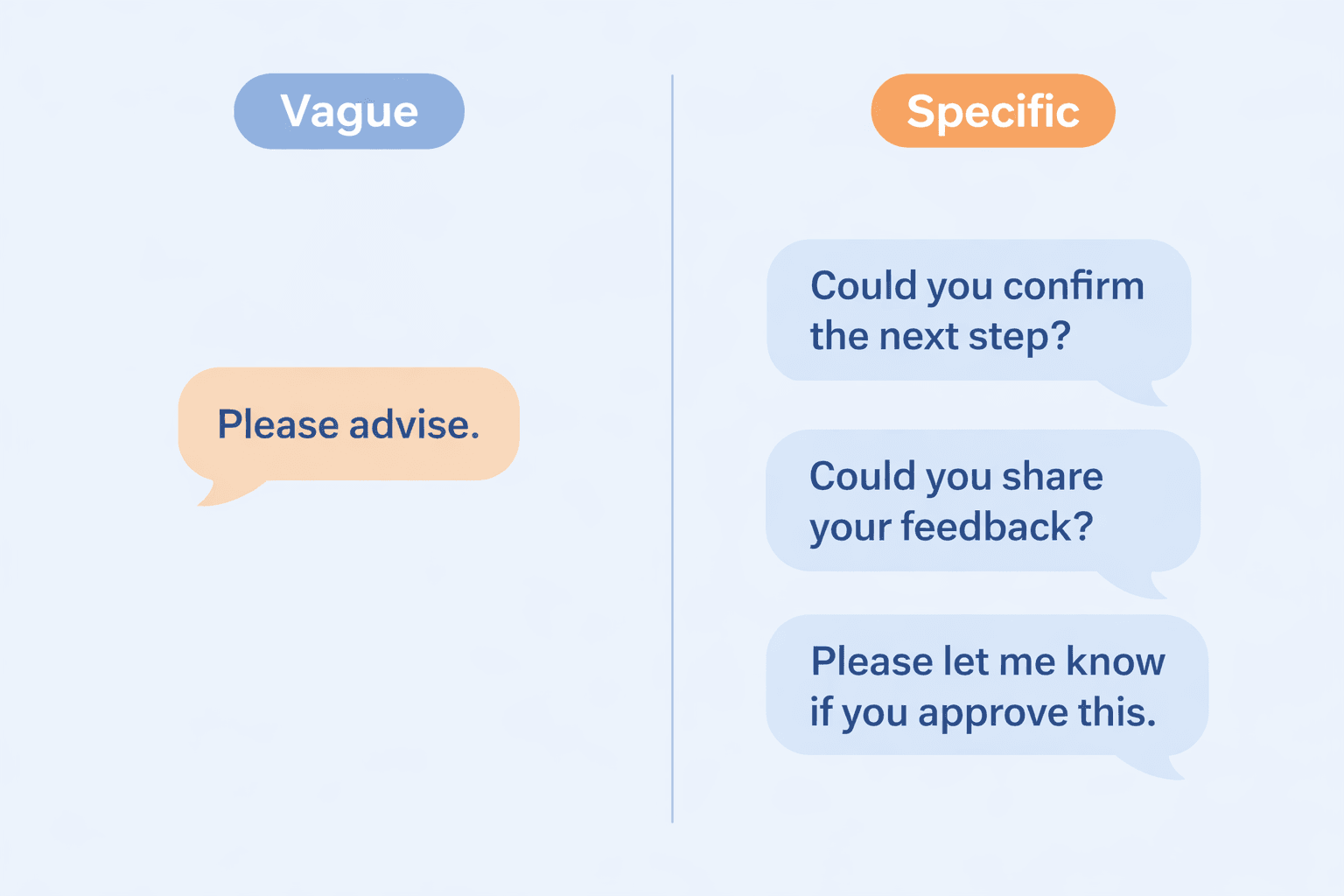
The best please advise alternatives are specific asks such as "Could you share your feedback?" and "Could you confirm the next step?"
Replace vague closers with the exact response you want.
Quick swaps:
- •"Please advise." -> "Could you confirm the next step?"
- •"Please advise." -> "Could you share your feedback by Thursday?"
- •"Please advise." -> "Let me know how you would like to proceed."
Jump to sections
Use these anchors to jump straight to the section you need.
Quick Answer: Best "Please Advise" Alternatives
A better alternative to "please advise" is a specific request that tells the reader exactly what you need — such as "Could you share your feedback?" for opinions, "Please let me know if you approve this" for decisions, or "Could you confirm the next step?" for direction. Specific phrasing gets faster replies.
Not sure which phrase fits your email? Paste your draft into AI Grammar Buddy's Email Improver — it detects vague requests and rewrites them into specific, professional asks.
What Does "Please Advise" Mean?
"Please advise" means "please tell me what you recommend, decide, or want me to do next."
That is the basic please advise meaning. The phrase is common in business email because it sounds formal and efficient. The problem is that it often hides the real ask.
It can mean:
- tell me what to do next
- approve this
- choose between options
- give feedback
That is too much work for one phrase. The reader has to guess what kind of answer you want, which is why it can feel vague or cold.
If you want the fuller please advise meaning breakdown, that guide goes deeper into tone, context, and why the phrase keeps showing up in office email.
This belongs to the same family as at your earliest convenience meaning and per my last email meaning: phrases that sound professional on the surface but often create friction because they are indirect.
It also sits close to "please cascade this." Both phrases sound formal, but both fail when they hide the real action. If your email is about passing an update through teams, read cascade meaning in business before you send it.
Is "Please Advise" Rude?
Not by default.
It is grammatically fine. It is not offensive. In some teams, especially formal or process-heavy ones, nobody will blink at it.
But "not wrong" is a low bar.
"Please advise" can still feel cold or unclear when:
- the email is short and abrupt
- the request is missing a clear action
- the other person has to figure out the problem for you
- you are writing to a client or teammate who expects a warmer tone
So when people ask is please advise rude, the honest answer is this: it is not rude on its own, but it often reads as distant, vague, or unhelpful.
When Should You NOT Use "Please Advise"?
Avoid "please advise" in these situations:
- When you already know what you need. If you want approval, ask for approval. Writing "please advise" when you mean "can you sign off on this?" wastes the reader's time.
- When the email is short or abrupt. A two-line email ending in "please advise" reads as dismissive. Add context before you ask.
- When writing to a client. Clients expect you to come with solutions, not open-ended requests. Replace it with a specific question or a clear recommendation.
- When there is a deadline involved. "Please advise by Thursday" is better than "please advise" — but "Could you confirm your decision by Thursday so I can brief the team?" is better still.
When the action is non-negotiable rather than optional, review the meaning and tone of “insist” before using it.
The same rule applies when a hotel problem or flight delay affects a client visit. These business trip English phrases show how to explain the problem, its impact, and the exact help or schedule change you need.
These are the situations where 'please advise' most consistently fails in real inboxes — and where a specific question makes the biggest difference to reply speed.
Please Advise Alternatives: 15 Better Options
1. Please let me know your thoughts
Why it works: Warm, flexible, and easy to use when you want a general reaction.
Example: Please let me know your thoughts on the revised proposal.
2. I would appreciate your input
Why it works: More formal. Good when you want to sound respectful without sounding stiff.
Example: I would appreciate your input on the final budget assumptions.
3. Could you share your feedback?
Why it works: Clear and direct. Good for drafts, presentations, and client-facing work.
Example: Could you share your feedback on the attached deck by Thursday?
4. Let me know how to proceed
Why it works: Useful when the other person owns the decision and you need direction.
Example: If the client pushes back on pricing again, let me know how to proceed.
5. Could you confirm the next step?
Why it works: Better than vague advice because it asks for one specific thing.
Example: Could you confirm the next step after legal signs off?
6. What would you recommend here?
Why it works: Best when you genuinely want judgment, not approval or feedback.
Example: We can either extend the deadline or reduce scope. What would you recommend here?
7. Please let me know if you approve this
Why it works: Strong for manager and client emails because it turns a fuzzy ask into a yes-or-no decision.
Example: Please let me know if you approve this approach so I can send it today.
8. Could you let me know which option you prefer?
Why it works: Helpful when you can frame the choice instead of dumping the whole problem.
Example: Could you let me know which option you prefer: a Friday launch or a Monday launch?
9. Would you mind taking a look?
Why it works: Softer and more conversational. Good for internal team messages.
Example: Would you mind taking a look at section three before I send this out?
10. Can you point me in the right direction?
Why it works: Casual, human, and useful when you need guidance without sounding robotic.
Example: I am new to this workflow. Can you point me in the right direction?
11. Could you clarify what you would like me to do next?
Why it works: Good when instructions are incomplete and you need precise direction.
Example: I have updated the draft. Could you clarify what you would like me to do next?
12. Please let me know if any changes are needed
Why it works: Works well after you send a draft or deliverable and want revision notes.
Example: Please let me know if any changes are needed before I send the final version.
13. When you have a moment, could you review this?
Why it works: Polite without sounding old-fashioned. Best for non-urgent requests.
Example: When you have a moment, could you review this and flag anything unclear?
14. What is your preference here?
Why it works: Strong when the real issue is choice, not advice.
Example: We can invoice monthly or quarterly. What is your preference here?
15. Can I go ahead with this?
Why it works: Simple and fast. Great when you only need approval to move.
Example: Can I go ahead with this version, or would you like one more round of edits?
When to Use Each Alternative
| Situation | Best Phrase |
|---|---|
| Formal email to a manager | I would appreciate your input |
| Asking for approval | Please let me know if you approve this |
| Urgent request | Could you confirm the next step by 3 PM today? |
| Casual team chat | Would you mind taking a look? |
| Client feedback request | Could you share your feedback? |
| Process question | Could you confirm the next step? |
| You need a recommendation | What would you recommend here? |
| You are offering options | Could you let me know which option you prefer? |
| You need revision notes | Please let me know if any changes are needed |
| Non-urgent review | When you have a moment, could you review this? |
The pattern is simple. The best phrase depends on the response you actually need.
- Need a decision? Ask for approval.
- Need an opinion? Ask for feedback.
- Need direction? Ask for the next step.
If you want to skip the guesswork, the Email Improver will read your email's context and suggest the most appropriate closing request automatically.
Before vs After
Example 1
Before: Please advise.
After: Could you let me know how you would like to proceed by Friday?
Example 2
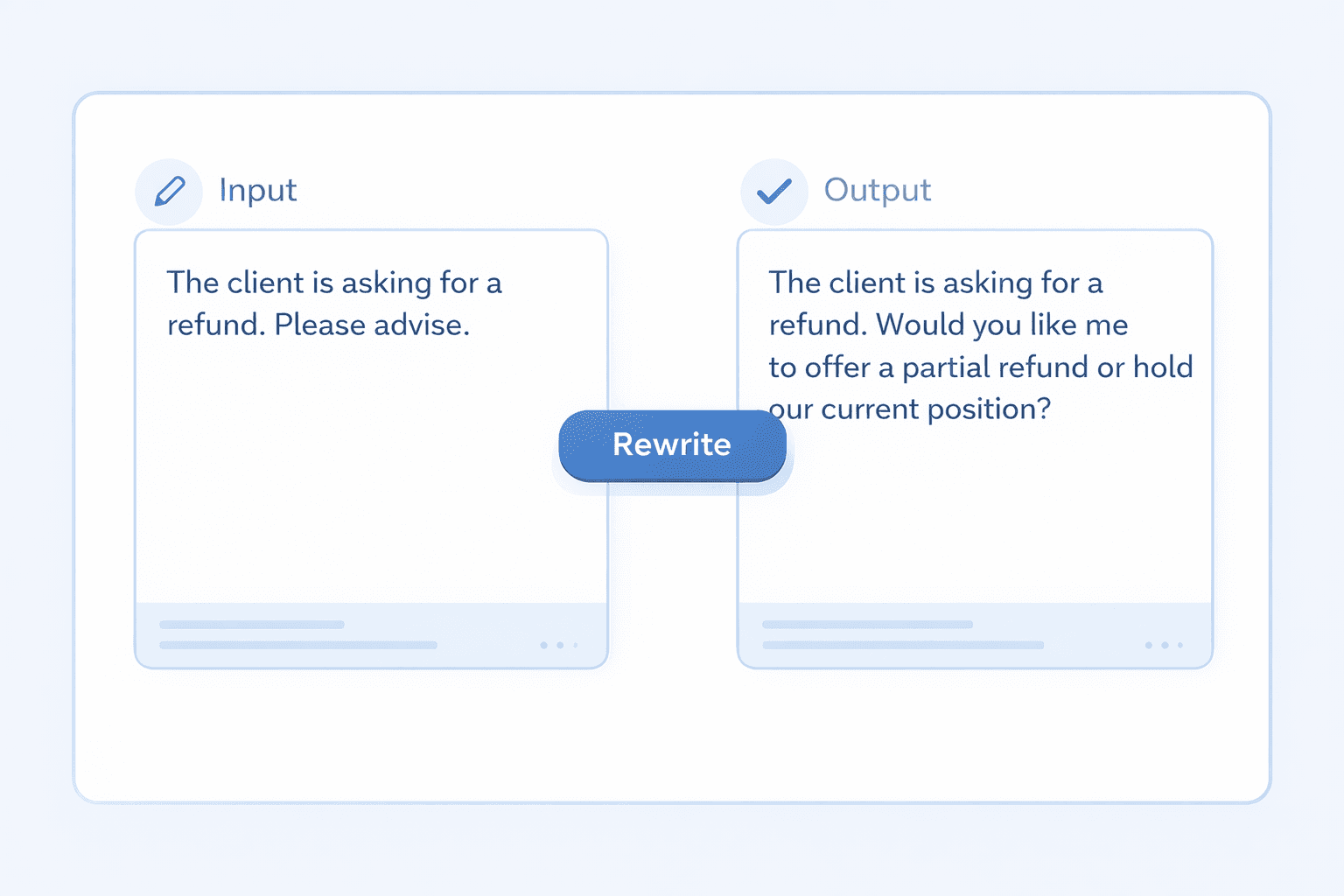
Before: The client is asking for a refund. Please advise.
After: The client is asking for a refund. Would you like me to offer a partial refund or hold our current position?
Example 3
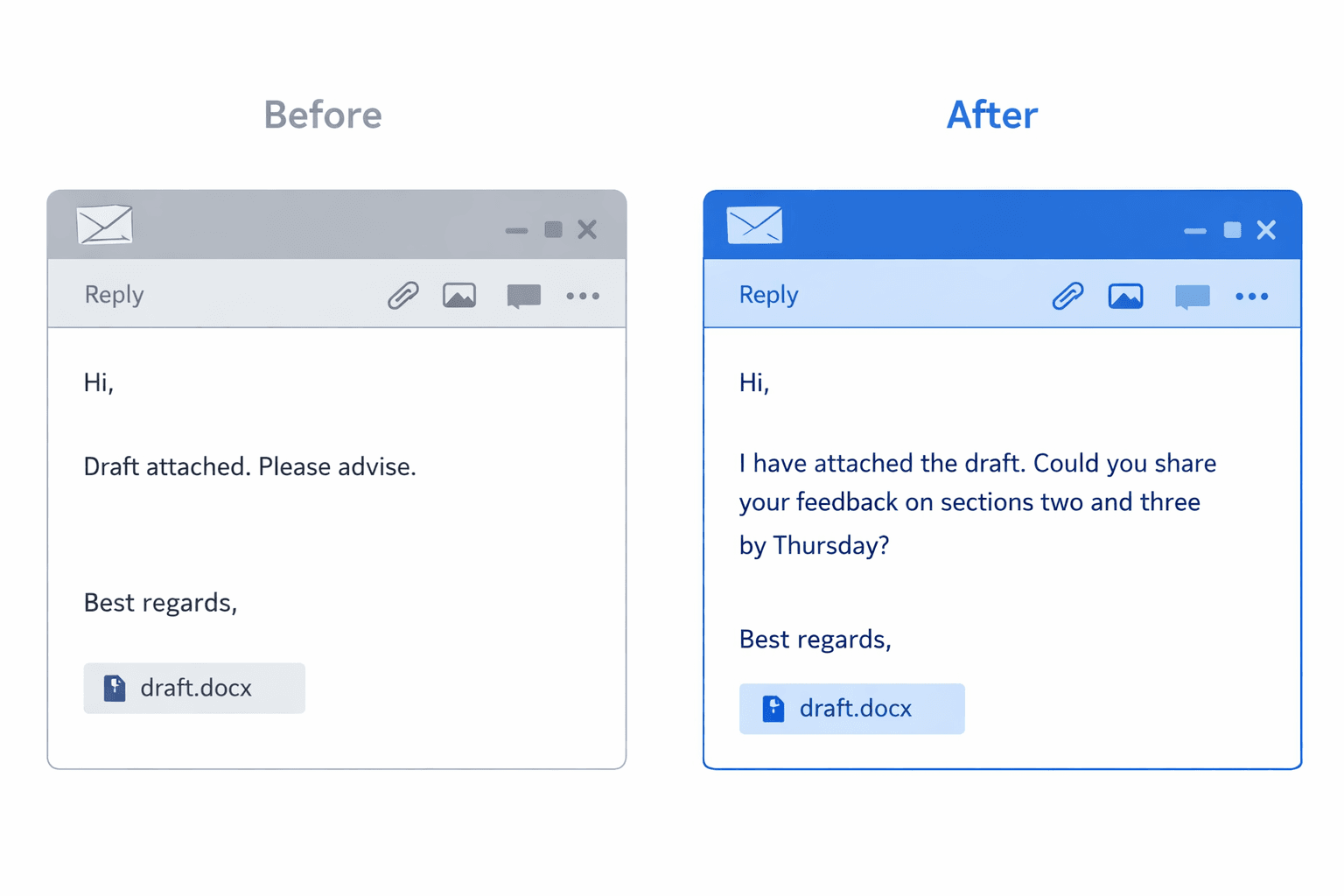
Before: Draft attached. Please advise.
After: I have attached the draft. Could you share your feedback on sections two and three by Thursday?
Example 4
Before: Vendor has not replied. Please advise.
After: Vendor has not replied. Should I send a follow-up today or escalate this tomorrow?
If a vendor or colleague has gone silent entirely, you may also need a stronger approach — read our guide on how to write a professional follow-up email for templates you can use immediately.
Here is the real difference:
- "Please advise" pushes the thinking onto the reader.
- A better rewrite gives the reader one clean question to answer.
That is why clear emails get faster replies.
Final Takeaway
Most people use "please advise" because it feels safe and formal. Based on the email patterns we see through AI Grammar Buddy, it is also one of the phrases most likely to get a slow or vague reply — because it asks the reader to do your thinking for you.
The alternatives in this guide are not just more polite — they are more precise. Precision gets replies. Vagueness gets ignored.
Pick the phrase that matches what you actually need: a decision, feedback, direction, or approval. Say that. Not "please advise."
If you want a faster way to clean up your email closers, try Email Improver. Paste your draft, and it handles the rewrite.
About This Article
Kin
Kin writes about business English and email tone for AI Grammar Buddy. She focuses on phrases that sound professional at first glance but slow replies once they hit a real inbox.
Frequently Asked Questions
What is a better way to say "please advise"?▼
A better way to say "please advise" is to ask for a specific response, such as "Could you share your feedback?", "Please let me know your thoughts," or "Could you confirm the next step?" Specific phrasing sounds clearer and more polite.
What does "please advise" mean?▼
"Please advise" means "please tell me what you recommend, decide, or want me to do next." It is not wrong, but it often sounds vague because it does not tell the reader what kind of answer you need.
Is "please advise" rude?▼
Not automatically. The phrase is grammatically correct and common in some workplaces. The problem is tone: when it appears without context, it can sound cold, abrupt, or like you are pushing the problem onto someone else.
What are polite alternatives to "please advise"?▼
Polite alternatives include "Please let me know your thoughts," "I would appreciate your input," "Could you share your feedback?," and "Let me know how to proceed." The best option depends on whether you need approval, direction, or a quick decision.
Should I use "please advise" in professional emails?▼
You can, but it is usually better to be more specific. In professional email, a direct request such as "Could you confirm the next step by Friday?" is clearer and more likely to get a fast response.
Keep going
Continue with AI Grammar Buddy
AI Grammar Buddy
Email Improver
Paste your draft and rewrite it for clearer, more professional English.
Rewrite This PhraseRelated guide
What Does Inherent Mean? Meaning, Examples and Business English Uses
What does inherent mean? Learn the meaning, inherent in vs to, and practical sentence examples for reports, emails and everyday English.
28 September 2026
Related guide
What Does Coherent Mean? Meaning, Examples and Business English Uses
Learn what coherent means, see natural sentence examples, compare coherent vs clear, and improve the flow of your emails and reports.
27 September 2026
Related guide
What Does Persist Mean? Meaning, Grammar and Examples
Persist means to continue despite difficulty or to keep existing. Learn how to use persist in, persist with, and persist correctly with workplace examples.
23 August 2026