"For Your Review" Meaning in Email (+ 5 Better Alternatives)
"For Your Review" Meaning in Email (+ 5 Better Alternatives)
By Kin · 14 June 2026 · 8 min read
Someone sends you a proposal with the line: "I’ve attached the draft for your review."
In our own editing sessions, that is one of the most common phrases that looks clear at first and then turns fuzzy the moment you ask a simple question: do they want comments, approval, or just a quick check?
That is why for your review meaning matters. The phrase is polite, but it only works when the rest of the email makes the next step obvious. If you want to tighten the wording before you send it, AI Grammar Buddy can help you make the ask clearer without making it sound cold.
TL;DR
"For your review" means the recipient should read the attached item and may need to comment, approve, or sign off. It is more action-oriented than "for your reference" and works best when you also name the document and state the next step.
AI Grammar Buddy
Rewrite this phrase in context
Paste your sentence and AI Grammar Buddy will turn it into clearer professional English.
Jump to sections
Use these anchors to jump straight to the section you need.
Quick Answer
"For your review" means the recipient should read the attached item and may need to give feedback, approval, or a response. It is more active than for your reference and less specific than "for your approval." Use it when the other person needs to look at something, not just keep it on file.
What Does "For Your Review" Mean in Email?
In email, for your review usually means:
- please read this
- please check this for errors
- please leave comments
- please approve if everything looks right
- please confirm the next step
The phrase is polite because it does not bark a command. But it still implies that the recipient should do something with the document.
If the request goes beyond reading and asks the recipient to approve, sign, process, or reply, compare “for your kind action” meaning and clearer alternatives.
Here is the easiest way to separate the common phrases:
| Phrase | Meaning | Best use |
|---|---|---|
| For your review | Please read and possibly respond | Drafts, reports, contracts, slides |
| For your reference | No action needed | Background info, records, FYI updates |
| For your approval | A yes/no decision is needed | Final drafts, budgets, agreements |
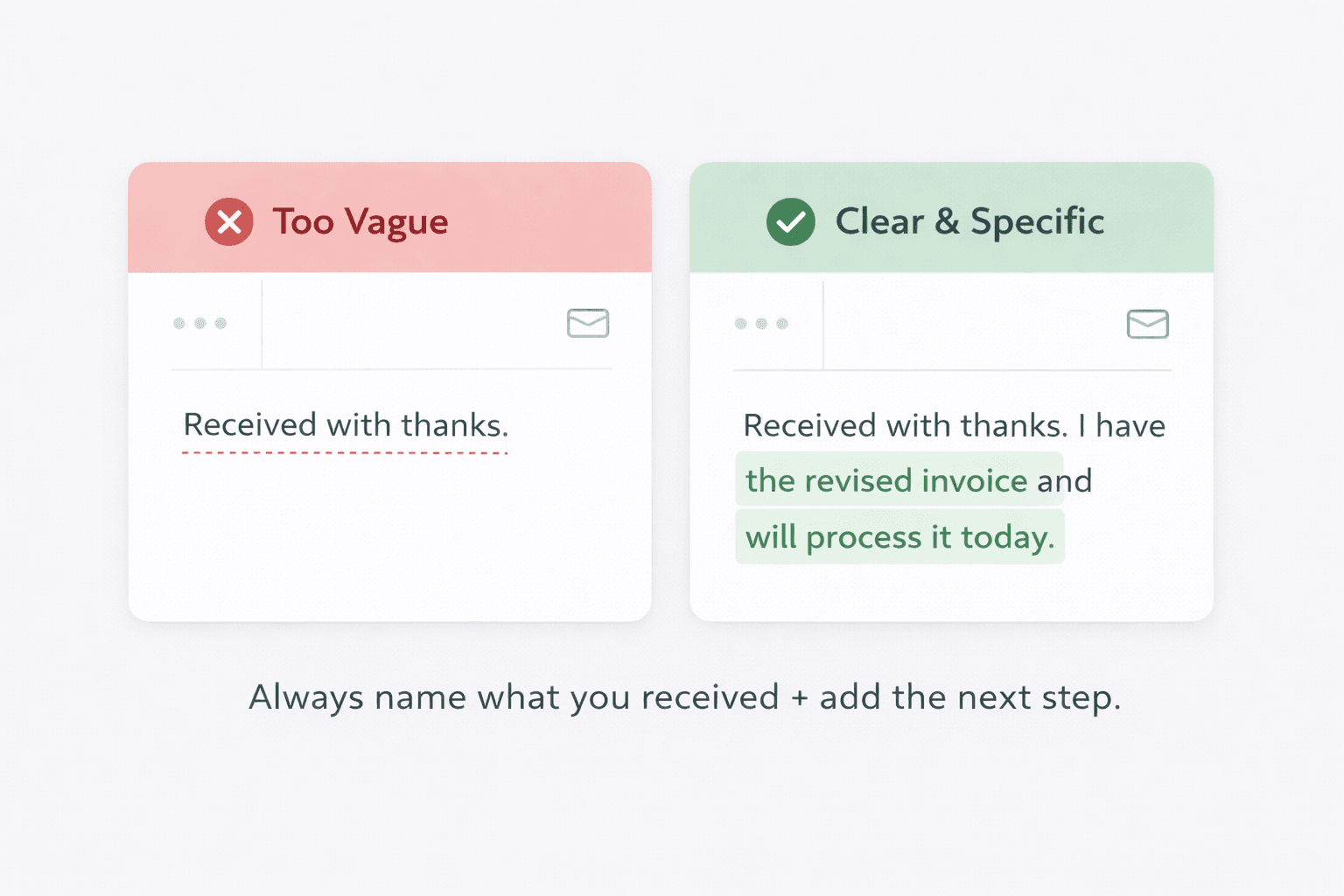
If an email says “for your kind information”, it normally signals awareness rather than review. Do not assume feedback is required unless the sender states it.
If you are sending a document to a manager, client, or recruiter, "for your review" is often the middle ground: clear enough to show there is a reason for sending it, but soft enough to stay polite. If the email needs only context, for your reference is usually better. If you want a clearer modern comparison, see our guide to perusal meaning, which covers the older business-English version and why it can sound dated outside some workplaces.
5 Better Alternatives to "For Your Review"
The best alternative depends on what you actually need from the reader. In our own rewrite work, the weak version is usually not the phrase itself. It is the missing action behind it.
| Alternative | Best use case | Why it helps |
|---|---|---|
| Please review the attached | Drafts, proposals, reports | Clear, direct, and still polite |
| Please review and share your feedback | When comments are needed | Tells the reader exactly what response you want |
| Please review and approve | Final documents, budgets, sign-off | Removes guesswork about the next step |
| Please confirm after reviewing | When you want acknowledgement | Good for decisions that need a simple reply |
| Please see the attached for your reference | When no action is needed | Better than review when the file is only for context |
The last option is the important one. If no action is needed, for your reference is usually the better phrase. If you need a more formal attachment line, please find attached alternatives can help you sound smoother without being stiff.
Examples
Seeing the phrase in context makes the difference obvious.
Example 1: Report
Before: Attached is the report for your review.
After: I’ve attached the Q3 report for your review. Could you share any comments by Wednesday?
Example 2: Contract
Before: Please see the contract for your review.
After: I’ve attached the draft contract for your review and approval. If everything looks good, please confirm by Friday.
Example 3: Job application
Before: My resume is attached for your review.
After: I’ve attached my resume and cover letter for your review. I’d be glad to discuss the role further.
Example 4: Team deck
Before: Deck attached for your review.
After: I’ve attached the deck for your review. Please focus on slides 4 to 6 and send any edits today.
Those rewrites work because they do three things:
- They name the document.
- They tell the reader what kind of review is needed.
- They add a deadline or clear next step when one matters.
Want a faster rewrite? Paste the sentence into AI Grammar Buddy and it will show you a clearer version in seconds.
Common Mistakes
1. Using it when no action is needed
If you only want to share information, "for your review" can sound like a request for feedback that never comes.
Better: "I’ve attached the background note for your reference."
2. Leaving out the document name
"Please find attached for your review."
That sentence is incomplete because the reader does not know what they are supposed to review.
Better: "Please find attached the revised proposal for your review."
3. Not saying what kind of review you want
Review, approval, and comment are not the same thing. If you need feedback, say feedback. If you need approval, say approval.
Better: "I’ve attached the draft for your review. Please share your comments by Thursday."
4. Using it as filler
Some writers add "for your review" to every attachment, even when the reader is not expected to do anything.
That makes emails feel generic. Match the phrase to the actual purpose of the message.
5. Mixing up review and reference
If you keep using both phrases interchangeably, the reader has to guess whether action is expected. That difference is why for your reference deserves its own category instead of being treated as a loose synonym.
That is the main communication problem this phrase creates.
How AI Grammar Buddy Can Help
AI Grammar Buddy is useful when you know the idea you want, but not the cleanest way to say it.
Use it to:
- turn a vague attachment line into a clear request
- decide between "review," "reference," and "approval"
- make the sentence sound more professional
- soften a message that feels too direct
- shorten a long email without losing the point

Try prompts like:
- "Make this sound more professional and concise."
- "Rewrite this so it clearly asks for feedback."
- "Change this to request approval instead of just a review."
- "Make this tone softer for a client email."
That kind of check is most useful before you send the draft to a manager, client, or recruiter.
FAQ
What does "for your review" mean?
It means the sender wants the recipient to read the attached item and possibly comment, approve, or respond.
Is "for your review" polite?
Yes. It is neutral and professional. The issue is usually clarity, not politeness.
Is "for your review" the same as "for your reference"?
No. "For your review" suggests attention or action. "For your reference" usually means no action is needed.
Should I say "for your approval" instead?
Use "for your approval" when you need a decision or sign-off. Use "for your review" when you mainly want the reader to read and check the document.
Can I use "attached for your review" in a job application email?
Yes. It is common and professional, especially when you are sending a resume, cover letter, or portfolio.
What if I want to sound less formal?
You can say "I’ve attached the draft for you to take a look at" or "I’ve attached the file in case it’s helpful." AI Grammar Buddy can help you choose the right level of formality.
Is "for your kind perusal" the same thing?
It is close in meaning, but it is a more formal and older-sounding version. If you want the same idea in clearer modern English, see our guide on for your kind perusal.
Final Takeaway
"For your review" means the recipient should look at the attachment and may need to respond. It is a useful phrase, but it works best when you add the document name and the next step.
Use it when you want feedback. Use "for your reference" when no action is needed. Use "for your approval" when you need a decision.
If you want to make that choice faster, AI Grammar Buddy can rewrite the sentence so the intent is obvious before you hit send.
About This Article
Kin
Business English writer
Kin writes about workplace English and email tone for AI Grammar Buddy. She focuses on phrases that sound polite in draft form but need more precision in a real inbox.
Frequently Asked Questions
What does "for your review" mean in email?▼
It means the sender wants the recipient to look at the document, email, or attachment and possibly comment, approve, or respond. It usually signals that some action may be needed, even if the request is polite.
Is "for your review" polite?▼
Yes. It is a neutral, professional phrase. The main weakness is not tone — it is that the phrase can be too vague if you do not say what kind of review you want.
Is "for your review" the same as "for your reference"?▼
No. "For your review" suggests attention or action. "For your reference" usually means the recipient only needs the information and no reply is expected.
When should I use "for your approval" instead?▼
Use "for your approval" when you need a clear yes/no decision, sign-off, or formal confirmation. If the reader simply needs to read the file, "for your review" is enough.
Can I say "attached for your review" in a job application email?▼
Yes. It is common to write "I have attached my resume for your review." It works well as long as the rest of the email sounds professional and specific.
What are better alternatives to "for your review"?▼
Better alternatives include "please review the attached," "please review and share your feedback," "please approve," and "attached for your reference" when no action is needed.
Keep going
Continue with AI Grammar Buddy
AI Grammar Buddy
Email Improver
Paste your draft and rewrite it for clearer, more professional English.
Rewrite This PhraseRelated guide
Alleviate Meaning: Grammar, Synonyms and Examples
What does alleviate mean? Learn its pronunciation, grammar, synonyms and common mistakes, with clear sentence examples for everyday and workplace writing.
1 October 2026
Related guide
What Does Inherent Mean? Meaning, Examples and Business English Uses
What does inherent mean? Learn the meaning, inherent in vs to, and practical sentence examples for reports, emails and everyday English.
28 September 2026
Related guide
What Does Coherent Mean? Meaning, Examples and Business English Uses
Learn what coherent means, see natural sentence examples, compare coherent vs clear, and improve the flow of your emails and reports.
27 September 2026