For Your Kind Information Meaning in Email (vs FYI)
What does “for your kind information” mean in email? Learn whether FYKI is correct or rude, how it differs from FYI, and see clearer alternatives.

A message beginning FYKI can create two uncertainties: does the reader recognise the abbreviation, and are they expected to act? Its full form, “for your kind information,” is documented in Indian institutional and workplace correspondence, but it can sound stiff or corrective elsewhere. If action is required, state the task and deadline directly.
Jump to sections
Use these anchors to jump straight to the section you need.
Quick Answer
FYKI means “for your kind information.” It introduces information the sender wants the reader to know and usually does not request a reply or action. The phrase is documented in Indian institutional and workplace correspondence; for international business email, use FYI, “please note,” or state the required action directly.
If your email mixes an update with a request, paste it into AI Grammar Buddy’s Email Improver. It can separate what the reader needs to know from what they need to do.
For Your Kind Information Meaning in Email and Chat
In an email, “for your kind information” introduces something the sender wants the recipient to know, such as:
- a schedule change
- a decision or approval
- a forwarded email or attachment
- a policy reminder or clarification
For example:
For your kind information, the meeting has been moved to 3 p.m.
The intended meaning is:
Please be aware that the meeting has been moved to 3 p.m.
No action is stated. The reader would normally treat this as an update.
Is “for your kind information” correct English?
It is understandable and documented in Indian institutional English, but it is not the most natural choice for every international audience.
Two official examples document the wording in use:
| Source | Wording in the published document | What the example supports |
|---|---|---|
| India’s Accountant General office | “The above is for your kind information.” | Use in an institutional email notice |
| Embassy of India in Budapest | “This is for your kind information.” | Use in an official publication notice |
These examples establish that the wording is genuinely used in Indian institutional correspondence. They do not measure how common it is or prove that every Indian workplace prefers it.
In a widely viewed English Language Learners discussion, contributors find the phrase unusual and recommend “for your information.” Treat that discussion as evidence of reader reaction, not as a dictionary or a survey of regional usage.
Use this audience rule:
- Within a workplace where the phrase is normal: it may be accepted without comment.
- With international clients, new colleagues, or a general audience: use “for your information” or say exactly why you are sharing the message.
Our guide to Indian English vs global business English explains how familiar local wording can land differently across teams.
Is it professional, polite, or rude?
“For your kind information” is polite in intention. In a neutral update, it is not rude:
For your kind information, the office will be closed on Monday.
However, it can sound stiff or passive-aggressive when it introduces blame:
For your kind information, I already sent this to you twice.
A calmer rewrite names the facts and the next step:
I sent the document on Tuesday and have attached it again here. Please let me know if you cannot open it.
Does it require action or a reply?
Usually, no. Like FYI, the phrase normally signals awareness rather than action.
For this guide, the editorial check separates two decisions: what the reader needs to know and what the reader needs to do. The examples below follow that rule; they are editorial models, not findings from a workplace survey.
| Sender’s purpose | Clear wording |
|---|---|
| Share a routine update | “FYI, the meeting has moved to 3 p.m.” |
| Highlight an important fact | “Please note that the deadline is Friday.” |
| Give background | “I have included the earlier thread for context.” |
| Send a final document | “I have attached the signed copy for your records.” |
| Request feedback | “Please review the draft and comment by Thursday.” |
| Request approval | “Please approve the attached budget by Friday.” |
If the reader must do something, use an action verb such as review, approve, sign, confirm, send, or reply. If no action is needed, you can remove doubt with: “No action is needed; I am sharing this for context.”
If the message is explicitly asking the recipient to do something, see our guide to “for your kind action” meaning and clearer alternatives.
What does “for your kind information and necessary action” mean?
“For your kind information and necessary action” means “please read this and take whatever action is required.” The variation “for your kind information and further action” has the same problem: it signals action without naming the task.
Split information from action:
Vague: For your kind information and necessary action, please see the attached quotation.
Clear: Please review the attached quotation and approve it by 4 p.m. Friday.
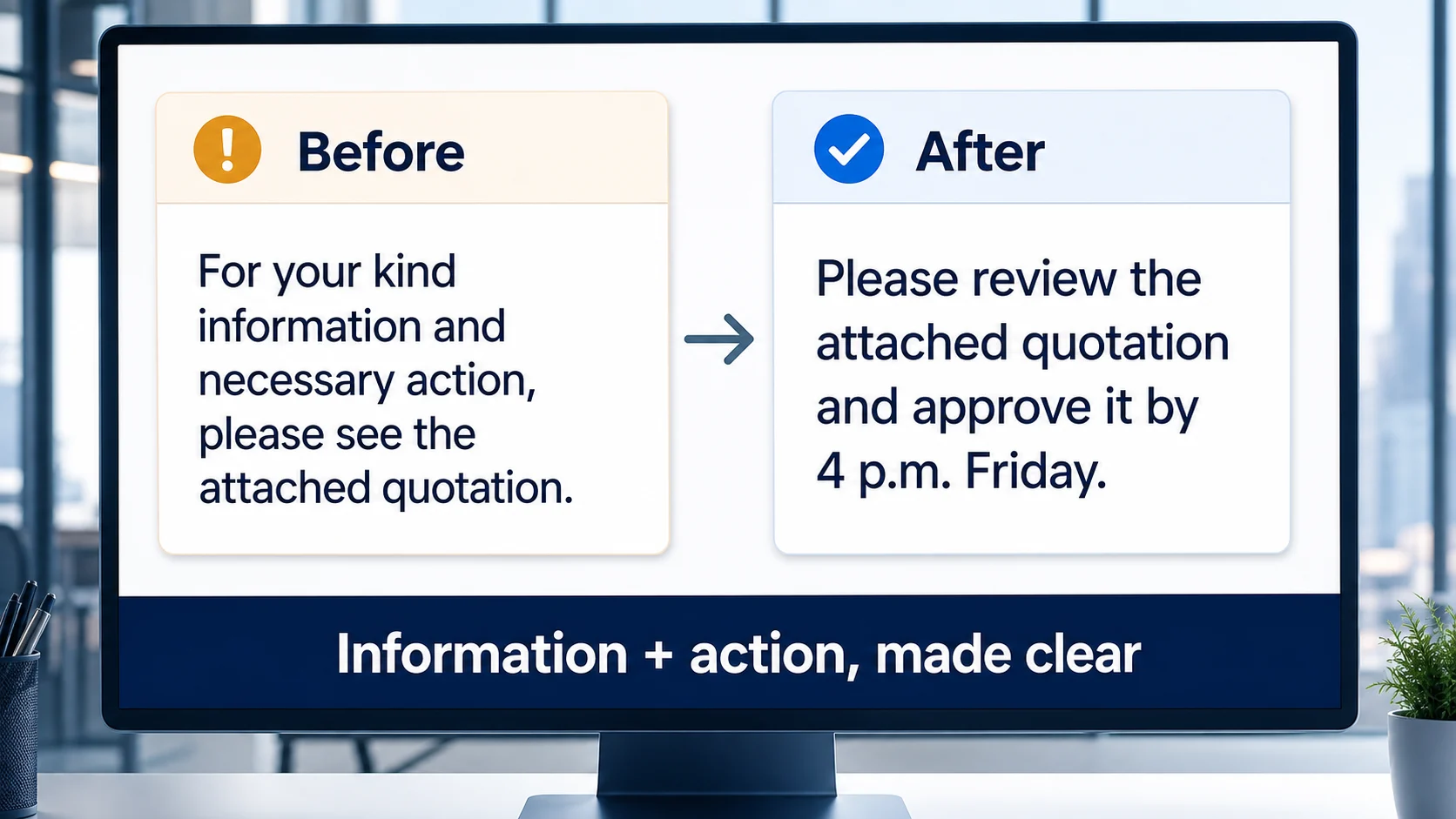
If the message is only informational, write “No action is needed.” If action is required, state the verb, owner, and deadline. The same fix applies to “kindly oblige” in email: respectful wording cannot replace a clear request.
AI Grammar Buddy’s Email Improver rewrites vague action phrases into a specific task and deadline, then lets you review the tone before sending. The product test near the end of this guide shows the result—and the placeholders that still needed human checking.
For a closer comparison of optional information and supporting material, see what “for your reference” means in email.
“For Your Kind Information” vs FYI
The two expressions have nearly the same meaning, but they differ in familiarity and tone.
| Phrase | Meaning | Tone | Best use |
|---|---|---|---|
| For your kind information | I am sharing this for your awareness | Very formal; regional | A workplace where the phrase is already conventional |
| FYKI | Abbreviation of “for your kind information” | Unfamiliar to many readers | Avoid unless your audience uses it |
| For your information | I am sharing something you should know | Neutral to formal | Full-sentence updates and external email |
| FYI | Abbreviation of “for your information” | Neutral and concise | Internal email and chat |
Cambridge Dictionary defines FYI as the written abbreviation for “for your information.” FYKI is not an interchangeable standard abbreviation for global audiences.
Can FYI sound rude?
FYI is normally neutral when it introduces useful information, but it can sound sharp before a correction. Instead of:
FYI, that is not what the contract says.
A purpose-specific opener is better:
To clarify, the contract allows 30 days for payment.
Choose a phrase that matches the purpose: updating, reminding, clarifying, or requesting.
Better Alternatives to “For Your Kind Information”
The best replacement depends on the purpose of the message.
| Alternative | Use it when | Example |
|---|---|---|
| FYI | sharing a short internal update | “FYI, tomorrow’s call starts at 10.” |
| Please note | drawing attention to an important detail | “Please note that the office closes at 5 p.m.” |
| Just a quick update | giving a friendly progress report | “Just a quick update: testing is now complete.” |
| For context | adding background that explains a decision | “I have included the earlier thread for context.” |
| For your records | sending a final item to keep | “The paid invoice is attached for your records.” |
| To clarify | correcting or removing ambiguity | “To clarify, the new rate begins on 1 August.” |
| No action needed | making the expectation explicit | “No action is needed; I am sharing this for awareness.” |
Do not automatically use “for your review.” That phrase suggests the recipient should examine the item and may need to respond. Read our guide to “for your review” meaning in email before using it as an FYI alternative.
If an attachment is meant to be read rather than simply noted, our perusal meaning guide explains why “for your perusal” asks for attention while FYI normally does not.

Examples
1. Forwarding background information
Unclear:
Please see the email below for your kind information.
Clearer:
I am forwarding the supplier’s email below for context. No action is needed.
2. Highlighting a deadline
Stiff:
For your kind information, the registration closes on Friday.
Clearer:
Please note that registration closes at 5 p.m. Friday.
3. Correcting a misunderstanding
Passive-aggressive:
For your kind information, the payment was already made.
Professional:
To clarify, we made the payment on 18 July. I have attached the receipt for your records.
4. Asking for action
Mixed signal:
For your kind information, the draft is attached. Please do the needful.
Specific:
Please review the attached draft and add your comments by 2 p.m. Thursday.
Regional openers often hide the real task. See what “do the needful” means for more specific rewrites.
Common Mistakes
1. Using FYKI with readers who may not know it
FYKI is less widely recognised than FYI. Use FYI or “for your information” when writing across countries or companies.
2. Hiding an action request inside an informational message
The phrase signals awareness, not approval, a signature, or a reply. State the action and deadline.
For request-specific wording, use these clearer alternatives to “please advise”.
3. Using the phrase before criticism
Before criticism, it can sound sarcastic. Use “to clarify” and focus on facts and next steps.
4. Confusing information, reference, and review
Use information for an update, reference for material that may be useful later, and review when you expect the recipient to examine something. Choosing by purpose prevents missed action.
How AI Grammar Buddy Can Help
A phrase can be understandable and still create the wrong signal. On 10 August 2026, we tested this synthetic draft in AI Grammar Buddy using the Professional tone, Request goal, and UK English setting:
FYKI, the quotation is attached for your kind information and necessary action. Please do the needful by Friday.
The complete tool output was:
Dear [Recipient Name],
Please find the quotation attached for your review. We would appreciate it if you could confirm your decision by Friday, [Date].
Thank you.
Best regards, [Your Name]
The rewrite removed FYKI, named the task as a review and confirmation, and kept the Friday deadline. It also inserted [Recipient Name], [Date], and [Your Name] placeholders. That is an important limitation: the output still needs a human check for names, dates, facts, and whether “confirm your decision” accurately describes the approval you need.
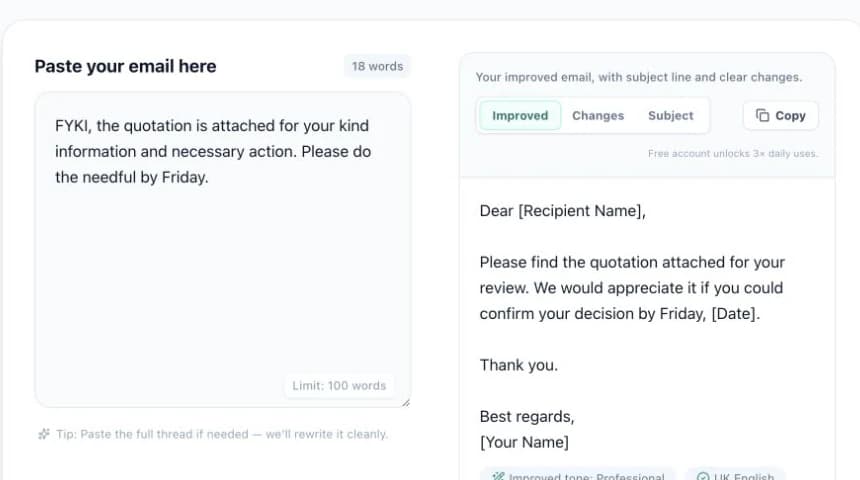
Paste one unclear sentence into the Email Improver and compare the original with a clearer professional version before using the result.
Final Takeaway
“For your kind information” means “I am sharing this for your awareness.” It is documented in Indian institutional and workplace correspondence, but it may sound stiff or unfamiliar to readers elsewhere.
Use FYI or “for your information” for a neutral update. Better still, name the purpose: “please note,” “for context,” “for your records,” or a direct action with a deadline. Clear expectations are more useful than extra formality.
About This Article
Kin
Senior Business English Editor
Kin reviews AI Grammar Buddy’s workplace email guides for clarity, tone, and cross-cultural understanding. For this guide, she checked two official Indian examples, Cambridge’s FYI definition, and the dated product test shown below. Each rewrite was then checked to preserve the sender’s meaning and make any required action explicit; this process is an editorial review, not a workplace survey.
Last updated 10 August 2026
Frequently Asked Questions
What does FYKI mean?▼
FYKI means “for your kind information.” It tells the reader, “I am sharing this information so that you are aware of it.” It normally introduces an update or background information and does not, by itself, request action.
Is “for your kind information” correct English?▼
It is documented in Indian institutional and workplace correspondence, but it may sound stiff or unfamiliar to readers elsewhere. For international email, “for your information” is usually clearer.
Is “for your kind information” professional?▼
It can be acceptable in a workplace where the phrase is conventional. For international clients or colleagues, “FYI,” “please note,” or a specific sentence usually sounds clearer and more natural.
What is the difference between FYI and FYKI?▼
FYI means “for your information” and is widely understood. FYKI means “for your kind information,” is less common, and may sound regional, overly formal, or passive-aggressive in a correction.
Does “for your kind information” require a reply?▼
Usually not. If you need the reader to review, approve, sign, or reply, state that action and include a deadline instead of relying on the phrase.
What can I say instead of “for your kind information”?▼
Choose the phrase by purpose: “FYI” for an update, “please note” for an important point, “for context” for background, “for your records” for a final document, or a direct request when action is required.
Keep going
Continue with AI Grammar Buddy
AI Grammar Buddy
Email Improver
Paste your draft and rewrite it for clearer, more professional English.
Rewrite This PhraseRelated guide
Email Clarity Checklist
Check whether every workplace message states its purpose, action, and deadline.
Related guide
Business Email Grammar Guide
Fix tone, structure, and vague wording in professional messages.
Related guide
Professional Email Templates
Use clear templates for updates, requests, follow-ups, and approvals.