Requesting You to Kindly — Is It Grammatically Correct? What to Say Instead
Is "requesting you to kindly" correct English? Learn why it sounds awkward and see clearer, more professional email alternatives with examples.
If you have ever typed — or received — an email that ended with "requesting you to kindly look into the matter and revert at the earliest," you already know exactly what this article is about.
The phrase "requesting you to kindly" is everywhere in Indian office email. It appears in project updates, support tickets, HR requests, and approval chains. It is used with genuine politeness. And yet it consistently reads as awkward to international colleagues — not rude, but not quite right either.
This guide breaks down exactly why the phrase reads the way it does — and gives you twelve direct replacements organised by situation, a tone ladder for matching phrasing to context, and three copy-paste email templates you can use today.
TL;DR
"Requesting you to kindly" is awkward and indirect. Replace it with "Please [verb]" or "Could you [verb]" — same politeness, fewer words, clearer to every reader.
Top alternatives:
- •Requesting you to kindly send = Please send (use: 'Please send the signed agreement by Friday')
- •Requesting you to kindly look into = Could you look into (use: 'Could you look into this and share an update?')
- •Requesting you to kindly approve = Please approve (use: 'Please review and approve the attached form')
AI Grammar Buddy
Rewrite this phrase in context
Paste your sentence and AI Grammar Buddy will turn it into clearer professional English.
Jump to sections
Use these anchors to jump straight to the section you need.
Quick Answer
"Requesting you to kindly" is not technically wrong English, but it is structurally awkward. The phrase stacks two politeness markers ("requesting" + "kindly") on top of each other and places "kindly" inside an infinitive, creating a split infinitive. The result is indirect, wordy, and — to most international readers — faintly old-fashioned. The cleanest replacement in almost every case is "Please [verb]" or "Could you [verb]" — equally polite, shorter, and universally clear.
You can also paste your email directly into the Email Improver to get an instant rewrite.
Where Does "Requesting You to Kindly" Come From?
The phrase belongs to a tradition of deferential, formal correspondence that developed in South Asian administrative and office culture — particularly in India's IT, banking, and government sectors. You will find it most often in:
- Project status requests — "Requesting you to kindly share the status at the earliest."
- Support ticket follow-ups — "Requesting you to kindly look into the issue and resolve the same."
- Approval emails — "Requesting you to kindly approve the leave application enclosed herewith."
- Payment or document requests — "Requesting you to kindly arrange for the payment and do the needful." See our guide on do the needful meaning for similar rewrites, or compare the British informal phrase “do the necessary”.
The intent is always respectful. Saying "requesting you to kindly" instead of a bare "please send" adds distance between the speaker and the demand — a natural instinct in hierarchical, high-context workplaces where directness can be read as presumptuous.
Within those workplaces, the phrase is understood and expected. The problem arises when the same email goes to a global client, a Singapore counterpart, or a Western colleague — audiences who parse it differently.
Is "Requesting You to Kindly" Grammatically Correct?
The short answer: it is not wrong, but it is structurally awkward.
The grammatically complete form of the phrase is:
"I am requesting you to kindly submit the form."
In practice, "I am" is dropped, producing an elliptical sentence:
"Requesting you to kindly submit the form."
This elliptical construction is technically acceptable in English — subject-dropping appears in many formal registers. But it creates two problems that compound each other:
1. The split infinitive. Placing "kindly" between "to" and "submit" creates a split infinitive: "to kindly submit." Modern usage accepts many split infinitives, but this one reads clumsily because "kindly" is not modifying the action — it is modifying the request. Moving it outside the infinitive ("please submit" or "submit this kindly") clarifies the sentence.
2. Redundant politeness markers. "Requesting" already frames the utterance as a polite appeal. Adding "kindly" on top doubles the deference. In standard English, one politeness marker is sufficient — "please," "kindly," or "could you" — not two layered together. Using two creates the same effect as saying "please kindly" or "I humbly respectfully request": too much, so it paradoxically sounds less sincere.
Verdict: The phrase is understandable, but it will register as non-standard to international readers and native English speakers. It is one of those constructions that works within its home register but travels poorly.
Why It Sounds Awkward in International Emails
1. It is too wordy
"Requesting you to kindly send the document" uses seven words to do what "Please send the document" does in four. Global business writing favours economy — fewer words, same meaning, same politeness.
2. The indirectness reads as hesitation
International readers may interpret "requesting you to kindly" as passive or evasive — as if the writer is reluctant to make a clear ask. Direct requests ("Please send," "Could you confirm") project confidence and professional email tone. Indirect ones can make the sender look uncertain.
3. "Kindly" carries unexpected connotations outside South Asia
In Indian English, "kindly" is a standard, warm politeness marker — equivalent to "please" and completely neutral. Outside South Asia, particularly in the UK and US, "kindly" can read as slightly passive-aggressive: the corporate equivalent of "I would kindly ask you not to do that again." It is not offensive, but the connotation is different — and unexpected.
The same cross-cultural tone question appears in formal closings. See whether “kindly oblige” is polite and what it means in email.
4. The missing subject
Dropping "I am" from "I am requesting you to" leaves the sentence without an explicit subject. Most readers fill in the gap automatically, but it adds a fractional cognitive load and gives the sentence a slightly unfinished quality.
Simple Rewrite Rule
One rule covers 80% of cases:
Replace "requesting you to kindly [verb]" with "Please [verb]" or "Could you [verb]."
| Original | Rewrite |
|---|---|
| Requesting you to kindly send the report | Please send the report |
| Requesting you to kindly look into the issue | Could you look into this issue? |
| Requesting you to kindly approve the form | Please approve the attached form |
| Requesting you to kindly revert at the earliest | Please reply by [date] |
To add formality or a deadline, extend after the verb:
- "Please send the report by Friday at 5 PM."
- "Could you approve the form before the Monday meeting?"
You do not need "requesting," "you to," or "kindly" to sound polite. "Please" carries the full weight of courtesy on its own.
12 Best Alternatives to "Requesting You to Kindly"
Polite + Soft
Use these when writing to senior colleagues, important clients, or for sensitive requests where tone matters most.
| # | Alternative | Example sentence |
|---|---|---|
| 1 | Would you be able to | "Would you be able to share the updated timeline by Thursday?" |
| 2 | Could you please | "Could you please review the attached document at your convenience?" |
| 3 | I would appreciate it if you could | "I would appreciate it if you could confirm receipt of this email." |
| 4 | It would be helpful if you could | "It would be helpful if you could share your comments before Friday." |
Neutral + Clear
Use these for most everyday professional emails — internal teams, vendors, cross-functional requests.
| # | Alternative | Example sentence |
|---|---|---|
| 5 | Please | "Please send the signed agreement at your earliest convenience." |
| 6 | I would like to request | "I would like to request your approval on the attached proposal." |
| 7 | May I ask you to | "May I ask you to review section 3 of the attached report?" |
| 8 | Can you | "Can you update the tracker with your progress by end of day?" |
| 9 | I am writing to request | "I am writing to request the latest invoice for our records." |
Firm + Deadline
Use these when the action is time-sensitive, when a polite first message has already been sent, or when you need to be unmistakably clear.
| # | Alternative | Example sentence |
|---|---|---|
| 10 | Please ensure that | "Please ensure that the form is submitted by Monday, 9 AM." |
| 11 | We require [X] by [date] | "We require the signed documents by 5 PM on Friday to proceed." |
| 12 | I need you to | "I need you to confirm the booking details by tomorrow morning." |
Common Scenarios — With Rewrites
Asking for an Update
❌ "Requesting you to kindly provide an update on the project status at the earliest."
✓ "Could you share a quick status update on [project name]?" ✓ "Please let me know where things stand — I need an update before the Friday call."
Asking Someone to Fix an Issue
❌ "Requesting you to kindly look into the matter and resolve the same at the earliest."
✓ "Could you investigate this issue and share an update by [date]?" ✓ "Please look into this and let me know the root cause so we can move forward."
Asking for Approval
❌ "Requesting you to kindly approve the leave application enclosed herewith."
✓ "Please review and approve the attached leave application." ✓ "Could you approve this request by [date]? I need to finalise my travel arrangements."
Asking for a Document or Payment
❌ "Requesting you to kindly arrange for the payment and do the needful."
✓ "Could you arrange the payment by [date]? Please find the invoice attached." ✓ "Please send the signed NDA so we can proceed to the next stage."
Tone Ladder
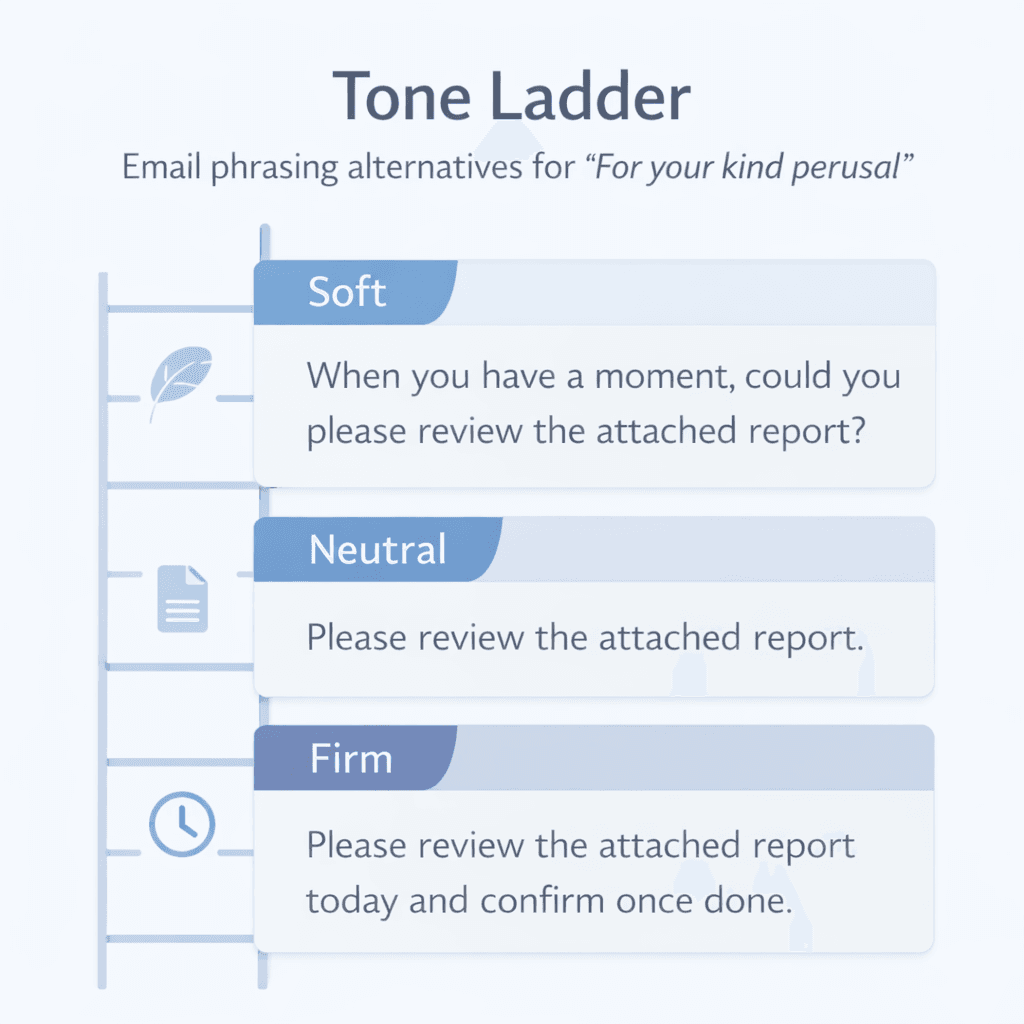
The most common mistake is defaulting to soft phrasing out of habit — even when the situation calls for neutral or firm. If a soft request has already been ignored, escalating to neutral (specifying a deadline) is appropriate and professional, not rude.
Match your phrasing to the relationship and urgency:
| Tone | When to use | Example |
|---|---|---|
| Soft | Senior stakeholder, important client, first request | "Would you be able to review the draft when you have a moment?" |
| Neutral | Colleague, internal team, second touchpoint | "Please review the draft and share your comments by Thursday." |
| Firm | Overdue action, time-critical deadline, final reminder | "We need your sign-off by Friday morning to meet the launch date." |
3 Copy-Paste Email Templates
Template 1: Asking for a Status Update
Subject: Status Update — [Project / Task Name]
Hi [Name],
Could you share a quick update on [project/task name]? It would be helpful to have a sense of where things stand before [meeting/deadline on date].
Please let me know if you need anything from my end in the meantime.
Thank you.
Best regards, [Your Name]
Template 2: Asking for Approval
Subject: Approval Needed — [Document / Request Name]
Dear [Name],
Please find the attached [document name] for your review.
Could you approve it by [date]? This will allow us to [next step — e.g., proceed with the contract / confirm the booking / submit the application].
Let me know if you have any questions or would like to discuss.
Thank you.
Best regards, [Your Name]
Template 3: Asking for a Document or Payment
Subject: [Document / Invoice Name] — Action Required by [Date]
Hi [Name],
Please find attached [document name / invoice number].
Could you arrange [signature / payment / submission] by [date]? This will help us [reason — e.g., close the project / meet the deadline / proceed to the next phase].
Thank you for your prompt attention.
Best regards, [Your Name]
Use Grammar Buddy to Rewrite Your Emails
Still not sure if your email sounds right? Paste it into AI Grammar Buddy. The Email Improver flags phrases like "requesting you to kindly" automatically and rewrites them to match your audience — whether that's a senior manager, a global client, or a first-time vendor. No guessing. Just a cleaner email.
"Requesting you to kindly look into the matter and revert at the earliest."
"Could you look into this and share an update by [date]? Let me know if you need anything from my end."
If this phrase comes up in your emails, you may also be using for your kind perusal — another common Indian English phrase this guide helps you replace.
Key Takeaways
- "Requesting you to kindly" is grammatically defensible but professionally damaging. It stacks two politeness markers, creates a split infinitive, and signals hesitation to every international reader. Stop using it.
- The fix is always "Please [verb]" or "Could you [verb]." These are shorter, clearer, and equally polite. You do not need three words to do what one word does.
- Specificity beats formality every time. "Please send the signed contract by Friday" is more professional than any combination of "kindly," "humbly," or "requesting you to." Name the document. Name the action. Name the deadline.
- Use AI Grammar Buddy to catch this before you hit send. Paste your email into the Email Improver — it flags indirect phrasing and suggests direct rewrites in seconds.
Frequently Asked Questions
Is "requesting you to kindly" grammatically correct?▼
Not strictly wrong, but structurally awkward. The complete form — "I am requesting you to kindly..." — is technically acceptable, though it stacks two politeness markers and contains a split infinitive. "Please [verb]" or "Could you [verb]" is cleaner and more natural in international business English.
What does "kindly request you to" mean?▼
"Kindly request you to" means "I politely ask you to." It is a formal, deferential phrasing common in South Asian business English. It is understandable but unnecessarily wordy. "Please" or "could you" communicates the same meaning in fewer words.
Is "I kindly request you to" correct English?▼
Grammatically it is functional, but "I kindly request" is redundant — a request is already a polite appeal. "I would like to request" or simply "please" are cleaner alternatives that sound more natural to international readers.
What is a good alternative for a humbly request email?▼
Replace "I humbly request" with "I would appreciate it if you could," "could you please," or "I would like to request." These are appropriately polite without sounding overly deferential, which can actually undermine professional credibility.
How do I sound professional in email requests without using "kindly"?▼
Use "please," "could you," or "would you be able to." Then add specificity — name the document, the action, and the deadline. Specificity signals professionalism more effectively than any politeness marker.
When is "kindly" acceptable in a professional email?▼
"Kindly" is fine when used alone: "Kindly note that the deadline is Friday." Problems arise when it stacks with other softeners ("requesting you to kindly") or replaces "please" in contexts where readers may perceive it as passive-aggressive.
What is the difference between "please" and "kindly" in email?▼
Both signal politeness, but they carry different connotations globally. "Please" is universally neutral. "Kindly" is standard in South Asian English but can sound old-fashioned or slightly stern to UK and US readers. When in doubt, use "please."
What should I use instead of "requesting you to kindly do the needful"?▼
Be specific about the action. Replace "kindly do the needful" with the exact task: "Please submit the form by Friday," "Could you process the request today?" or "Please confirm once the payment is arranged." Vague phrases like "do the needful" signal unclear thinking regardless of how many politeness markers surround them.
Next step
Rewrite this phrase in context
Paste your sentence and AI Grammar Buddy will turn it into clearer professional English.
Keep going
Continue with AI Grammar Buddy
AI Grammar Buddy
Email Improver
Paste your draft and rewrite it for clearer, more professional English.
Rewrite This PhraseRelated guide
What Does Inherent Mean? Meaning, Examples and Business English Uses
What does inherent mean? Learn the meaning, inherent in vs to, and practical sentence examples for reports, emails and everyday English.
28 September 2026
Related guide
What Does Coherent Mean? Meaning, Examples and Business English Uses
Learn what coherent means, see natural sentence examples, compare coherent vs clear, and improve the flow of your emails and reports.
27 September 2026
Related guide
What Does Persist Mean? Meaning, Grammar and Examples
Persist means to continue despite difficulty or to keep existing. Learn how to use persist in, persist with, and persist correctly with workplace examples.
23 August 2026