"Well Received With Thanks": Meaning + 12 Better Replies
Well received means accepted positively. In some regional emails, “well received, thank you” confirms receipt. Learn the difference and see 12 clearer replies.

Reviewed by Business English editorial team.
In reviewing workplace email rewrites for AI Grammar Buddy users across Singapore, Hong Kong, and India, we keep seeing the same pattern: short acknowledgement lines that feel polite locally but land as stiff or vague in global inboxes.
You just replied to a client with "Well received with thanks." It feels efficient and professional. But in London, New York, or Sydney, it can land very differently: stiff, translated, or oddly impersonal.
That is the real problem with well received with thanks. The phrase is understandable, but it does not say exactly what most people think it says. In general English, well received usually means something was positively accepted, not simply delivered. In some Singapore, Hong Kong, and other Asian office emails, writers use “Well received, thank you” to confirm that a message or file arrived.
This guide explains what well received with thanks actually means, why it sounds awkward in international email, and what to say instead if you want a clearer, more natural reply.
TL;DR
"Well received with thanks" is understandable, but it is not the clearest default for professional email.
Best default: "Thanks, I've received it and will review it today."
Quick picks:
- •"Received with thanks" is the clearest option when you are confirming receipt.
- •"Thanks, I've received it" sounds more natural in everyday professional email.
- •"Thank you for sending this - I'll review it today" is best when you need to show a next step.
AI Grammar Buddy
Check your sentence instantly
Get grammar, wording, and clarity fixes in one pass.
Jump to sections
Use these anchors to jump straight to the section you need.
Quick Answer
Quick Answer: Well received normally means accepted or reacted to positively. “The proposal was well received” means people liked or approved of the proposal. In some regional business emails, “Well received, thank you” is intended to mean “I received it, thank you.” For clear international email, write “Received with thanks” or “Thanks, I've received it and will review it today.”
| Wording | Intended meaning | Natural use |
|---|---|---|
The proposal was well received. | The proposal was viewed positively. | General English: feedback, approval, reviews, launches |
It was a well-received proposal. | The proposal was viewed positively. | Before a noun, use the hyphenated adjective well-received |
Well received, thank you. | I received it, thank you. | Regional email confirmation; understandable but potentially ambiguous globally |
Received with thanks. | I received it, thank you. | Clear receipt confirmation |
Well Received Meaning: Praise vs Email Confirmation
The distinction is simple:
- General adjective meaning: well received = welcomed, approved of, or reacted to positively.
- Regional email use: well received, thank you = the sender wants to confirm receipt and express thanks.
These meanings overlap only because the same words are used. If you are describing a successful meeting, idea, proposal, presentation, product, or policy, well received is natural:
“The proposal was well received by the board.”
If you are replying to an attachment, received is the important word. Removing well makes the confirmation clearer:
“Received with thanks. I will review the proposal today.”
Is "Well Received with Thanks" Correct in Email?
The short answer is: not completely wrong, but not the strongest choice either.
The issue is the phrase well received itself. In standard English, we usually use it like this:
The proposal was well received by the client.Her presentation was well received at the meeting.The new policy was well received by employees.
In all three cases, well received means positively accepted or liked by people.
That is different from:
I received your email.I have received the document.Thanks, I've got the file.
So when you write well received with thanks, your meaning is still guessable, but the wording is not very precise. Readers can understand it, yet still feel that it sounds translated, over-formal, or slightly unnatural.
This matters most in:
- client communication
- job applications
- replies to your manager
- cross-border teams using US or UK business English
If your office already uses the phrase every day, nobody may object. But if you want the clearest global-English version, received with thanks or thanks, I've received it is safer.
Received With Thanks vs Well Received With Thanks
This is the distinction most articles skip, but it is the one that actually helps you write better replies.
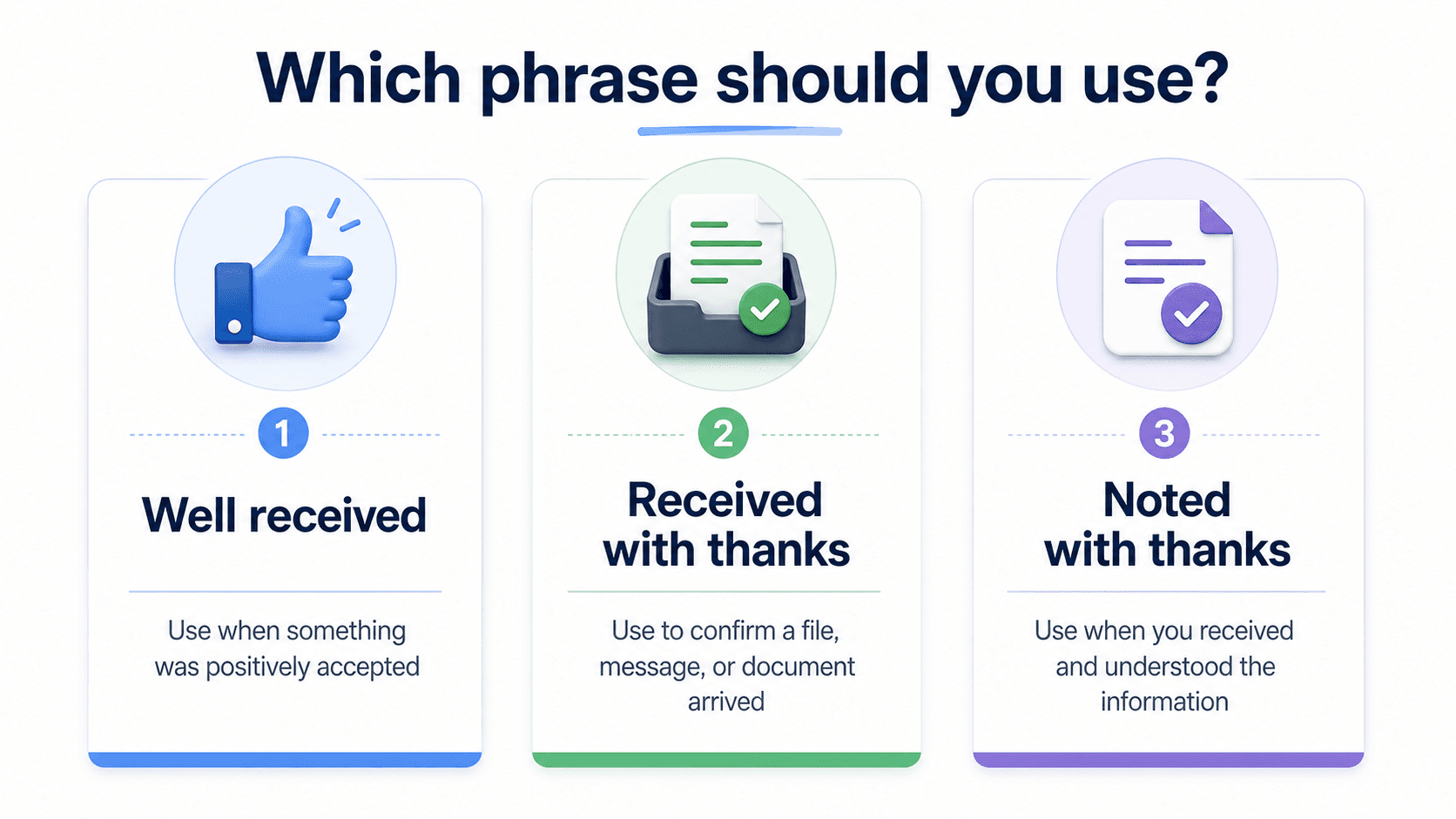
| Phrase | What it usually means | Best use |
|---|---|---|
Well received | Something was positively accepted | Feedback, presentations, proposals, launches |
Received with thanks | I received it, thank you | Files, messages, documents, attachments |
Noted with thanks | I received and understood the information | Updates, instructions, internal status messages |
If you only want to confirm delivery, received with thanks is usually the cleanest option.
If you also need to show action, make the next step explicit:
Thanks, I've received the file and will review it today.Thank you for sharing this. I'll come back with feedback tomorrow morning.
If you want the broader confirmation formula, read our guide on acknowledging receipt professionally.
Examples
Here is the fastest way to improve this phrase in real email situations.
| Situation | Weak Reply | Better Reply |
|---|---|---|
| Someone sent a file | Well received with thanks. | Thanks, I've received the file. |
| A client sent a brief | Well received with thanks. | Thank you for sharing this. I've received the brief and will review it with the team today. |
| Your boss assigned a task | Well received with thanks. | Understood, thank you. I'll send you an update by 4 PM. |
| A colleague sent an update | Well received with thanks. | Thanks for the update. |
| You need time to review | Well received with thanks. | Thanks, I've received this and will review it today. |
| Internal quick reply | Well received with thanks. | Got it, thanks. |
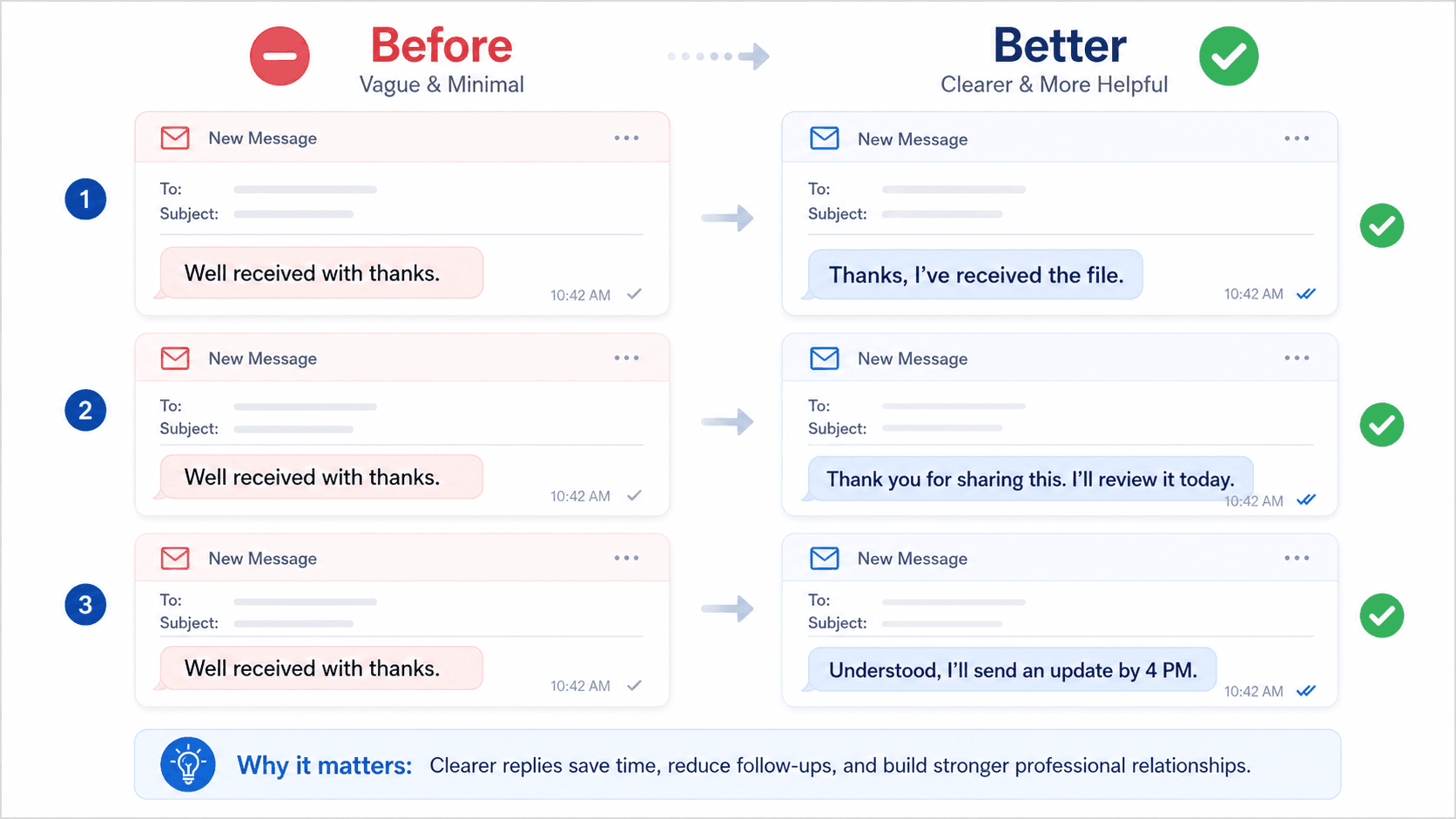
Not sure which one sounds most natural? Paste your sentence into AI Grammar Buddy's Grammar Checker and compare the wording before you send it.
Here are three quick rewrites you can copy:
Before: Well received with thanks.
After: Received with thanks.
Before: Well received with thanks.
After: Thanks, I've received the attachment and will review it this afternoon.
Before: Well received with thanks.
After: Thank you for the update - I'll take it from here.
If you are writing to a client, senior manager, or recruiter, the stronger reply is usually the one that also shows the next step.
Common Mistakes
The first mistake is using well received when you only mean I got it.
That creates a tone problem. Even when the reader understands you, the phrase can sound:
- too formal
- slightly translated
- vague about what happens next
The second mistake is replying too briefly when the sender expects engagement.
For example, if a client sends a long request, this reply feels closed:
Well received with thanks.
This version is stronger:
Thank you for the detailed brief. I've received it and will come back with questions by tomorrow morning.
The extra clause does two useful jobs:
- it shows you actually read the message
- it tells the sender what will happen next
The third mistake is piling up stiff phrases in the same line. Replies like these usually sound robotic:
Well received and noted with thanks.Duly well received with many thanks.Your email is well received with thanks.
If you often write stacked phrases like that, Grammar Checker can help you compress them into one natural sentence.
If you want to compare similar acknowledgement phrases, also see how to reply to "noted", whether "noted with thanks" sounds rude, and our guide to "do the needful" alternatives.
How AI Grammar Buddy Can Help
When we review drafts from Asian workplace writers, well received with thanks sits in the same problem group as please do the needful and please advise: understandable, but heavier than necessary.
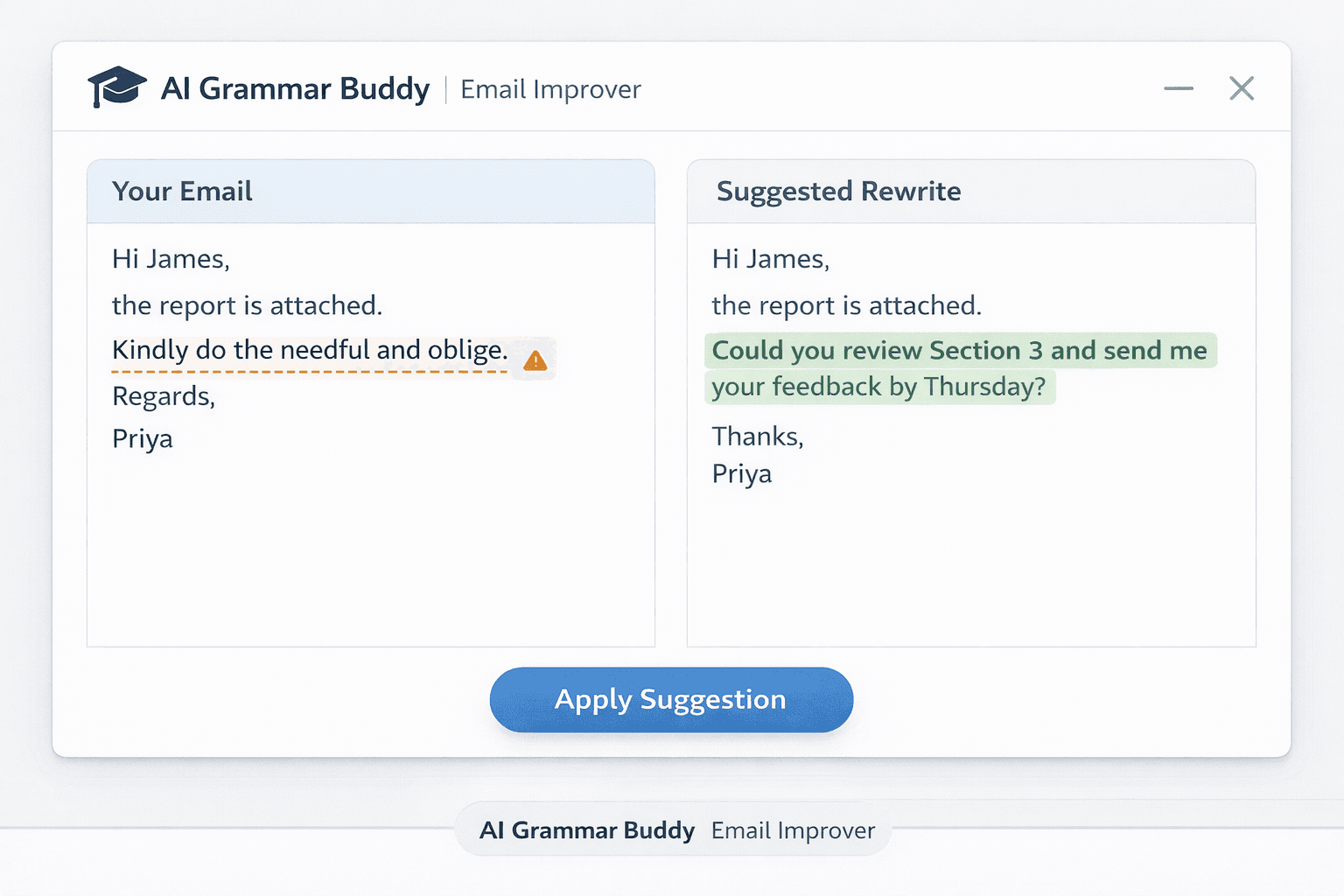
Grammar Checker is useful here because the problem is often sentence-level, not paragraph-level. You do not need a full rewrite. You need a faster way to spot:
- awkward phrasing
- grammar slips
- wording that sounds too stiff
- cleaner global-English alternatives
For example, it can help you revise Well received with thanks into:
Thanks, I've received it and will review it today.Thank you for sending this. I'll take a look and get back to you shortly.Received with thanks. I will follow up by end of day.
That kind of sentence-level correction is small, but it changes how competent and approachable your email sounds.
FAQ
Is well received with thanks grammatically correct?
It is understandable, but it is not the clearest modern business-English choice. The bigger issue is tone and precision, not strict grammar.
What does well received with thanks mean in email?
Most people use it to mean "I received your message, thank you." But well received more often means something was positively accepted, which is why the phrase can sound slightly off.
Is well received with thanks rude?
Usually no. But it can sound cold, formal, or unnatural in US/UK-facing emails, especially if the sender expects a fuller response.
What is better: well received with thanks or received with thanks?
Received with thanks is usually better when you mean a document, file, or message has arrived. It is shorter and more precise.
Can I still use well received with thanks in Singapore or Hong Kong offices?
Yes. Many workplaces in Asia use it and understand it immediately. The risk rises when you write to international clients or native-English audiences unfamiliar with that style.
Final Takeaway
Well received with thanks survives because people usually understand it. But that does not make it the best default.
If your goal is clear, modern professional English, use a line that directly states what happened:
Thanks, I've received it.Received with thanks.Thank you for sending this - I'll review it today.
Those versions are clearer, warmer, and easier for global readers to process. If you want the broader email phrase cluster, continue with our professional email templates. If you want to clean up your own sentence before sending it, run the line through AI Grammar Buddy's Grammar Checker.
About This Article
Business English Editorial Team
Reviewed by Business English editorial team
Our Business English editorial team reviews practical workplace writing guides and uses AI Grammar Buddy's grammar checker and email improver to help thousands of users write clearer, more confident English.
Last updated 2 August 2026
Frequently Asked Questions
What does "well received" mean?▼
"Well received" usually means accepted, welcomed, or reviewed positively. For example, “The proposal was well received” means people reacted favourably to it.
Is "well received with thanks" grammatically correct?▼
It is understandable, but it is not the clearest modern business-English choice. The bigger issue is tone and precision, not strict grammar.
What does "well received with thanks" mean in email?▼
Most people use it to mean "I received your message, thank you." But "well received" more often means something was positively accepted, which is why the phrase can sound slightly off.
Is "well received with thanks" rude?▼
Usually no. But it can sound cold, formal, or unnatural in US/UK-facing emails, especially if the sender expects a more engaged reply.
What should I say instead of "well received with thanks"?▼
Use clearer options like "Thanks, I've received it," "Received with thanks," or "Thanks for sending this - I'll review it today."
Next step
Check your sentence instantly
Get grammar, wording, and clarity fixes in one pass.
Keep going
Continue with AI Grammar Buddy
AI Grammar Buddy
Grammar Checker
Run a fast grammar, wording, and clarity check on your sentence.
Check My SentenceRelated guide
Conserve Meaning in English: Preserve vs Conserve in Emails
Conserve meaning in English: use something carefully so it is not wasted. See workplace email examples, conserve vs preserve, reserve, and save.
22 August 2026
Related guide
How to Become a Proofreader With No Experience (2026)
No degree or clients yet? Learn skills, markup, a 3–5 sample portfolio, free tools, and realistic job steps—plus what proofreading courses actually require.
29 July 2026
Related guide
How to Check Grammar Mistakes in 8 Steps
Learn how to check grammar mistakes in English with an 8-step process, common error examples, a reusable checklist, and tips for using an online checker.
26 July 2026