Acknowledge Receipt Email: How to Confirm an Email Professionally (+ 20 Examples)
Learn how to acknowledge receipt of an email professionally. See 20 examples, modern alternatives to 'acknowledged with thanks', and better business email replies.
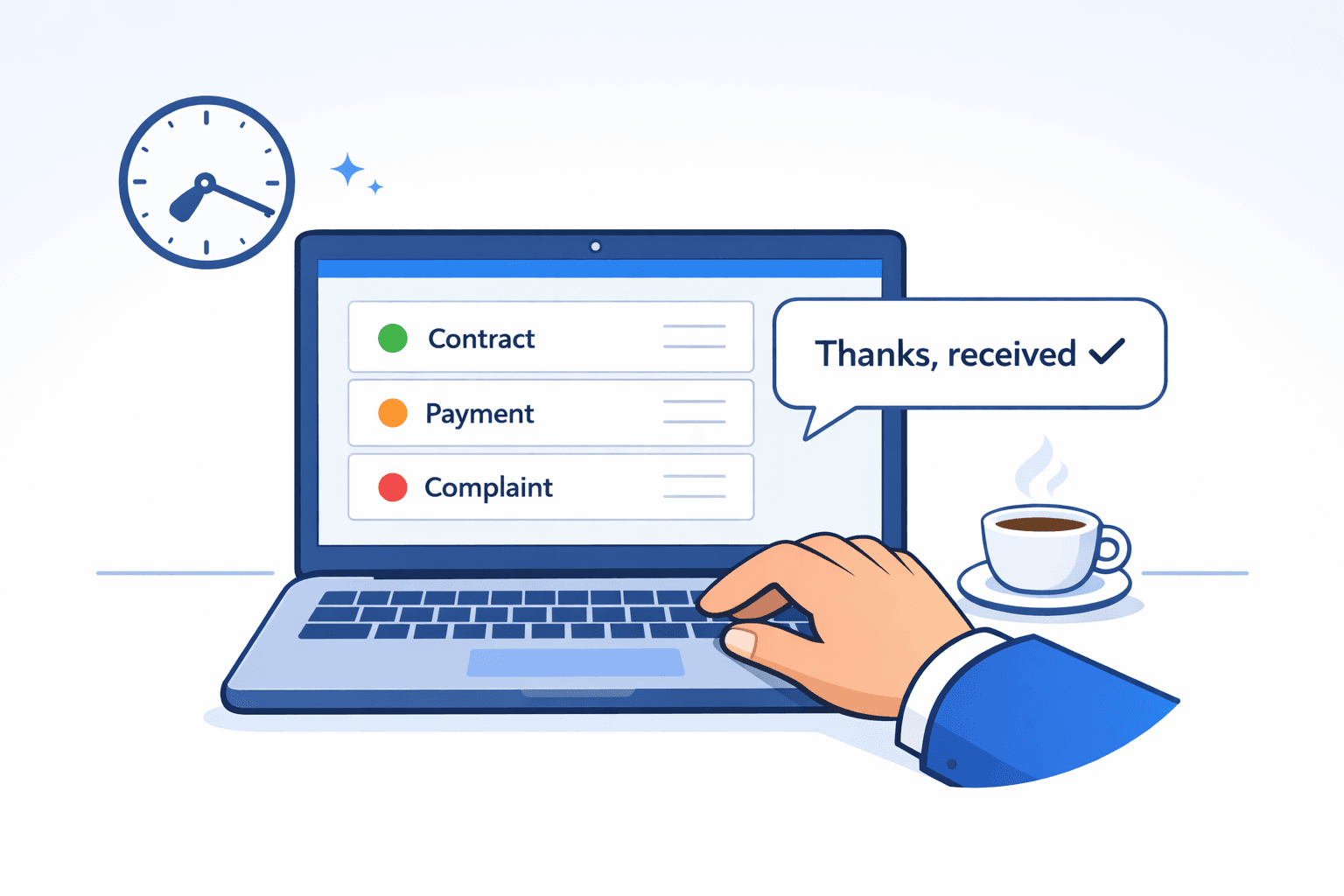
An acknowledge receipt email sounds simple until you need to send one fast. A client sends a signed contract, finance shares proof of payment, or a candidate submits an application, and now you need to confirm receipt without sounding cold, robotic, or too formal.
Many people default to phrases like "Acknowledged with thanks" or "Please acknowledge receipt." They are understandable, but in modern business English they often sound stiffer than the situation needs.
At AI Grammar Buddy, we analyze thousands of real workplace emails across Singapore, India, and global teams. One pattern shows up constantly: phrases that are technically clear, but still sound dated or distant in a fast-moving inbox.
A better approach is short, specific confirmation in natural business English. This guide explains what "acknowledge receipt" means in email, when you should use it, when you can skip it, and how to write it without sounding like a legal memo. You will also get 20 practical examples you can copy and adapt.
If you want a faster rewrite while you read, AI Grammar Buddy's Email Improver is especially useful for turning stiff confirmation lines into clear, professional replies.
TL;DR
"Acknowledge receipt email" simply means confirming that you received a message, file, payment, or request.
Example: "Thanks, I have received the file and will review it this afternoon."
Better modern approach:
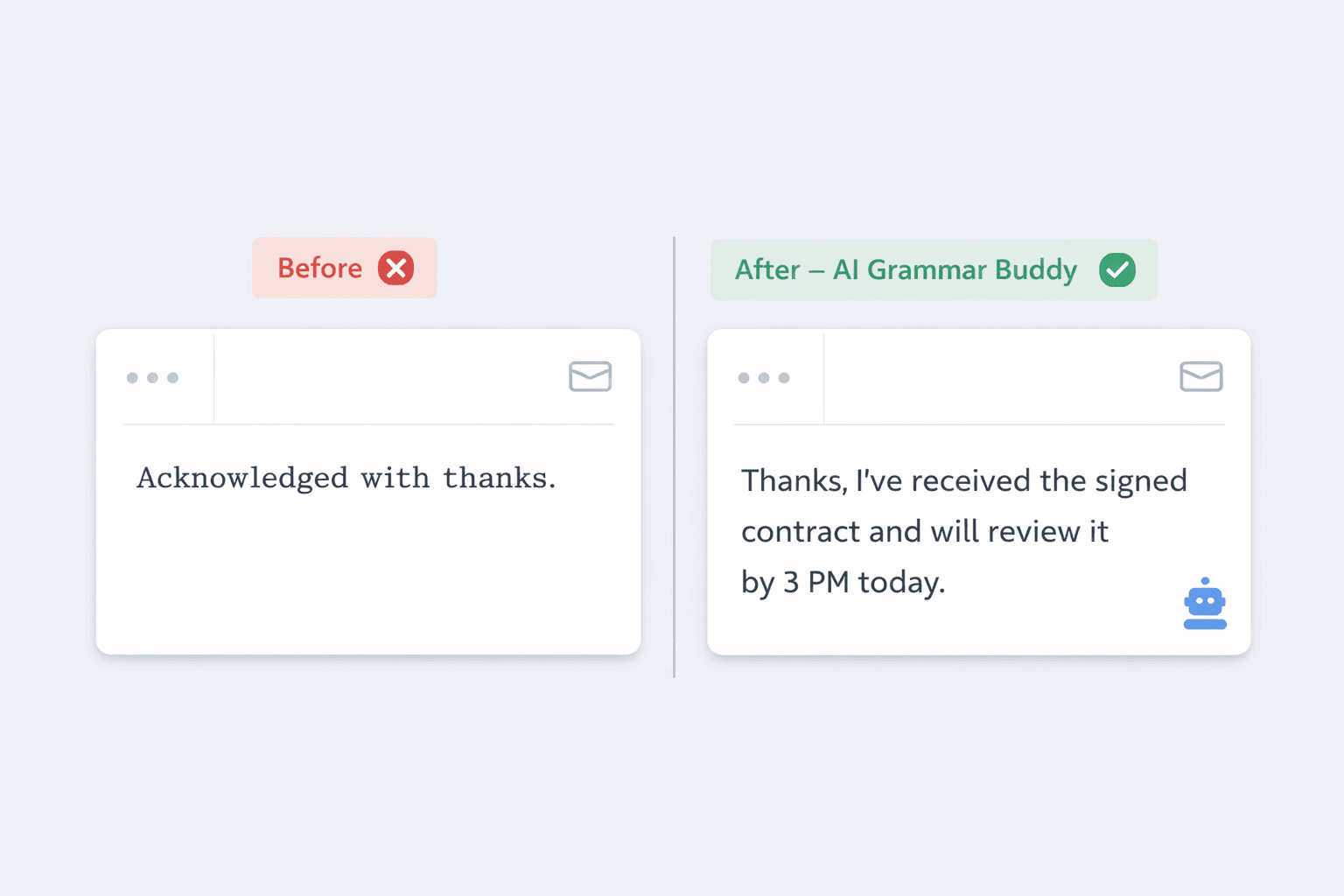
- •Instead of "Acknowledged with thanks," write "Thanks, I have received the file and will review it today."
- •Instead of "Please acknowledge receipt," write "Please confirm you received the signed contract."
- •If your draft still sounds stiff, AI Grammar Buddy's Email Improver can rewrite it into clearer professional English.
AI Grammar Buddy
Turn this template into your email
Start with the example, then rewrite it for your real situation.
Jump to sections
Use these anchors to jump straight to the section you need.
Acknowledge Receipt Email Meaning: What Does It Actually Mean?
An acknowledge receipt email is a reply that confirms you received a message, document, file, payment, application, or complaint.
That is the core meaning. It does not automatically mean:
- you approve the content,
- you have finished reviewing it,
- you agree with it,
- or the matter is resolved.
It simply means: "I received this."
That distinction matters. In many workplaces, people use a receipt confirmation when there is a handoff, a deadline, or some business risk involved. The sender wants certainty that the message arrived and did not disappear into an inbox.
What is the "please acknowledge receipt" meaning?
The plain please acknowledge receipt meaning is: "Please tell me that you received this."
It is common in more formal emails, especially when someone is sending:
- signed documents,
- invoices,
- payment instructions,
- application materials,
- complaints,
- compliance or HR records.
The phrase is understandable, but it can sound stiff. In many modern business emails, "Please confirm receipt" or "Please let me know once received" sounds more natural.
What is the "please confirm receipt" meaning?
The please confirm receipt meaning is almost the same: "Please tell me that this reached you."
Compared with "please acknowledge receipt," it usually sounds:
- slightly more modern,
- slightly less legal,
- and easier to use in normal office communication.
If you work with global teams, "please confirm receipt" is often the safer choice unless the context is highly formal.
How to Acknowledge Receipt of Email Professionally
If you are wondering how to acknowledge receipt of email without sounding awkward, use this simple structure:
- Thank or acknowledge the sender
- Confirm what you received
- Add the next step if one matters
That formula keeps your reply useful. It avoids the problem of short replies that sound closed or dismissive, like "noted with thanks" or "noted" when the sender actually needs reassurance.
If the exact phrase you are considering is “OK noted,” see our guide to the meaning and tone of “OK noted” in email. It explains why acknowledgement is not the same as agreement or a promise to act.
Here is the formula in action:
Thanks for sending this. I have received the revised contract and will review it this afternoon.
That works because it does three jobs at once:
- it confirms receipt,
- it sounds human,
- and it tells the sender what happens next.
If you stop at only "Acknowledged with thanks," your meaning is still understandable, but the tone becomes more formal and less helpful.
"Acknowledge Receipt" vs "Please Confirm Receipt" vs "Acknowledged With Thanks" vs "Noted With Thanks"
These phrases are related, but they are not identical.
The practical acknowledged with thanks meaning is usually: "I received it, thank you." The issue is not comprehension. The issue is tone. In many modern inboxes, it sounds more formal and less conversational than necessary.
| Phrase | Meaning | Tone | Best use |
|---|---|---|---|
| Acknowledge receipt | Confirm that something was received | Formal to neutral | Documents, complaints, applications, payment records |
| Please confirm receipt | Ask the other person to tell you it arrived | Neutral to formal | Important emails, attachments, contracts |
| Acknowledged with thanks | Confirm receipt and add appreciation | Formal, stiff, slightly dated | Administrative confirmations, traditional office writing |
| Noted with thanks | Confirm you have read and understood the message | Transactional, regional, can sound cold globally | Routine updates, especially in some Asian offices |
In practice:
- "Acknowledge receipt" is about receipt.
- "Please confirm receipt" is a request for the other person to confirm.
- "Acknowledged with thanks" is acceptable, but often sounds more formal than necessary.
- "Noted with thanks" is not the same thing. It usually means "I have received and understood your message." It is more about acknowledgment of information than receipt of a file or handoff.
If your team often uses phrases like "noted with thanks" or "well noted", you may also want to read our guide to better alternatives for Singapore emails.
When You Should Send an Acknowledge Receipt Email
You do not need a receipt confirmation for every message. But you should send one when the sender needs certainty.
The most common cases are:
- Important documents: contracts, signed forms, legal records, HR paperwork
- Money-related communication: payment proofs, invoices, remittance details
- Applications: job applications, vendor applications, scholarship submissions
- Complaints or service issues: the sender wants confirmation that the issue is being handled
- Client deliverables: decks, reports, revised files, approval versions
- Boss or stakeholder instructions: confirming you received the ask and will act on it
In these situations, a short confirmation reduces anxiety and avoids follow-up messages like: "Just checking if you saw my email."
If you do not confirm receipt and the item is important, the sender may need to chase you. If that happens, our guide on how to chase an email politely helps from the other side of the conversation.
When Acknowledging Receipt Is Unnecessary
Sometimes a receipt email adds no value.
You can usually skip it when:
- the email is routine and low risk,
- no file, deadline, or money is involved,
- the sender does not need proof of delivery,
- or your detailed response is coming very soon anyway.
For example, you usually do not need a separate acknowledgment for:
- a casual internal update,
- a simple FYI message,
- a calendar invite you will answer in the next email,
- or a short note from a colleague that does not require action.
This is where many non-native English users get stuck. They worry that not replying is rude, so they send something too formal like "Acknowledged with thanks" or "Received and well noted." In reality, a warmer and shorter message is often better, and sometimes no separate reply is needed at all.
The same principle shows up in other stiff business phrases such as "please advise", "requesting you to kindly", and "for your kind perusal". The issue is usually not grammar. It is over-formality.
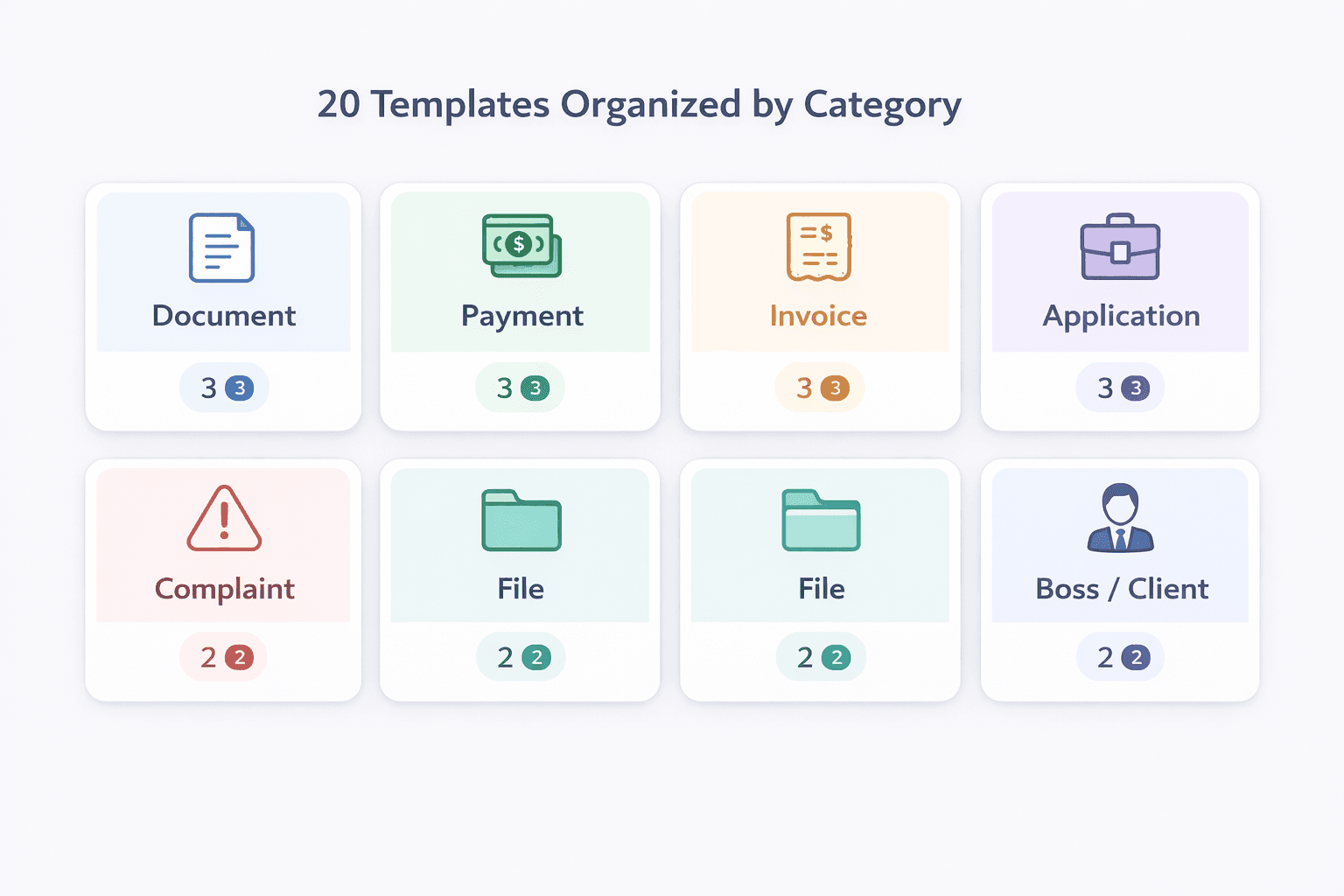
20 Practical Acknowledge Receipt Email Examples
Use these as working templates. Keep the wording, then swap in your own document, amount, timeline, or next step.
Document received
- Thanks, I have received the signed agreement.
- I have received the document and will review it by tomorrow afternoon.
- Received with thanks. I will circulate the document to the team today.
Payment received
- This is to confirm that we have received your payment. Thank you.
- Thank you. We have received the transfer and will issue the receipt shortly.
- Payment received with thanks. Your account will be updated today.
Invoice received
- We have received invoice INV-2048 and will process it according to the agreed terms.
- Thanks for sending the invoice. I have received it and forwarded it to finance.
- Invoice received. Please expect payment within 7 business days.
Application received
- Thank you for your application. We have received your materials and will review them shortly.
- This email acknowledges receipt of your application for the Marketing Executive role.
- We have received your CV and portfolio. Our team will contact you if you are shortlisted.
Complaint received
- Thank you for raising this. We have received your complaint and are reviewing it now.
- I acknowledge receipt of your message and will come back with an update by 4 PM tomorrow.
File received
- I have received the file. It opens correctly on my side.
- Thanks, the revised deck came through. I will review version 3 this afternoon.
These are replies to the sender. If you are writing the original message that sends the file, use a clear attachment line from our professional alternatives to “please find attached” guide.
Boss or client email received
- Received, thank you. I will action this before end of day.
- Thanks for the note. I have received your instructions and will update the draft accordingly.
Formal vs friendly versions
- Formal: Please be informed that we have received your request and are processing it.
- Friendly but still professional: Thanks, we have received your request and are working on it now.
These examples cover the most common business use cases, but you can make them stronger by adding one useful detail:
- when you will review it,
- when the sender can expect a reply,
- or what happens next.
That extra line is the difference between a bare receipt confirmation and a reassuring professional reply.
Better Alternatives for Modern Business Emails
In many workplaces, you do not need the heaviest phrase available. Clearer alternatives often sound better than "acknowledged with thanks" or "please acknowledge receipt."
Here are stronger modern options:
- Thanks, I have received it.
- Received, thank you.
- I have received the file and will review it today.
- Thanks for sending this over. It has come through on my side.
- We have received your application and will be in touch after review.
- I have received your message and will follow up by tomorrow afternoon.
What makes these better?
- They use normal business English, not rigid office shorthand.
- They confirm receipt clearly.
- They often include a next step.
That matters especially if you are writing across cultures. In some Asian offices, highly compressed phrases are normal. In international teams, a warmer line usually travels better.
Too Stiff vs Better Modern Rewrite
Here are side-by-side fixes you can use immediately.
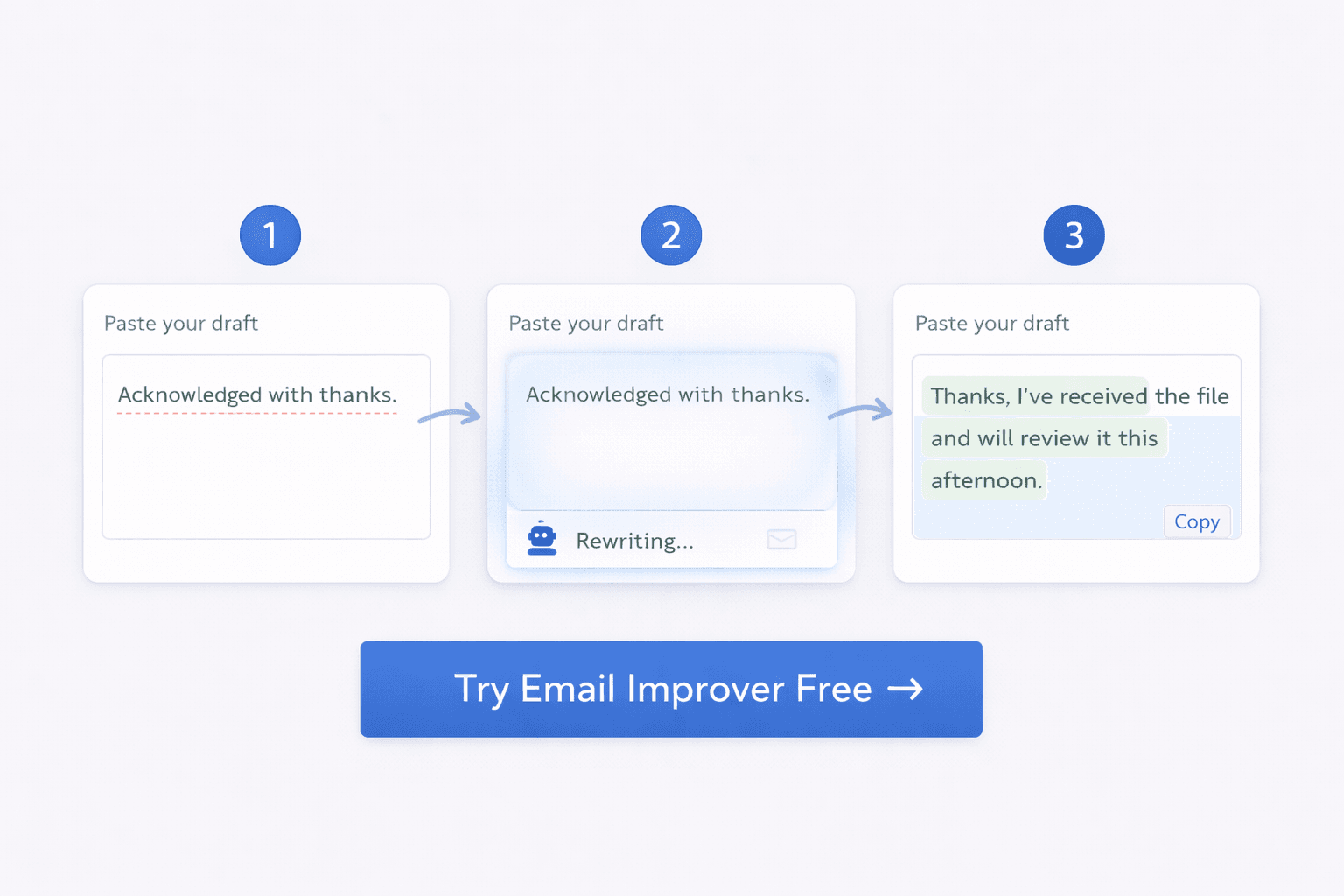
Original draft: "Acknowledged with thanks."
Improved version: "Thanks, I have received the file and will review it today."
You can generate replies like this automatically using AI Grammar Buddy's Email Improver.
| Too stiff | Better modern rewrite | Why it works |
|---|---|---|
| Acknowledged with thanks. | Thanks, I have received the file. | Same meaning, more natural English |
| Please acknowledge receipt of the below. | Please confirm you received the signed contract. | More specific and easier to process |
| This is to acknowledge receipt of your email. | Thanks for your email. I have received it. | Shorter and less legalistic |
| Noted with thanks. | Thanks for the update. I have received it and will review it today. | Adds warmth and next step |
| Kindly acknowledge receipt and do the needful. | Please confirm receipt and let me know if anything is missing. | Removes outdated wording and clarifies the ask |
| Please confirm receipt ASAP. | Please confirm receipt by 3 PM today if possible. | More polite and more useful |
Common Mistakes When Confirming Receipt
Most acknowledge-receipt emails go wrong in one of five ways.
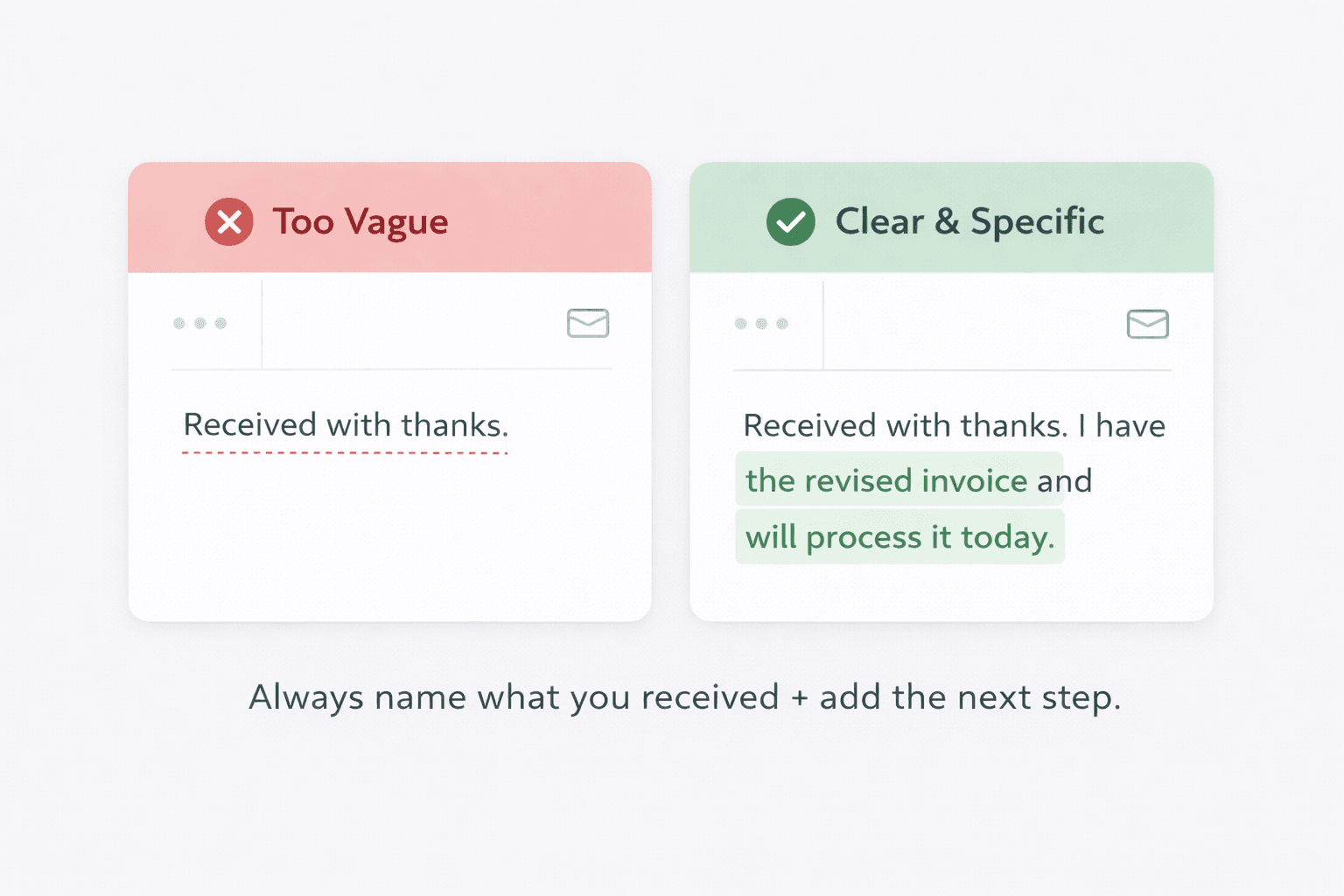
1. Confirming receipt without naming what you received
Bad:
Received with thanks.
Better:
Received with thanks. I have the revised invoice.
The second version removes doubt.
2. Using overly stiff language for routine email
Phrases like "acknowledged with thanks" or "this is to acknowledge receipt" are not wrong. They just sound heavier than most everyday office emails need.
3. Forgetting the next step
If the sender is anxious, the best acknowledgment is:
- confirmation,
- timeline,
- next action.
For example:
Thank you. I have received the complaint and will share an update by noon tomorrow.
4. Confusing receipt with agreement
If you write "Noted" or "Acknowledged," some people may think you agree, approve, or accept responsibility. If you only mean receipt, say so clearly.
5. Asking for receipt confirmation when it is not needed
Do not turn every email into a process step. If the attachment is low risk and the relationship is informal, "Let me know if anything is missing" may be enough.
Quick Takeaway: Clear Confirmation Beats Stiff Business Phrases
If you remember one rule from this article, remember this:
Clear confirmation beats stiff business phrases.
A strong acknowledge receipt email does not try to sound impressive. It does three simple things:
- confirms receipt,
- uses natural business English,
- adds the next step when needed.
That is why "Thanks, I have received the file and will review it today" usually works better than "Acknowledged with thanks."
If your audience is international, clarity matters even more. The safest choice is usually not the most formal phrase. It is the clearest one.
Need Help Rewriting a Stiff Acknowledge Receipt Email?
If your draft sounds too formal, too short, or too cold, paste it into AI Grammar Buddy's Email Improver.
It helps you turn lines like:
- "Acknowledged with thanks."
- "Please acknowledge receipt."
- "Received and noted."
into replies that sound clearer, more natural, and more professional.
Try AI Grammar Buddy's Email Improver if you want a faster way to polish an acknowledge receipt email before you send it.
Frequently Asked Questions
What does acknowledge receipt mean in email?▼
"Acknowledge receipt" means to confirm that you received an email, document, payment, file, or request. In business email, it does not mean you agree with the content or that the issue is resolved. It only confirms receipt.
Is "please acknowledge receipt" polite?▼
"Please acknowledge receipt" is polite enough, but it sounds formal. In many modern business emails, "Please confirm receipt" or "Please let me know once received" sounds more natural.
What is the please confirm receipt meaning?▼
It means "please tell me that this has reached you." The phrase is commonly used when the sender wants certainty that an important email, attachment, or payment information was received.
Can I say "acknowledged with thanks"?▼
Yes, but it can sound stiff or old-fashioned in everyday office email. A warmer version is "Thanks, I have received it" or "Received with thanks. I will review it today."
Do I need to acknowledge every email?▼
No. A receipt confirmation is most useful when there is business risk, a deadline, money, legal documentation, a job application, or a complaint involved. For routine low-stakes messages, no separate acknowledgment is often needed.
Next step
Turn this template into your email
Start with the example, then rewrite it for your real situation.
Keep going
Continue with AI Grammar Buddy
AI Grammar Buddy
Email Improver
Paste your draft and rewrite it for clearer, more professional English.
Rewrite My EmailRelated guide
50 Professional Email Templates for Work (With Examples)
Professional email templates for work with examples and quick rewrites from AI Grammar Buddy.
17 March 2026
Related guide
Essential Client & Vendor Email Templates: Apology Email to Customer, Quotations and More
Copy, personalize, and send practical apology email to customer templates, request for quotation email examples, payment reminders, complaint replies, and vendor follow-ups.
13 March 2026
Related guide
Interview Invitation Email: 18 HR Templates That Work in 2026
Interview invitation email, job rejection, meeting minutes & confirmation templates. 18 copy-paste HR samples for modern workplace communication.
12 March 2026