"Per My Last Email": Rude? 10 Better Alternatives
You open your inbox. You see "Per my last email..." and before you have read the next word, you have already decided how you feel about the person who sent it.
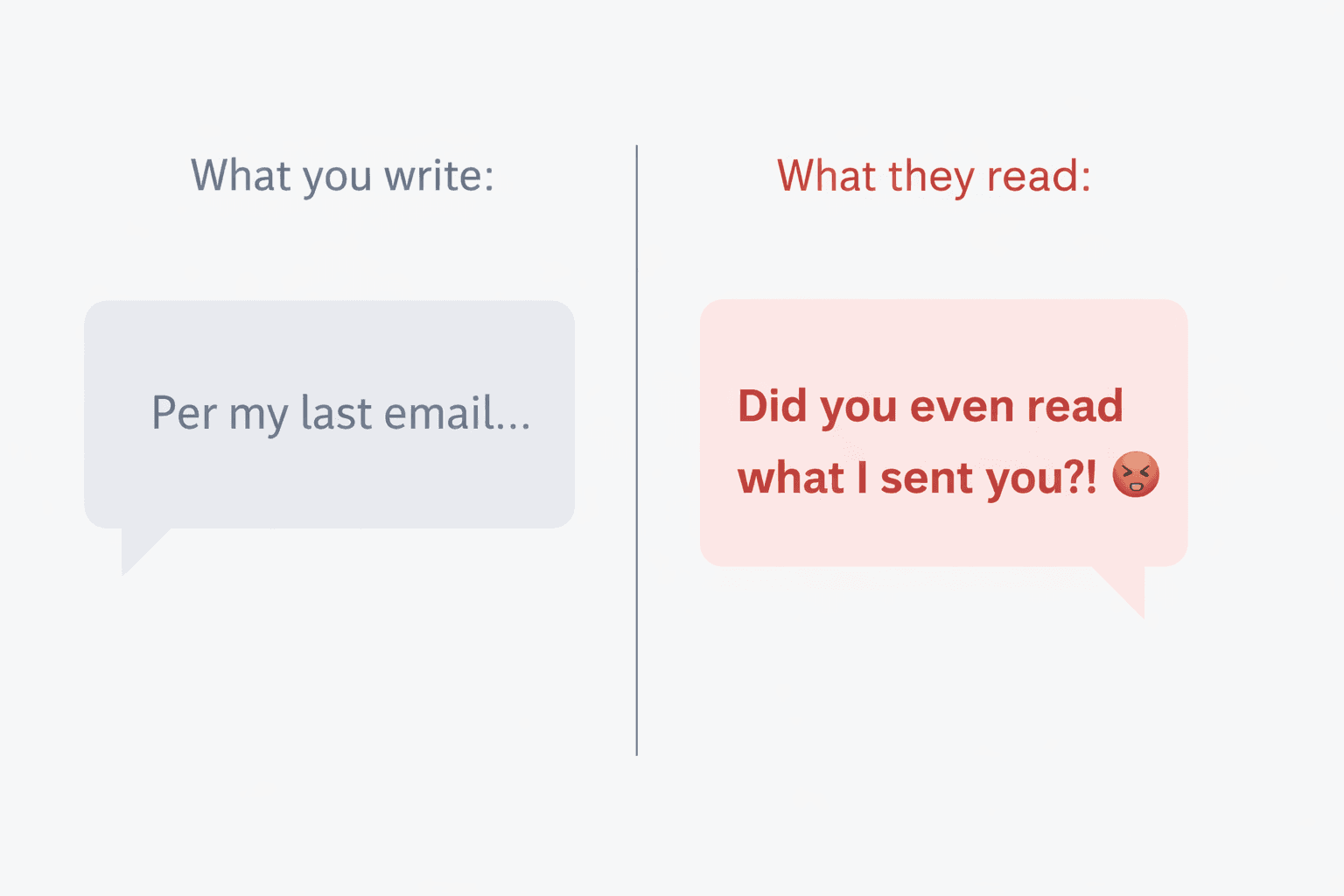
That is the real problem with this phrase. Most people use it to save time. What it actually does is put the other person on the defensive, which makes them slower to reply, not faster.
This guide explains what the phrase signals, when it is defensible, and which alternatives get better results without the friction.
TL;DR
"Per my last email" means "I already shared this before." It is not always rude, but it often sounds impatient or passive-aggressive. In most work emails, a warmer follow-up that repeats the key point is safer and gets better results.
Best fix: briefly restate the request instead of making the reader dig through the thread.
Quick swaps:
- •"Per my last email..." -> "Just following up on the note I sent Tuesday about the timeline."
- •"Per my last email..." -> "Sharing this again below in case it is helpful."
- •"Per my last email..." -> "Could you confirm the next step by Thursday?"
Jump to sections
Use these anchors to jump straight to the section you need.
Quick Answer
"Per my last email" means "I already shared this in a previous email, and I want you to refer to it now." It is not automatically rude, but it often sounds impatient or passive-aggressive. In most professional emails, a warmer follow-up that repeats the key point works better and gets faster replies.
If you want to check whether your follow-up sounds sharp before you send it, paste it into AI Grammar Buddy. It flags tone problems and rewrites stiff email phrasing in seconds.
Per My Last Email Meaning
The plain-English translation of per my last email is:
"As I mentioned in my previous email..."
People usually use it in one of three situations:
- They already answered a question.
- They already shared a file, link, or deadline.
- They are following up because the other person has not acted yet.
So the core per my last email meaning is not complicated. It points back to an earlier message and reminds the reader that the information is already there.
The problem is tone. The phrase does not just point backward. It also quietly says, "You missed this the first time."
That is why it often lands badly in workplace email. It may be efficient for the sender, but it creates friction for the reader.
This is the same pattern behind other office phrases that carry an unintended edge. If your team uses phrases like please revert or noted with thanks, those carry similar tone risks in professional email.
For a broader look at how indirect phrasing creates friction, our guide on kindly do the needful covers the same pattern in detail.
The wording is familiar. The tone is where the trouble starts.
Why People Use It
Most people do not use "per my last email" because they want to be rude.
They use it because they are trying to do one of these things quickly:
- Keep the thread moving
- Avoid repeating themselves
- Document that the information was already sent
- Nudge someone who missed the earlier message
All of those goals are reasonable.
But good email writing is not just about what you mean. It is also about what the other person hears. If your wording makes them feel corrected, blamed, or embarrassed, your message gets harder to answer.
That is why a short restatement usually performs better than a backwards reference.
Instead of making the reader search the thread, bring the key point forward again. That feels more helpful and less confrontational.
Is "Per My Last Email" Rude?
Not always. But very often, yes, it sounds rude.
That distinction matters.
The phrase itself is not offensive. The issue is the social meaning attached to it. In real inboxes, "per my last email" often signals frustration, impatience, or status pressure.
It can sound rude when:
- The other person is senior and you seem to be correcting them
- The thread is already tense
- You use it without restating the actual point
- The reader genuinely missed the email and did not ignore you on purpose
Compare these two versions:
Per my last email, the signed contract is still outstanding.
Just following up on the contract below. We still need the signed copy to proceed.
The second version does the same job. It just sounds more composed.
If your team works across cultures, this matters even more. A phrase that feels neutral to you may read as passive-aggressive to someone else.
A note on cross-cultural teams
If you work with colleagues in Singapore, India, the Philippines, or the Middle East, the phrase carries extra risk. In high-context communication cultures, calling out an oversight - even indirectly - can feel like a public correction. A warmer restatement is not just polite in these contexts. It is strategically smarter. You get a faster reply, and you protect the working relationship at the same time.
Why It Sounds Passive-Aggressive
"Per my last email" sounds passive-aggressive because it highlights a mistake without naming it directly.
Instead of saying:
You missed my earlier note.
you say:
Per my last email...
That indirectness is exactly what gives the phrase its edge.
The wording lets the sender sound technically polite while still signaling annoyance. In some cases, that is intentional. In many cases, it is not. Either way, the reader usually feels it.
If your real goal is simply to get a response, the phrase works against you. People reply faster when the message feels helpful, specific, and easy to process.
Better Alternatives
Here are better replacements for "per my last email" based on what you actually need.
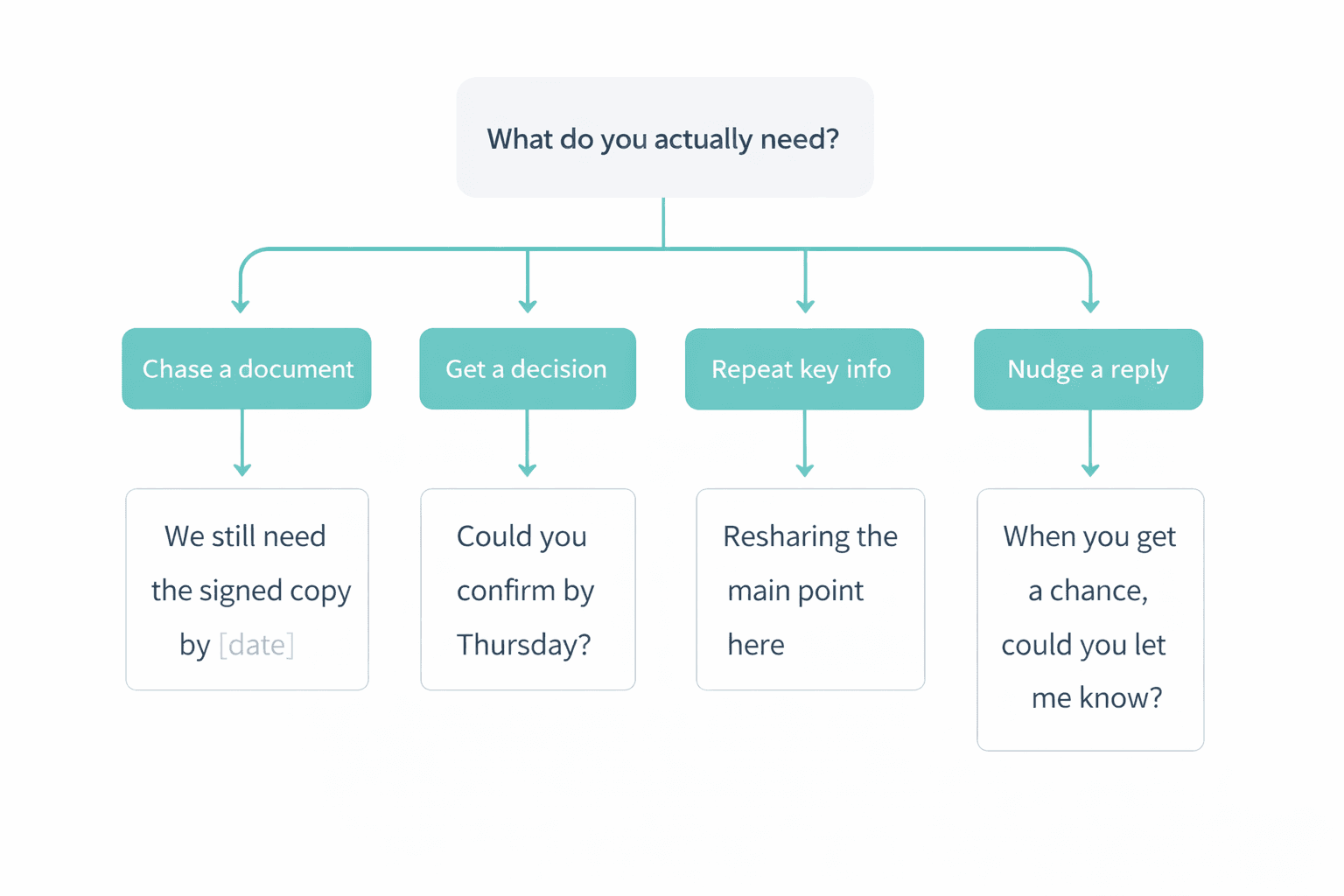
| If you mean... | Say this instead |
|---|---|
| I am following up | Just following up on the note below. |
| I need you to see the key detail again | Resharing the main point here for convenience. |
| I need a decision | Could you confirm whether we can proceed by Thursday? |
| I need a file or document | We still need the signed copy before we can move forward. |
| I need a reply | When you have a moment, could you let me know your view? |
| I want to be firm but professional | Following up again here, as the deadline is tomorrow at 3 PM. |
| I need a fast yes-or-no answer | Could you confirm yes or no by end of day? |
| I am resending an attachment | I am attaching the file again here for convenience. |
| I need approval from a manager or client | Please let me know if you are happy for me to proceed. |
| I need to nudge without sounding sharp | Checking in again here in case this got buried in your inbox. |
The best alternative is usually the one that:
- names the action
- repeats the missing detail
- gives a timeline if needed
That is more effective than sending the reader on a scavenger hunt through the thread.
If you catch yourself using stock phrases often, AI Grammar Buddy can clean them up fast. Paste the email in, and it will rewrite sharp follow-ups into clear, natural business English. Try AI Grammar Buddy here.
Before vs After Email Examples
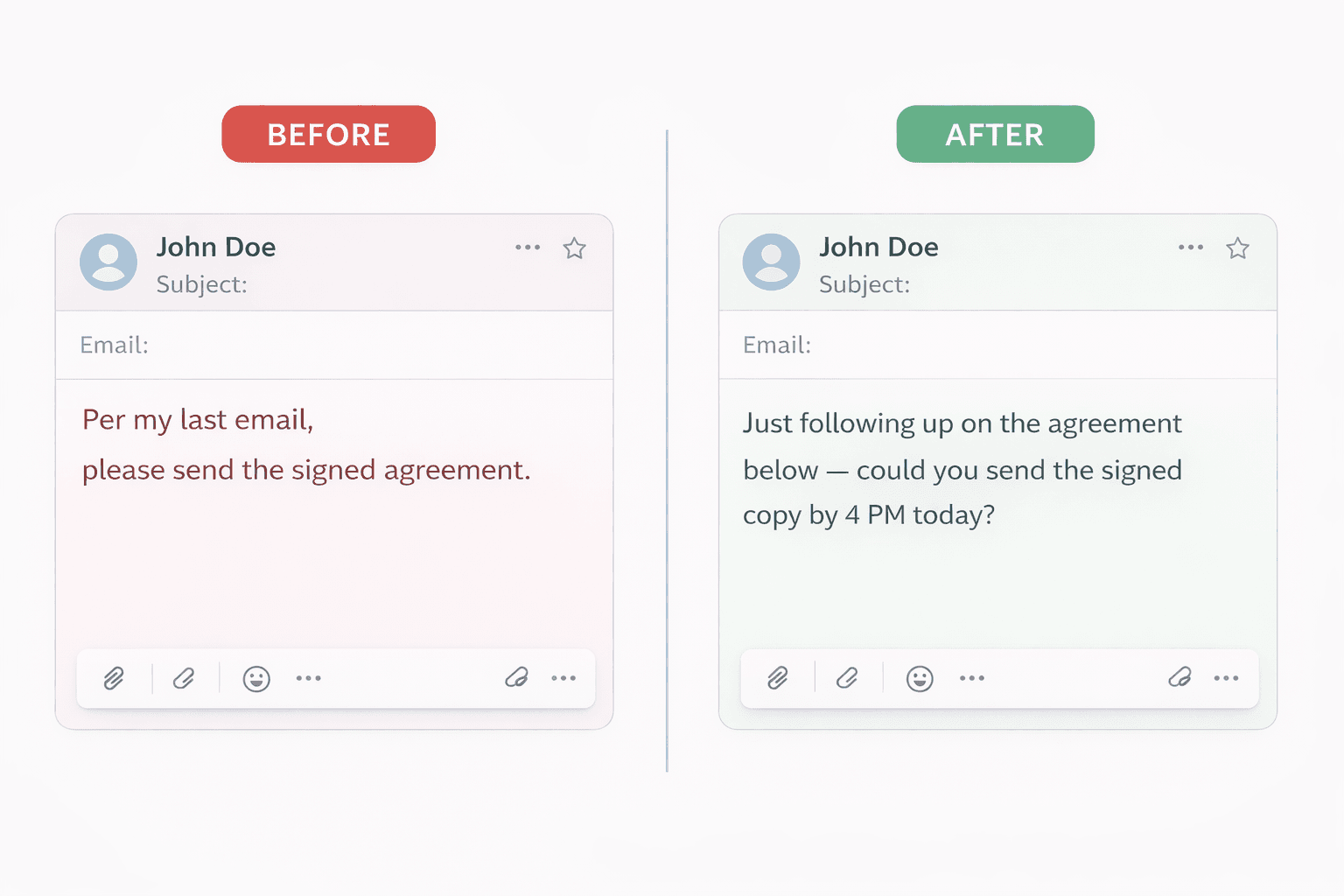
Here is where the phrase usually breaks down.
Example 1: Chasing a document
Before
Per my last email, please send the signed agreement.
After
Just following up on the agreement below. Could you send the signed copy by 4 PM today so we can start onboarding?
Why the rewrite works: it keeps the pressure, but it adds context and a next step.
Example 2: Reminding someone about a deadline
Before
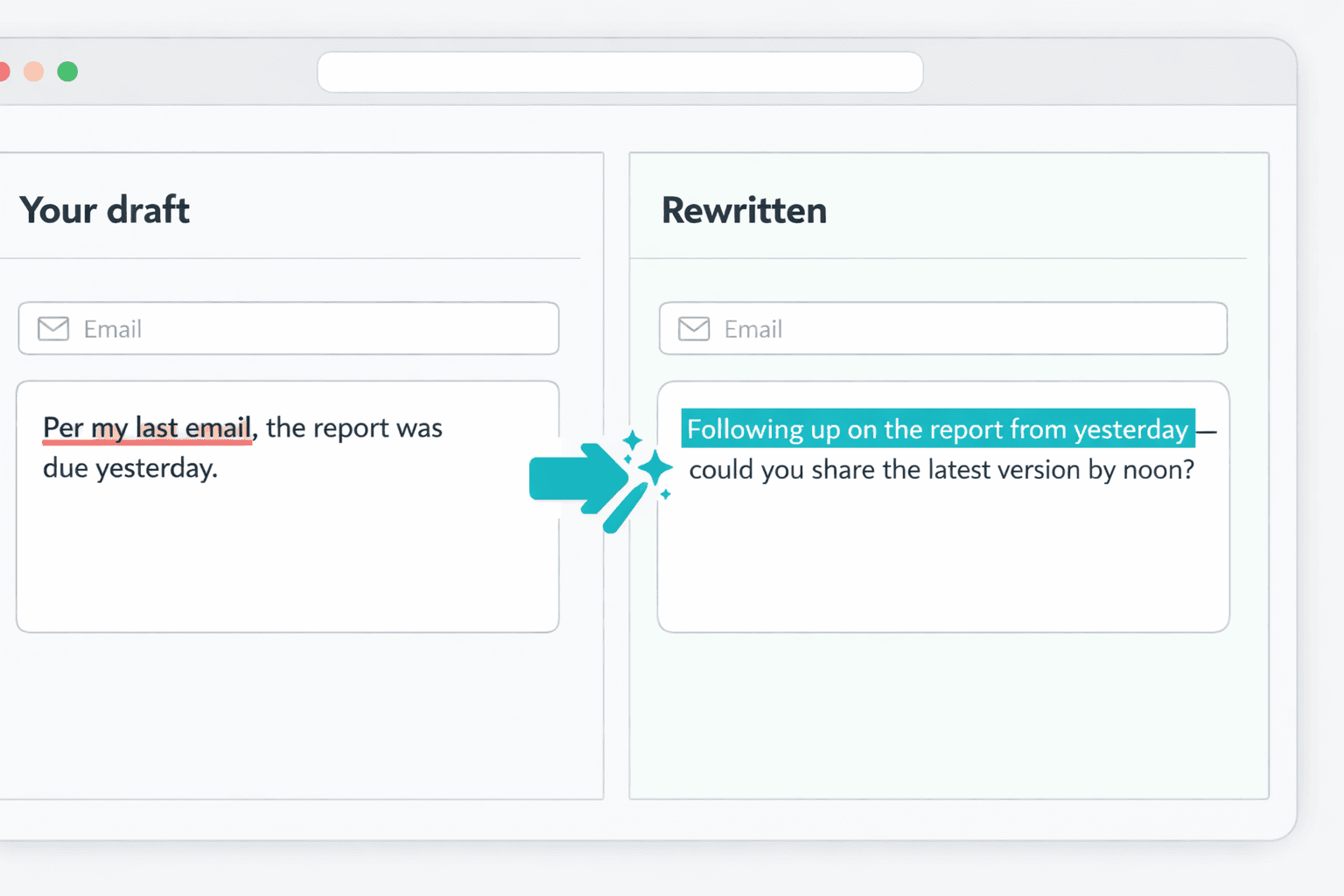
Per my last email, the report was due yesterday.
After
Following up on the report deadline from yesterday. Can you share the latest version by noon, or let me know if you need more time?
Why the rewrite works: it sounds solution-focused instead of accusatory.
Example 3: Answering a repeated question
Before
Per my last email, the meeting is at 2 PM.
After
The meeting is still set for 2 PM today. I am resharing the calendar link below for convenience.
Why the rewrite works: it answers the question directly and removes embarrassment.
Example 4: Following up with a client
Before
Per my last email, please confirm whether you approve the proposal.
After
Just checking in on the proposal below. Please let me know if you would like to approve it as is, or if you would like any changes before Friday.
Why the rewrite works: it sounds collaborative, not corrective.
A Simple Rewrite Formula
When you are tempted to type "per my last email," use this instead:
Follow-up opener + repeated key detail + clear next step
For example:
Just following up on the invoice below. We still need confirmation today so finance can release payment tomorrow.
If the situation involves a completely unanswered email rather than a missed detail, the approach is slightly different - see our guide on how to write a follow-up email after no response.
That formula works because it removes guesswork.
The reader does not need to search old emails.
They do not need to infer what you want.
And they do not feel like they are being scolded.
Should You Ever Use It?
Sometimes, yes.
If you are in a long thread, have already repeated yourself clearly, and need to document that the information was previously shared, the phrase can be defensible.
Even then, it is usually stronger to soften it:
As noted in my previous email on Tuesday, the rollout is scheduled for 14 April.
That version sounds more neutral than "per my last email," especially when paired with the actual detail.
In most day-to-day work email, though, there is no real upside to the sharper version. You do not win clarity. You only add emotional friction.
Final Take
The real per my last email meaning is simple: "I already sent this information before."
What makes the phrase risky is not definition. It is tone.
If your goal is to get a reply, protect the relationship, and sound professional, skip the phrase and restate the key point instead.
That one change makes your emails easier to answer and harder to misread.
Turn "per my last email" into a better follow-up
Paste your draft into AI Grammar Buddy and rewrite passive-aggressive follow-ups into clear, professional English before you send.
Per my last email, we still need approval on the quote.
Thanks.
Free to try. No credit card required.
About This Article
Kin
Frequently Asked Questions
What does "per my last email" mean?▼
"Per my last email" means "according to the email I sent earlier" or "as I already mentioned in my previous message." People usually use it to remind someone that the information, request, or deadline was already shared.
Is "per my last email" rude?▼
Not automatically. The phrase is grammatically fine, but it often sounds annoyed, impatient, or passive-aggressive because it highlights that the other person missed your earlier message.
Why does "per my last email" sound passive-aggressive?▼
It can sound passive-aggressive because it points out the other person’s oversight without saying so directly. Even if that is not your intention, the phrasing can feel sharp, especially in tense or high-stakes email threads.
What can I say instead of "per my last email"?▼
Use warmer and clearer follow-ups such as "Just following up on my note below," "Resharing the key detail here," or "Could you confirm whether we can proceed by Friday?" These versions move the conversation forward instead of sounding corrective.
Is "as per my last email" the same as "per my last email"?▼
"As per my last email" and "per my last email" are used interchangeably in professional email. Both reference a previous message, and both carry the same risk of sounding impatient or passive-aggressive to the reader.
Is it ever OK to use "per my last email" with your manager?▼
Generally, no. Using the phrase upward carries extra social risk. A safer option is to restate the key point directly: "Just following up on the note from Tuesday - the deadline is this Friday."
What does "per my last email" mean in text slang or memes?▼
Online, "per my last email" has become shorthand for politely-worded frustration. It is widely recognised as office passive-aggression and frequently appears in workplace memes to mean: "I already told you this - please pay attention."
Keep going
Continue with AI Grammar Buddy
AI Grammar Buddy
Email Improver
Paste your draft and rewrite it for clearer, more professional English.
Rewrite This PhraseRelated guide
What Does Inherent Mean? Meaning, Examples and Business English Uses
What does inherent mean? Learn the meaning, inherent in vs to, and practical sentence examples for reports, emails and everyday English.
28 September 2026
Related guide
What Does Coherent Mean? Meaning, Examples and Business English Uses
Learn what coherent means, see natural sentence examples, compare coherent vs clear, and improve the flow of your emails and reports.
27 September 2026
Related guide
What Does Persist Mean? Meaning, Grammar and Examples
Persist means to continue despite difficulty or to keep existing. Learn how to use persist in, persist with, and persist correctly with workplace examples.
23 August 2026