Cascade Meaning in Business: Definition, Examples, and How to Use It in Emails
Learn what cascade means in business, how it is used in goals and communication, and why a small change can create a cascade effect.

A manager says, "Please cascade this to the team." A strategy slide says, "We need cascading goals." A project update warns that one supplier delay may "cascade through the quarter."
All three use the same word, but not in exactly the same way. If you use "cascade" wrong in an email or a strategy document, it makes your writing sound vague or overly corporate. This guide breaks down all three business meanings, shows real examples, and gives you a simple test: if you cannot name what is moving, where it is going, and when it arrives, your sentence is not specific enough.
TL;DR
In business, cascade usually means passing goals, information, or decisions through different levels of a company, or describing a chain reaction where one change creates several downstream effects.
Top alternatives:
- •Cascade goals = break a big company goal into smaller team goals.
- •Cascade communication = pass an update through management levels.
- •Cascade effect = one business problem creates follow-on problems.
Jump to sections
Use these anchors to jump straight to the section you need.
Quick Answer
Cascade meaning in business: to pass goals, information, or decisions through levels of an organization, or to describe a chain reaction where one business change leads to several downstream effects.
In practice, cascade usually appears in three business contexts:
- cascading goals
- cascading communication
- cascade effects
If you are not sure whether your sentence sounds clear or too corporate, paste it into AI Grammar Buddy's Email Improver. It can rewrite vague management wording into plain professional English.
Cascade Meaning in Business: What It Actually Means
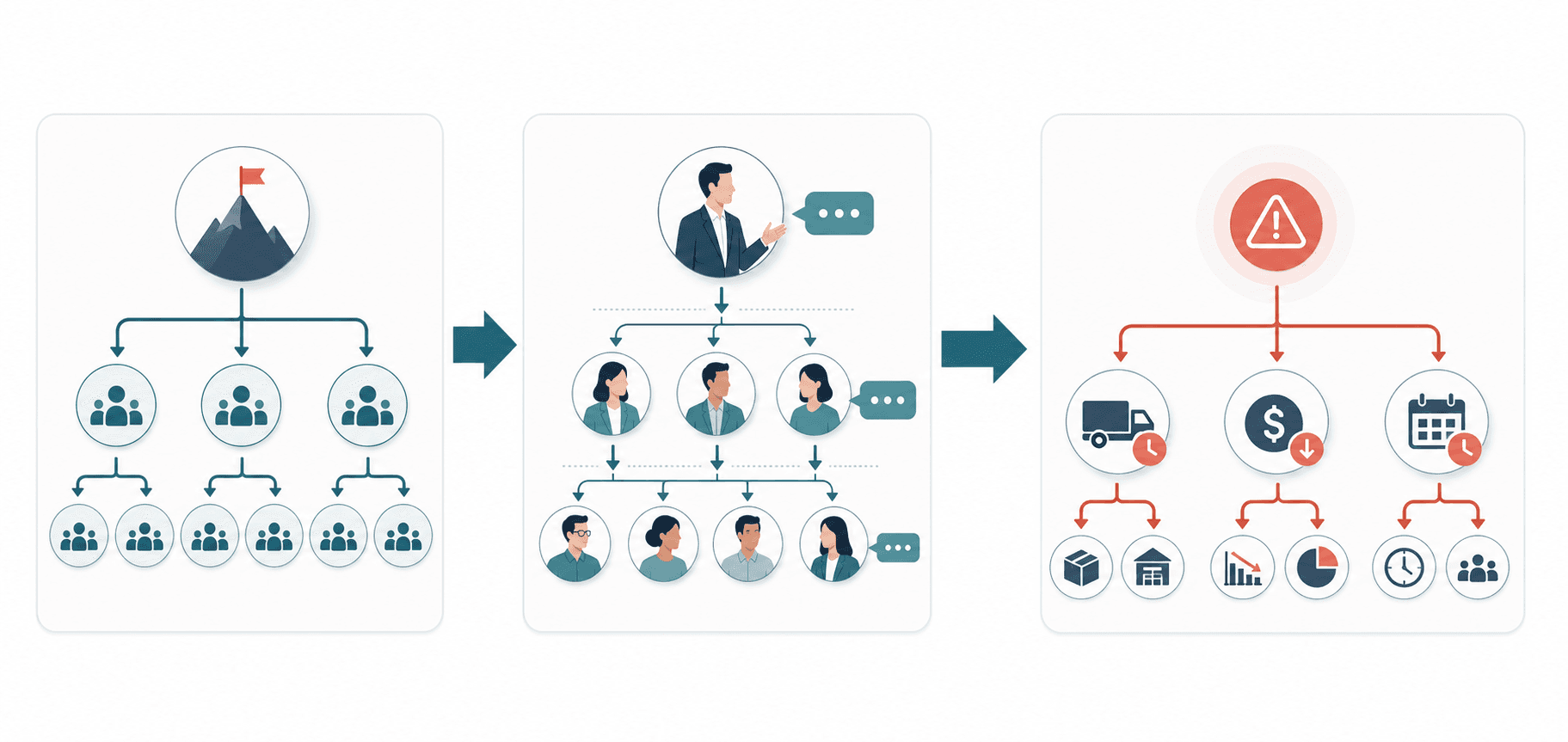
In business English, cascade is usually a verb. It often means that something starts at one level and then moves through other levels in a structured way.
For example:
- leadership goals cascade into department goals
- a policy update cascades from managers to staff
- a shipping delay cascades into budget, schedule, and staffing problems
The core idea is simple:
one input creates multiple aligned outputs, or one change creates multiple follow-on consequences
That is why the word often sounds more precise than share, but only if you tell the reader what is moving and where it is going.
| Business use | What it means | Weak sentence | Clearer sentence |
|---|---|---|---|
| Cascading goals | Break a high-level goal into team or individual goals | "We need to cascade this goal." | "We need to turn the company retention goal into targets for Customer Success, Sales, and Product." |
| Cascading communication | Pass an update through management or team levels | "Please cascade." | "Please share the policy update with all team leads by Friday." |
| Cascade effect | Show downstream consequences from one change | "The delay may cascade." | "The delay may affect shipping dates, support volume, and the Q3 revenue forecast." |
1. Cascading goals
This is the most common strategy use.
A company may set one annual goal such as improving renewal revenue. That goal then cascades into:
- a customer success retention target
- a sales upsell target
- a product adoption target
- individual manager KPIs
In this context, cascade means breaking one high-level objective into smaller goals that different teams can act on.
Example:
- "Leadership cascaded the 2027 growth goal to each department."
That goal-management meaning is also how many HR and performance-management sources use the term. AIHR's guide to cascading goals and a Rutgers performance-management glossary both frame cascading goals as translating higher-level objectives into lower-level work. The language lesson is this: when you use cascade in a work email, do not stop at the high-level idea. Name the level, owner, and result.
2. Cascading communication
This is the management communication use.
Suppose HR announces a new leave policy. Senior leaders brief department heads, department heads brief team leads, and team leads explain it to staff.
That is a communication cascade.
Example:
- "Please cascade the revised leave policy to your teams after the all-hands meeting."
This usage is common in larger organizations where not every message comes directly from the top to every employee. If you have ever wondered whether as discussed sounds rude in these updates, that is a related phrasing question: the words may be understood, but the tone depends on context and specificity.
3. Cascade effect in business
This is the operations or finance use.
Here, the word means a ripple effect or chain reaction.
Example:
- "The late shipment may cascade into stock shortages, delivery delays, and higher support volume."
This is close to how teams use words like downstream, spillover, or knock-on effect.
Examples
The easiest way to understand cascade meaning in business is to look at real work situations.
Example 1: Goals cascade from strategy to team work
A CEO announces a company target to improve operating margin by 4%. Finance, procurement, and operations then receive smaller goals tied to cost control, pricing discipline, and supplier efficiency.
That is a classic cascading-goals structure. The top-line strategy becomes concrete work for each function.
Example 2: Communication cascades after a leadership decision
An executive team decides to change the hybrid-work policy. Instead of emailing all staff immediately, they brief directors first. Directors then brief managers, and managers answer team-level questions.
That is a communication cascade. The goal is consistency, not speed alone.
Example 3: One disruption creates a cascade effect
A raw-material shortage delays production by one week. That one issue then affects:
- customer delivery dates
- warehouse scheduling
- overtime planning
- month-end revenue timing
That is a cascade effect. One event creates several business consequences.

Example 4: Better wording in business writing
These two lines do not sound equally clear:
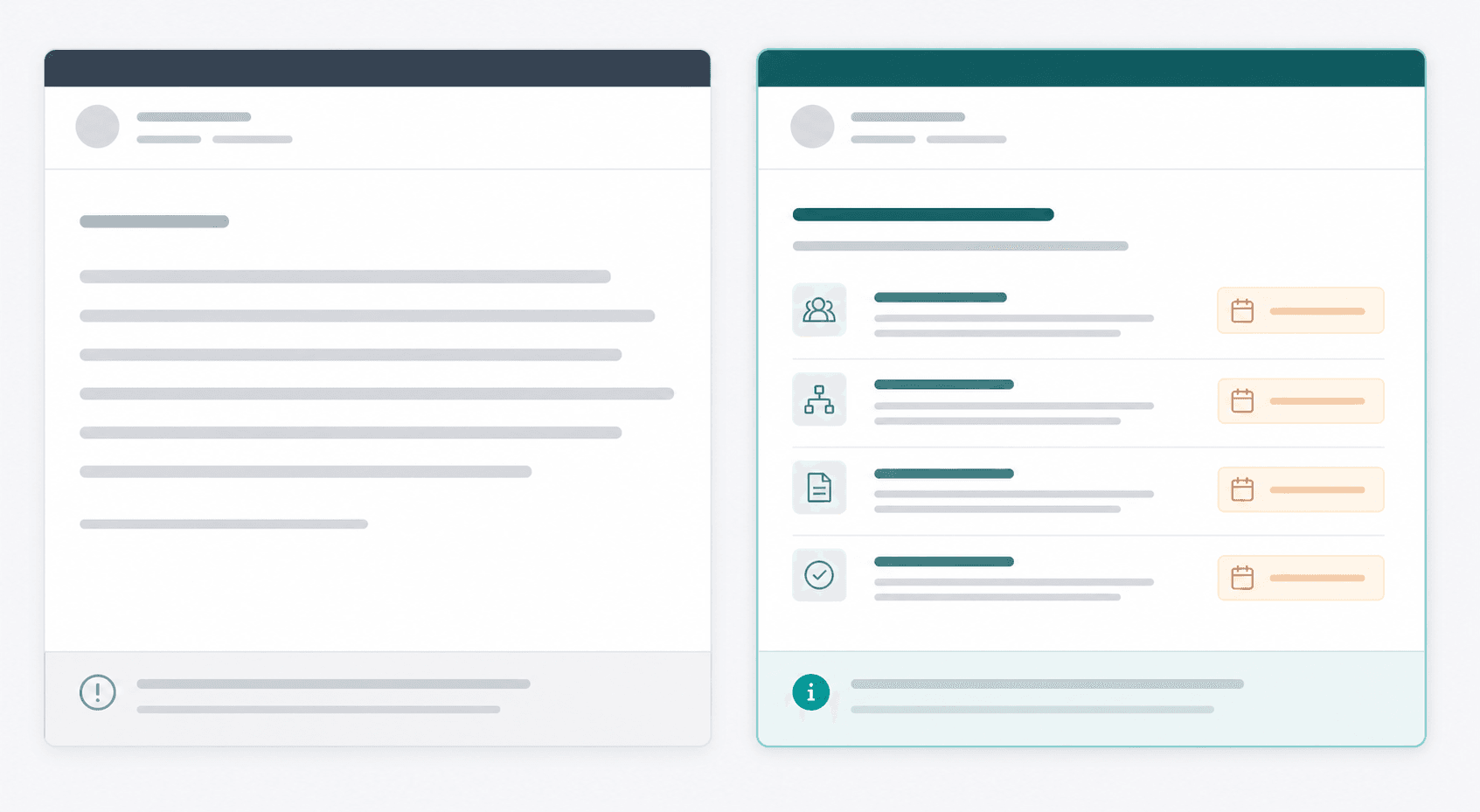
Weak: "Please cascade this." Better: "Please cascade the revised onboarding checklist to all team leads and confirm completion by Friday."
The second version is stronger because it answers four business questions:
- what should be cascaded
- who should receive it
- what action should happen
- when it is due
You do not have to rewrite every sentence by hand. AI Grammar Buddy can turn a vague update like "Please cascade this" into a complete, actionable instruction automatically.
If your internal updates often sound vague, review our business email grammar guide or clear writing gets you promoted for examples of stronger workplace phrasing.
Common Mistakes
1. Using cascade without naming the action
This is the most common mistake.
- Vague: "Please cascade."
- Better: "Please cascade the client FAQ update to the regional support leads."
Want to check if your cascade sentence is specific enough? Paste it into AI Grammar Buddy's Email Improver and get a clearer rewrite in seconds.
2. Assuming cascade only means goals
Many people first hear the term in cascading goals, but the word is broader than that. It can describe communication flow or operational ripple effects too.
3. Using it as empty management jargon
Sometimes teams use cascade because it sounds formal, not because it adds meaning.
For example:
- Weak: "We will cascade the framework across the organization."
- Better: "We will share the framework with each team lead and review ownership on Thursday."
If a simpler verb is clearer, use the simpler verb.
| Verb | Best use | Tone | Example |
|---|---|---|---|
Cascade | Passing goals or updates through layers | Formal, management-focused | "Please cascade the revised policy to your team leads." |
Share | Sending information directly | Plain and neutral | "Please share the revised policy with your team." |
Roll out | Launching a process, tool, or change | Operational | "We will roll out the new approval process next Monday." |
Pass on | Informal transfer of information | Casual | "Could you pass this update on to the support team?" |
Break down | Turning a big goal into smaller work | Clear and practical | "Please break this goal down into team-level targets." |
If a simpler verb is clearer, use the simpler verb. Our business email grammar guide covers more cases where formal language helps and where it only slows the reader down.
4. Confusing cascade with urgency
A message can be cascaded slowly or quickly. The word does not automatically mean immediate action. If timing matters, say so directly.
5. Forgetting the downstream consequence
When people write about a cascade effect, they often mention the first issue but not the later effects. That weakens the update.
Compare:
- "The vendor issue may cascade."
- "The vendor issue may cascade into a later shipment date, higher freight cost, and a revised launch plan."
Cascade in Emails: Quick Reference
This is the section most HR-focused articles miss. In email, cascade is not only a strategy word. It is a wording choice that can make you sound either precise or vague.
Use this quick test before you send:
Can the reader identify what is moving, who receives it, and what happens next?
If the answer is no, rewrite the sentence.
| Email situation | Weak wording | Better wording |
|---|---|---|
| Passing a policy update | "Please cascade this." | "Please share the revised leave policy with all team leads by Friday." |
| Asking managers to brief teams | "Cascade to everyone." | "Please brief your direct reports on the new escalation process before Monday's stand-up." |
| Turning strategy into team work | "Cascade the goal." | "Please convert the Q3 renewal goal into team-level targets and owners." |
| Warning about downstream effects | "This could cascade." | "This delay could affect shipping dates, support coverage, and the launch timeline." |
A simple sentence formula
Use this structure when cascade is the right word:
Please cascade [specific update or goal] to [specific audience] by [deadline], so [next action or reason].
Examples:
- "Please cascade the revised security checklist to all regional managers by Thursday, so they can brief their teams before rollout."
- "Please cascade the updated Q4 hiring target to department heads, so each team can revise its workforce plan."
- "Please cascade the client escalation process to support leads today, so weekend coverage follows the new workflow."
If this sentence feels too heavy, replace cascade with a simpler verb. Most emails are stronger with share, brief, assign, or break down.
How AI Grammar Buddy Can Help
AI Grammar Buddy is useful when you know what you want to say, but your sentence still sounds vague, stiff, or too internal.
It can help you:
- rewrite management updates in clearer English
- replace broad corporate shorthand with concrete action language
- explain downstream business effects more precisely
- improve tone in emails, policy notes, and team announcements
For example, you can turn:
- "Please cascade and advise."
into:
- "Please share the revised process with your team and let me know if any department needs clarification by Friday."
If you often write team updates, policy rollouts, or process changes, AI Grammar Buddy's Email Improver helps you sound clear without sounding robotic.
You may also find these related guides useful:
If the team is being asked to reduce waste or protect a limited supply, compare that action with conserve resources in a workplace sentence.
FAQ
What does cascade mean in business?
In business, cascade usually means passing goals, information, or decisions through levels of a company, or causing a chain reaction of downstream effects.
What are cascading goals?
Cascading goals are company goals broken down into department, team, and individual goals so each level supports the same strategy.
What does it mean to cascade information?
It means to pass a message through layers of management or teams so the organization receives the same update in stages.
Is cascade always top-down?
Usually yes for goals and communication. But in operations and finance, it can also describe ripple effects that move across functions rather than straight down a hierarchy.
Is cascade a good word to use in emails?
It can be, but only when you are specific. Instead of writing only "please cascade," name the message, the audience, and the expected timing.
What is a simpler alternative to cascade?
Depending on the sentence, better alternatives may be share, pass on, break down, roll out, or cause follow-on effects. If you are not sure which alternative fits your sentence best, AI Grammar Buddy's Email Improver can suggest the right verb based on your full email context.
Final Takeaway
Cascade meaning in business usually comes down to one practical idea: something moves through levels of a company, or one change creates several connected effects.
The word is useful when it makes structure clearer. It becomes weak when it stands in for missing detail. If you use it, make sure the reader can tell what is moving, who is responsible, and what happens next. Our email clarity checklist gives you a fast way to test every sentence before you send it.
About This Article
Kin
Senior Business English Editor
Kin reviews workplace email drafts, management updates, and planning-deck wording for AI Grammar Buddy. She focuses on helping non-native professionals replace vague corporate shorthand with clear action language.
Last updated 8 July 2026
Frequently Asked Questions
What does cascade mean in business?▼
In business, cascade usually means passing goals, information, or decisions through levels of an organization, or causing a chain reaction of downstream effects.
What are cascading goals?▼
Cascading goals are company goals that are translated into department, team, and individual goals so work stays aligned.
What does it mean to cascade information?▼
It means sharing a message step by step through different management or team levels so the full organization receives the same update.
Is cascade always a top-down word?▼
Usually yes when it refers to communication or goals, but in operations and finance it can also describe ripple effects across the business.
Is cascade good business English?▼
It can be, but only when the sentence is specific. If the meaning is unclear, a simpler verb such as share, assign, or cause may be better.
What is a simpler alternative to cascade?▼
Depending on the sentence, better alternatives may include share, pass on, break down, roll out, or cause follow-on effects. If you are not sure which alternative fits your sentence best, AI Grammar Buddy's Email Improver can suggest the right verb based on your full email context.
Keep going
Continue with AI Grammar Buddy
AI Grammar Buddy
Email Improver
Paste your draft and rewrite it for clearer, more professional English.
Rewrite This PhraseRelated guide
Alleviate Meaning: Grammar, Synonyms and Examples
What does alleviate mean? Learn its pronunciation, grammar, synonyms and common mistakes, with clear sentence examples for everyday and workplace writing.
1 October 2026
Related guide
What Does Inherent Mean? Meaning, Examples and Business English Uses
What does inherent mean? Learn the meaning, inherent in vs to, and practical sentence examples for reports, emails and everyday English.
28 September 2026
Related guide
What Does Coherent Mean? Meaning, Examples and Business English Uses
Learn what coherent means, see natural sentence examples, compare coherent vs clear, and improve the flow of your emails and reports.
27 September 2026