Well Noted Meaning in Email: Is It Correct or Rude?
"Well noted" in email can sound stiff or cold. Learn what it means, when to avoid it, and 12 natural alternatives with real examples.

You sent "Well noted." The other person has not replied since. Was it rude? Not exactly. But in US, UK, and Australian workplace emails, it often reads as cold, clipped, or slightly translated.
In many Singapore, Hong Kong, and Asian workplace emails, "well noted" is a common acknowledgement. It usually means: I have read this, understood it, and will keep it in mind. But in US, UK, or Australian-facing email, it can sound stiff, old-fashioned, or too brief.
In reviewing acknowledgement rewrites inside AI Grammar Buddy, we keep seeing the same pattern: writers choose "well noted" to sound respectful, but readers often hear distance instead of professionalism.
This guide explains what "well noted" means in email, whether it is correct, when it may sound rude, and what to write instead when you want a warmer, more natural reply. It focuses on well noted in email, not the broader "noted with thanks" topic.
TL;DR
"Well noted" usually means "I have understood or recorded this." It is understandable, but it can sound stiff, translated, or too brief in modern professional email.
Safer default: "Noted, thank you" for a short reply, or "Thanks, I have noted this and will follow up accordingly" when action is expected. Add a next step for clients, managers, and sensitive topics.
Quick picks:
- •"Noted, thank you." - short and neutral
- •"Thanks, I have noted this." - warmer and clearer
- •"Understood, thank you. I will follow up by Friday." - best when action is needed
AI Grammar Buddy
Rewrite this phrase in context
Paste your sentence and AI Grammar Buddy will turn it into clearer professional English.
Jump to sections
Use these anchors to jump straight to the section you need.
Quick Answer
"Well noted" means "I have understood or recorded this." It is not usually rude, but it can sound stiff or translated in modern professional email. If you want a safer default, write "Noted, thank you", "Thanks, I have noted this", or "Understood, thank you. I will follow up accordingly."
If your sentence sounds too formal or direct, paste it into AI Grammar Buddy's Email Improver and ask for a natural professional rewrite.
Use this quick rule:
| Situation | Best reply |
|---|---|
| Simple internal update | Noted, thank you. |
| Boss gives instructions | Understood, thank you. I will proceed accordingly. |
| Client gives feedback | Thank you for the feedback. I will review this and send an update by tomorrow. |
| Sender needs receipt confirmation | Received, thank you. I will review the file today. |
Well Noted Meaning in Email: What It Actually Signals
In email, "well noted" usually means:
- I have read your message.
- I understand the information.
- I have recorded it or will keep it in mind.
- I may act on it if action is expected.
For example:
Manager: Please update the client tracker before 5 PM.
Reply: Well noted.
The intended meaning is: I understand and will take care of it.
The word "well" tries to make the acknowledgement sound complete or careful. But in modern email, it does not add much useful meaning. That is why "well noted" can feel like a direct translation from local office English rather than a natural reply.
That said, "well noted" is a compressed reply. It does not say what you will do next, when you will do it, or whether you agree. That is why it can feel incomplete when the original email involves a client request, a deadline, feedback, or a sensitive issue.
For receipt-focused messages, read our guide on how to acknowledge receipt of an email professionally. "Well noted" is about understanding. Receipt confirmation is about confirming that something arrived.
Is "Well Noted" Correct English?
"Well noted" is understandable English, but it is not always the most natural phrase.
The word "noted" already means the information has been noticed, recorded, or acknowledged. Adding "well" is common in some business-English environments, but it can sound slightly unnatural to native English readers because people do not usually say "well noted" in everyday speech.
These sound more natural in most professional emails:
Noted, thank you.Thanks, I have noted this.Understood, thank you.Thanks for the update.
Use "well noted" carefully if your reader expects global business English. It is not a grammar error in the way a misspelled word is an error, but it may not be the strongest tone choice.
The safer pattern is:
Acknowledge + thank + action if needed.
Examples:
Noted, thank you.Thanks, I have noted this.Understood, thank you. I will update the file today.
If you want a quick grammar and wording check before sending, try the AI Grammar Buddy Grammar Checker.
Is "Well Noted" Rude?
"Well noted" is not automatically rude. In many Asian offices, it sounds efficient and respectful. The risk is that it may sound cold when the other person expects more engagement.
It can feel too abrupt when:
- a client gave detailed feedback,
- your manager assigned an important task,
- someone shared bad news,
- you need to confirm a deadline,
- or the sender expects reassurance.
Compare these two replies:
| Original message | Risky reply | Better reply |
|---|---|---|
| Please revise the deck and send it by 3 PM. | Well noted. | Understood, thank you. I will send the revised deck by 3 PM. |
| We are concerned about the delay. | Well noted. | Thank you for flagging this. I will check with the team and update you by noon. |
The better replies do not just acknowledge the email. They show ownership.
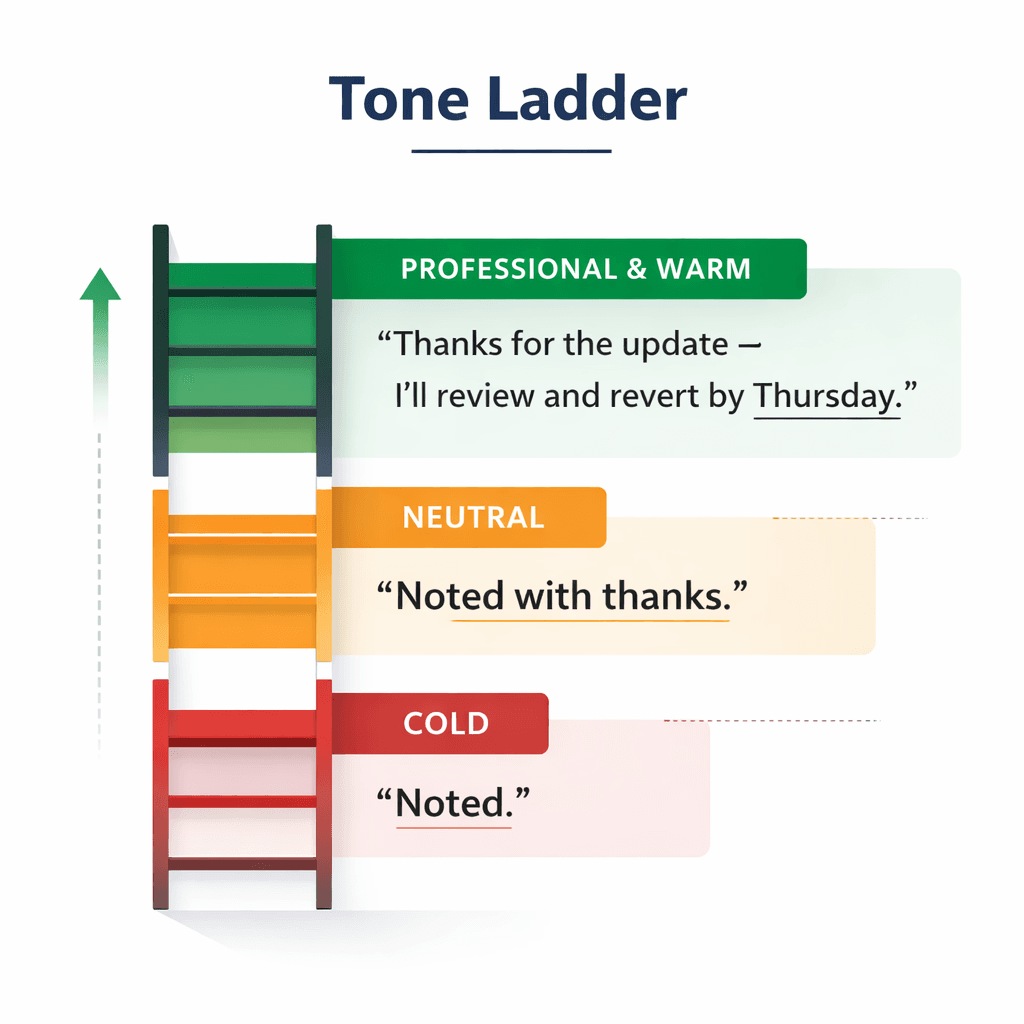
Workers spend a large share of the week writing, not just talking. Grammarly's 2024 State of Business Communication report says workers spend 19 hours a week on writing tasks, which is why a short phrase that sounds cold can create more friction than people expect (source).
If you are not sure whether your reply sounds too brief, too formal, or too vague, paste the whole message into AI Grammar Buddy. It rewrites the tone based on who you are replying to, not just the phrase in isolation.
When "well noted" is acceptable
Use it only when all three are true:
- the thread is internal,
- the message is routine,
- and no one needs a deadline, decision, or reassurance from you.
Example:
Well noted, thank you. I will update the tracker.
Even here, "Noted, thank you" is cleaner.
When to avoid "well noted"
Avoid it when the sender expects care or accountability:
| Avoid "well noted" when... | Use this instead |
|---|---|
| A client gave detailed feedback | Thank you for the feedback. I will review and send the revised version by Thursday. |
| Your boss assigned a task | Understood, thank you. I will proceed and update you by EOD. |
| Someone raised a problem | Thanks for flagging this. I will check and come back with an update. |
| A document was sent for review | Received, thank you. I will review the document today. |
Well Noted vs Noted
"Noted" is shorter and more neutral. It means "I have seen this" or "I understand." In a fast internal chat, it can be fine.
"Well noted" feels slightly more formal. It tries to sound more complete than "noted," but it may also sound dated.
Use:
Noted, thank you.for a short professional reply.Understood, thank you.when you want to show comprehension.Thanks, I have noted this and will follow up.when action is expected.
If someone replies to you with only "noted," our guide on how to reply to "noted" professionally explains when to respond and when to leave the thread closed.
The main difference is tone. "Noted" can sound blunt because it is very short. "Well noted" can sound more formal, but not necessarily more natural. In most professional emails, "Noted, thank you" beats both because it keeps the reply short while adding warmth.
For the broader word-level intent, see our primary guide to noted meaning in email and chat.
Well Noted vs Noted With Thanks
"Noted with thanks" means "I acknowledge this and thank you for it." It is common in Singapore, Hong Kong, India, Malaysia, and other Asian workplace settings.
"Well noted" sounds less warm because it does not include thanks. It confirms understanding, but it does not show appreciation.
If you are deciding between them:
- Use
Noted, thank you.for the safest short version. - Use
Thanks for the update.when someone shared information. - Use
Understood, I will proceed accordingly.when you need to act.
For the broader meaning question, see our guide to what "noted with thanks" means. If you are choosing a reply for a Singapore colleague, manager, or client, use the Singapore office tone guide for the context test.
This distinction matters for SEO and for real email writing: "well noted" is mainly about whether the message was understood, while "noted with thanks" is about acknowledgement plus gratitude. They overlap, but they are not the same phrase.
Well Noted vs Well Received
"Well noted" and "well received" are not the same.
"Well noted" means the message was understood or recorded.
"Well received" usually means something was accepted positively:
The proposal was well received by the client.The announcement was well received by the team.
So if someone sends you a file, "well received" is often not the best reply. It can sound like you are saying the file was popular or positively accepted, when you only mean it arrived.
If you use phrases like "well received with thanks," read our detailed guide on well received with thanks before using it in client-facing email.
Quick Reference Table
| Phrase | Meaning | Sounds natural? | Best use |
|---|---|---|---|
| Well noted | I have understood / recorded this | Sometimes stiff | Formal internal updates |
| Noted | I have seen this | Neutral but short | Quick replies |
| Noted with thanks | I acknowledge it with thanks | Common in Asia, can sound formulaic | Workplace emails |
| Well received | Usually means appreciated / positively received | Often misused | Feedback / announcements |
What to Write Based on Who You Are Replying To
The best replacement depends on who will read your email. A line that works with a close teammate may feel too casual for a client.
| Recipient | Avoid | Better reply |
|---|---|---|
| Close teammate | Well noted. | Got it, thanks. |
| Manager | Well noted. | Understood, thank you. I will proceed accordingly. |
| Senior leader | Well noted. | Thank you for the direction. I will factor this into the revised plan. |
| Client | Well noted. | Thank you for the feedback. I will review this and send an update by tomorrow. |
| HR / admin | Well noted. | Received, thank you. I will complete the form by Friday. |
| Customer support | Well noted. | Thank you for flagging this. I will check and come back with an update. |
Better Ways to Say "Well Noted" in Email
Choose the reply based on the relationship, context, and whether action is required.
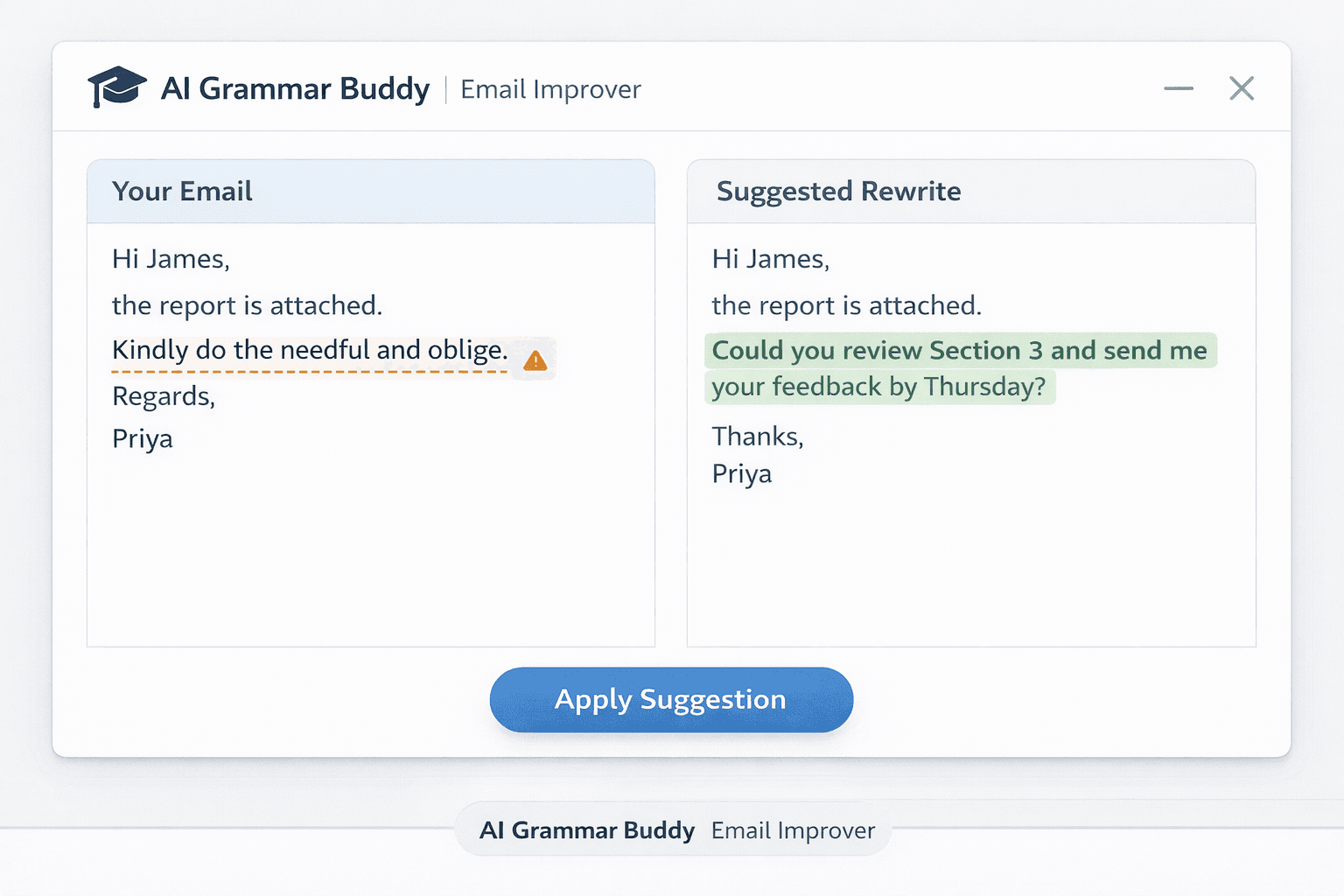
The list below works better when you adapt it to the real email, not just copy the shortest line. You can also drop any of these into AI Grammar Buddy's Email Improver and have it adjust the wording for a boss, client, teammate, or HR thread.
Short and neutral
Noted, thank you.Understood, thank you.Thanks for the update.Received, thank you.
Warm and professional
Thanks, I have noted this.Thank you for letting me know.I appreciate the update.Thanks for sharing this with me.
Action-oriented
I have noted this and will follow up accordingly.Thanks, I will review this and get back to you.Understood, I will proceed with the next steps.Thanks, I will take this into account before sending the final version.
Senior / polished
Thank you for the context. I will factor this into the revised plan.Understood. I will align the next draft with this direction.Thanks for highlighting this. I will review the details and update you by tomorrow.Thank you for the clarification. I have noted the change and will reflect it in the final version.
These alternatives sound more complete because they add one of three things: thanks, context, or action.
If you need role-specific wording rather than another synonym list, compare the Singapore workplace alternatives to “noted with thanks” for managers, colleagues, clients, vendors, and schedule changes.
Examples: Before and After
| Situation | Before | Better |
|---|---|---|
| Manager gives instructions | Well noted. | Understood, thank you. I will update the tracker before 5 PM. |
| Client sends feedback | Well noted. | Thank you for the feedback. I will revise the draft and send an updated version tomorrow. |
| Colleague shares an FYI | Well noted. | Thanks for the update. |
| Boss changes a deadline | Well noted. | Noted, thank you. I will adjust the timeline accordingly. |
| Customer raises an issue | Well noted. | Thank you for flagging this. I will check with the team and come back with an update. |
| Someone sends an attachment | Well noted. | Received, thank you. I will review the file today. |
| Regional team changes scope | Well noted. | Thanks for clarifying the scope. I will adjust the next draft accordingly. |
| Senior stakeholder gives direction | Well noted. | Thank you for the direction. I will incorporate this into the revised plan. |
Notice the pattern: the improved version is still short, but it gives the reader more confidence.
Common Mistakes
The biggest mistake is using "well noted" when the sender needs a next step.
Avoid replies like:
Well noted.Well noted with thanks.Well noted and received.Well noted on this.Your information is well noted.Well noted with thank you.
These are understandable, but they often sound like office shorthand rather than natural professional English.
A better formula is:
Thanks + what you understood + what you will do next.
Example:
Thanks, I have noted the revised deadline and will send the updated draft by Thursday.
Another mistake is using "well noted" as a receipt confirmation. If someone sent an attachment, payment proof, or signed form, a clearer receipt line is better:
Received, thank you. I will review the file today.
That keeps the meaning closer to receipt, not just understanding.
This is the same trap behind phrases like as discussed in email and for your review meaning in email. They are not always wrong, but they often sound complete to the writer and incomplete to the reader.
If you are not sure whether your reply contains enough action detail, use AI Grammar Buddy's Email Improver. It can turn a flat acknowledgement into a reply that confirms the message and the next step.
How AI Grammar Buddy Can Help
Short acknowledgement replies are hard because tone depends on culture. A phrase that sounds normal in a Singapore or Hong Kong office may sound cold to a US or UK client.
AI Grammar Buddy's Email Improver can help you turn stiff or translated replies into natural professional English. For example, it can rewrite:
Well noted.
into:
Understood, thank you. I will update the file and send the revised version by 4 PM.
If you only need to check whether a phrase is grammatically clear, use the Grammar Checker. If you need the reply to sound warmer, clearer, or more senior, use the Email Improver.
When to Stop Using "Well Noted" in Email
"Well noted" is understandable, but it is not the safest default for professional email. If the message is routine and internal, it may be fine. If the email involves a client, manager, deadline, or sensitive issue, write one clearer sentence instead.
If you are cleaning up the rest of the thread, it also helps to replace vague closings such as looking forward to hearing from you with a more specific ask.
Best default:
Noted, thank you. I will follow up accordingly.
That small upgrade keeps the efficiency of "well noted" while making your reply sound warmer, clearer, and more professional.
About This Article
Kin
Senior Business English Editor
Kin reviews workplace email drafts, acknowledgement phrases, and tone problems for AI Grammar Buddy. She focuses on the replies that sound polite locally but still land as stiff or unclear in global business English.
Last updated 16 June 2026
Frequently Asked Questions
What does "well noted" mean in email?▼
"Well noted" usually means "I have understood this," "I have recorded this," or "I will take this into account." In workplace email, it is an acknowledgement, not a detailed reply.
Is "well noted" correct English?▼
It is understandable, but it is not the most natural default in modern business email. "Noted, thank you" or "Thanks, I have noted this" usually sounds clearer.
Is "well noted" rude?▼
Not usually. It becomes risky when the message needs warmth, empathy, or a clear next step. A very short reply can sound cold to US, UK, or Australian readers.
What is better than "well noted"?▼
Use "Noted, thank you," "Understood, thank you," "Thanks for the update," or "I have noted this and will follow up accordingly," depending on the situation.
Is "well noted" the same as "well received"?▼
No. "Well noted" means understood or recorded. "Well received" usually means something was accepted positively, so it is often misused when someone only wants to confirm receipt.
Can I say "well noted with thanks"?▼
You can, but it sounds heavy and formulaic. "Noted, thank you" is cleaner, while "Thanks, I have noted this and will follow up" is better when action is expected.
What should I say instead of "well noted" to my boss?▼
Use a respectful reply with action, such as "Understood, thank you. I will proceed accordingly" or "Thanks, I have noted this and will update you by Friday."
Next step
Rewrite this phrase in context
Paste your sentence and AI Grammar Buddy will turn it into clearer professional English.
Keep going
Continue with AI Grammar Buddy
AI Grammar Buddy
Email Improver
Paste your draft and rewrite it for clearer, more professional English.
Rewrite This PhraseRelated guide
What Does Persist Mean? Meaning, Grammar and Examples
Persist means to continue despite difficulty or to keep existing. Learn how to use persist in, persist with, and persist correctly with workplace examples.
23 August 2026
Related guide
What Does Insist Mean? Grammar, Examples and Common Mistakes
Insist means to demand something firmly or state that something is true. See how to use insist on, insist that and insist upon in workplace sentences.
22 August 2026
Related guide
What Does Tentative Mean? Dates, Meetings & Email Examples
Tentative means not final yet. See tentative date/meeting meaning, Outlook and email replies, synonyms, and common workplace mistakes.
20 August 2026