How to Reply to "Do the Needful" in Email
Received "please do the needful" in an email? Learn how to reply clearly, politely, and professionally with copy-paste examples for every situation.
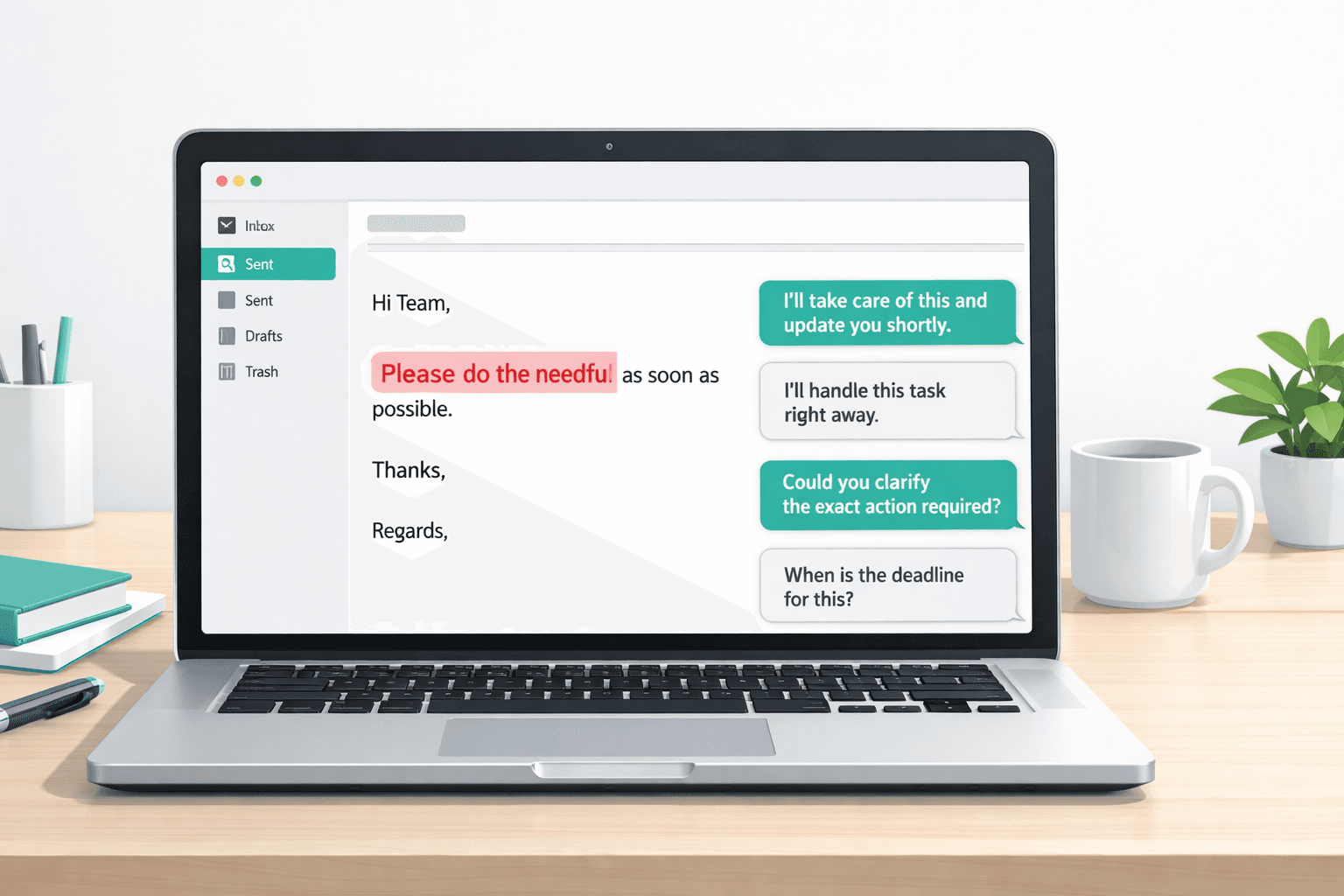
You received an email that says "please do the needful" and now you need to reply without sounding stiff, vague, or confused. The most common mistake is replying with "will do the needful," which repeats the same problem and adds no clarity. A better reply names the action, the timing, or the blocker in one line. This guide shows you how to do that for managers, clients, and colleagues.
Jump to sections
Use these anchors to jump straight to the template set you need.
TL;DR
The best reply to "do the needful" is a clear one: confirm the action, ask for clarification, state any approval dependency, or push back politely with a realistic next step.
AI Grammar Buddy
Rewrite this phrase in context
Paste your sentence and AI Grammar Buddy will turn it into clearer professional English.
Quick Answer
The best way to reply to "do the needful" is to replace the phrase with a clear next step. Confirm what you will do, ask what is unclear, state any approval dependency, or push back politely with timing. That sounds more natural and professional than replying, "will do the needful."
- "Sure, I'll update the file and send it by 3 PM."
- "Happy to help. Could you confirm which version you want me to use?"
- "I can proceed once finance approval comes through."
- "I'm afraid I won't be able to finish this today, but I can send it tomorrow morning."
Not sure if your reply sounds right? Paste it into the Email Improver and compare your draft against a clearer version before you send it.
What "Do the Needful" Means
"Do the needful" usually means "please do what is necessary" or "please take the required action."
It is common in many Asian workplaces and is often intended to sound polite and efficient. In Singapore, India, Malaysia, and Hong Kong, you will often see it in admin, finance, vendor, and operations emails where the process is already understood. The cultural expectation behind it is usually respectful efficiency: the sender assumes you know the steps and just needs you to act.
This is one example of the broader gap between Indian English and global business English. You will often see the same pattern beside regional phrases like please check and revert. If you want the deeper meaning, history, and alternatives, see our guide to "do the needful" meaning and alternatives and our explanation of "kindly do the needful and oblige".
How to Reply to "Do the Needful" Professionally
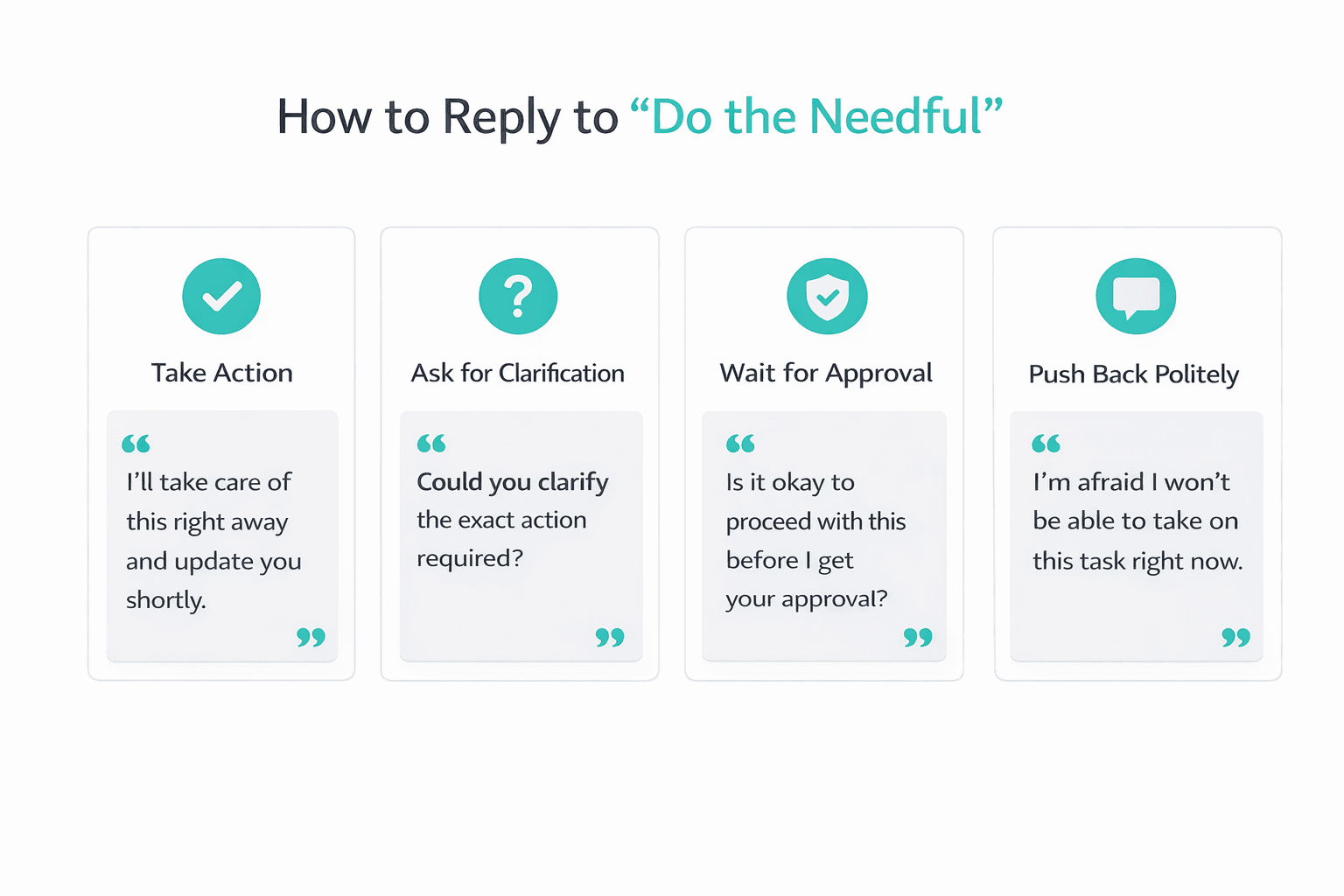
The best do the needful reply depends on what the email is actually asking you to do. In practice, most replies fall into four common situations. I found that the fastest way to defuse this phrase in mixed regional teams is to reply with either a deadline or a clarifying question.
1. When you will take action
Use these replies when the request is clear and you can handle it immediately.
Thanks. I'll take care of this and send you an update by 4 PM.
Sure, I'll review the document and share comments by tomorrow morning.
Understood. I'll complete the requested changes and confirm once done.
2. When you need clarification
Use these when the sender has written "please do the needful" but the exact action is still unclear.
Happy to help. Could you please clarify which action you would like me to take?
Certainly. Just to confirm, would you like me to update the report or send it to the client?
I can do that. Could you please confirm the deadline and the expected deliverable?
This is often the best answer to how to reply to please do the needful when the original message is too vague.
3. When you need approval
Sometimes you can do the work, but not until someone signs off first.
I can proceed with this once I receive approval from finance.
I'm ready to action this, but I'll need your confirmation before moving forward.
Happy to proceed. Please confirm whether I have approval to submit this on your behalf.
4. When you want to push back politely
Not every request should be accepted as-is. If the timeline is unrealistic or the task is outside your scope, reply clearly and calmly.
I'm afraid I won't be able to complete this by today, but I can send it by noon tomorrow.
I'm happy to support this, but I'll need the missing files before I can proceed.
I don't think I'm the right person to handle this. Would you like me to loop in the operations team?
If you are wondering how to respond to kindly do the needful without sounding difficult, this is usually the safest approach: explain the constraint and offer a reasonable next step.
Email Reply Examples You Can Copy
1. Replying to your manager
Situation: Your manager asked you to update a report and the task is clear.
Subject: Re: Q2 report update
Hi Sarah,
Understood. I'll update the report with the latest numbers and send the revised version by 4 PM today.
If you want the regional breakdown included as well, I can add that in the same draft.
Best,
[Your Name]
2. Replying to a client
Situation: A client asked you to make a change, but you need one detail confirmed first.
Subject: Re: Requested revision
Hi Daniel,
Happy to help with this. Could you please confirm which version of the deck you would like us to revise?
Once I have that, I'll update it and send it back by tomorrow morning.
Best regards,
[Your Name]
3. Replying to a colleague
Situation: A colleague asked you to handle something today, but you need to push back politely.
Subject: Re: Access request
Hi Mei,
I can help with this, but I won't be able to complete it before this afternoon.
I'll check the access settings after lunch and send you an update by 3 PM.
If it is urgent, feel free to loop in IT as well.
Thanks,
[Your Name]
If you also deal with short acknowledgements like "Noted," our guide on how to reply to "noted" professionally covers when to reply and when to leave the thread closed.
What to Avoid When Replying
Avoid these weak replies:
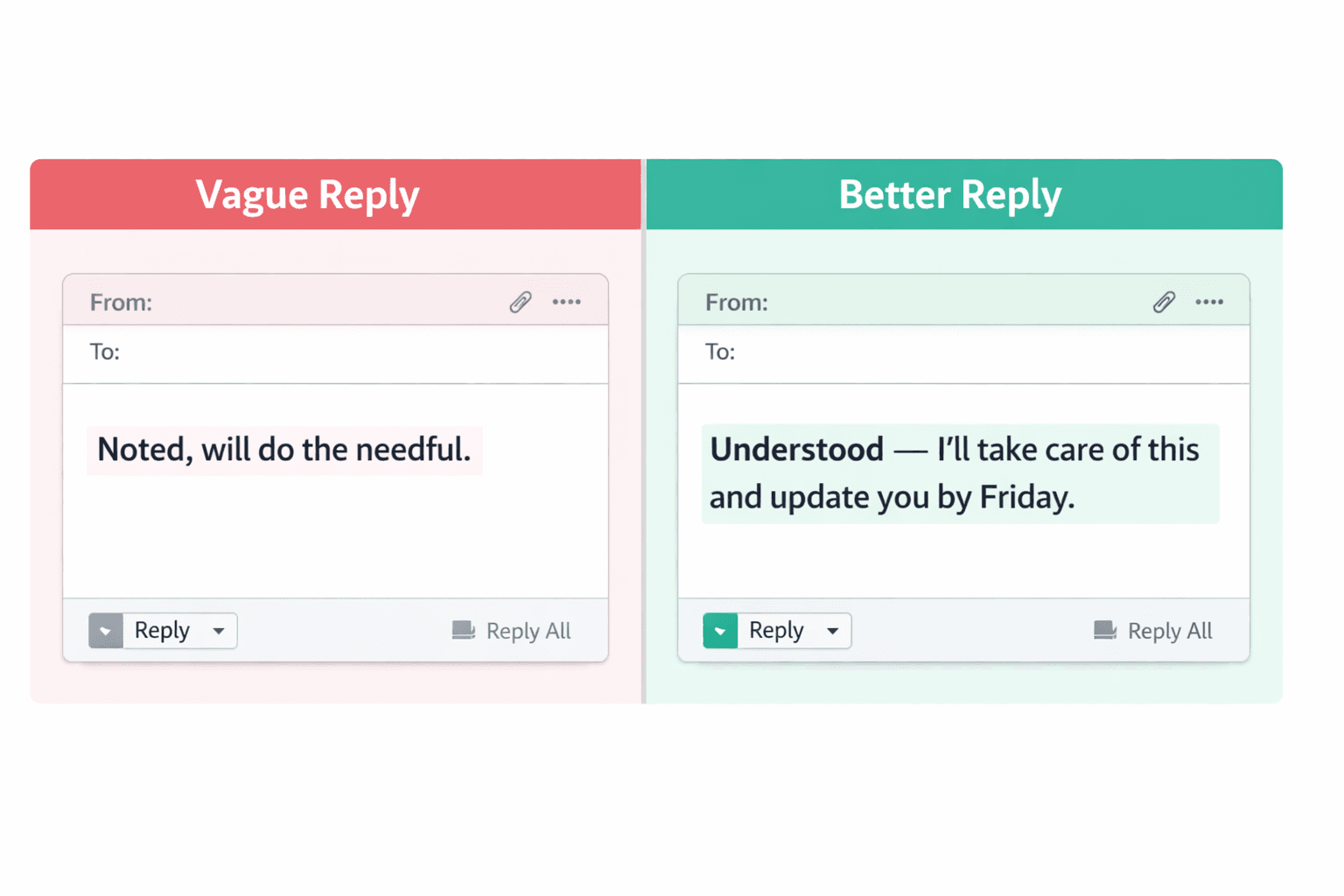
- "Will do the needful." This repeats the same vagueness and does not tell the reader what happens next.
- "Noted." This can sound too abrupt if action is expected.
- "Done." Do not use this unless the task is actually finished.
- Guessing the request. If the action is unclear, ask instead of assuming.
- Sounding defensive. Replace "Your email is unclear" with "Could you please clarify the exact action required?"
In practice, we've seen that replies become clearer as soon as the verb changes from do to a real action such as review, approve, send, or confirm. A better please do the needful email response should reduce confusion, not create another follow-up. The same rule also improves related phrases such as please advise in email and other requests that sound polite but stay vague.
See exactly how AI Grammar Buddy fixes these patterns in the Email Improver: "Will do the needful" becomes "Understood. I'll send the revised file by 2 PM."
Real example: how AI Grammar Buddy rewrites a vague reply
❌ Before: Noted, will do the needful.
✅ After (rewritten with AI Grammar Buddy): Understood. I'll handle this and share an update by this afternoon.
Better Alternatives to Repeating "Do the Needful"
If you want to sound modern and professional, replace the phrase with a specific verb.
Instead of:
- "I will do the needful."
Say:
- "I'll handle this today."
- "I'll review the attachment and reply by noon."
- "I'll update the file and send the revised version shortly."
- "I'll check with the vendor and keep you posted."
- "I'll complete the requested changes by tomorrow."
- "I'll confirm once everything is in place."
This works in both internal and external emails because it makes the next step obvious. It also fits better with email etiquette in Singapore and regional workplaces, where short emails are common but the clearest messages still name the action.
Final Tip: Use Clear Action Language Instead
If you often reply to phrases like "please do the needful," build the habit of using direct action language instead. It makes your email sound more natural, more accountable, and more professional across global teams.
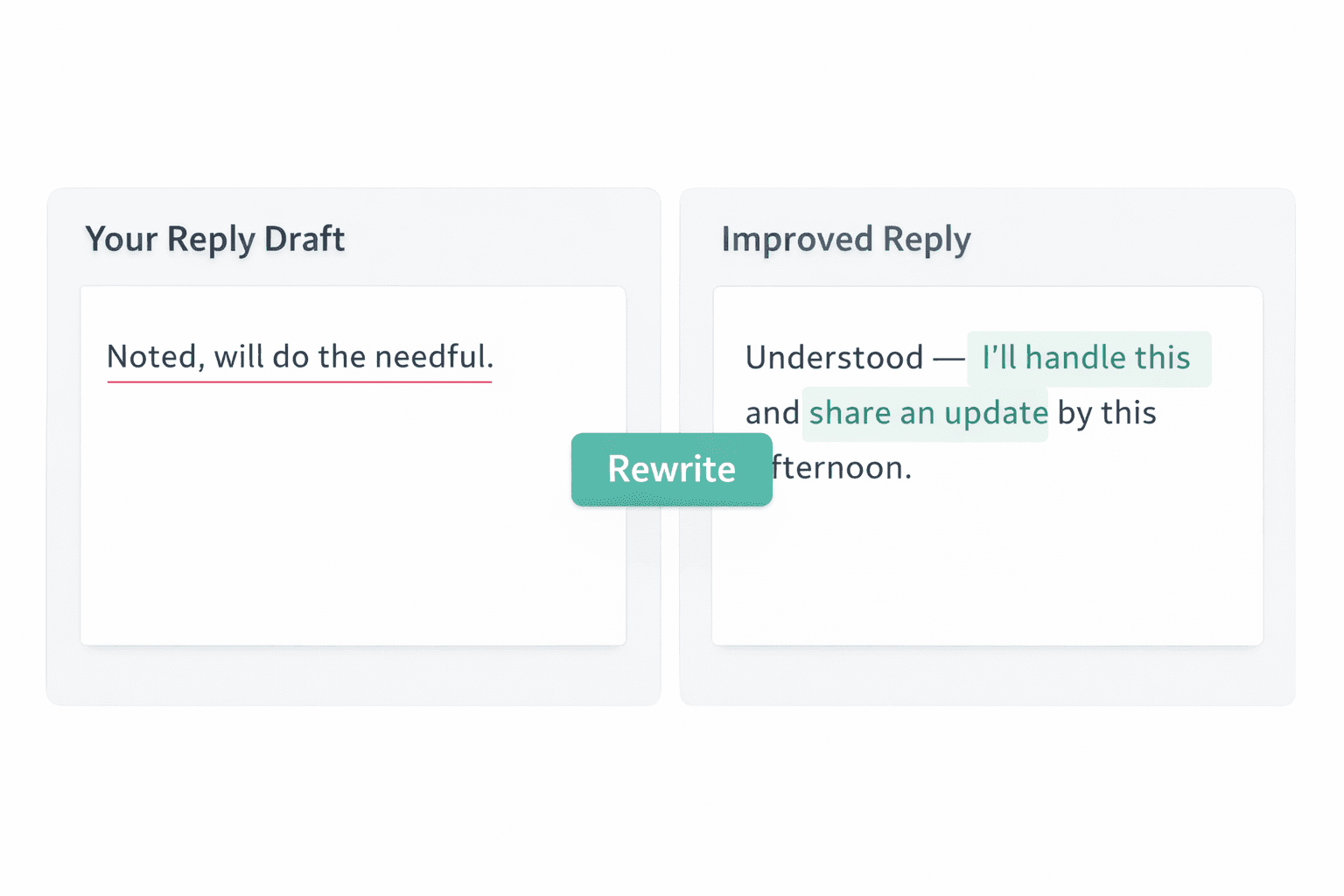
If you want a faster way to rewrite vague replies, try the Email Improver. It can turn short, repetitive phrases into clearer professional English in seconds.
Conclusion
The phrase itself is not the real problem. In many South and Southeast Asian offices, "do the needful" is simply a polite shorthand between people who already know the process. The safer reply is to turn that shorthand into a clear action, a question, or a realistic timeline so nobody has to guess. If you want a quick check before sending, GrammarBuddy's Email Improver is a practical way to tighten a vague reply without making it sound rude.
About This Article
GrammarBuddy Editorial Team
Editors covering cross-border workplace English in Asia
We review the email phrases that cause the most friction in international workplaces and show how to rewrite them into clear, modern English.
Last updated 30 March 2026
Frequently Asked Questions
How do you reply to "please do the needful" professionally?▼
Reply with a clear next step, not with another vague phrase. For example: "Sure, I will update the file and send it by 4 PM today."
Should I reply with "will do the needful"?▼
Usually no. It is better to use a specific action verb such as "I will review this today" or "I will send the revised version by tomorrow morning."
What if the request is unclear?▼
Ask a polite follow-up question. For example: "Happy to help. Could you please confirm the exact action required?"
Is "do the needful" rude?▼
Not usually. In many Asian workplaces it is intended to sound polite and professional. The main issue is that it can feel vague in international email communication.
What is a professional reply to do the needful?▼
A professional reply should show ownership, clarity, and timing. Example: "Understood. I will handle this and share an update by this afternoon."
How do you respond to kindly do the needful in email?▼
Use the same approach: acknowledge the request, then state the exact action, question, or timing. For example: "Certainly. I will review the attachment and send my comments by tomorrow morning."
Next step
Rewrite this phrase in context
Paste your sentence and AI Grammar Buddy will turn it into clearer professional English.
Keep going
Continue with AI Grammar Buddy
AI Grammar Buddy
Email Improver
Paste your draft and rewrite it for clearer, more professional English.
Rewrite This PhraseRelated guide
As Discussed Meaning in Email: Is It Rude? 10 Better Alternatives
What does "as discussed" mean in email? Learn if it sounds rude or passive-aggressive, when to avoid it, and 10 clearer alternatives with real examples.
27 March 2026
Related guide
"For Your Reference" Meaning (When to Use It + Better Alternatives)
What does "for your reference" mean in email? Learn when it sounds polite, when it falls flat, and 11 better alternatives for professional emails.
26 March 2026
Related guide
Is "Please Advise" Rude? What It Really Means + Better Alternatives
"Please advise" isn't rude — but it often sounds cold and vague. Learn what it really signals in email and 10 specific alternatives that get faster replies.
23 March 2026