15 Looking Forward to Hearing From You Alternatives for Professional Emails
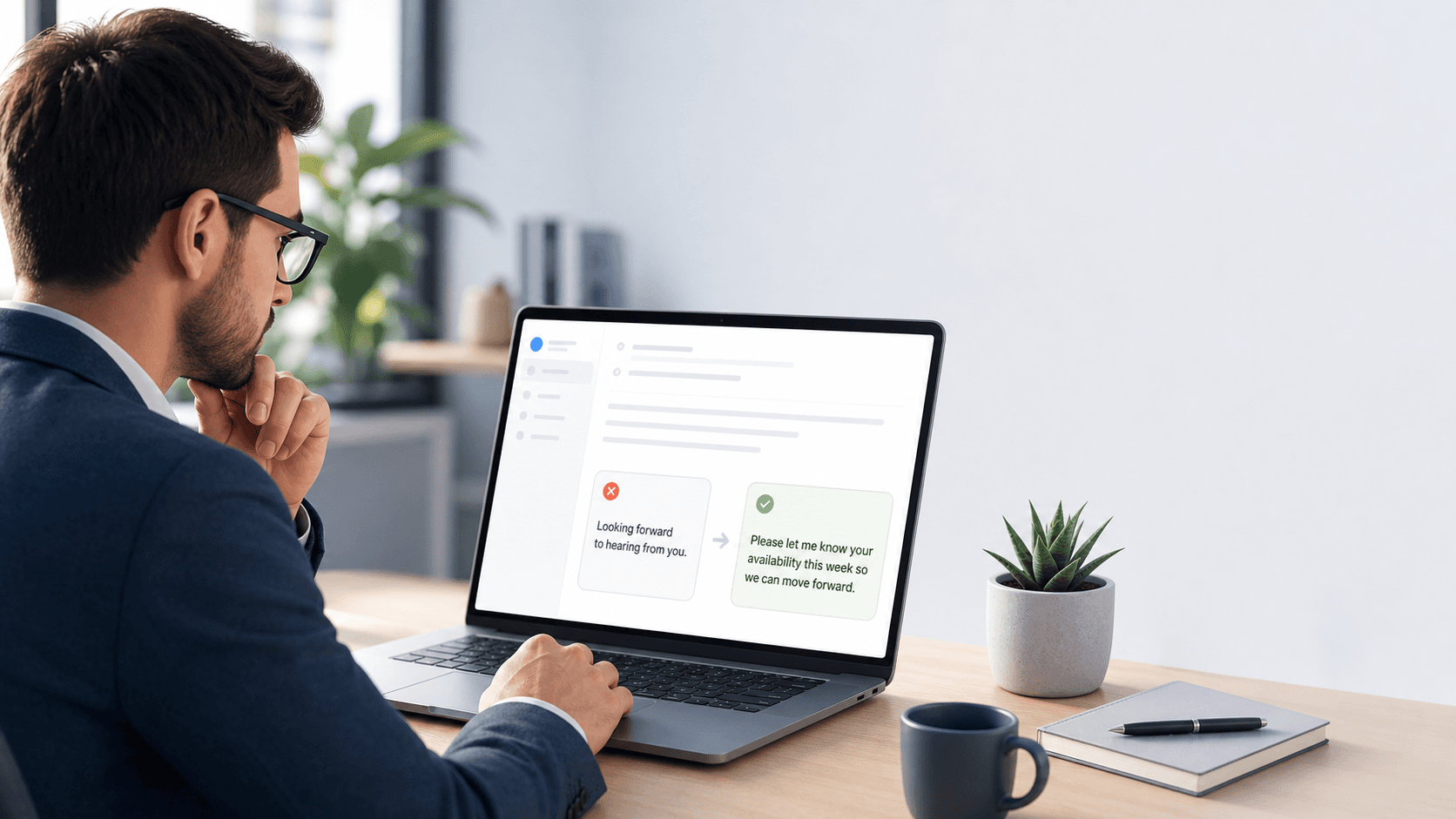
You spend twenty minutes writing a careful proposal email. Then you end it with: "Looking forward to hearing from you."
Three days pass. Nothing.
The problem is not your email. It is your closing. A vague ending gives the reader no reason to reply today rather than tomorrow, or at all.
These looking forward to hearing from you alternatives are not about sounding fancier. They are about making it obvious what reply you actually want.
If your email still feels soft or generic, paste it into AI Grammar Buddy to make it clearer, more polite, or more professional before you send it.
TL;DR
The best looking forward to hearing from you alternatives ask for a specific response, such as feedback, approval, or a meeting time.
Use the closing that matches the reply you actually want.
Quick swaps:
- •"Looking forward to hearing from you." -> "Could you share your feedback by Friday?"
- •"Looking forward to hearing from you." -> "Let me know what works for you."
- •"Looking forward to hearing from you." -> "Please confirm if you approve this version."
Jump to sections
Use these anchors to jump straight to the section you need.
Quick Answer
The best looking forward to hearing from you alternatives are specific closings such as "Could you share your feedback by Friday?", "Let me know what works for you," or "Please confirm if you approve this version."
15 Looking Forward to Hearing From You Alternatives
I kept this list to 15 on purpose. In testing these phrases with business email drafts inside AI Grammar Buddy, I found that most readers do not need 60 options. They need a short list that covers the situations they actually write in: feedback, approval, scheduling, follow-up, and internal updates.
Use the original phrase when you want a neutral, polite ending. Use these alternatives when you want a clearer response.
1. Could you share your feedback?
Best for: proposals, decks, drafts, and presentations
Tone: direct, professional, collaborative
Example: Could you share your feedback on the revised proposal by Thursday afternoon?
2. Please let me know your thoughts
Best for: general reactions and open-ended input
Tone: warm, neutral
Example: Please let me know your thoughts on the updated copy for the landing page.
3. I would appreciate your response by Friday
Best for: requests with a real deadline
Tone: polite, time-aware
Example: I would appreciate your response by Friday so I can finalize the schedule with the vendor.
4. Let me know what works for you
Best for: meetings, calls, and schedule coordination
Tone: flexible, friendly
Example: I am free Tuesday afternoon or Thursday morning. Let me know what works for you.
5. Please confirm if you approve
Best for: manager review, sign-off, and client approval
Tone: clear, decisive
Example: Please confirm if you approve this version so I can send it to the client today.
Not sure if your email sounds too formal or too vague? Paste it into AI Grammar Buddy — it will flag weak closings and suggest a clearer version in seconds.
6. I would love to hear your feedback
Best for: softer relationship-driven emails
Tone: warm, conversational
Example: I would love to hear your feedback on the first draft when you have a moment.
7. Can you let me know the next step?
Best for: process-driven conversations where the other person owns the workflow
Tone: direct, practical
Example: Once finance reviews this, can you let me know the next step?
8. Please keep me posted
Best for: ongoing updates and status changes
Tone: casual, professional
Example: Please keep me posted if the timeline shifts after the client call.
9. I hope to hear from you soon
Best for: interview follow-ups and lighter-touch reminders
Tone: polite, slightly softer than the original
Example: I hope to hear from you soon regarding the interview outcome.
10. Let me know if you would like to discuss this further
Best for: client emails and consultative situations
Tone: open, professional
Example: Let me know if you would like to discuss this further. I would be happy to walk through the options.
11. What are your thoughts?
Best for: short internal messages and collaborative decision-making
Tone: direct, informal
Example: We can move ahead with either option. What are your thoughts?
12. Please reply when convenient
Best for: non-urgent internal review
Tone: polite, low-pressure
Example: Please reply when convenient if you would like any changes before publishing.
13. I would appreciate your quick reply
Best for: mild urgency with a clear reason
Tone: polite, urgent
Example: I would appreciate your quick reply, as we need to confirm the booking today.
14. If I do not hear back by Thursday, I will proceed with Option A
Best for: keeping projects moving without another round of vague follow-up
Tone: firm, respectful
Example: If I do not hear back by Thursday, I will proceed with Option A so we stay on schedule.
15. Looking forward to your feedback
Best for: review requests where the response you want is clearly comments
Tone: polished, specific
Example: Looking forward to your feedback on the updated report.
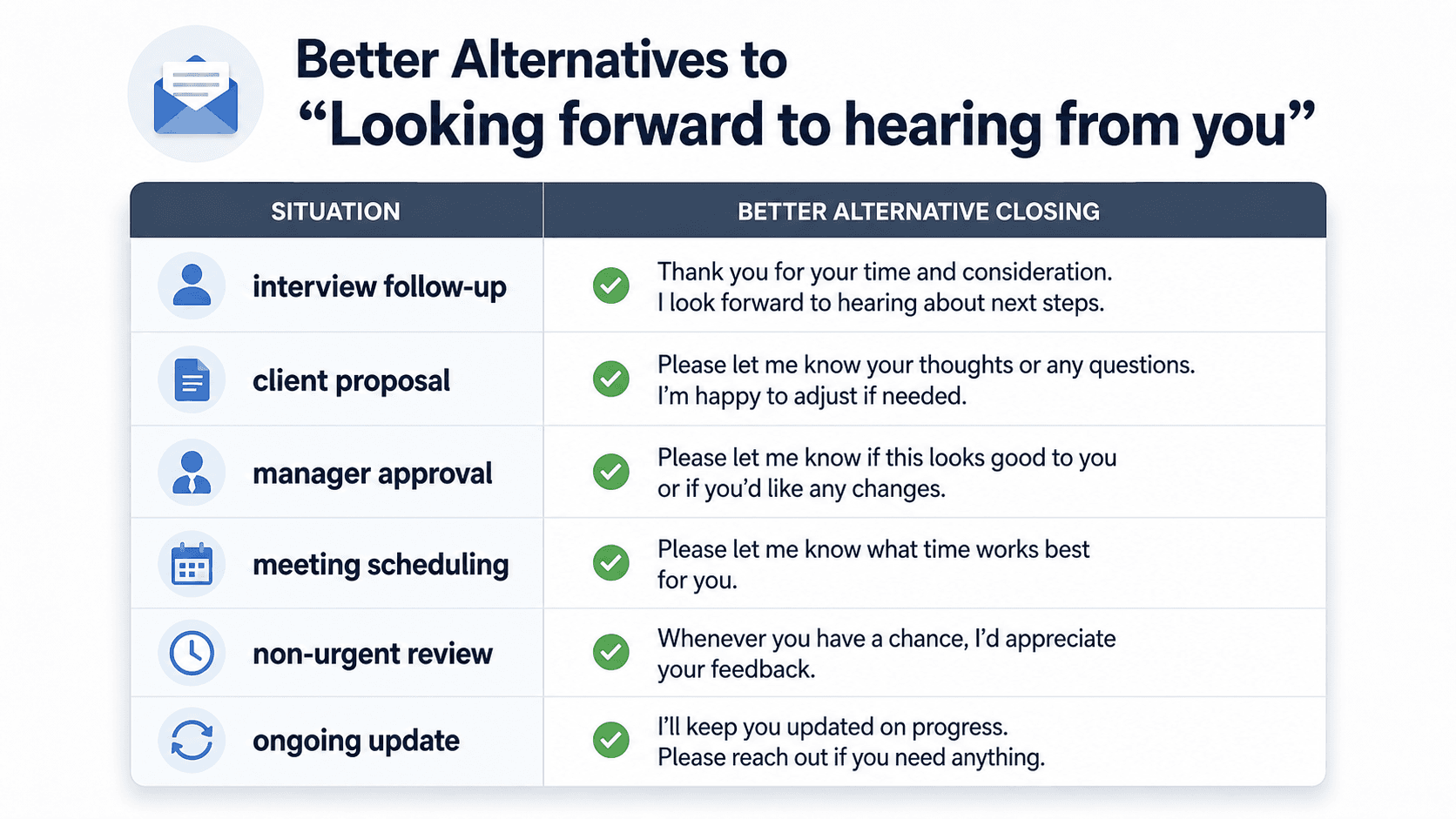
The pattern is simple: the more specific the ask, the easier it is for the reader to answer.
This is why vague closings sit in the same problem family as please advise alternatives and at your earliest convenience meaning. They sound polite, but they still leave too much work to the reader.
If you need the sentence before the request—not the request itself—compare these better ways to say "in conclusion" for professional email summaries.
Examples
Most people do not need a fancier phrase. They need a better match between the email and the response they want.
| Situation | Tone | Better Closing |
|---|---|---|
| Interview follow-up | Polite, patient | I hope to hear from you soon regarding the next steps in the interview process. |
| Client proposal | Direct, professional | Could you share your feedback by Friday? |
| Manager approval | Clear, decisive | Please confirm if you approve this approach. |
| Meeting scheduling | Flexible, friendly | Let me know what works for you. |
| Non-urgent review | Low-pressure | Please reply when convenient. |
| Ongoing update | Casual, professional | Please keep me posted. |
In testing these phrases with business email writers, I found that the strongest closings usually do one of three things:
- ask for feedback
- ask for a decision
- ask for a time
Anything broader tends to create delay.
Before and after rewrite 1
Scenario: a proposal email to a client after a pricing revision
Before: Looking forward to hearing from you.
After: Could you share your feedback on the proposal by Friday?
Before and after rewrite 2
Scenario: an internal scheduling email after a project kickoff
Before: Looking forward to hearing from you soon.
After: Let me know what time works for you next week, and I will send the invite.
Before and after rewrite 3
Scenario: a recruiter follow-up after a second interview
Before: I look forward to hearing from you about the interview.
After: I hope to hear from you soon regarding the next steps in the interview process.
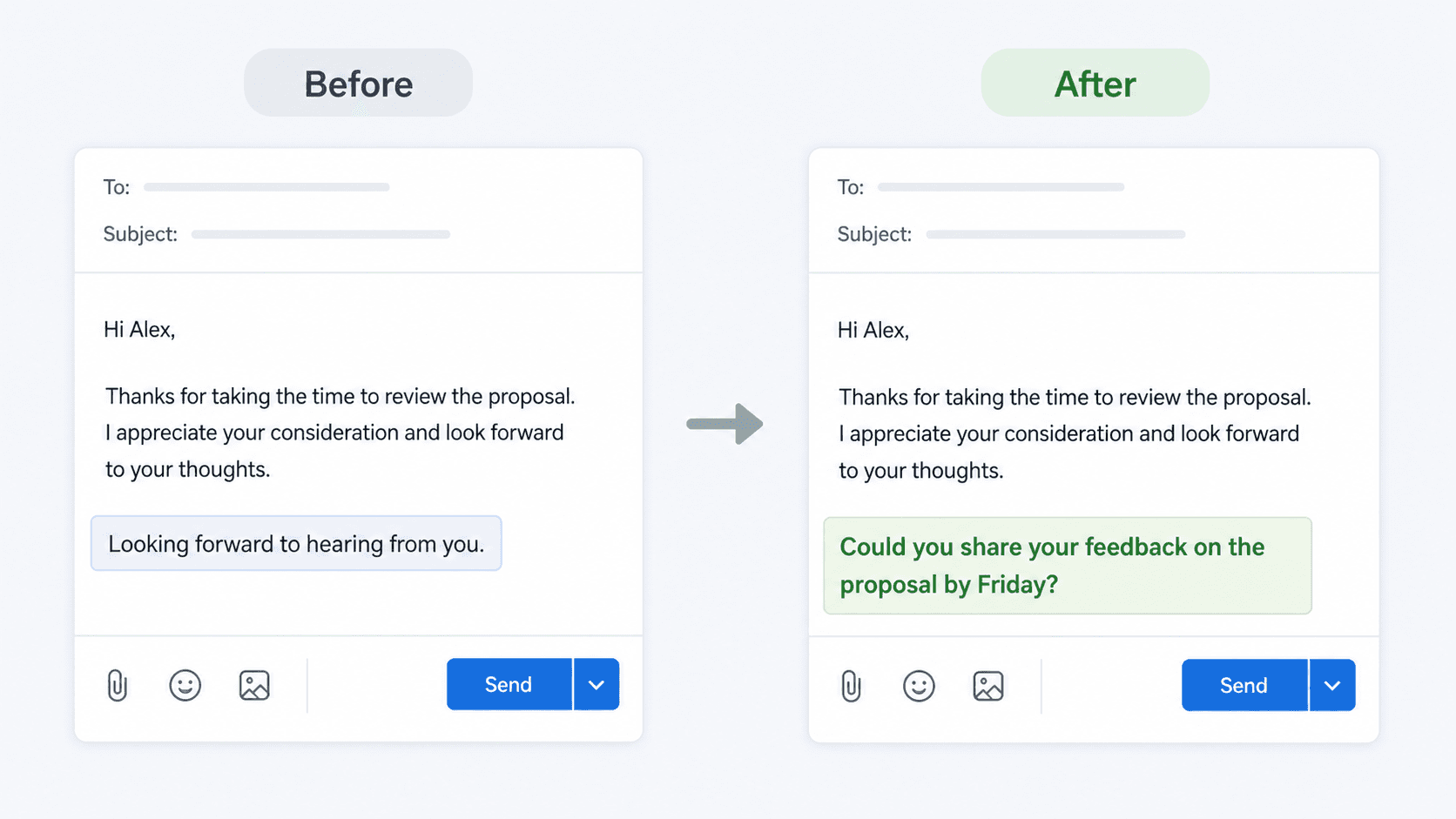
These rewrites took about two seconds in AI Grammar Buddy. Paste your draft closing and it will suggest a version matched to your real goal — feedback, approval, or scheduling.
If you are writing to a recruiter, our guide on follow-up email after interview sample gives more targeted examples for that context. If your next problem is the follow-up itself, how to chase an email politely covers timing and tone.
Common Mistakes
1. Using the same closing in every email
A client proposal, an interview follow-up, and a meeting request should not all end the same way.
2. Asking for a reply without naming the reply
"Looking forward to hearing from you" can mean almost anything. If you need feedback, say feedback. If you need approval, say approval.
3. Adding fake urgency
"Looking forward to hearing from you soon" is still vague. If timing matters, give a date.
4. Sounding too formal for a casual internal email
Some alternatives become stiff if the context is informal. "Please confirm your approval" may be perfect for a client but excessive for a teammate. If this is where you usually get stuck, our formal vs casual email tone guide gives a clearer framework for adjusting tone.
5. Being polite but not actionable
This is the real issue. Many readers search for a better way to say looking forward to hearing from you because the original phrase feels nice but does not help the conversation move forward.
This is exactly what AI Grammar Buddy catches. It reads your closing, identifies if it is too passive, and rewrites it for the response you actually need.
How AI Grammar Buddy Can Help
AI Grammar Buddy is useful when your email sounds polite but still feels blurry.
It can spot weak closings such as:
- Looking forward to hearing from you
- Please advise
- As discussed
- At your earliest convenience
Then it can rewrite them based on your real goal.
For example:
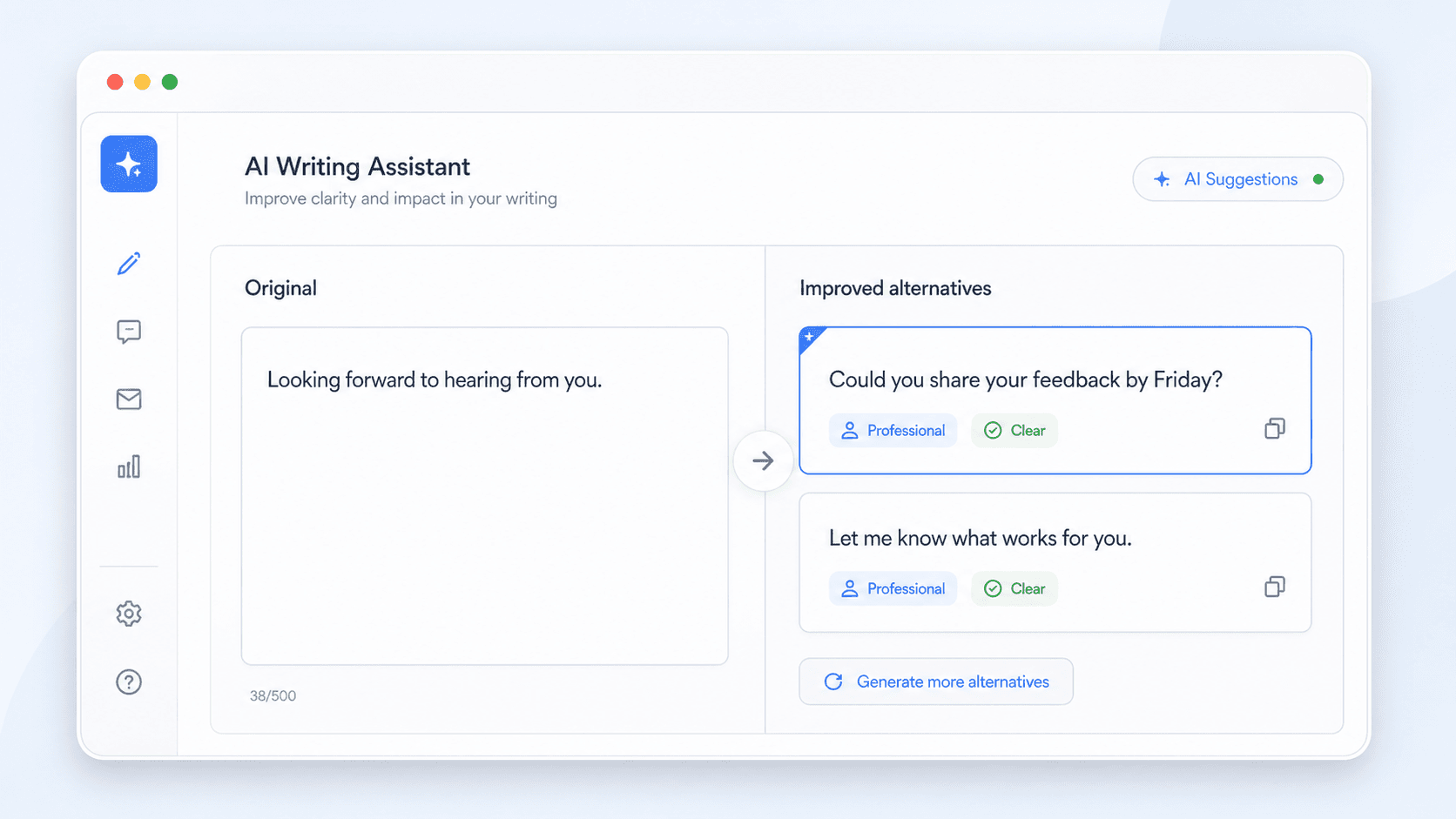
- "Looking forward to hearing from you." becomes
- "Could you share your feedback by Friday?"
Or:
- "Looking forward to hearing from you soon." becomes
- "Let me know what works for you, and I will book the meeting."
If you are unsure whether your email sounds too passive, AI Grammar Buddy can rewrite it in a clearer, more professional tone. Open the Email Improver tool for quick rewrites, or go deeper with our professional email templates, email clarity checklist, and as discussed meaning guides.
Final Takeaway
The best looking forward to hearing from you alternatives are not more impressive. They are more useful.
Instead of ending every email with one polite line, decide what reply you actually want:
- feedback
- approval
- a meeting time
- the next step
- a decision
Once you know that, your closing becomes easier to write and easier to answer.
If you want a faster rewrite before sending, paste your draft into AI Grammar Buddy and turn a vague closing into a clear next step.
About This Article
Kin
Senior Business English Editor
Kin reviews business email drafts, rewrite patterns, and tone problems for AI Grammar Buddy. She focuses on the closings that sound polite at first but still delay replies in real workplace email.
Last updated 15 June 2026
Frequently Asked Questions
Is 'looking forward to hearing from you' professional?▼
Yes. It is polite, professional, and grammatically correct. The problem is not correctness. The problem is that it can be too generic when you need a specific response.
What is a better way to say 'looking forward to hearing from you'?▼
A better alternative depends on the situation. Use 'Could you share your feedback?' when you want comments, 'Please confirm if you approve' when you want a decision, or 'Let me know what works for you' when scheduling.
Is 'I look forward to hearing from you' too formal?▼
Not usually. It is neutral and common in professional email. It only starts to feel repetitive when you use it in every message.
What should I say instead in an interview follow-up?▼
A strong option is: 'I hope to hear from you soon regarding the next steps in the interview process.' It sounds professional without feeling too aggressive.
Is 'looking forward to hearing from you soon' correct?▼
Yes, it is correct. But it is still broad. If the response matters, a specific ask or deadline is usually better.
Keep going
Continue with AI Grammar Buddy
AI Grammar Buddy
Email Improver
Paste your draft and rewrite it for clearer, more professional English.
Rewrite This PhraseRelated guide
What Does Persist Mean? Meaning, Grammar and Examples
Persist means to continue despite difficulty or to keep existing. Learn how to use persist in, persist with, and persist correctly with workplace examples.
23 August 2026
Related guide
What Does Insist Mean? Grammar, Examples and Common Mistakes
Insist means to demand something firmly or state that something is true. See how to use insist on, insist that and insist upon in workplace sentences.
22 August 2026
Related guide
What Does Tentative Mean? Dates, Meetings & Email Examples
Tentative means not final yet. See tentative date/meeting meaning, Outlook and email replies, synonyms, and common workplace mistakes.
20 August 2026